
Caterpillars are the larval stage of butterflies and moths. Most feed on plant material and are known for their voracious appetites. On the whole, they are perfectly harmless to humans, although they may be a little annoying if they have chomped through your favorite plants. Some caterpillars, however, can give you a painful sting. You may come across them in forests, parks, and in your own backyard. The severity and type of reaction you experience depend on the caterpillar species, the degree of contact, and your individual susceptibility. Let’s meet some of the most common fluffy but dangerous caterpillars.
How and Why Do Caterpillars Sting You?
If you do get stung by a caterpillar, do not take it personally! They do not set out to hurt you. Most people are stung either because they have picked up a caterpillar or because they have accidentally brushed against it. Caterpillars are part of the diet of many birds, bats, insects, and other bugs. Some have evolved an effective defense mechanism to try and put predators off. They have a special type of hollow, quill-like hair called setae, which are connected to sacs containing poison. When you touch the caterpillar, the setae get broken and the poison is delivered onto your skin. Not all caterpillars with spines are venomous.
Saddleback Caterpillar (Acharia stimulea)
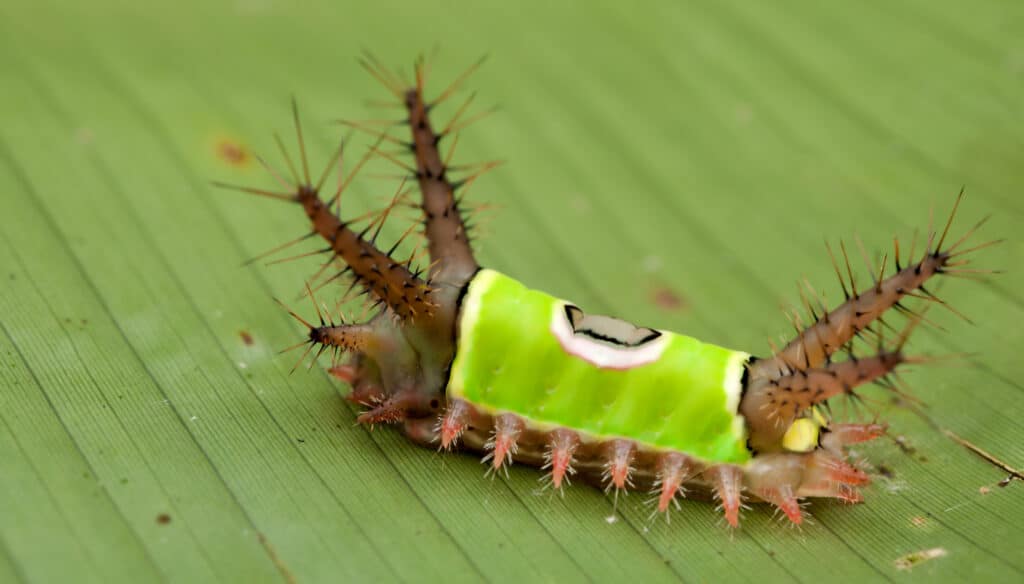
The saddleback caterpillar is a species native to North America and Mexico.
©Hagit Berkovich/Shutterstock.com
The larval stage of the slug moth is called the saddleback caterpillar. It is a native species in a large range in the eastern United States. You may find them as far south as Florida, north to New York and Massachusetts, and west to Texas, Indiana, and Kansas. The caterpillars can feed on a wide array of host plant species, including maple, various palms, artichoke, and pecans.
There is no mistaking a saddleback caterpillar! They have a slug-like body with vivid warning coloring and are about an inch long. A bright green, saddle-shaped pattern bordered in white with a brown center appears on their back. Their bodies have fleshy horns containing numerous hollow, sharp-pointed spines that break off easily and can become embedded in the skin. The spines contain hemolytic and vesicating venom, which damages skin tissue. Because the spines can embed deeply into the flesh, they delay healing as the venom dries into the damaged tissue.
Saddleback Caterpillar Sting
An encounter with these caterpillars can cause a nasty contact dermatitis with intense burning, hair standing on end, increased sweating in the area, redness, and blistering. This can go on for up to five hours. What’s more, the venom can cause a more widespread condition called acute urticaria, which causes migraines, gastrointestinal symptoms, and asthma complications. In more serious cases, it can cause anaphylactic shock, rupture of red blood cells, and hemorrhage.
Puss Caterpillar (Megalopyge opercularis)
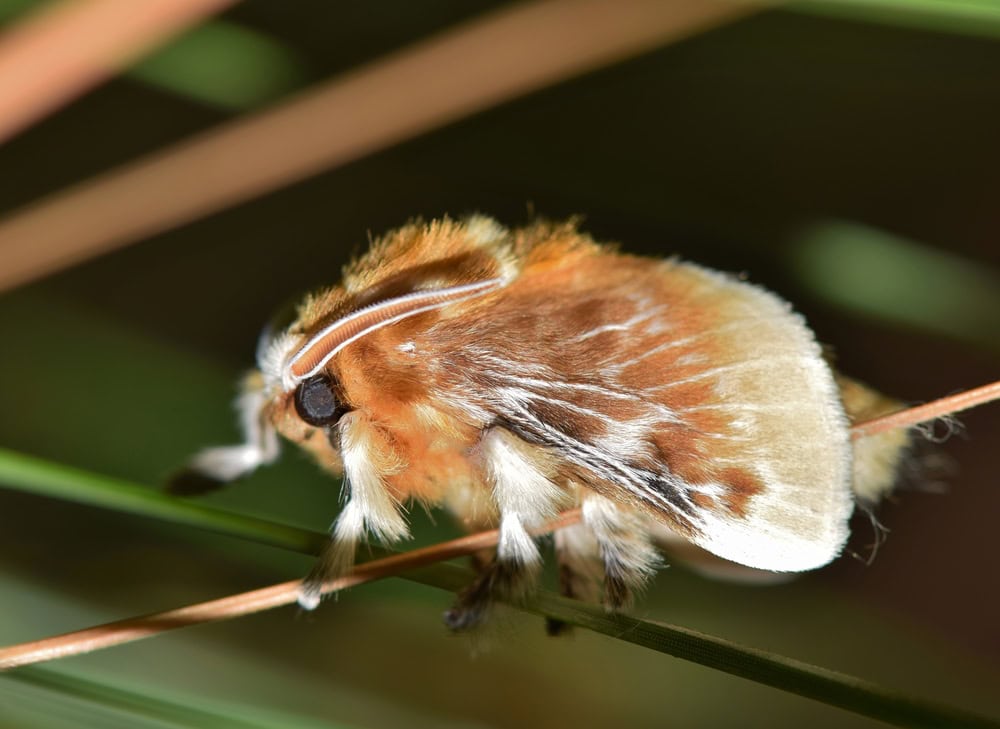
Puss caterpillars feed on oaks and elms.
©Brett Hondow/Shutterstock.com
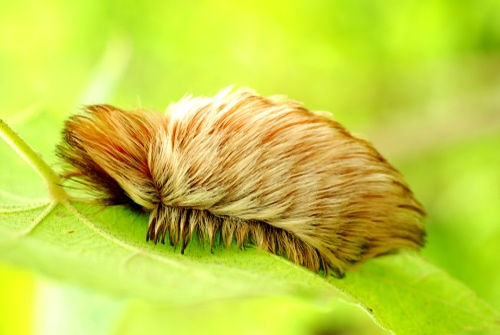
Larvae of the southern flannel moth are called numerous common names, including puss caterpillars, asps, fire caterpillars, and woolly slugs. They are found from New Jersey to Florida and west to Arkansas and Texas. However, they occur in greatest concentrations in Texas from Dallas southward in the western central part of the state. Their host plants include oaks and elms.
The larvae (caterpillars) go through five or six instars (life stages), changing color and becoming increasingly hairy with each molt. The later instars resemble a bundle of fur. Their ‘hairs’ are actually hollow spines with a venom gland at the base. The larger the caterpillar, the more toxic the sting. Additionally, if you are stung in an area where your skin is thinner, the severity will be greater. That said, some people react more severely to contact with the caterpillars than others.
Puss Caterpillar Sting
Generally, there is an immediate, intense burning, and a red grid-like pattern appears on the skin, which matches the pattern of the caterpillar’s spines. There may also be localized swelling and enlargement of the local lymph nodes. In the wider body, the toxin can cause headache, fever, nausea, and vomiting. More serious complications include tachycardia, low blood pressure, seizures, abdominal pain, muscle spasms, and convulsions.
Io Moth Caterpillar
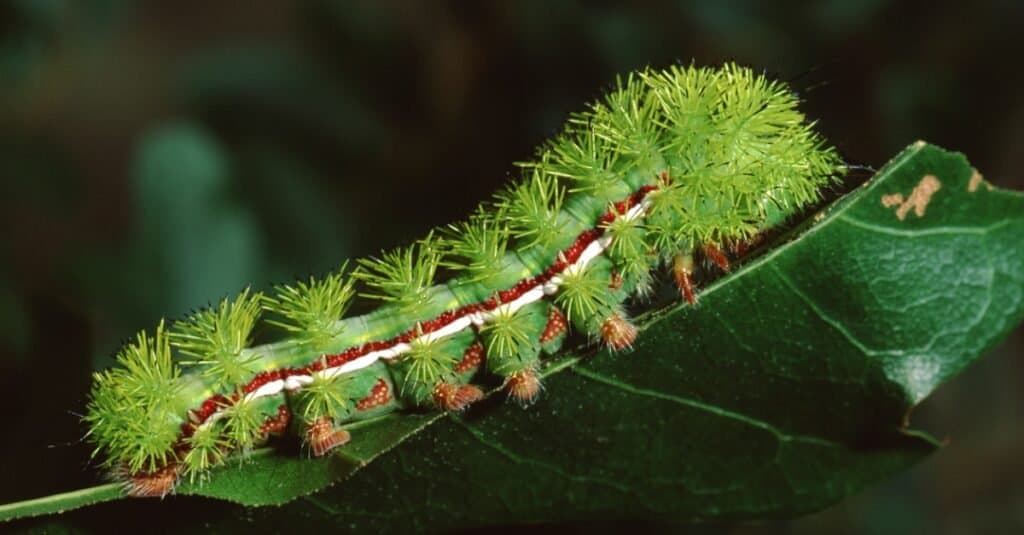
Io moth caterpillars are pea green with stripes.
©iStock.com/Weber
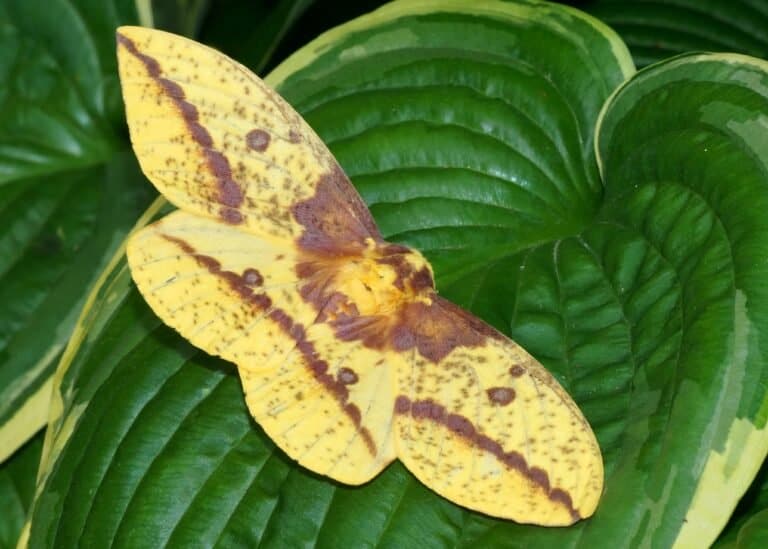
The Io moth (Automeris io) is a beautiful creature with distinctive hind wing eyespots. This species occurs throughout the eastern half of the United States, as far west as Utah, Colorado, and Texas, and as far north as Quebec and Ontario. Their food plants range from grasses and herbs to hardwood trees such as apple, dogwood, elm, hickory, oak, sycamore, and willow.
This species has around five caterpillar instars, and they finally reach around 2.5 inches long. During this lifestage, they are a pea green color with a distinctive lateral abdominal white stripe edged on the top and bottom with red stripes. All of the caterpillar instar stages can sting. They have venomous spines, and some are tipped with setae. The tips of the spines break off in the skin, releasing venom. As the spine tips are embedded in the skin, they may cause inflammation as they begin to break down. This is because they are made of chitin, and we know that chitin can trigger an inflammatory response. Io caterpillar venom has not been analyzed in detail, but likely contains histamine or at least triggers a histamine-like response.
Io Moth Caterpillar Sting
There is no evidence that Io caterpillar stings are common, and a study found that they only accounted for 11 percent of caterpillar stings. However, this may be down to under-reporting. Some people react more than others, but the most common symptoms are painful itching followed by a raised welt on the skin, surrounded by a red flare (erythema). It takes a couple of hours for the pain to die down, and the physical changes to the skin resolve within 6-8 hours.
Dagger Moth Caterpillar (Acronicta americana)
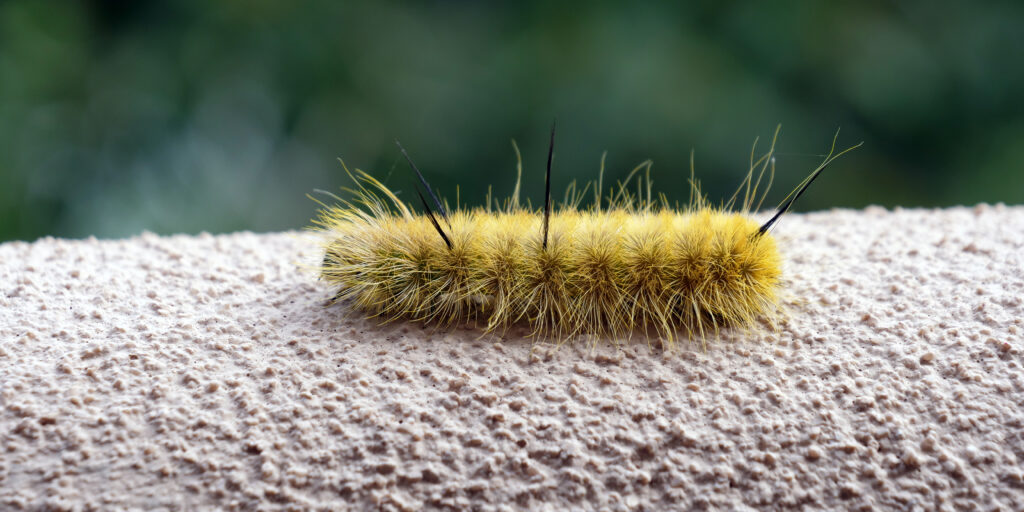
American Dagger Caterpillars are toxic and cause stinging when they’re touched.
©Martha Marks/Shutterstock.com
The American dagger moth gets its name from the dagger-shaped markings on its wings. Its range covers North America east of the Rocky Mountains. The caterpillars feed on deciduous trees such as alder, ash, elm, maple, oak, willow, and other hardwood trees. This means you will find them in yards, parks, backyards, forests, and woodlands throughout the growing season. They are usually found on the soil near host trees.
These caterpillars are around two inches long and look fuzzy with medium-length yellow, yellow-green, or white setae. In addition, they have four ‘pencils’ or tufts of longer black setae that extend out from the first and third abdominal segments. There is a fifth tuft at the rear. It is thought that these pencils can break off and embed themselves in your skin. Toxins within the pencils cause the sting.
Dagger Moth Caterpillar Sting
There are reports of people becoming covered in hives after touching these caterpillars. One victim’s hands were swollen for five days, and she also had an itchy rash all over her body.
Smoky Moth Caterpillar
There are several species of smoky moths in the Zygaenidae family. The laurelcherry smoky moth (Neoprocris floridana) is found mainly in Florida, except for the Keys, and in Lee County, Alabama. As its name suggests, they feed on Carolina laurelcherry. The first and second instar caterpillars are yellow, and the later ones have a pattern of dark lines. The fully grown caterpillars are only around half an inch in length. Most of their body is covered in venomous setae.
Smoky Moth Caterpillar Sting
These caterpillars are listed as envenoming caterpillars. Their setae are hollow and are filled with an irritating fluid. However, these setae do not break off and embed in the skin. They can cause a mild burning and itching sensation with a reddening in the affected area. This is followed by the development of a raised wheal. The irritation seems to be short-lived and is resolved within a few hours.