Quick Take
- One bear stays eerily unbothered while its neighbors clash. What is it doing instead?
- Prime fishing real estate comes with a hidden hierarchy. Who gets the best spot?
- Grizzly or brown bear? The names are tangled in a way that surprises most people.
- One fish powers this famous gathering, and it isn't the one you'd guess from the photo.
When several hungry bears show up at the same waterfall, things can get a little crowded. The best fishing spots offer an easy chance to catch salmon swimming upstream, and not every bear is willing to share. But what happens when two massive brown bears decide they want the same piece of real estate?
In this remarkable wildlife clip, several bears are gathered around a waterfall, hoping to catch their next meal. Everything seems relatively peaceful until two of the animals have a sudden disagreement. Within seconds, one bear appears to shove the other right off the edge and into the rushing water below. Meanwhile, another bear nearby seems perfectly content to stay out of the argument.
It’s a fascinating glimpse into how bears interact when food is concentrated in one location. But was this a fight for dominance, a disagreement over fishing space, or something else entirely? Watch the clip now and see what happens when these powerful animals get a little too close for comfort.
Watch One Bear Push Another Off the Waterfall
What Happens Between the Two Bears?
The footage, shared from an explore.org wildlife camera, begins with several large brown bears gathered around a waterfall. Some are positioned in the water below, while others have claimed spots along the upper edge, where they can watch for salmon attempting to swim upstream. It’s a popular place to fish, but there’s only so much room for everyone.
About 13 seconds into the clip, two bears near the top turn toward one another. Both open their mouths in what appears to be a tense confrontation. Then, without much warning, one bear makes contact with the other, sending it over the edge into the water below. The encounter is over almost as quickly as it begins.
One of the more entertaining details is the nearby bear that doesn’t appear interested in participating. As the confrontation unfolds, it stays in place and eventually lowers its head. We can’t know what that animal is thinking, but the contrast between the brief clash and its apparent indifference makes the footage especially memorable.
Why Do Brown Bears Fight Over Fishing Spots?
Brown bears are generally solitary animals, but abundant food can bring large numbers of them into surprisingly close quarters. At places like Brooks Falls in Alaska’s Katmai National Park and Preserve, bears gather during the annual salmon migration. The waterfall temporarily slows the fish as they attempt to move upstream, creating an opportunity for bears to catch them with relatively little effort.
Of course, some locations are better than others. A bear standing near the edge of the falls may have a much easier time catching salmon than one searching through deeper, faster-moving water. According to the National Park Service, larger and more dominant bears frequently occupy the most productive fishing positions. Smaller or less dominant individuals often have to settle for other locations.
When two bears want the same spot, they may communicate through body language, vocalizations, and displays of aggression. Sometimes one backs down. Other times, a brief physical confrontation follows. The interaction in this video is consistent with the kinds of disputes that can occur around concentrated food sources, although the footage alone doesn’t establish exactly what motivated either animal.
Are These Grizzly Bears or Brown Bears?
The names grizzly bear and brown bear are often used interchangeably, and there’s a good reason for that. Both refer to members of the same species, Ursus arctos. In North America, the term grizzly is generally associated with bears living farther inland, while coastal brown bears have access to rich food sources such as salmon and other marine resources.
That distinction matters when discussing Alaska’s famous bear-watching locations. The bears regularly seen at Brooks Falls are considered coastal brown bears, even though the waterfall itself isn’t on the ocean. They benefit from salmon returning from Bristol Bay, and that abundant food supply helps support their impressive size. These bears can also tolerate being closer together than many inland grizzlies, although competition and occasional aggression remain part of their lives.
What Kind of Fish Are the Bears Catching?

Chum salmon are one of the Pacific salmon species eaten by brown bears, although sockeye salmon are particularly important at Brooks Falls.
©Sergey Uryadnikov/Shutterstock.com
Brown bears are omnivores, meaning they eat both plants and animals. Depending on their habitat and the season, their diets can include berries, grasses, roots, insects, small mammals, carrion, and larger animals. But for coastal brown bears in Alaska, salmon can be one of the most important sources of nutrition, especially when the fish return to freshwater rivers to spawn.
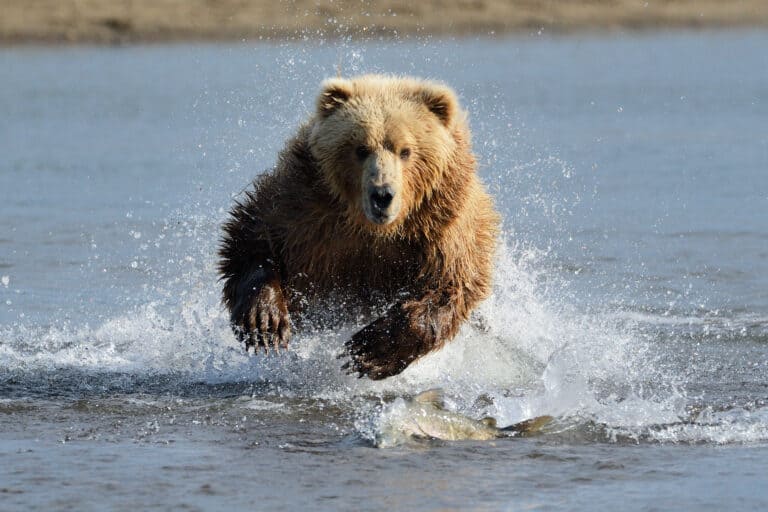
At Brooks Falls, the main attraction is sockeye salmon, also known as red salmon. These fish migrate upstream during the summer, often leaping out of the water as they attempt to clear the waterfall. Bears use several fishing techniques, including waiting near the falls to catch fish in midair or pursuing them in the river. The salmon provide the calories and fat needed to help the bears prepare for their long winter dormancy.
Other Pacific salmon species, including chum, coho, pink, and Chinook, are also found in the broader Katmai region. While these fish can be valuable food sources, sockeye are particularly associated with the famous gatherings at Brooks Falls.
The video offers a good reminder that catching dinner isn’t always a peaceful activity for a brown bear. Even when salmon are plentiful, having access to the right fishing location can make a difference. And as this encounter demonstrates, the bears themselves sometimes have very different opinions about who gets to stand where.