
Quick Take
- Norse mythology gave this breed a legendary status long before anyone thought to compare it to your average housecat, and the reason why might just surprise you. Explore the Norse origins →
- A large male Norwegian forest cat doesn't just outweigh a normal cat. The difference is enough to reframe what 'big' even means for a domestic breed. See the size comparison →
- Their coats look like a luxury upgrade, but every layer actually serves a very specific purpose built for survival rather than aesthetics. Discover the coat details →
- Norwegian forest cats take far longer to reach full size than most people expect, and understanding that timeline will change how you'd care for one. Check the maturity timeline →
The Norwegian forest cat is an ancient breed that evolved naturally in Norway’s forests for centuries without human interference. In Norway, their name is skogkatt, which means “forest cat” in Norwegian. These large cats are notorious for their long, thick, silky coats and lynx-like ears with tufts. They are not the most affectionate cats, but they do form strong connections with their owners. However, what most people notice about them is their size. So, when it comes to comparing the size of a normal cat to a Norwegian forest cat, just how big are they?
The History of the Norwegian Forest Cat
Humans have used cats to help keep pests away and as pets for centuries, but these felines weren’t always domesticated. Cats had an interesting transition from wild cats to human companions. Cats came into humans’ lives around 12,000 years ago when the earliest human settlements occurred in the Fertile Crescent (a crescent-shaped region in Western Asia and North Africa, spanning areas including modern-day Iraq, Syria, Lebanon, Jordan, Israel, and Egypt). As people evolved from their nomadic lifestyles and started developing farmlands, they experienced problems with rodents getting into their stored grain. The high population of rodents attracted Felis silvestris lybica or Middle Eastern wildcats. Soon most of these early towns were benefiting from the presence of these cats, and they became one of the most valued pets over time as new species of cat emerged, Felis catus, the domestic cat.
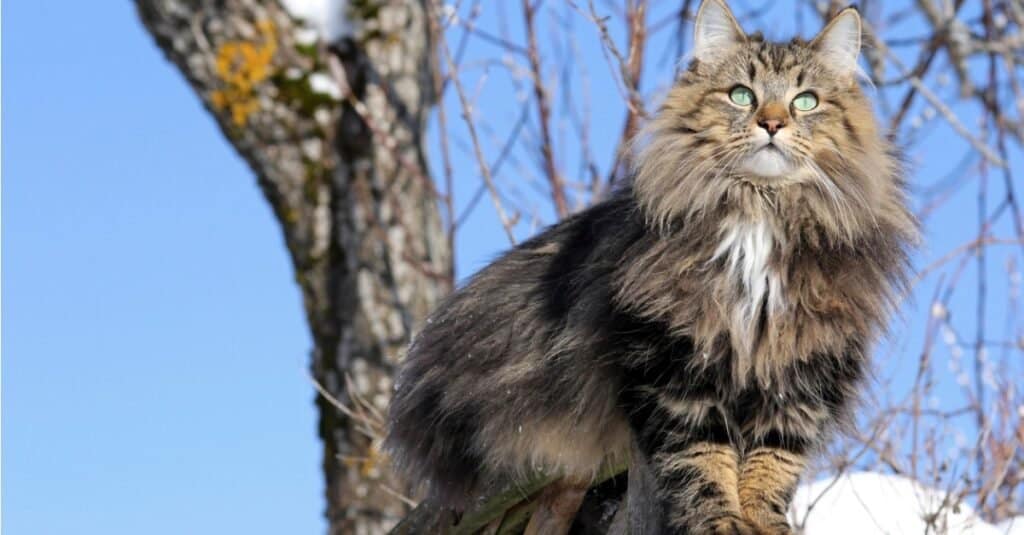
Experts speculate that the Norwegian forest cat’s ancestors include the Turkish Angora and Siberian cat.
©iStock.com/Astrid860
The Norwegian forest cat is very important in Norse mythology as they are said to be the Norse goddess Freyja’s favorite animal. There are many drawings and artworks showing two Norwegian forest cats pulling her chariot. While these cats’ origins are unknown, some experts speculate that the modern-day Norwegian forest cat’s ancestors may include the Turkish Angora and Siberian cat. Cat fanciers believe these cats traveled with the Vikings from Great Britain or other areas to Norway around 1,000 A.D. Once there, they lived in the forests for centuries, evolving into master hunters and climbers. After many years, these cats eventually made their way to farmlands, where they proved their worth as prized mouse hunters, eventually creeping into the hearts of the Norwegian people.
Norwegian Forest Cat Size and Build vs. a Normal Cat
When it comes to Norwegian Forest cat size and build vs. a normal cat’s size and build, normal cats are generally smaller, especially when comparing the males. But by how much?
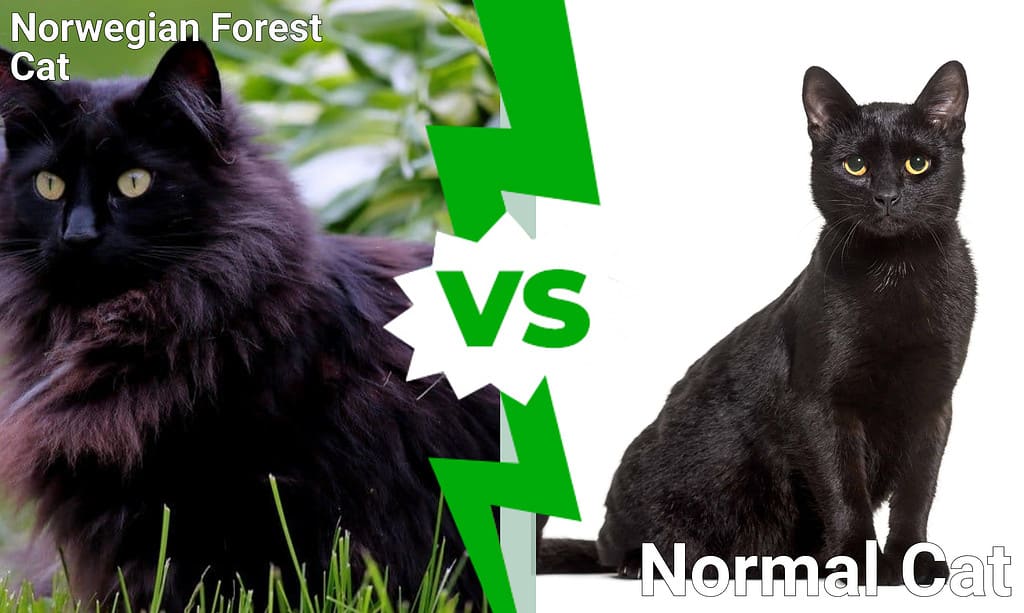
Just How Big Is a Norwegian Forest Cat?
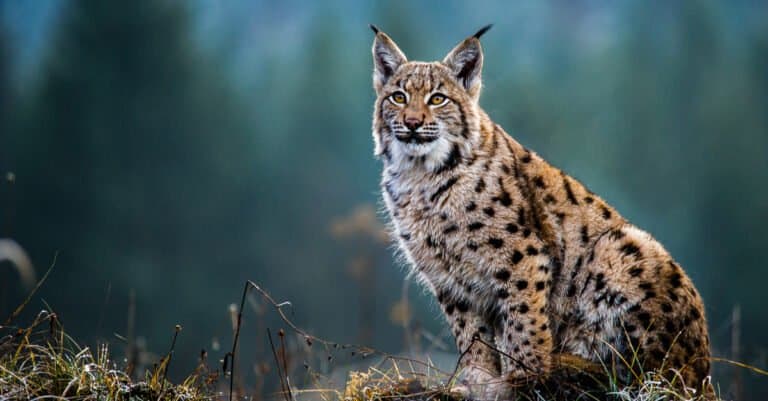
Norwegian forest cats are a large domestic breed, with males generally weighing between 13 to 16 pounds with a top weight of around 20 pounds. Females typically weigh 9 to 13 pounds. These cats are slow to mature and are not considered fully grown until they are around 5 years old. Norwegian forest cats stand 9-12 inches at the shoulder and measure 12-18 inches long. They are muscular but well-balanced, with a substantial bone structure. They have taller hind legs and a bushy tail. These cats have triangular-shaped heads and large ears with a wide base that arch forward. One of the breed’s most desirable characteristics is the tufts of hair on the end of their ears, referred to as lynx tips.
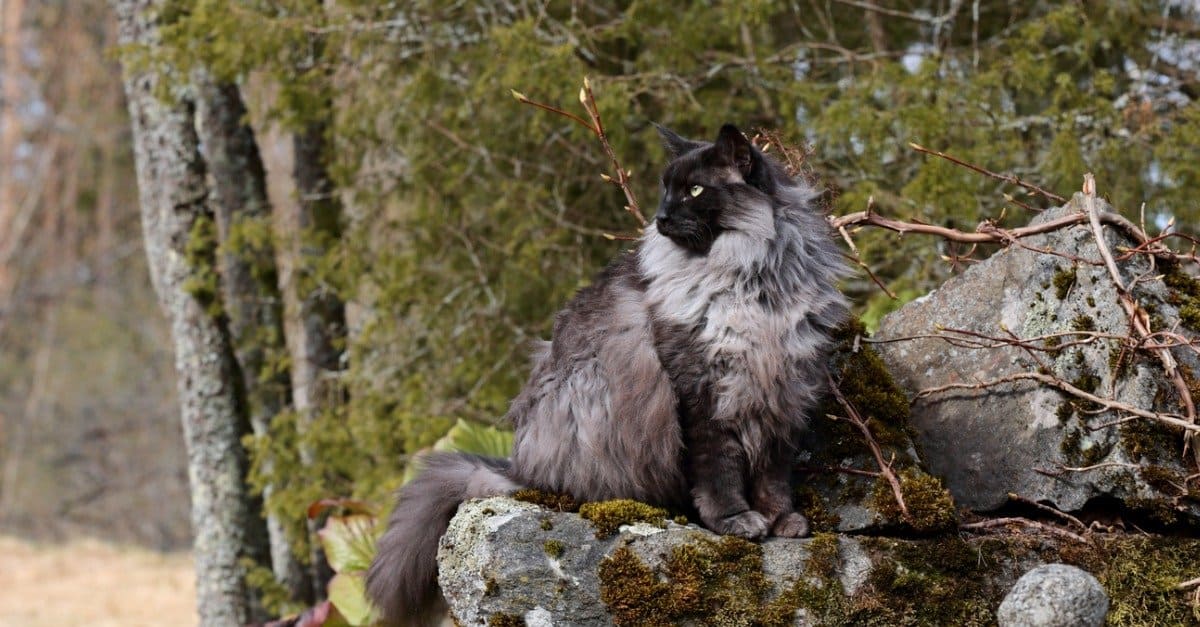
Their double coats keep them warm during the harsh Scandinavian winters. Each layer of their double coat serves a different purpose. The outer coat is long, coarse, and water-resistant, while the short, dense undercoat provides insulation. They also have a frontal ruff around the neck and chin, especially during the winter. Norwegian forest cats can be many different colors, shades, and patterns, including tabby, calico, bi-color, solid, tortoiseshell, smoke, and cameo.
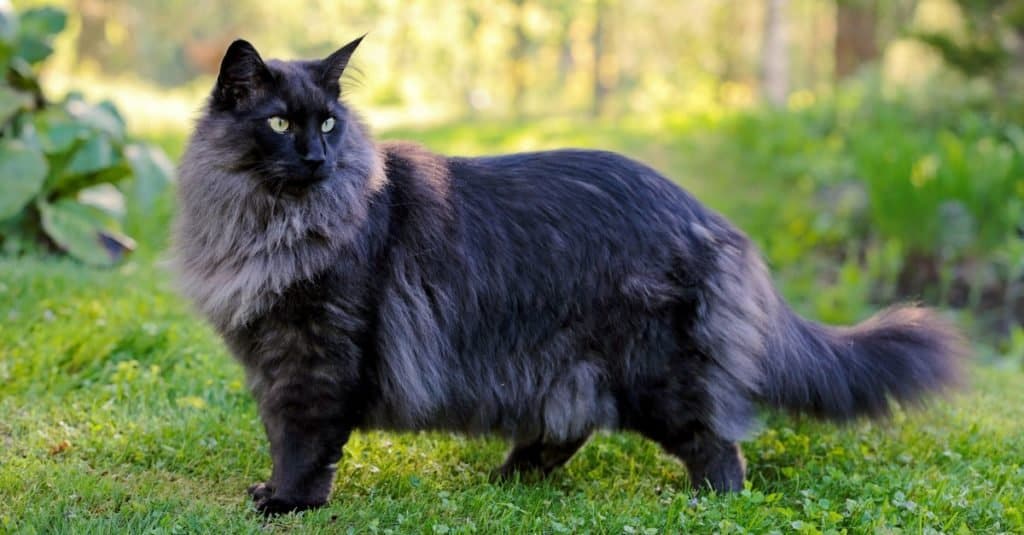
Norwegian forest cats have a frontal ruff around the neck and chin.
©Elisa Putti/Shutterstock.com
The Size of Normal Domestic Cats
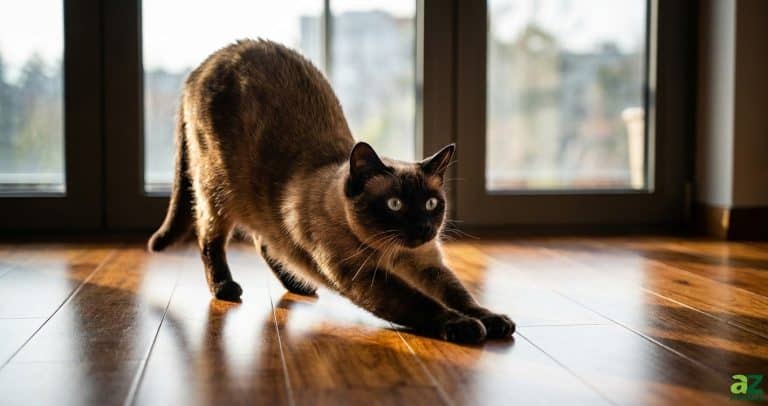
Most household cats are mixed breeds, so their size and build can vary depending on their ancestry. The average weight for a normal, healthy domestic cat varies from 8 to 12 pounds, but weights from 7 to 15 pounds are common depending on sex, as males are generally larger than females. So, a large male Norwegian forest cat could weigh 5-8 pounds more than a regular domestic cat, which is about the weight of another entire cat! Some large males could be over twice as heavy as smaller domestic cats. Female Norwegian forest cats are just slightly larger than average domestic cats, but large male domestic cats would outweigh a female Norwegian forest cat by several pounds.
Most domestic cats stand 9-10 inches tall, but some may be slightly taller or shorter, so Norwegian forest cats may only be an inch or two taller. The average body length of most domestic cats is 12-18 inches, which is the same length as a Norwegian forest cat. Domestic cats are considered adults at 12 months, but most do not reach their full size and maturity until 18 months old. Depending on their ancestry, some cats may continue growing beyond 18 months.
Normal, healthy cats usually have long, slender bodies that are not too compact and not too thin. They have muscular legs and long tails. Their coats and colors are highly varied since they are not purebred cats. Non-standardized breeding has produced cats in all colors, coat lengths, and textures.