
In Japan, the Buddhist pine tree is the state tree of the prefecture of Chiba. Throughout the country, Buddhist pine trees — known in Japanese as both kusamaki and inumaki — are popular for use in gardens. Because of their size, they are generally planted as small trees or large shrubs. The wood from the inumaki variety is also used to build houses! But did you know that Buddhist pine trees are also a popular choice for Bonsai tree art?
Read on to discover everything you need to know about caring for a Buddhist pine Bonsai tree!
| Botanical Name | Podocarpus macrophyllus |
| Common Types | Buddhist pine |
| Sunlight | Buddhist pine Bonsai trees love bright sunlight. They can even develop problems if they are not exposed to enough light. |
| Soil | Moist, well-draining soil. Any specialty Bonsai soil mixture should suit them just fine! |
| Water | Thorough watering during the growing season, then lessened during the cold seasons. Soil and root ball should always be kept moist! |
| For Beginners? | Yes! Buddhist pine Bonsai trees are easy to care for. They also take to pruning well and can be shaped into many simple styles. |
| Indoors or Outdoors? | Indoors throughout the year. If temperatures are cool during the spring and summer, they can be placed outdoors in semi-shaded areas. |
| Pairs Well With… | Moss, rocks, and other natural ornamentations. Though most Buddhist pine Bonsai trees are dramatic enough to steal the scene all on their own! |
Common Types of Buddhist Pine Bonsai Trees
Buddhist pine trees are native to southern Japan. They can also be found throughout the eastern and southern regions of China. They are known by many names throughout the world. In Japan, they are called kusamaki and inumaki. In China, their name is luóhàn sōng. When translated literally, this means “arhat pine”. In English, they are called yew plum pine, fern pine, and Japanese yew.
There are no known varieties or cultivars of the Buddhist pine tree! Below, we’ve outlined everything you need to know about the Buddhist pine tree.
Podocarpus macrophyllus
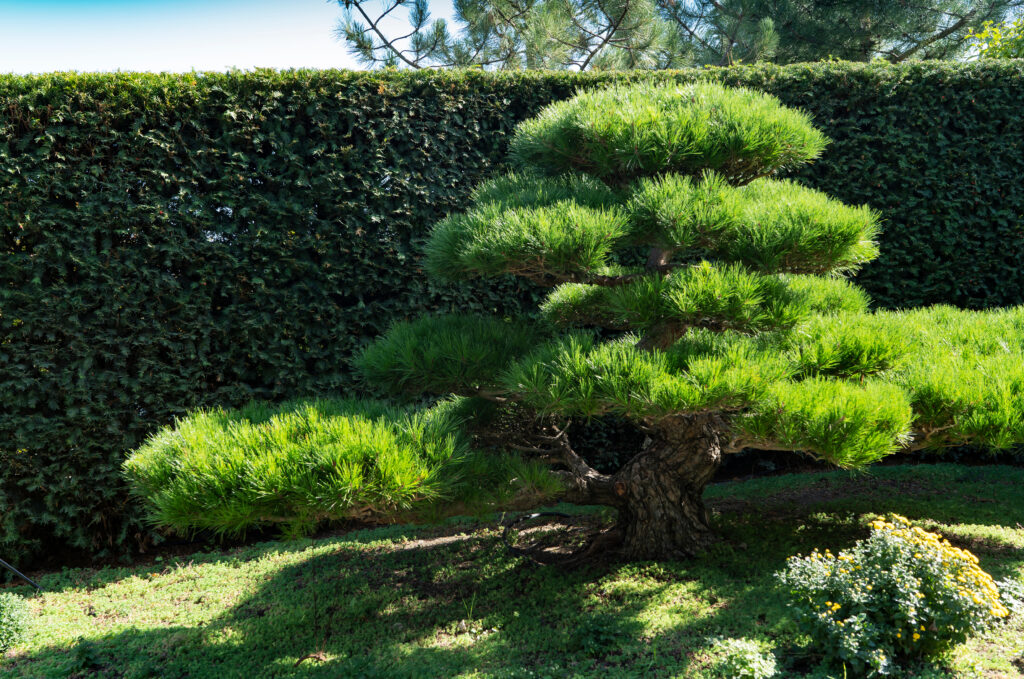
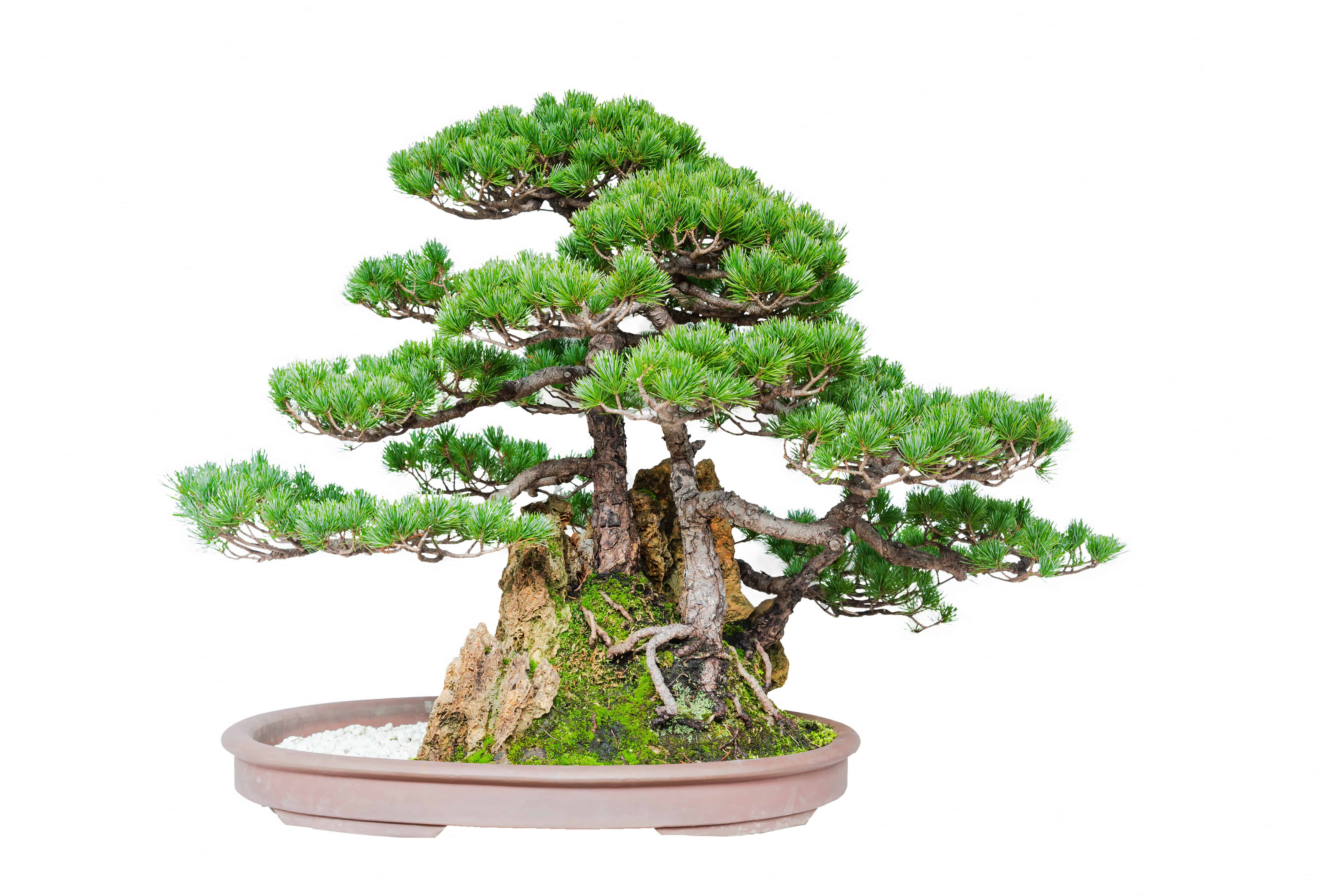
The Podocarpus macrophyllus, or Buddhist pine, is a popular choice for Bonsai.
©BestPix/Shutterstock.com
Otherwise known as the Buddhist pine tree, Podocarpus macrophyllus trees are slow-growing. At their highest height — found across their natural habitats in Japan and China — they are around 65 feet tall. This makes them small to medium-sized conifer trees. They grow upright, with leaves shaped like stars. These leaves appear a dark, vivid green color and have a leathery feel upon being touched.
Because Buddhist pine trees are coniferous trees, they bear cones. These cones are small, usually around an inch or less in length. The seeds that grow alongside them are poisonous if eaten!
Buddhist pine trees are known for being particularly hardy. As such, they are tolerant of drought and salt. Since they are often grown as indoor potted plants throughout the world, they are also used to pots and being pruned. This makes them perfectly suited for Bonsai tree art!
Caring for Your Buddhist Pine Bonsai Tree

Buddhist pine Bonsai trees don’t need too much attention to grow, but they are slow to growth in general.
©QQQQQQQT/Shutterstock.com
As a whole, Buddhist pine Bonsai trees do not need too much attention to help them grow. They grow slowly and are tolerant of some drought. This makes them a good plant for those just starting out with Bonsai tree art! However, to help them thrive, they do need some care.
From sunlight and placement to soil and water, here is all you need to know to help your Buddhist pine Bonsai tree grow its best!
Sunlight
Buddhist pine Bonsai trees love bright light and prefer direct sunlight over partial sunlight. Though they can thrive no matter what, as long as they get some kind of sunlight for a few hours every day!
Low light, or a lack of light, can result in the leaves of these trees growing longer than normal. This can cause problems when these trees are being grown as Bonsai trees. So, to ensure that your tree is growing the best that it can, try to expose it to as much bright light as possible! Grow lights can help with a lack of light.
Soil Type
A tricky part of owning and caring for a Bonsai tree can be selecting the right soil for it. Especially since soil can really make or break a plant in general. Bonsai trees are different in that there are specialty soil mixes available for these plants. They are made from a few different components and can be personalized for a specific Bonsai tree.
When planted naturally or in pots not intended for Bonsai tree art, Buddhist pine trees love soil that is rich in nutrients. It is best if this soil is kept moist but not soggy and is well-draining. Bonus points if it’s a little bit acidic, too! These traits can be replicated in Bonsai tree soil mixtures. For the most part, Buddhist pine Bonsai trees should grow well no matter what soil mixture they are planted in.
Water
Another tricky aspect of caring for a Bonsai tree is watering it properly. Bonsai trees generally need a decent amount of water in order to grow well. However, overwatering can be a definite issue. This can cause root rot. On the other hand, underwatering is also very common. The root ball of a Bonsai tree can dry out if not kept moist, which leads to the death of the entire plant.
To ensure that your Buddhist pine Bonsai tree is growing its best, it needs to be watered thoroughly throughout the growing season. This will help the roots develop so the tree can grow up strong!
During the winter, and a bit during the fall, cut back on watering your tree. The best rule of thumb is to water when the topsoil is dry to the touch. Be wary of overwatering the tree, though, no matter the season.
If possible, try to steer clear of watering a Buddhist pine Bonsai tree with especially hard water.
Placement
Another part of Bonsai care that can be difficult is knowing where to place your Bonsai tree. For the most part, there isn’t much of a rule of thumb. All Bonsai tree species have different care requirements. This is true of Buddhist pine Bonsai trees, of course!
Buddhist pine trees prefer cool environments, and this is the same for a Buddhist pine Bonsai tree. They seem to thrive best in temperatures between 50 and 70 degrees Fahrenheit.
As a whole, these trees do not need too much humidity. However, if temperatures are high enough that the air begins to dry out, your tree will need some humidity!
While these trees can be kept indoors throughout the year, they can definitely be placed outdoors in the spring and summer. If being grown in a place where outdoor temperatures are especially hot and dry, it is a good idea to bring the plant indoors. They can also be placed beneath semi-shade to keep them cooler and protected!
Buddhist pine Bonsai trees do not handle frost well, like most other Bonsai trees. This is because they are weakened when planted in Bonsai tree pots. To keep your Buddhist pine Bonsai tree safe from frost, the best idea is to bring it indoors. You can also keep it in a cold-frame greenhouse!
Sometimes, if they are kept in an especially warm room or area during the winter, these trees can keep growing a little bit!
Pruning Your Buddhist Pine Bonsai Tree
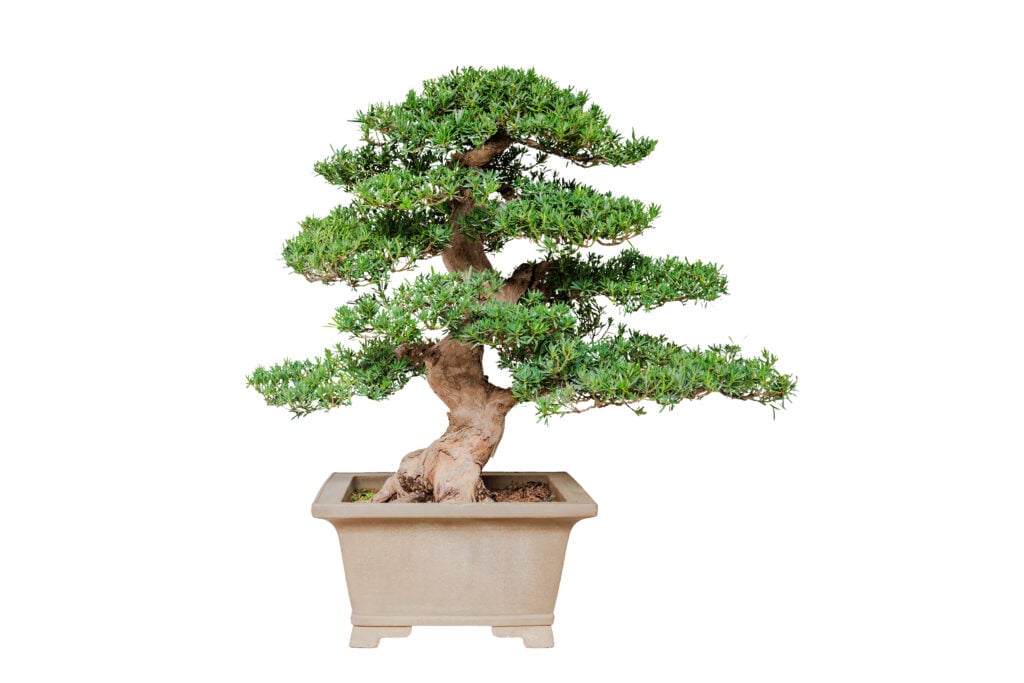
The Moyogi style of Bonsai — in which the tree is formed in the shape of an S — is a common choice for Buddhist pines.
©QQQQQQQT/Shutterstock.com
Since Buddhist pine Bonsai trees are often grown indoors they have become used to being potted. They are also used to being pruned! In fact, these trees take very well to pruning.
The best time to prune a Buddhist pine Bonsai tree is in the spring. Allow new growths and shoots to reach lengths of about 4 inches. Once they have, they can be pruned. Make sure you are only pruning the stems, though, and not cutting through the leaves.
You can wire these trees without worry, too! Wiring can even be done in any season. It is best, though, to let the youngest growths harden a bit before wiring them. And then, a few months later, the wires can be removed!
Ideal Buddhist Pine Bonsai Tree Styles
There are many Bonsai tree styles that can be achieved with a Buddhist pine Bonsai tree! Some of these styles are more challenging than others. Here are the most ideal styles for a Buddhist pine Bonsai tree.
First and foremost, the most common style is probably the Chokan style. This style, which is also called the formal upright style, involves letting your Bonsai tree grow upright with a single trunk. Leaves and branches are pruned away from the bottom of the trunk. Because of their natural stature, Buddhist pine trees suit this style very well. The rich colors of their bark and leaves make this a beautiful, dramatic style!
Another popular style for these trees is the style of Moyogi. This style is also called the informal upright style. Similarly to the Chokan style, it involves growing a Bonsai tree with a singular trunk. However, with the Moyogi style, this trunk is curved into a shape resembling the letter S. A branch usually grows at every bend of the trunk.
Another upright style to try with these trees is the style of Sokkan. It is similar to Chokan in that it involves growing your Bonsai tree straight and upright. The difference between these two styles is that with Sokkan, the main trunk is split at one point to allow for two different trunks to grow from the same source.
It is also possible to achieve the Yose-ue style with a Buddhist pine Bonsai tree. Also known as the forest style, Yose-ue involves growing your Bonsai tree with multiple trunks growing from different sources to resemble a forest.
Propagating Your Buddhist Pine Bonsai Tree

Seeds and semi-hardwood cuttings both can propagate a Buddhist pine.
©Barbara Ash/Shutterstock.com
Buddhist pine Bonsai trees can be propagated from seeds as well as semi-hardwood cuttings. To promote better, or faster, growth, it is recommended that these cuttings be taken from the tree during the growing season! These cuttings need warm soil to grow their best.
Common Problems with Buddhist Pine Bonsai Trees
If a Buddhist pine Bonsai tree is grown indoors, there aren’t too many problems to be found. The few problems that do arise often come from issues with placement or watering. They can be solved quickly and easily!
If your Buddhist pine Bonsai tree has developed long leaves, this is because it is not getting enough light. The leaves have grown longer than usual because they are reaching toward their light source to get more of it. To solve this problem, simply move the tree to an area with better, or stronger, light. Grow lights can also be used! You can also prune the leaves back if you wish.
Buddhist pine Bonsai trees can also be attacked by scale insects as well as mealy bugs. To take care of these problems, the proper pesticides should do the trick!