
When it comes to building nests, birds use a wide variety of tactics and materials. Some birds, like the puffin, burrow into the ground or take over abandoned rabbit warrens. Others, including the bald eagle, build giant nests atop tall trees that grant them a view of the surrounding landscape. Emperor penguins do not build nests at all and simply perch their eggs on their feet. Birds that do build nests do so with a variety of materials, including plants and grasses that they find in the environment. Birds use these materials to cushion their eggs. Twigs, grass, moss, lichen, rocks, and even paper may find their way into a bird’s nest. Some birds, however, choose to use one of nature’s greatest building materials: mud. From tiny songbirds to large wading birds, continue reading to learn about six birds that construct their nests with mud.
Cliff Swallow
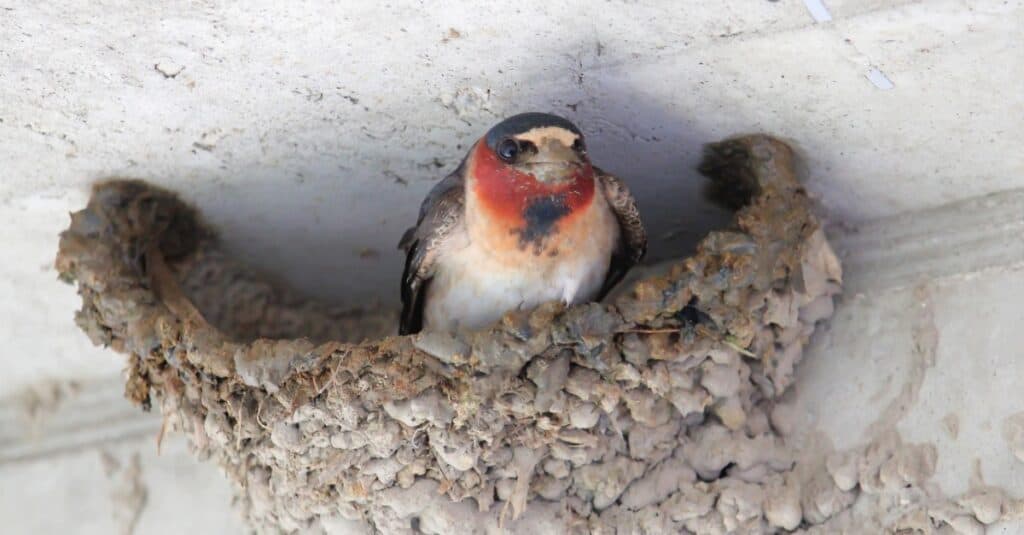
Cliff swallows build their nests out of mud along the side of cliffs or buildings.
©iStock.com/Kuhu
Also known as the American cliff swallow, the cliff swallow (Petrochelidon pyrrhonota) is a songbird belonging to the Hirundinidae family of swallows and martins. Cliff swallows breed throughout North America and overwinter in South America. On average, they measure around 5 inches long and feature short bills and long, pointed wings. Their plumage appears dark brown, with a white forehead and belly, and red cheeks. The cliff swallow gets its name from its habit of building its nest along cliff faces or the sides of buildings. Cliff swallows nest in large colonies, which may contain thousands of individual birds. They build their gourd-shaped nests together and may stack their nests on top of each other. To build their nests, they carry mud and clay in their beaks back to their nesting site. Since the process takes so long, cliff swallow pairs may reuse the same nest year after year.
Rufous Hornero
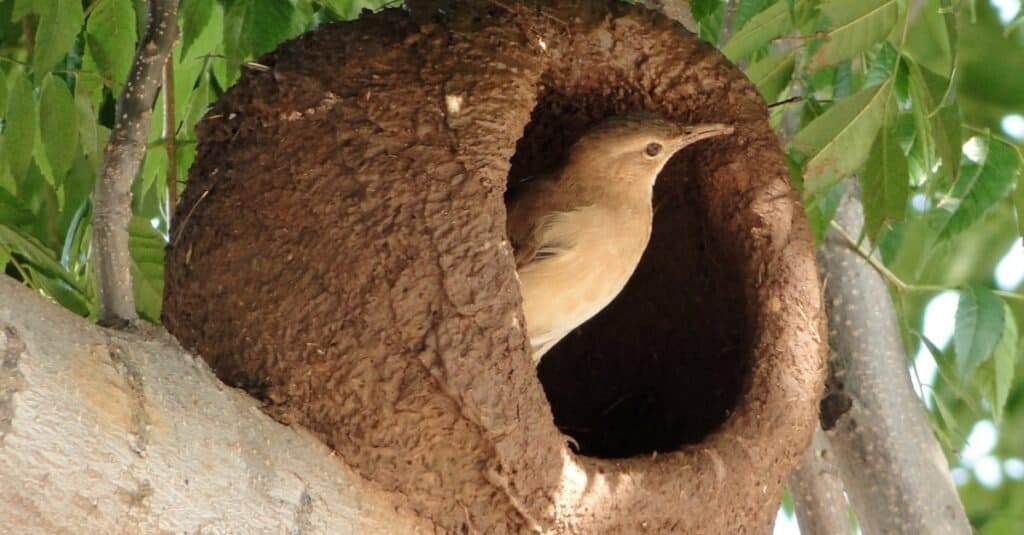
The rufous hornero builds an oven nest out of mud and clay.
©iStock.com/MarcosMartinezSanchez
The rufous hornero (Furnarius rufus), or red ovenbird, is a member of the Furnariidae family of ovenbirds. Endemic to South America, rufous horneros live in scrublands, fields, farmland, and grassy plains. Generally, they measure 7 to 8 inches long and sport a thin, curved bill which they use to forage for insects. The rufous hornero gets its name from its reddish-brown coloring and its habit of building an oven nest. In Spanish, horno means oven, which describes the shape of its nest. Like other ovenbirds, the rufous hornero builds a domed nest that looks suspiciously like a brick oven. During the breeding season, males and females work together to build a large nest made from clay. A nest usually takes only a few days to complete, but it can also take up to several months. Both parents take turns building the nest, incubating their eggs, and feeding their young.
Eastern Phoebe
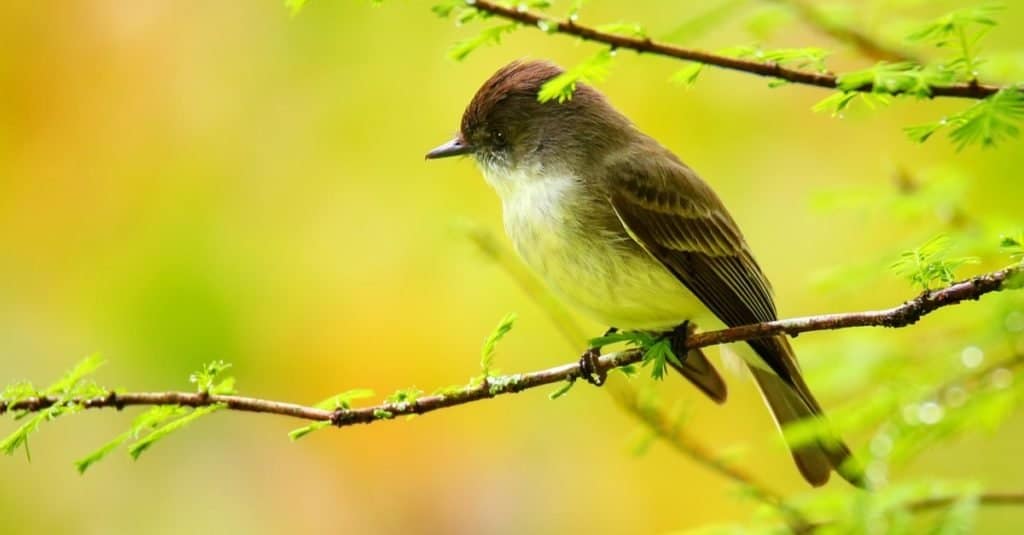
The eastern phoebe builds a cup nest out of mud and grass.
©Don Mammoser/Shutterstock.com
The Eastern phoebe (Sayornis phoebe) is a tiny songbird in the Tyrannidae family of tyrant flycatchers. It gets its name from Diana, the Roman moon goddess, who also goes by the name Phoebe. True to its name, the Eastern phoebe ranges throughout the eastern half of North America. They typically measure around 5.5 to 6.7 inches long. Eastern phoebes sport a large head and feature a gray-brown back, whitish belly, and throat. You can often find an Eastern phoebe’s open cup nest on the sides of buildings, bridges, or other human structures. They build their nests out of mud and then line the inside with grass and moss. Both the male and female take turns to feed their hatchlings, which eat a diet of insects, fruits, and berries. However, Eastern phoebes often get targeted by brown-headed cowbirds, which lay their eggs in other birds’ nests.
Purple Martin
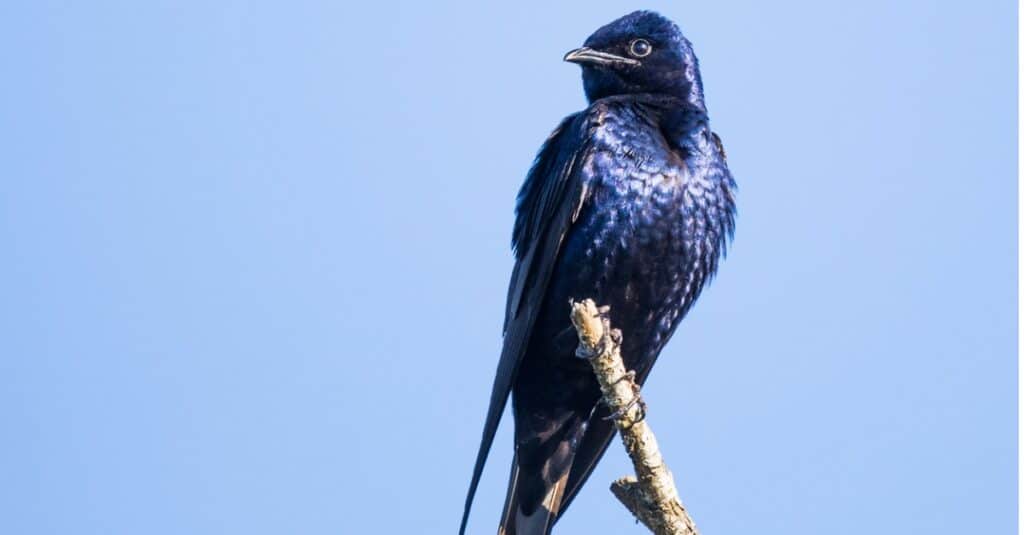
The purple martin builds its nest out of mud and twigs inside cavities.
©iStock.com/Jeff Huth
The purple martin (Progne subis) is another member of the swallow and martin family, Hirundinidae. The largest swallow in North America, the purple martin, measures around 7.5 to 7.9 inches long. It gets its name from its distinctive color, which sets it apart from other swallows and martins. While technically more dark blue than purple, its iridescent feathers can appear purple at times. Known for their agility and acrobatic displays, purple martins can snatch insects such as mosquitoes right out of the air. During the breeding season, both males and females work together to choose a suitable nesting site. Purple martins build their nests inside cavities and will take advantage of artificial houses, gourds, or hollows in trees. They build their nests out of twigs and small rocks, as well as some seashells, sometimes adding a mud dam at the front of the nest. They then line the inside with soft grasses topped with leaves to cushion the eggs.
Black-billed Magpie

Black-billed magpies build domed nests on top of trees.
©iStock.com/kojihirano
Also known as the American magpie, the black-billed magpie (Pica hudsonia) belongs to the Corvidae family. Black-billed magpies range throughout North America. On average, they measure 18 to 24 inches long, while their tail makes up almost half their total body length. Their thick plumage appears black and white, and also contains spots of iridescent blue on the tail and wings. They build their nests in trees, typically in open grasslands or urban areas. Like other corvids, they roost communally, particularly in winter, and will often mate for life. Black-billed magpies build domed nests at the tops of trees. The bottom half of the nest is made from mud, twigs, grasses, branches, leaves, and other plant matter. The top half is formed by a loose collection of twigs. A magpie nest may take up to 50 days to complete.
Flamingo

Flamingos build mound nests out of mud that measure nearly one foot high.
©Ondrej Chvatal/Shutterstock.com
The flamingo is a wading bird belonging to the family Phoenicopteriformes, of which it is the only extant member. Flamingos are wide-ranging, found in the Americas, the Caribbean, Africa, Asia, and Europe. They are 2.6 to 4.7 feet long and weigh anywhere from 5.5 to 7.7 pounds. In Spanish, the term flamingo translates to flame-colored, which alludes to their unique coloring. They range from light pink to red, and get their coloring from the beta-carotene and bacteria in their diet. Both females and males work to build their nests, which they will aggressively defend. Their nests are built atop mudflats and constructed into the shape of mounds. Made of mud, stones, straw, and feathers, these mounds can measure up to 12 inches tall. A small depression at the top of the mound serves as the spot where the female lays a single egg.