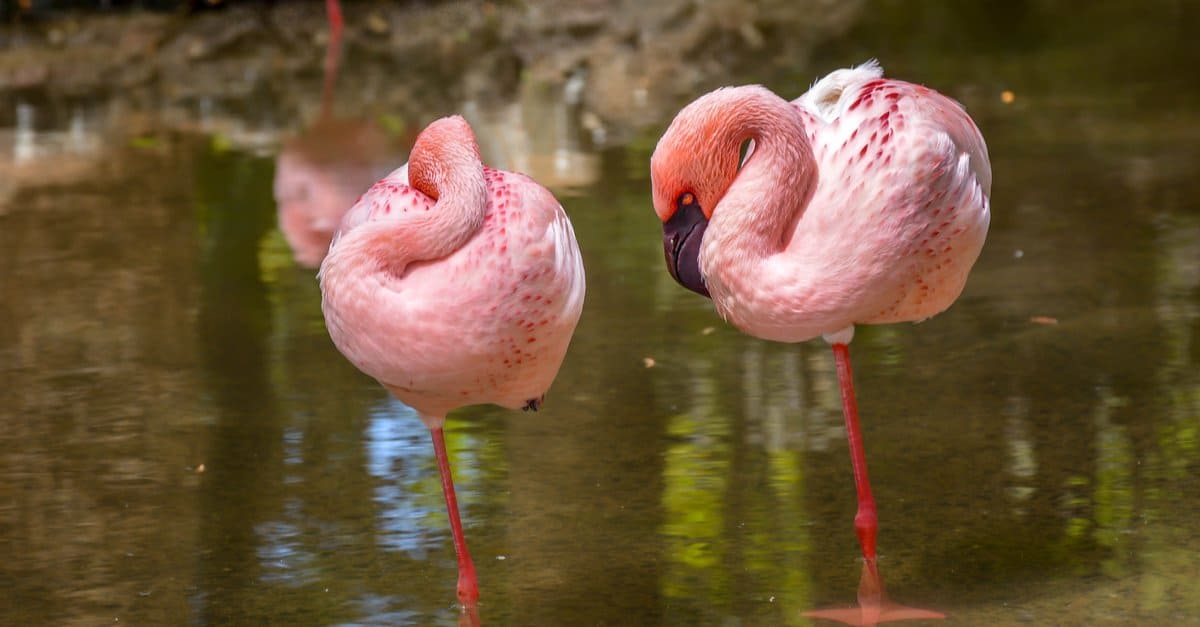

Have you ever tried to balance on one leg? While some yoga masters make this move appear simple, it’s not as easy as it looks. It requires a considerable amount of concentration, strength, balance, and coordination to stand on one leg for more than a few seconds. For humans, balancing on one leg is a great way to strengthen coordination, build endurance, and recalibrate the brain. People who practice yoga have long been aware of the benefits of standing on one leg. That said, even yogi masters don’t go around standing on one leg all the time. Yet, some species of birds stand on one leg regularly. Some even sleep standing on one leg. Continue reading to discover six birds that stand on one leg.
Why Birds Stand on One Leg
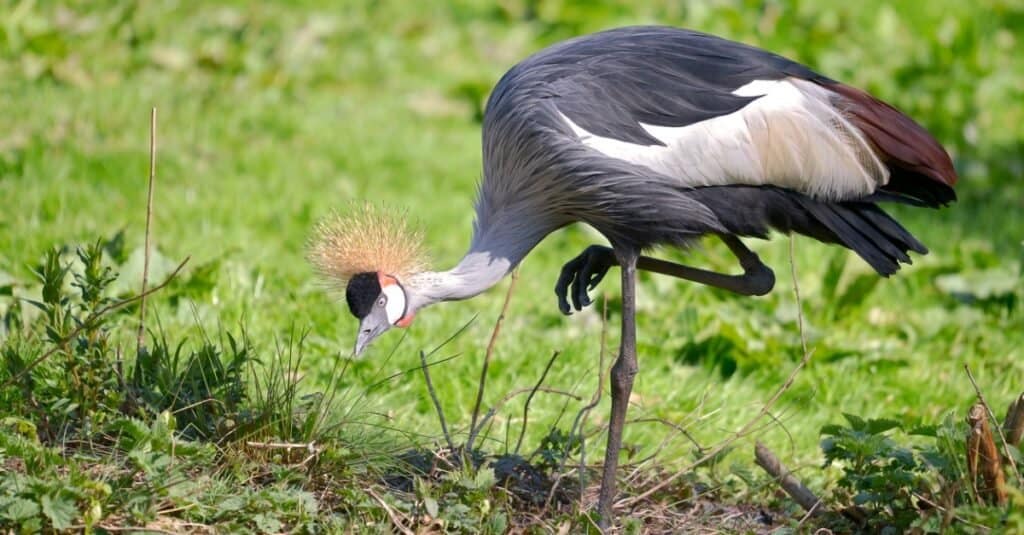
A Black Crowned Crane (Balearica pavonina) on one leg, looking for insects.
©iStock.com/Musat
Birds that stand on one leg do so for many reasons. Primarily, it’s an adaptation that allows birds to retain heat more efficiently. Birds possess a complex web of arteries and veins that use concurrent blood flow to exchange heat. Known as rete mirabile (wonderful net) in Latin, this network allows birds to exchange heat through their feet. By standing on one leg, these birds reduce the amount of heat lost through their feet and legs. Some birds may stand on one leg as a tactic to aid in hunting. By reducing the number of feet they have in the water, the birds appear more like a stick than a predator.
#6: White Stork
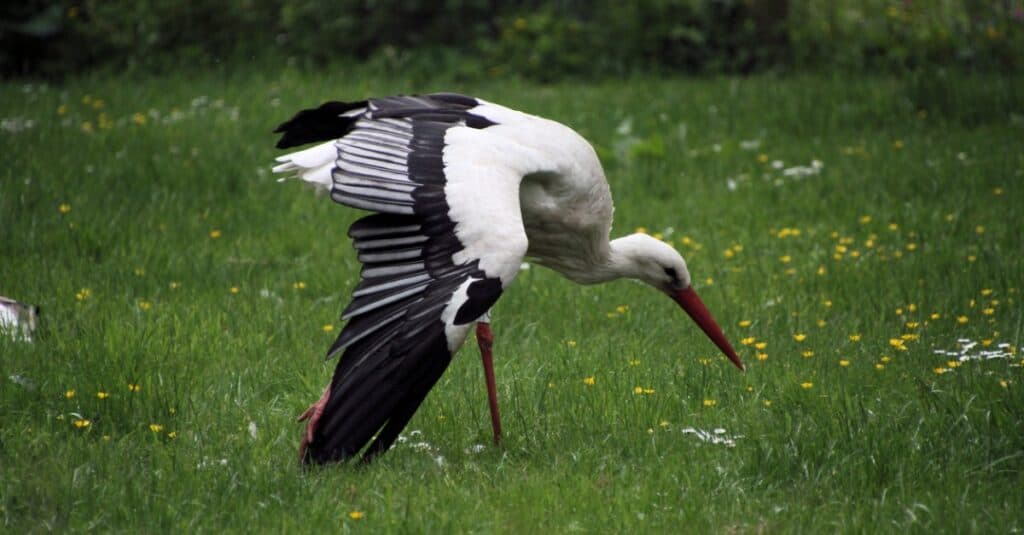
Storks have some of the longest beaks and legs in the world.
©iStock.com/Simon11uk
The white stork (Ciconia ciconia) is a member of the stork family Ciconiidae. It gets its name from its predominantly white plumage, although the edges of its wings and tail appear black. They range throughout Southern Africa, Europe, Southwestern Asia, and the Indian subcontinent. Since they rely on air thermals to fly long distances, they rarely migrate over water. White storks live in wetland habitats as well as grasslands and fields, and shun densely forested areas. Known for their social nature, white storks live in small groups during the breeding season and in large colonies during winter. Their diet consists of a wide range of prey, including fish, amphibians, small mammals, small birds, and reptiles. Typically, white storks measure 39 to 45 inches long with a wingspan between 61 and 85 inches. Given that their long, orange-colored legs lack feathers, you can often see these birds balancing on one leg in a field.
#5: Canada Goose
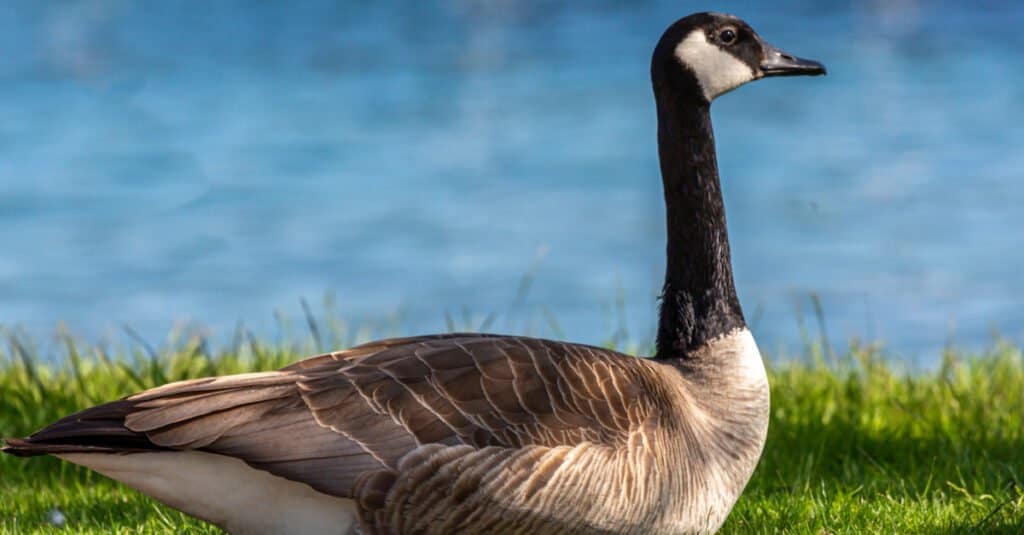
The Canada goose can often be seen resting on one leg near a pond or in a field.
©David McIntosh/Shutterstock.com
The Canada goose (Branta canadensis) is one of the most recognizable members of the family Anatidae. These wild waterfowl are endemic to Canada and the Northern United States, but now thrive in introduced regions. You can find them throughout North America, as well as in introduced populations in Europe, New Zealand, Japan, Chile, Argentina, and the Falkland Islands. In addition to living around wetlands and grasslands, Canada geese have also adapted to living in urban environments. On average, they measure 30 to 43 inches long and sport a wingspan of 50 to 73 inches. Their distinctive plumage appears black on the head and neck, white on the chin and underparts, and brown elsewhere. Canada geese eat a mostly herbivorous diet, but will also eat insects and small fish. When not begging for food, you can often find these birds relaxing by a pond.
#4: Budgerigar
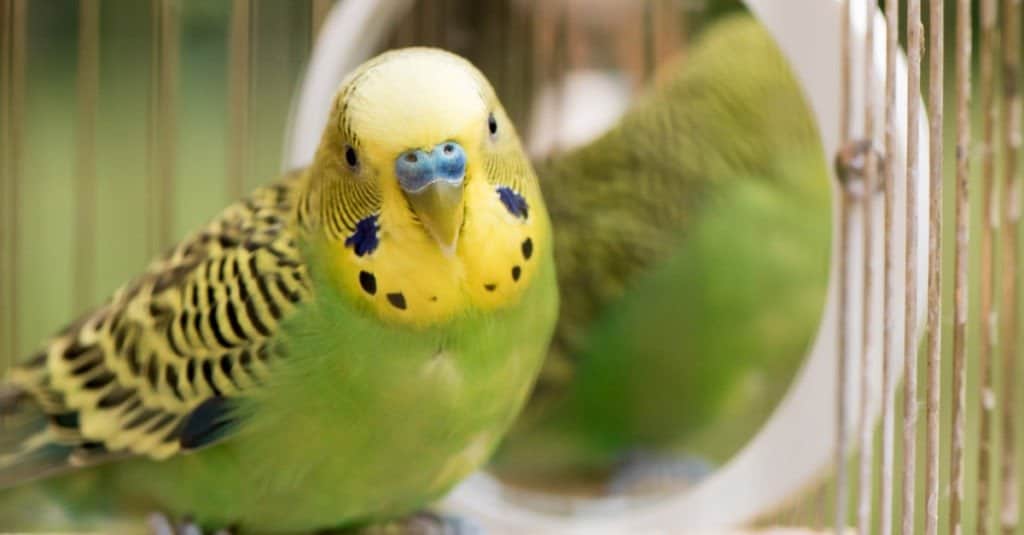
Budgies are among the most popular parrots kept as pets, and often perch on one leg in their cage.
©Vyaseleva Elena/Shutterstock.com
Also known as the common parakeet or simply parakeet, the budgerigar is a small parrot in the family Psittaculidae. It’s the only member of its genus, Melopsittacus, and one of the most common birds kept in captivity. In their native home of Australia, budgerigars or “budgies” live in forests, grasslands, and scrublands. Budgerigars were once established in the wild in Florida, but as of 2025, only rare escapees are occasionally seen, and there are no longer established wild populations.
On average, they measure 7 inches long and sport a wingspan of around 12 inches. Budgies have bright green plumage with a yellow face and black-and-yellow wings. In captivity, however, they can be found in a wide range of colors, including red, blue, yellow, and gray. Their diet primarily consists of seeds, although they also eat fruits, berries, and vegetable matter. People who have pet budgies will often see these birds asleep while balancing on one leg on a perch.
#3: Red-Tailed Hawk
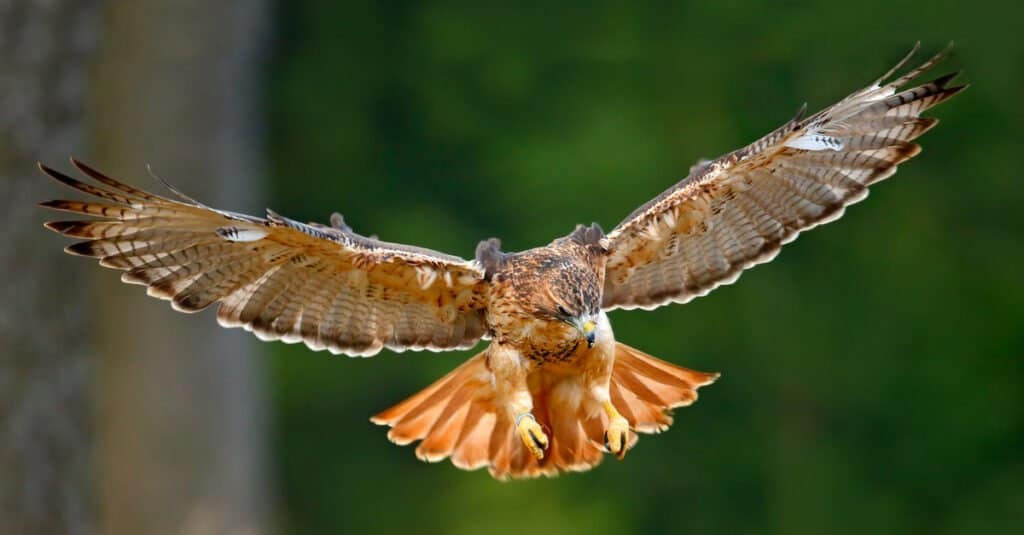
Red-tailed hawks will stand on one leg as they rest between hunting trips.
©Ondrej Prosicky/Shutterstock.com
The red-tailed hawk (Buteo jamaicensis) is another bird that stands on one leg. Sometimes known colloquially as the chickenhawk, the red-tailed hawk is a member of the hawk, eagle, and harrier family, Accipitridae. Red-tailed hawks range throughout North America, where they rank as one of the most common raptor species. A large species, they measure 18 to 26 inches long and sport a wingspan between 3 feet 7 inches and 4 feet 8 inches. It gets its name from its rufous-colored tail, whereas the rest of its plumage varies depending on the subspecies. They eat a wide variety of foods, and their diet varies according to their environment. It includes rodents, insects, small birds, amphibians, and reptiles such as snakes. In the wild, you’ll often see a red-tailed hawk perched up on one leg while it rests between hunting forays.
#2: Great Blue Heron
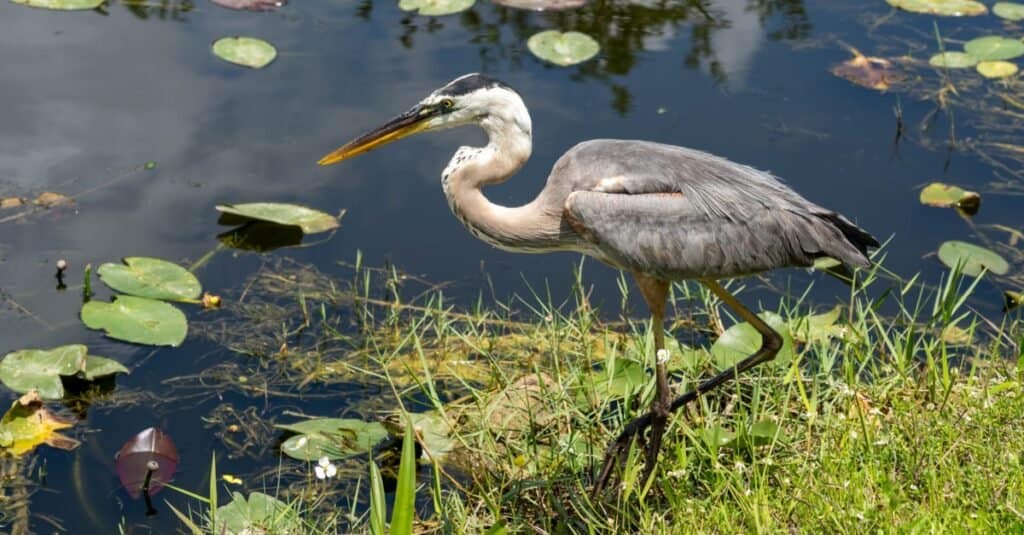
Great blue herons will stand on one leg very still while hunting.
©ttomasek15/Shutterstock.com
The great blue heron (Ardea herodias) is a large wading bird in the family Ardeidae. It typically lives in wetland and coastal habitats where it can access food. Great blue herons breed across much of North America, including Southern Canada, the United States, and parts of Mexico and the Caribbean. Northern populations migrate south to Mexico, Central America, and the Caribbean for the winter, while many populations are year-round residents in temperate regions. The great blue heron gets its name from its large size and distinctive color. They measure between 36 and 54 inches long and weigh between 4 and 7.9 pounds. Their plumage is blue-gray, with gray-white streaking on their front, reddish thighs, and black markings on the head and neck. Their diet includes fish, although they’ll also eat small mammals, amphibians, and reptiles such as snakes. They often stand on one leg while hunting to try and reduce their presence and lure in prey.
#1: American Flamingo
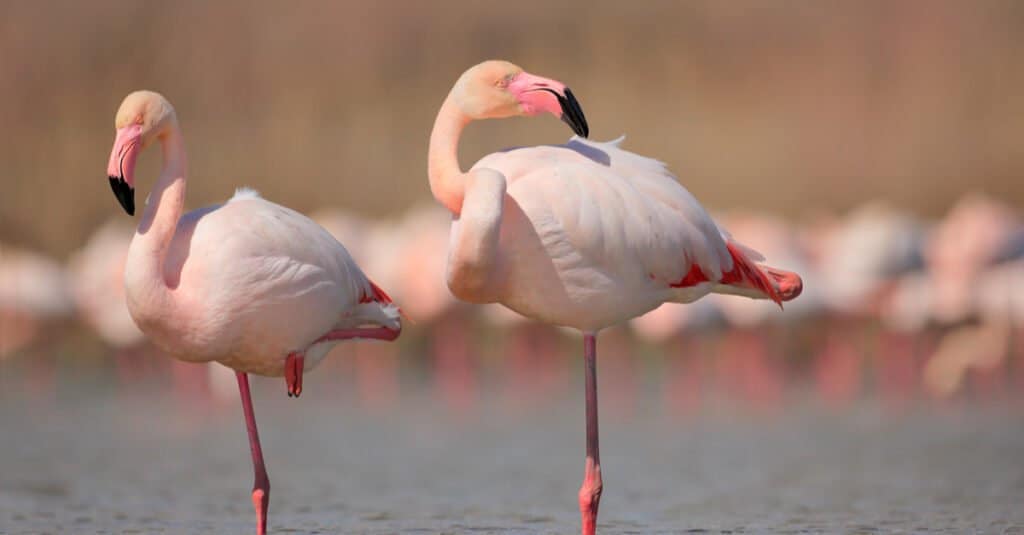
The American Flamingo is the only flamingo species endemic to North America.
©Ondrej Prosicky/Shutterstock.com
Also known as the Caribbean flamingo, the American flamingo (Phoenicopterus ruber) is a large wading bird in the family Phoenicopteridae. While closely related to the greater and Chilean flamingos, it is now considered a distinct species. It is the only flamingo species native to North America, and is also found in the Caribbean, northern South America, and the Galapagos Islands. American flamingos live in wetlands, including lagoons, mudflats, lakes, and shallow coastal regions. They measure 47 to 57 inches long and weigh between 4.9 and 6.2 pounds. Like other flamingos, their plumage appears reddish-pink, a color they get from their diet of crustaceans, predominantly shrimp. Among birds that stand on one leg, flamingos may be the bird people most often associate with this behavior. You can often see American flamingos balancing on one leg to help preserve body heat.