Quick Take
- One bird on this list can recognize your face and remember it. Crows that know your face →
- Some birds don't just hide their food. They actively deceive other animals who are watching them do it. Deceptive food-hiding behavior →
- A bird with a beak too small to feed itself has figured out a clever workaround by using tools it finds in its environment. How the finch uses tools →
- Ravens don't hunt alone, and their teamwork involves a trick that's almost too clever to believe. Ravens' cooperative hunting tricks →
You can tell a lot about the intelligence of a bird by watching its behavior. Some birds look for food, build their nests, and go about their daily tasks the same way throughout their lives. Other birds seem a bit more inquisitive. Some of the birds on this list excel at using tools, while others have a talent for outsmarting their fellow birds. There is even a bird that can recognize human faces. Continue reading to learn about the unique behaviors that earned each of these nine birds a place on the world’s smartest birds list.
California Scrub Jay
In the autumn, the California scrub jay (Aphelocoma californica) looks for food it can store to eat during the winter months. While a lot of birds store food, the California scrub jay adds a clever twist to the process.

A California scrub jay will sometimes pretend to hide its food in a certain spot and then hide it elsewhere.
©iStock.com/Keppela
Scrub jays understand that their supply of stored food may be stolen by other birds or even squirrels. So, when a California scrub jay is hiding its food, it keeps a close watch on its surroundings. If the jay thinks a bird is watching, it will hide the food in another place. It may even change the location of the food several times to fool other birds.
Eurasian Magpie
Eurasian Magpies (Pica pica) are best known for their warbling, chirping, whistling, and chattering. These birds are also recognized for their intelligence. Scientists put them to a challenging test, and they passed easily.
First, scientists placed a small sticker on a magpie’s body. Then, they put the bird in front of a mirror. The magpie looked into the mirror and immediately tried to remove the sticker from its feathers. This bird saw its reflection and knew the sticker didn’t belong there. Other types of birds simply tapped on the mirror, thinking it was another bird.

Magpies are able to recognize themselves in a mirror, while other birds cannot.
©iStock.com/birdsonline
Clark’s Nutcracker
The Clark’s nutcracker (Nucifraga columbiana) lives in the mountains in the western part of the United States. They have soft gray feathers on their heads and backs along with black wings with distinctive white patches. Though they live high in the mountains, this bird’s intelligence is well-known. In short, the Clark’s nutcracker has a remarkable memory.
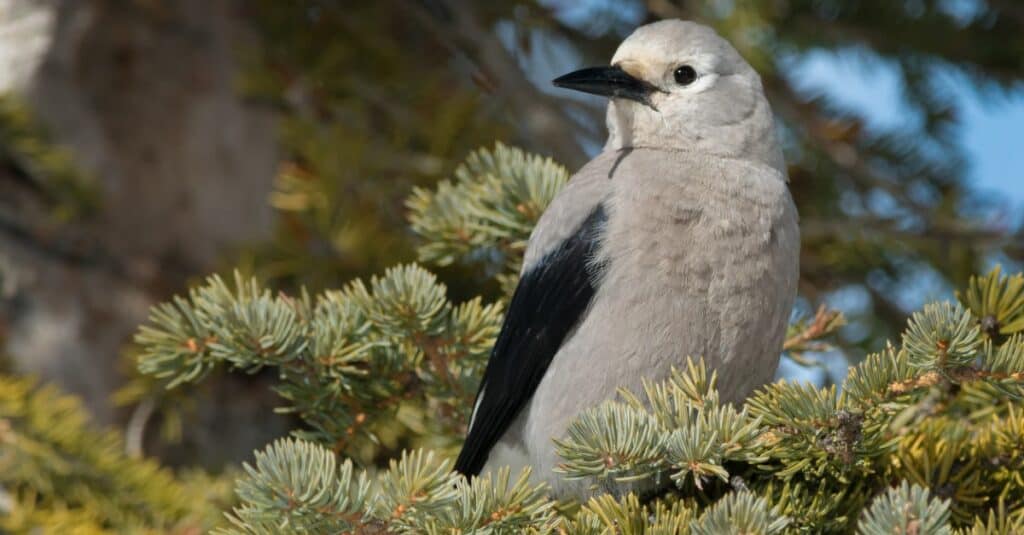
The Clark’s nutcracker stores as many as 30,000 pine seeds in one season.
©iStock.com/PaulReevesPhotography
Pine seeds are the Clark’s nutcracker’s primary food source. These birds put considerable effort into storing pine seeds during the summer to sustain themselves through the winter. They can store up to 98,000 pine seeds in a single year. However, they don’t store all of the seeds in one location. Instead, they store only four or five seeds in a single place.
This means the Clark’s nutcracker must remember thousands of hiding places. But how does it find buried seeds after snow falls? Scientists have concluded that the nutcracker uses tree stumps, fence posts, and other landmarks to help it remember where the seeds are buried. It is no wonder this bird ranks among the smartest in the world.
Raven
Ravens (Corvus corax) are well known for their black feathers and black eyes. Many famous stories, songs, myths, and poems feature this remarkable bird. What you may not know is that ravens are considered some of the smartest birds in the world.
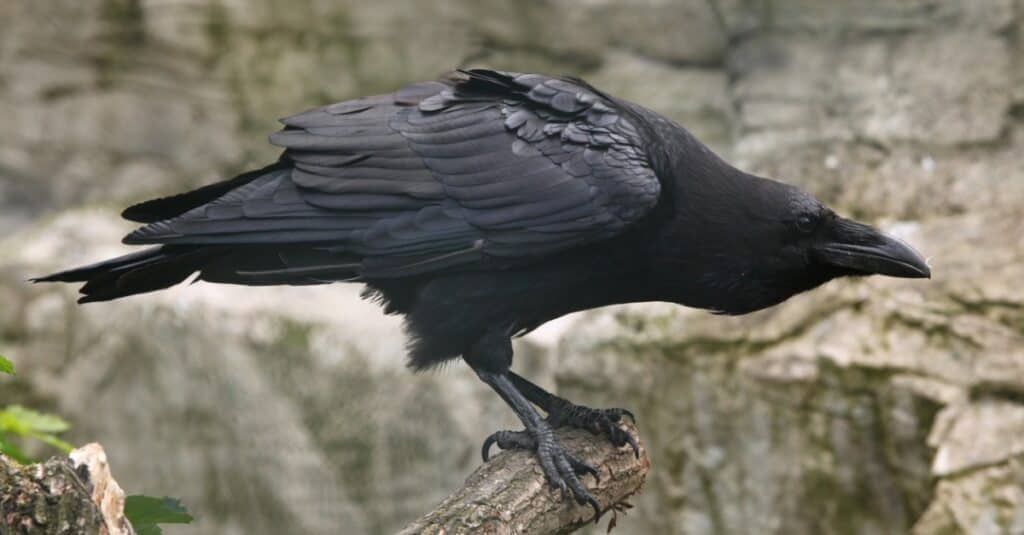
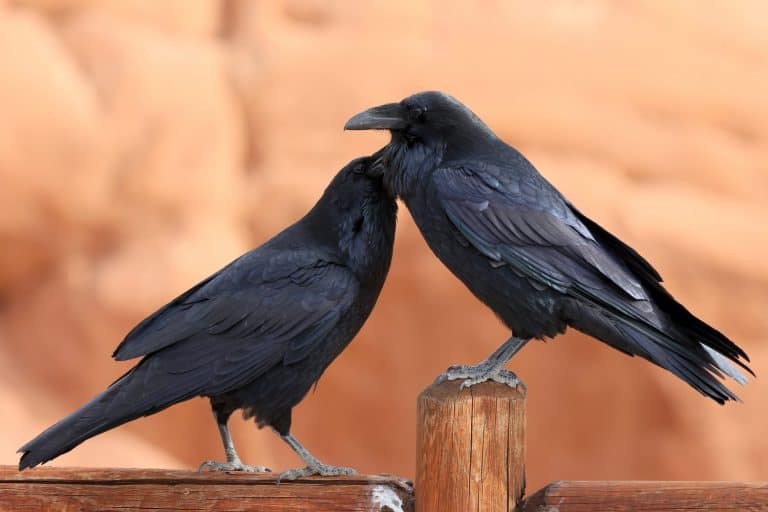
Ravens hunt in pairs to make the process more efficient.
©iStock.com/wrangel
Instead of hunting for prey on their own, ravens hunt in pairs, which makes the process more efficient. When a pair of ravens spots a nest of baby birds, one of them flies near the mother bird and creates a distraction to lure her away from the nest. When the mother is lured away and the coast is clear, the other raven moves in to grab one of the chicks.
Another reason this bird ranks among the smartest is its ability to master complex challenges. Ravens can complete a variety of challenges designed by scientists. In one such challenge, a raven used a stick held in its beak to push a stone out of a box, then dropped the stone into a tube to release food. Ravens are capable of figuring out the steps involved in completing a challenge.
Jackdaw
A jackdaw (Coloeus monedula) gets its interesting name from its call. It makes a noise that sounds like This curious bird has a place on the world’s smartest birds list for a few reasons.

Jackdaws are well-known for taking shiny objects.
©iStock.com/miksov
For one thing, jackdaws are notorious for taking shiny objects like coins and jewelry. These birds spot a sparkling object and cannot resist taking it. Sometimes, however, they take shiny items with a specific purpose in mind. Jackdaws sometimes remove the shiny caps from bottles of milk sitting on the porches and doorsteps of homes. But taking the cap is not their end goal. They also drink the milk from the bottle.
Jackdaws build nests using lots of different materials, including animal hair. Scientists have seen jackdaws following herds of deer so they can land on the backs of these mammals. The birds pluck hairs from deer to use for their nests.
Red-Billed Chough
Red-billed choughs (Pyrrhocorax pyrrhocorax) have black plumage similar to other birds on this list. However, they also have a bright red beak and legs.

The red-billed chough, pronounced like chuff, uses tools to break open a shell.
©iStock.com/birdsonline
Choughs are considered intelligent birds for their ability to use objects as tools to break open shells. For example, these birds sometimes eat mollusks, using the broken shell of one mollusk to crack open the shell of another mollusk.
Rook
Rooks (Corvus frugilegus) are black with a white face and a pointy black beak. The rook appears on this list of most intelligent birds because of its ability to solve problems.

The rook has great problem-solving abilities.
©Jane Rix/Shutterstock.com
One notable experiment involves a rook and a bottle half-filled with water, with a small worm floating on the surface. The rook sees the worm and wants to eat it. Although it can reach its beak into the bottle, the worm remains out of reach because the water level is too low. So the rook drops stones into the bottle to raise the water level until it can reach the worm.
Woodpecker Finch
The woodpecker finch (Camarhynchus pallidus) is not a woodpecker, but a finch.

Because their beaks are so small, woodpecker finches use twigs and sticks as tools to dig for dinner.
©Wilfred Marissen/Shutterstock.com
Native to the Galapagos Islands, woodpecker finches feed on worms and grubs found inside trees. However, the woodpecker finch’s short beak is not effective at digging grubs out of tree trunks or branches. This is where the woodpecker finch’s intelligence comes into play.
Woodpecker finches use twigs, sticks, and even cactus spines as tools to retrieve grubs from inside a tree.
Crow
Crows (Corvus) are considered the smartest of all birds for several reasons.
The New Caledonian crow (Corvus moneduloides) is widely considered the most advanced in terms of technical problem-solving, while the American crow (C. brachyrhynchos) is arguably the most heavily studied, particularly regarding social intelligence and human interaction.

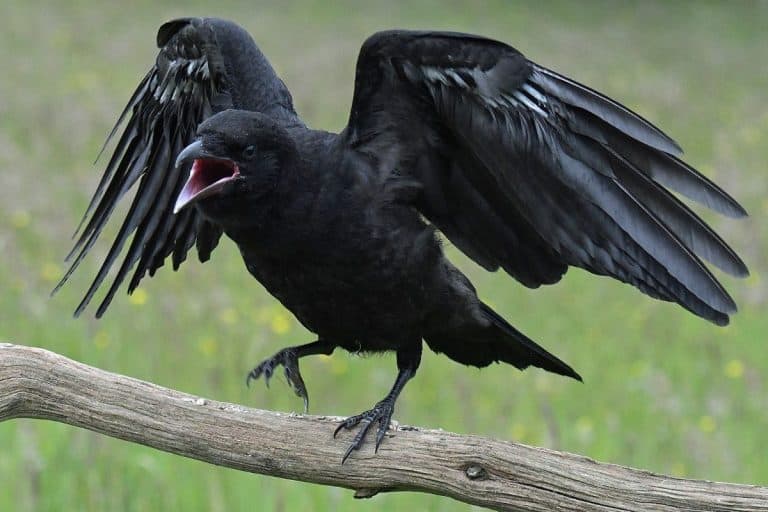
Crows are intelligent enough to remember individual human facial features.
©Pascale Gueret/Shutterstock.com
In Japan, carrion crows (C. corone) have been seen dropping nuts into a busy roadway, where the nuts are crushed beneath the tires of passing vehicles. The crows perch on a power line above the street, waiting for traffic to slow. When it does, they fly down to eat the pieces. This demonstrates cause-and-effect thinking.
In addition, crows can create tools out of leaves, twigs, and sticks to access insects from the ground or a tree. Finally, crows can recognize and remember individual human faces, a feat no other bird on this list has been able to perform.