
While birds descended from dinosaurs, the majority are of much smaller stature. The world’s largest bird species, ostriches (Struthio camelus), can weigh approximately 300 pounds and grow to a height of nine feet. On the opposite end of the spectrum, some birds are measured in inches and ounces rather than feet and pounds.
These petite birds have managed to carve out unique niches in their ecosystems, and their limited reach generally suggests specialized evolutionary development. Their small size demands fewer resources for survival and offers them unique opportunities to evade predators. Continue reading to learn more about the tiniest birds in the world.
1. Smallest Bird in the World: Bee Hummingbird
Average Length: 2.3 inches, Average Weight: 0.08 ounces
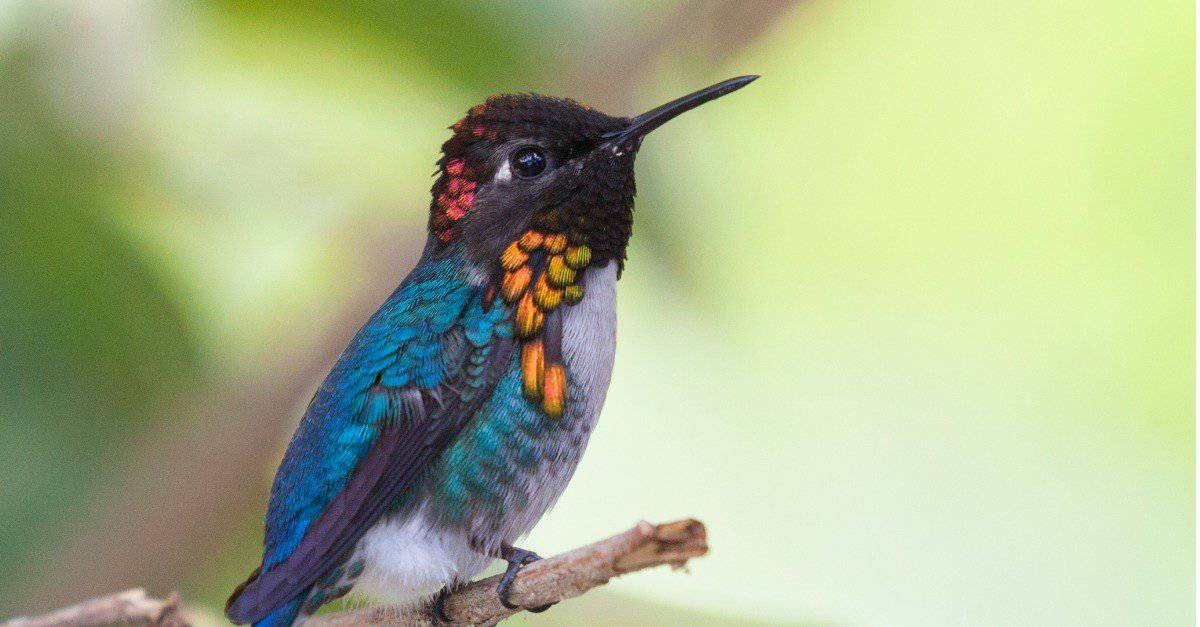
Taken in a hummingbird garden near Playa Larga, Cuba.
©James Bloor Griffiths/Shutterstock.com
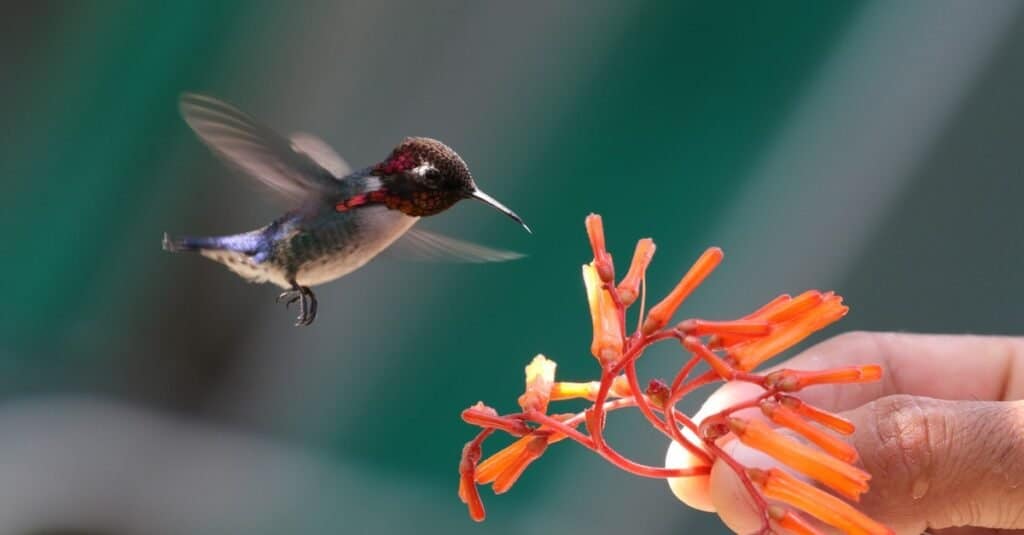
At barely two inches long, the bee hummingbird (Mellisuga helenae) takes the crown for the tiniest bird in the world. Their eggs are about the size of a coffee bean and can be comfortably kept in a nest the size of a quarter. Female bee hummingbirds weigh 0.092 ounces, more than the males but less than a dime. Unfortunately, their size makes them a target for predators, most notably mongoose, wasps, frogs, and spiders.
The heartbeat of bee hummingbirds averages an astounding 80 beats per second, which can double when mating. The bee hummingbird is native to Cuba, the only known habitat of the species.
2. Smallest Bird in Africa: Cape Penduline Tit
Average Length: 3.1 inches
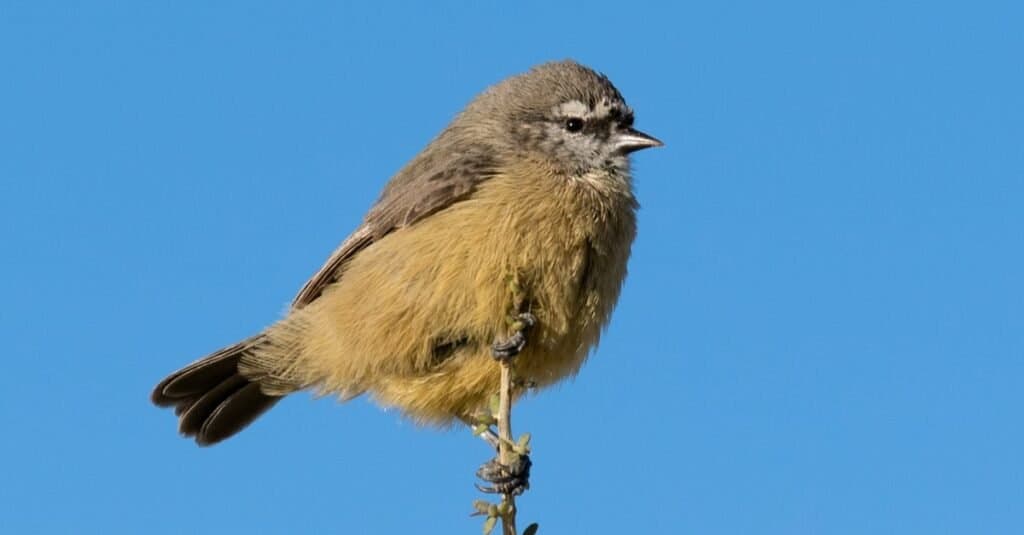
A Cape penduline tit perched on a branch against a blue sky.
©Daniel Danckwerts/Shutterstock.com
The Cape penduline tit (Anthoscopus minutus), also known as the southern penduline tit, is prodigious when compared to the world’s tiniest bird. Grayish-yellow in color, their range extends from the tip of South Africa up into Angola in the east and Zimbabwe in the west. Their habitats are shrubby plains and deserts, where they roost and make their nests in tall and thorny trees. Their nests are particularly ingenious, as they have an entrance hatch that can be pulled shut.
The roughly 3-inch-long Cape penduline tit is unique in that it mates monogamously but gathers into family units of three to four couples to help hatch the eggs and raise the children. Their diet consists of fruits, larvae, and insects. They are known to raid meals from spiderwebs, a dangerous undertaking given that spiders are often of similar size.
3. Smallest Bird in Europe: Goldcrest and Firecrest
Average Length: 3.5 inches, Average Weight: .21 ounces
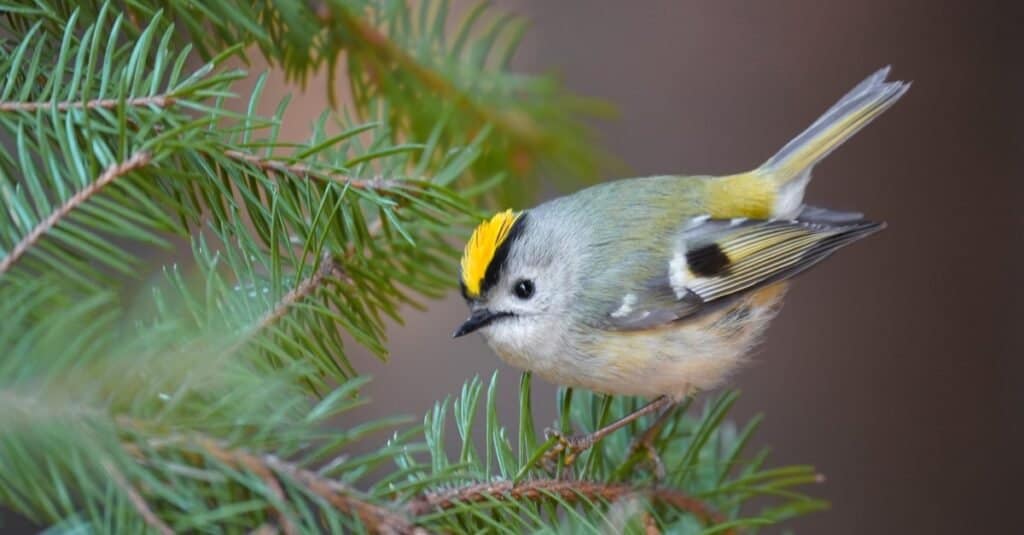
The smallest bird in Europe, the Goldcrest, Regulus regulus, or golden-crested kinglet.
©godi photo/Shutterstock.com
The goldcrest (Regulus regulus) and firecrest (Regulus ignicapilla) share the title for the tiniest bird in Europe, and have more than that in common. Both make their homes in coniferous forests but venture out of their isolated habitats in the winter to forage. They dwell throughout the continent, although firecrests tend to be more predominant in Southern Europe and even have habitats throughout North Africa.
Their size may contribute to their success as a species. Goldcrests and firecrests are approximately three and a half inches long and weigh 0.21 ounces. Their small stature allows these birds to fit into spaces that predators would either overlook or be unable to reach. When they do manage to get in the sights of a predator, their agility and small size often make them not worth the effort to pursue. Their eggs are even smaller, measuring half an inch on average.
4. Smallest Bird in North America: Calliope Hummingbird
Average Length: 3.3 inches, Average Weight: .1 ounces
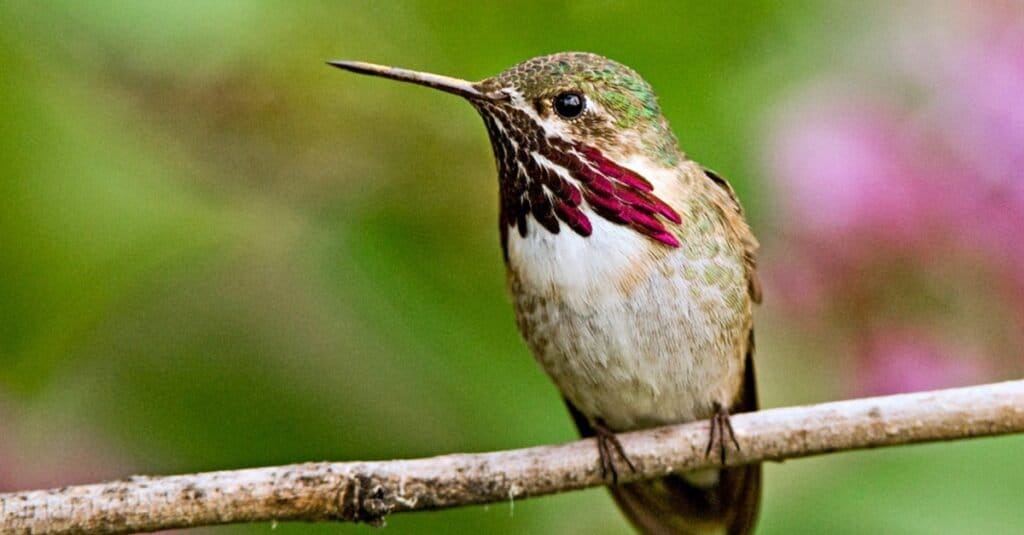
The Calliope Hummingbird is the smallest bird native to the United States and Canada. It has a western breeding range mainly from California to British Columbia.
©MTKhaled mahmud/Shutterstock.com
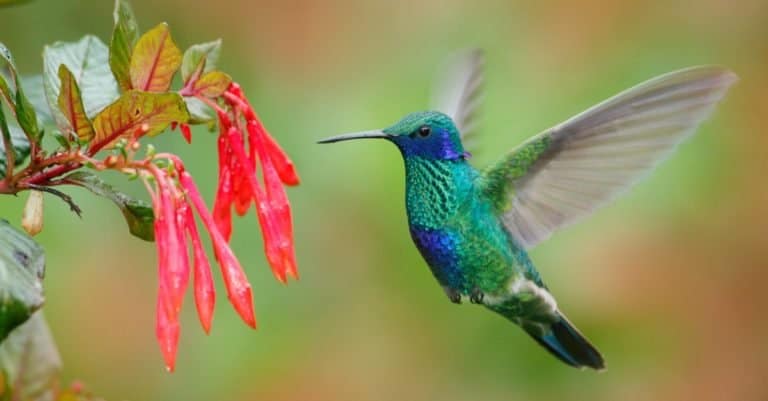
North America’s smallest bird is the calliope hummingbird (Selasphorus calliope). Their flight patterns take them all the way from Canada in the north to Mexico in the south. This elliptical migration pattern covers 5,000 miles, an impressive feat considering that these birds are approximately 3 inches long. They typically fly low, keeping to flowers that would go unnoticed by larger and potentially aggressive hummingbird species.
Calliope hummingbirds can be surprisingly fearless. During mating season, they have been known to chase after large and predatory birds like red-tailed hawks. In addition to being one of the tiniest birds, they are also stunning to look at. Males have a distinct splash of magenta that covers their chin and chest. Males perform their mating dance in a distinct U-shape that distinguishes them from other species of hummingbird.
5. Smallest Bird in South America: Esmeraldas Woodstar
Average Length: 2.5 inches
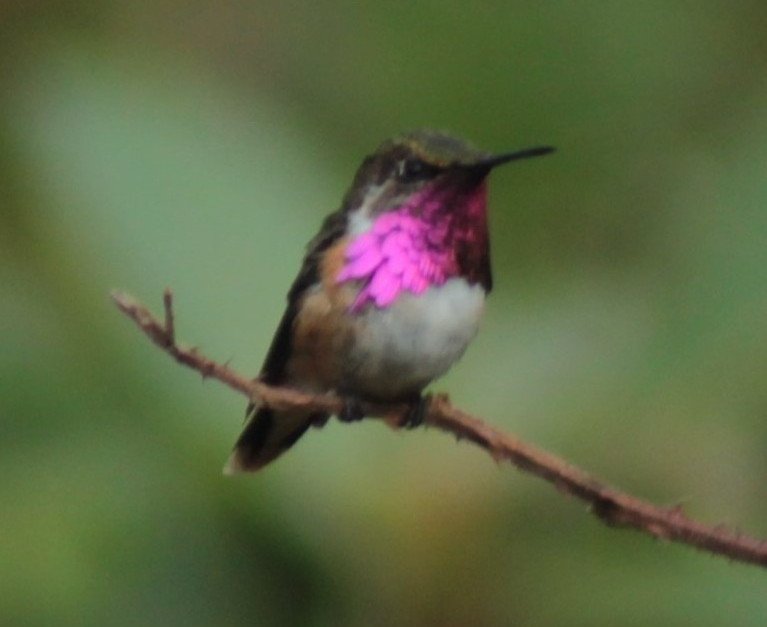
A beautiful Esmeraldas woodstar perched on a branch.
Researchers are still trying to figure out the basic habits of Esmeraldas woodstar (Chaetocercus berlepschi), a highly localized breed of hummingbird, the tiniest in South America. Despite measuring only 2.5 inches in length, males of this species stand out. Males have brilliant purple throats and green markings along their bodies, resembling a tiny vest. These birds can be found in deciduous forests throughout Ecuador, and they prefer wooded areas at higher altitudes.
However, they can be very hard to find in the wild. The species was thought to be extinct from 1912 until it was spotted again in 1990. They are rarely seen outside of breeding season. Where these birds go for the rest of the year remains a mystery for now. Unfortunately, they are classified as Vulnerable by the IUCN, threatened primarily by habitat destruction due to logging
6. Smallest Bird in Australia: Weebill
Average Length: 3.3 inches, Average Weight: .2 ounces
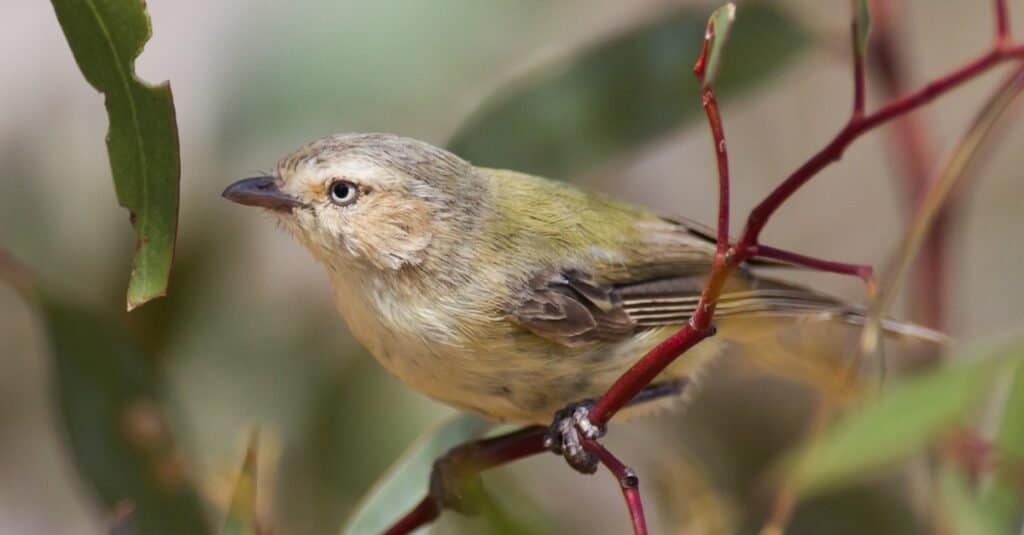
Found in woodlands and forests throughout mainland Australia, the weebill is Australia’s smallest bird.
©Jukka Jantunen/Shutterstock.com
Australia has a reputation for ecosystems occupied by large and deadly animals. However, the petite weebill (Smicrornis brevirostris) is proof that this continent is far more diverse than assumed. Its name is derived from its small size and its cry, which sounds like it is saying I’m a weebill. These cries are loud and can be heard all year long.
While weebills may be restricted to the continent, they have dispersed widely across the landmass, except in particularly harsh sections of the interior. These birds display distinctive plumage that’s a combination of cream and bright yellow, and they tend to make a home and stay there for the rest of their lives. Highly sociable birds, they hunt in flocks that often include other bird species, and mating pairs raise their young together.
7. Smallest Bird in Asia: Pale-Billed Flowerpecker
Average Length: 3.1 inches, Average Weight: .2 ounces
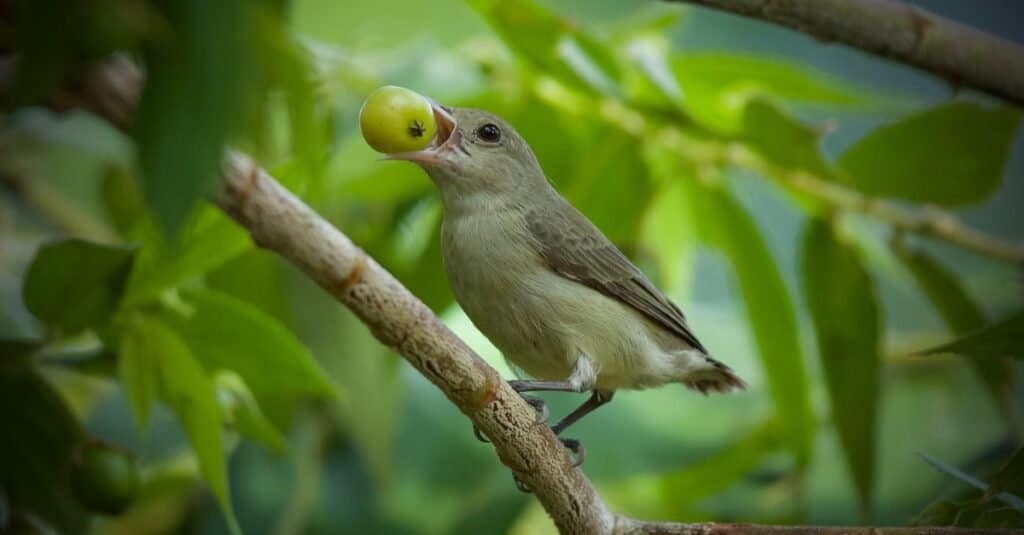
Pale-billed flowerpecker birds are tiny (8cm long and 4-6g in weight).
©VinaySagar/Shutterstock.com
The pale-billed flowerpecker (Dicaeum erythrorhynchos) is largely unremarkable in appearance apart from its size. Found throughout the Indian subcontinent, this bird is a common sight in urban gardens and can be distinguished by its high-pitched singing voice. They are known to poach Singapore cherries from the gardens they forage, though their diet primarily consists of mistletoe species.
Pale-billed flowerpeckers have developed highly efficient digestive systems designed to help them handle toxic mistletoe. The seed of the mistletoe berry passes through the body in three to four minutes and develops a coating that allows it to stick to trees. Mistletoe is a parasite that leaches nutrients from the trees it clings to, but it also serves a vital role in enriching the soil in the surrounding environments. This makes the pale-billed flowerpecker a crucial member of the ecosystem.
8. Smallest Bird in Antarctica: Wilson’s Storm Petrel
Average Length: 6.8 inches, Average Weight: 1.4 ounces
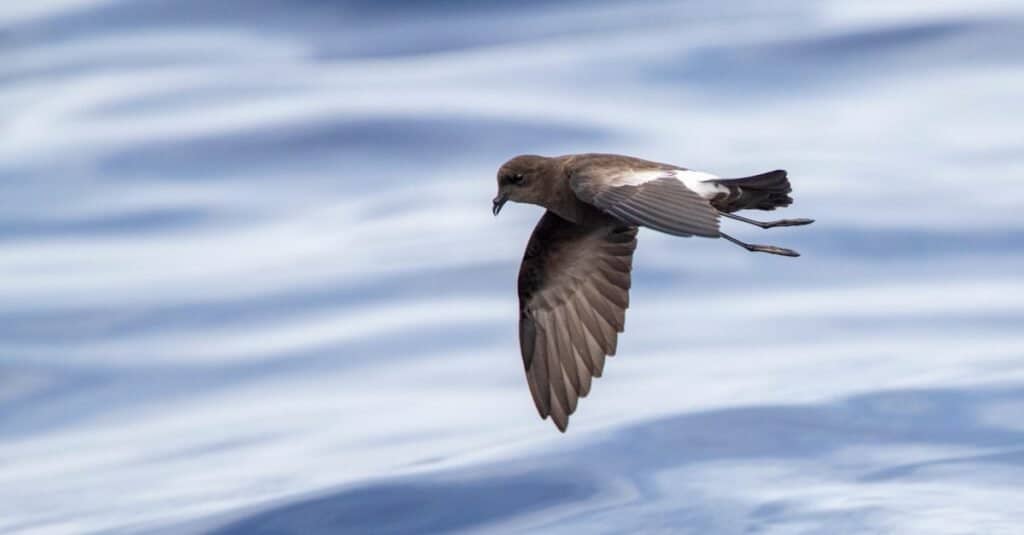
Wilson’s Storm Petrel in flight over the Atlantic Ocean surface off Madeira.
©Agami Photo Agency/Shutterstock.com
Wilson’s storm petrel (Oceanites oceanicus) is significantly larger than the tiniest birds from other continents. The fact that they manage to breed at all in this harsh environment is a testament to their resolve. They compensate for their small size by soaring through the troughs of waves, allowing them to migrate long distances despite their relatively weak capacity for flight.
Wilson’s storm petrel’s travel patterns take them down the Atlantic, and they can be seen from the United States’ east coast down to the most southern reaches of South America. Feeding primarily on crustaceans and small fish, this bird will simply hover over the waters and peck at the surface until it manages to catch some prey.