
Quick Take
- One North American swallow has completely abandoned its natural nesting instincts east of the Rockies, a shift that traces back to an ancient human practice. Purple martin nesting habits →
- One species spends its winters farther north than any other American swallow, bucking the migration pattern you would expect. Tree swallow winter range →
- Despite dramatically expanding its range over decades, one of the most familiar swallows is now quietly disappearing from North America. Barn swallow population decline →
- North America's smallest and largest swallows are separated by more than just size. Their relationships with humans couldn't be more different. North America's smallest swallow →
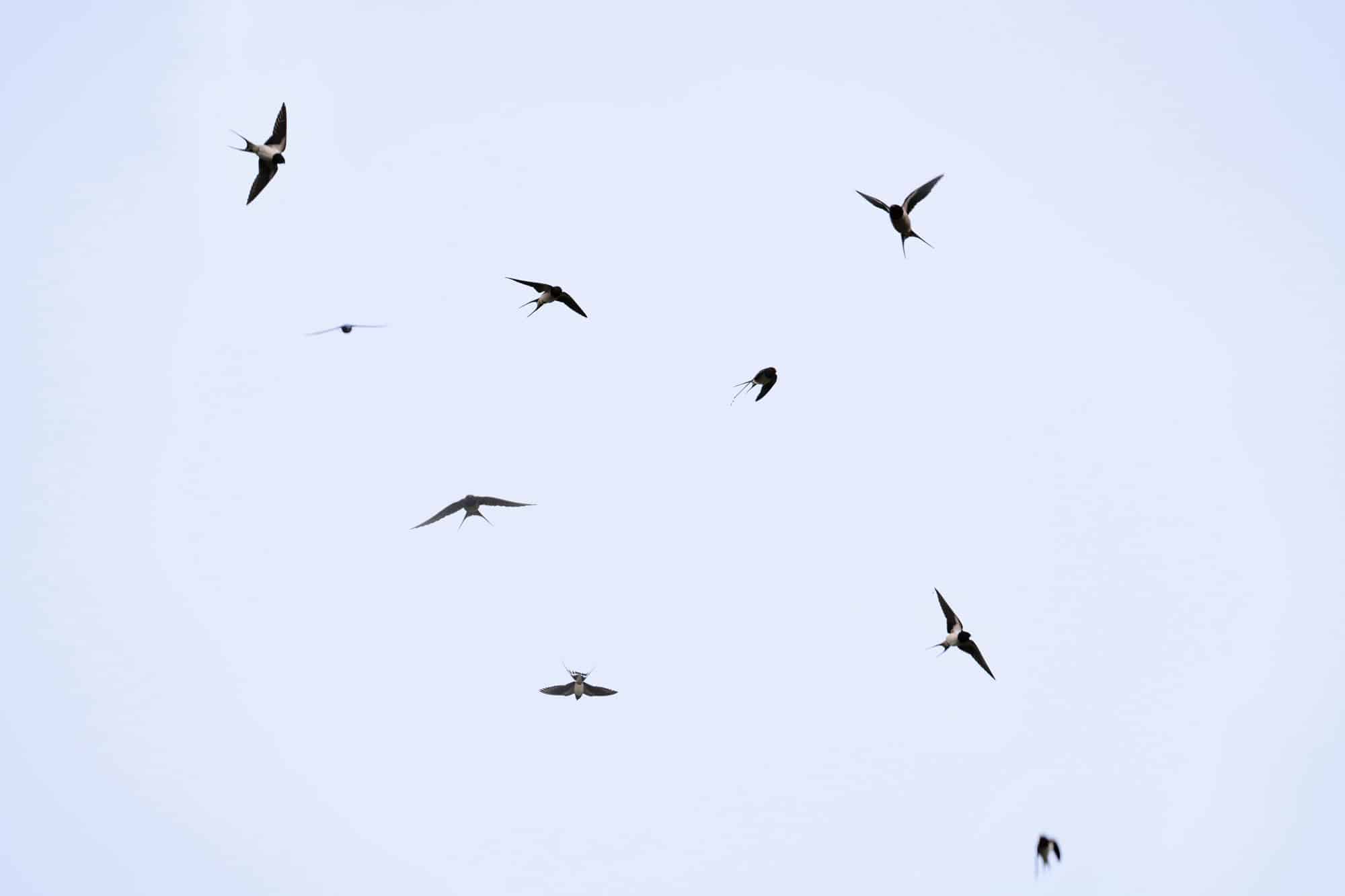
Swallows are exceptionally agile songbirds that can fly and soar for hours while chasing tiny insects. Nearly all swallows are aerial insectivores, meaning their primary method of hunting is catching flying insects in mid-air. Most swallows are gregarious and frequently flock on wires along highways when they aren’t flying. Adored by birdwatchers, swallows are also known to nest close to humans. Swallows belong to the family Hirundinidae, which includes swallows, martins, and saw-wings. Saw-wings are native to Sub-Saharan Africa. There are between 80 and 90 different species of swallows worldwide, and eight species that regularly occur or breed in North America. Continue reading to learn more about North American swallows.
Cliff Swallow
The cliff swallow (Petrochelidon pyrrhonota) is a highly sociable, migratory songbird recognized by its square-tipped tail, pale orange rump, chestnut throat, and white-to-cream forehead patch. It feeds aerially on a wide variety of flying insects.
Known to nest in colonies on vertical cliff faces and rock bluffs, the species has dramatically expanded its range and can frequently be found nesting under highway bridges, overpasses, and building eaves. The cliff swallow has an expansive breeding distribution across North America. During spring and summer, its range stretches from the subarctic regions of Alaska and Canada south into Central Mexico.
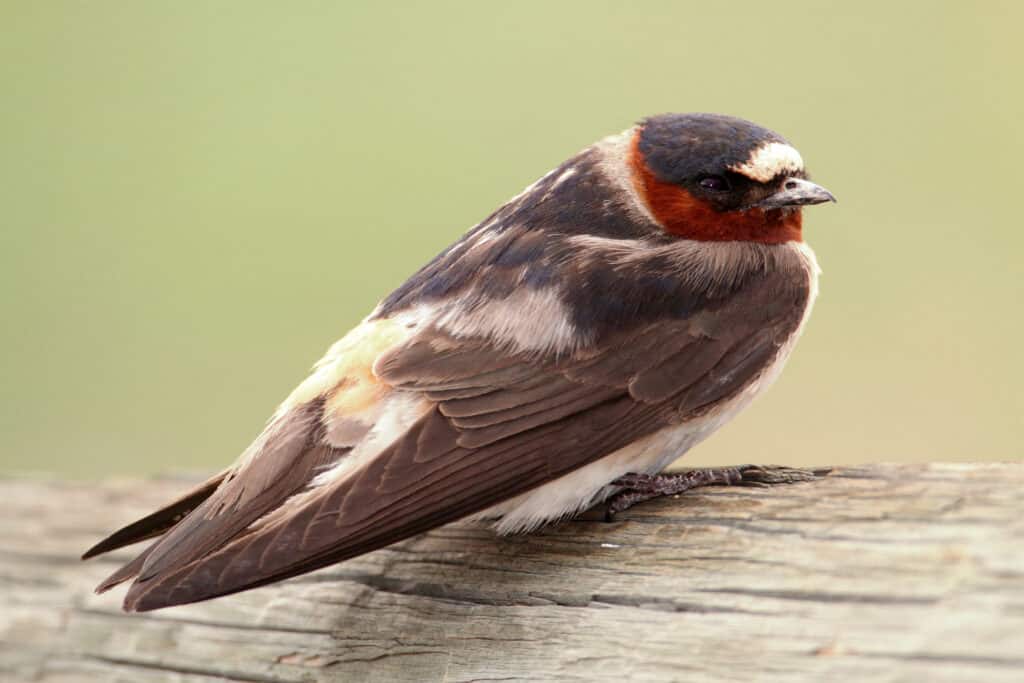
Cliff Swallows appear brown in low light, with dark necks and white bellies.
©iStock.com/SteveByland
There are four subspecies of cliff swallow: the Northern cliff swallow, the Mexican cliff swallow, the lesser cliff swallow, and Ganier’s cliff swallow, which is sometimes referred to as the West-Central cliff swallow.
Purple Martin
The purple martin (Progne subis) is the largest swallow species in North America, measuring approximately 7.5 to 8.5 inches in length with a wingspan ranging from 15 to 17 inches. Distributed widely across the continent during the breeding season, they range from Eastern Canada and the Great Plains down to the Gulf Coast, as well as localized populations along the Pacific Coast and parts of the Southwest.
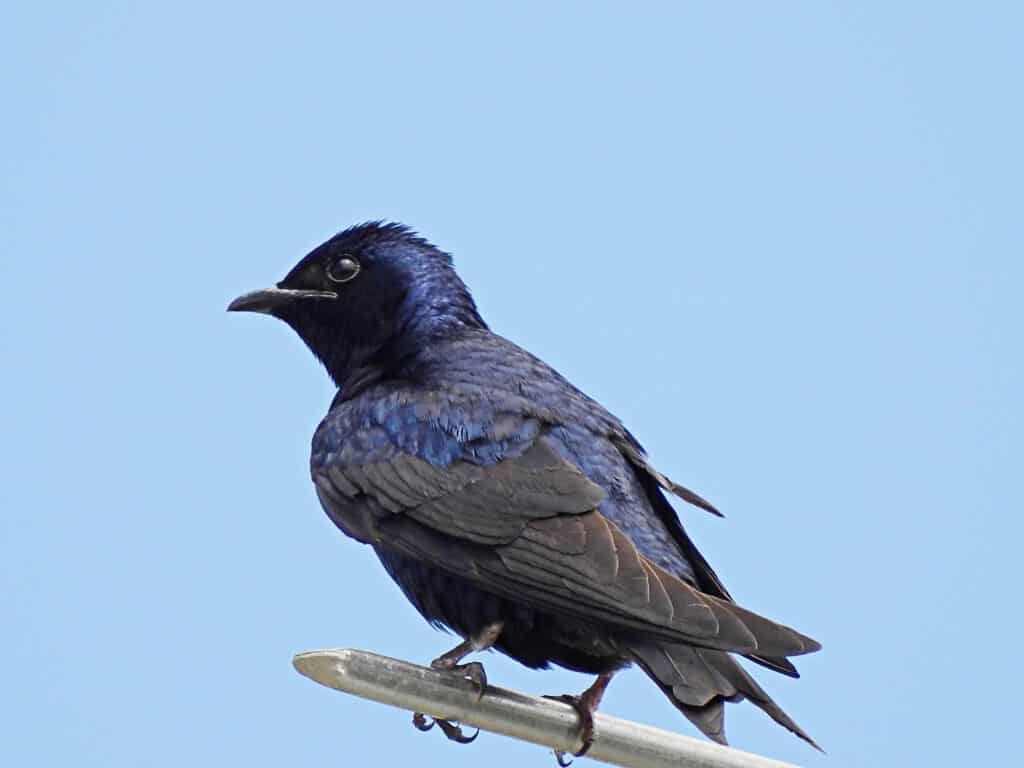
The purple martin, one of the largest swallow species, performs aerial tricks to catch flying insects.
©iStock.com/passion4nature
East of the Rocky Mountains, purple martins rely on multi-compartment houses and specialized gourds provided by humans for nesting. Historically, purple martins nested in dead trees and abandoned woodpecker holes.
However, Indigenous Americans began hanging hollowed-out gourds in their villages to attract martins. The birds acted as natural alarms and insect controllers, while human activity kept the birds safe from predators. Over generations, the Eastern population completely adapted its behavior, choosing human structures over natural cavities.
Cave Swallow
The cave swallow (Petrochelidon fulva) measures approximately 5.5 inches in length with a wingspan of about 13 inches. In North America, its breeding distribution is primarily concentrated in the Southwestern United States, specifically Texas and southeastern New Mexico, as well as a localized population in Southern Florida.
Its range extends farther south into Mexico and parts of the Caribbean. True to its name, the cave swallow historically utilized natural caves and sinkholes for nesting, although it has increasingly adapted to modern environments by building its mud-and-guano cup nests under highway bridges and concrete culverts.
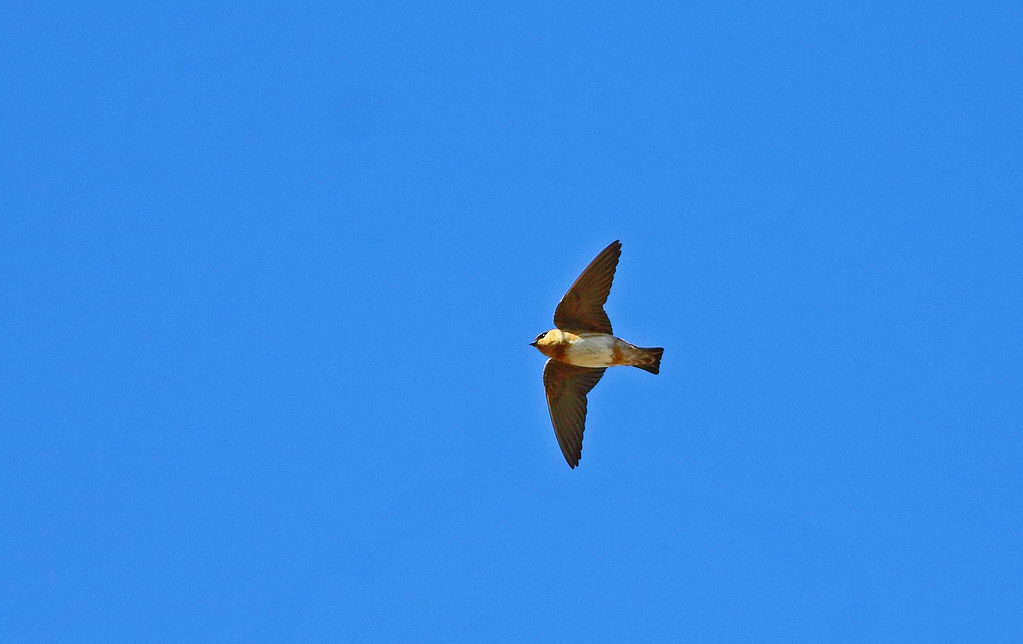
White eggs from cave swallows have subtle brown and purple spots on them.
©Gergo Nagy/Shutterstock.com
There are currently six distinct subspecies of cave swallows: the Texas cave swallow, the Yucatan cave swallow, the Cuban cave swallow, the Hispaniolan cave swallow, the Jamaican cave swallow, and the Puerto Rican cave swallow.
Tree Swallow
The tree swallow (Tachycineta bicolor) measures approximately 4.7 to 5.9 inches in length with a wingspan of 11.8 to 13.8 inches. It is widely distributed across North America, breeding extensively throughout Canada and the Northern and Central United States, as far north as Alaska, and overwintering along the Southern Coast of the U.S., Mexico, Central America, and the Caribbean.
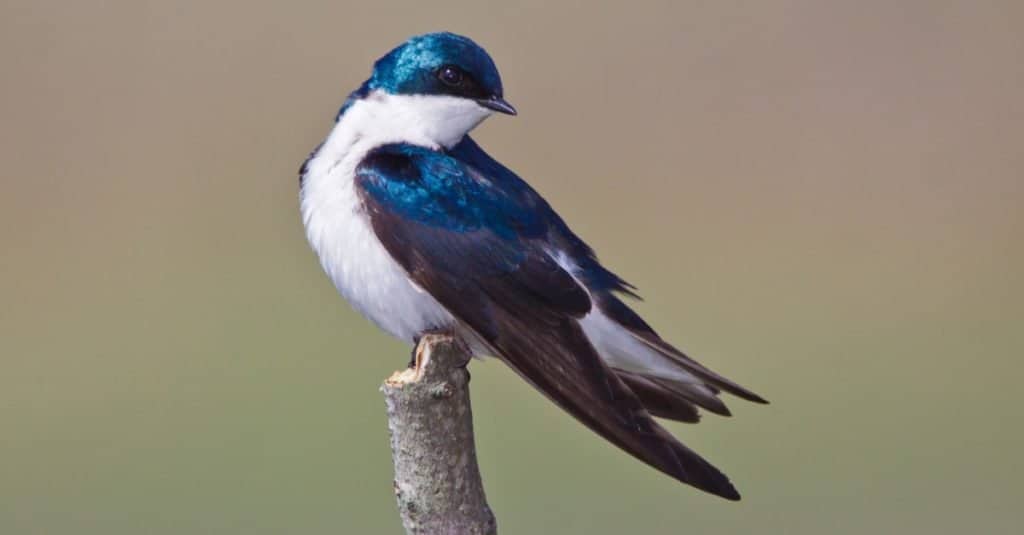
Tree swallows spend their winters farther north than any other swallow in America, and they migrate to their nesting areas much earlier than other swallows.
©Elliotte Rusty Harold/Shutterstock.com
Violet-Green Swallow
The violet-green swallow (Tachycineta thalassina) is a small, acrobatic aerial insectivore measuring about 4.7 to 5.5 inches in length with a wingspan of roughly 10.6 to 13.5 inches.
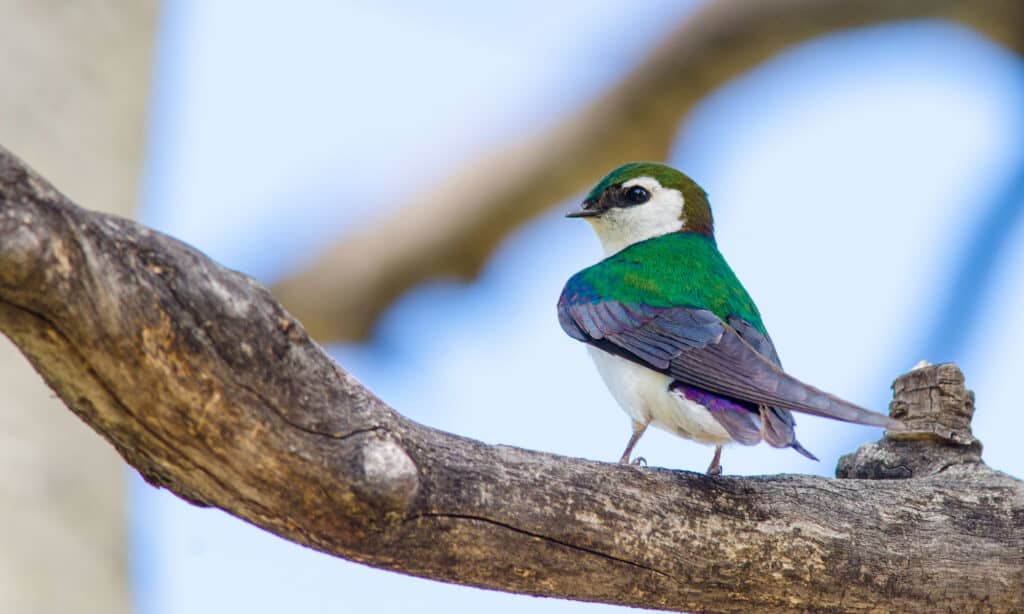
Violet-green swallows frequently forage for flying insects in lakes and streams.
©iStock.com/spates
Distributed widely across Western North America, its breeding range extends from central Alaska and western Canada down through the western United States to the highlands of Mexico, before it migrates to winter in Mexico and Northern Central America.
The violet-green swallow is divided into two recognized subspecies: the widespread, migratory nominate subspecies Tachycineta thalassina thalassina and the smaller, short-winged T. t. brachyptera found in Northwestern Mexico.
Barn Swallow
The barn swallow (Hirundo rustica) measures between 5.7 and 7.8 inches in length (including its elongated tail streamers) with a wingspan of about 12.5 to 13.6 inches.
It is widely distributed across North America, breeding abundantly from Southern Alaska and Canada down through much of Mexico. Barn swallows, as their name suggests, use human-made structures like barns and bridges for nesting.
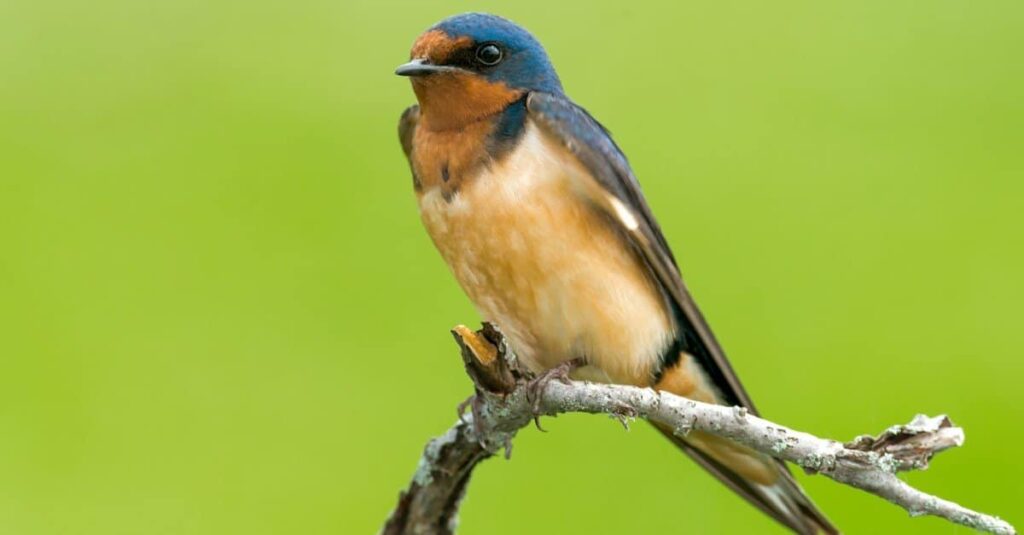
Despite their massive historical expansion, barn swallows are currently experiencing population declines in North America, particularly in the northeast, due to factors such as widespread insect loss, modern agricultural practices, and reduced availability of nesting sites.
©Paul Reeves Photography/Shutterstock.com
Of the eight recognized subspecies of barn swallows, only one, the American barn swallow (Hirundo rustica erythrogaster), is present in North America.
Northern Rough-winged Swallow
The Northern rough-winged swallow (Stelgidopteryx serripennis) measures approximately 5.1 to 5.9 inches in length with a wingspan of 11 to 12 inches.
Widely distributed across North America, the Northern rough-winged swallow breeds from Southeastern Alaska and across Southern Canada down through much of the United States, extending south into Mexico and Central America before wintering primarily from the Southern U.S. to Panama.
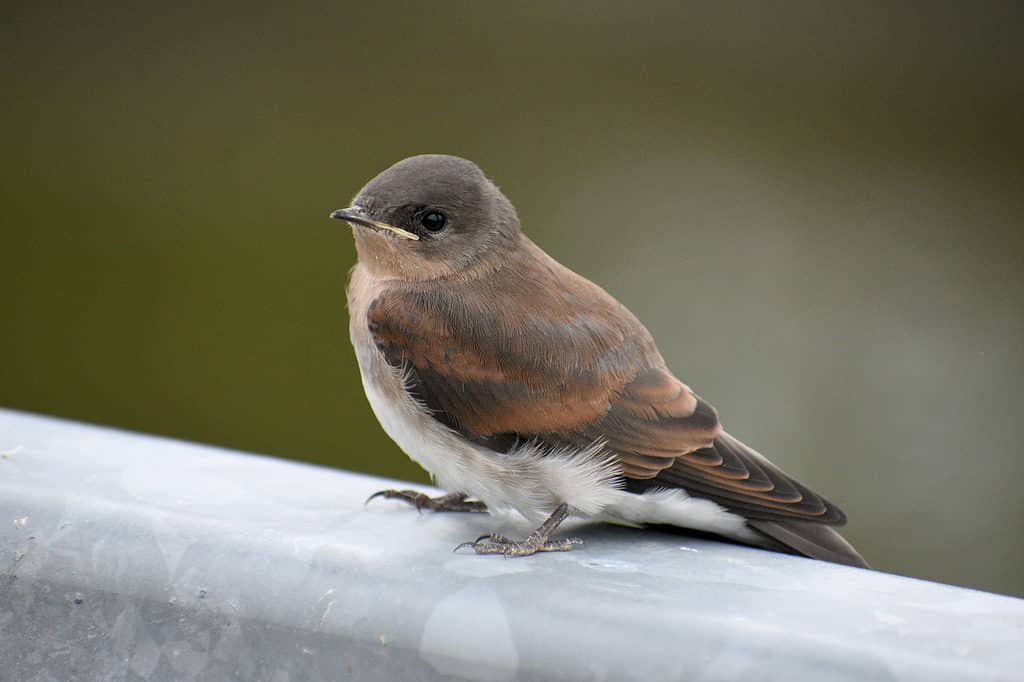
The Northern rough-winged swallow makes its home in abandoned burrows dug by other animals.
©Bird_Nerd45/Shutterstock.com
Six subspecies of rough-winged swallows are currently recognized: the Northern rough-winged swallow, the Southwestern rough-winged swallow, the fulvous-throated rough-winged swallow, Ridgway’s rough-winged swallow, Burleigh’s rough-winged swallow, and Stuart’s Northern rough-winged swallow.
Bank Swallow
The bank swallow (Riparia riparia) is North America’s smallest swallow species, measuring 4.7 to 5.5 inches in length with a wingspan of 9.8 to 13 inches. Widely distributed across the continent during the summer breeding season, it ranges from Alaska and across nearly all of Canada southward through much of the United States, preferring earthen banks near water or rock quarries to excavate its nesting burrows.
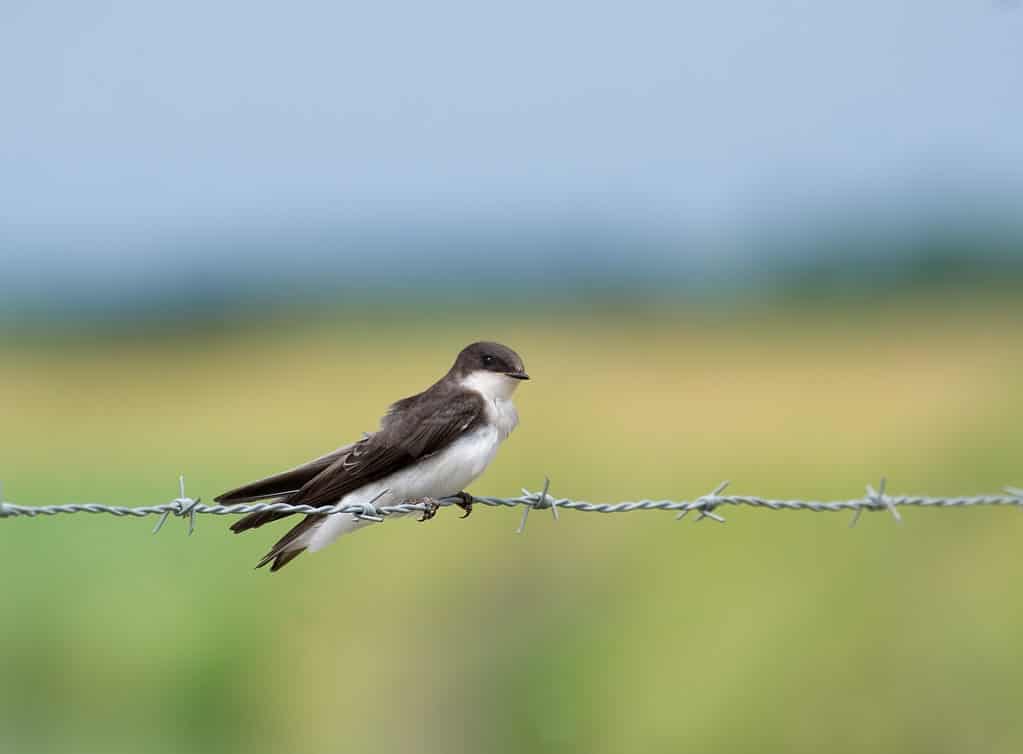
The bank swallow is also known as the sand martin.
©Charles Brutlag/Shutterstock.com
Of the three or four recognized subspecies of bank swallows globally, only one, Riparia riparia riparia is found in North America.