
Quick Take
- Roosters don't mate the way most people assume, and their anatomy makes the process surprisingly unlike any other common farm animal. See the mating process →
- Hens aren't passive in choosing a mate. They follow a strict hierarchy that has nothing to do with which rooster tries the hardest. Understand hen mate selection →
- You can tell whether an egg is fertilized without cracking it open, and doing so requires nothing more than a dark room. Try candling an egg →
Most of us have eaten eggs, but have you ever wondered about how chicken reproduction works? Or how some eggs become table fare and others become chickens? Of course, fertilization makes the difference, but there are several interesting steps in the chicken reproductive process that come before fertilization. Learn how hens choose mates, how roosters court hens, how chickens mate, and how eggs are fertilized, formed, and laid.
Understanding Chicken Reproduction
Usually, chicken reproduction and fertilization are a result of natural mating. However, sometimes artificial insemination can be used. The mating process is a series of behaviors, including the rooster initiating mating through courtship behaviors. Chickens are polygynous, but some males and females will never mate. One rooster can mate 10 to 30 times per day, depending on how many hens are available and how many other roosters are around. Learn more about how hens choose a mate, courtship, and the reproductive process in the following sections.
How Do Hens Choose Mates?
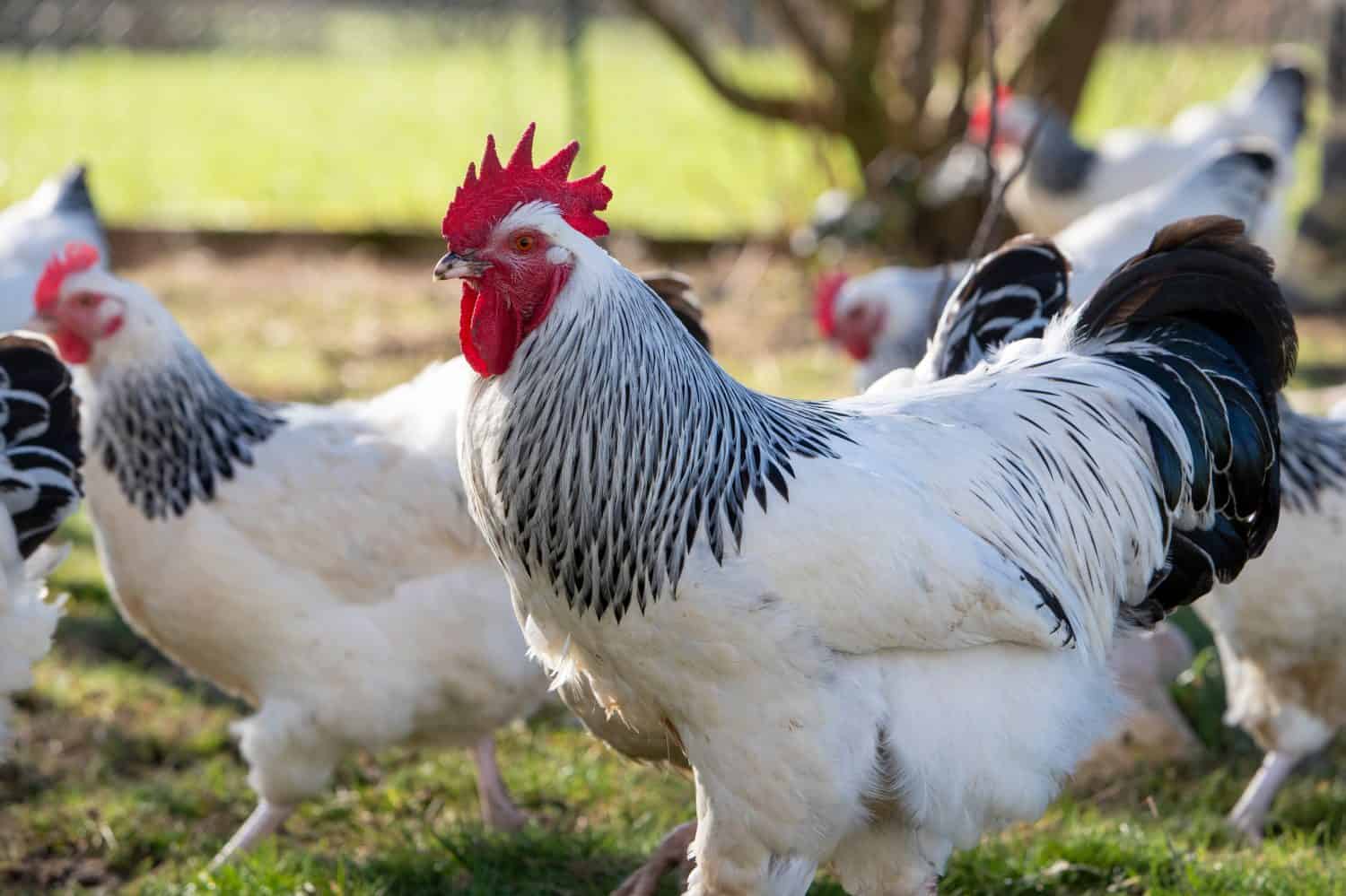
Hormones drive chicken reproduction, and these hormone levels increase as more daylight becomes available. Therefore, hens will look for roosters during daylight hours. Mating activity tends to peak during the early morning and again in the late afternoon, following the flock’s natural diurnal pattern. Female chickens will consider the alpha rooster first when looking to reproduce, as they want the best genes for their chicks. There will always be one alpha rooster in the flock. He will be the biggest and have the best feathers. Also, his wattle and comb will be the brightest red. He will be the best protector and provider for the flock.
However, younger males will compete for the alpha role, and if a male is successful, he will remain in that position until another younger male defeats him. As mating season approaches, the roosters go into overdrive and become obsessed with mating. In the wild, chickens need to survive, and the more offspring a rooster can provide, the better the chance the flock has of surviving.
Courtship
When trying to impress a female, the rooster will begin tidbitting, which is when he finds something nice to eat and calls a hen over to have a look. He will keep picking up and dropping the food so that she can come to see it. He may also use specific vocalizations to call a hen over. If the female approves of his offering, she will eat it. Roosters also fluff their feathers and preen, as well as bob their heads to show off their combs and wattles.
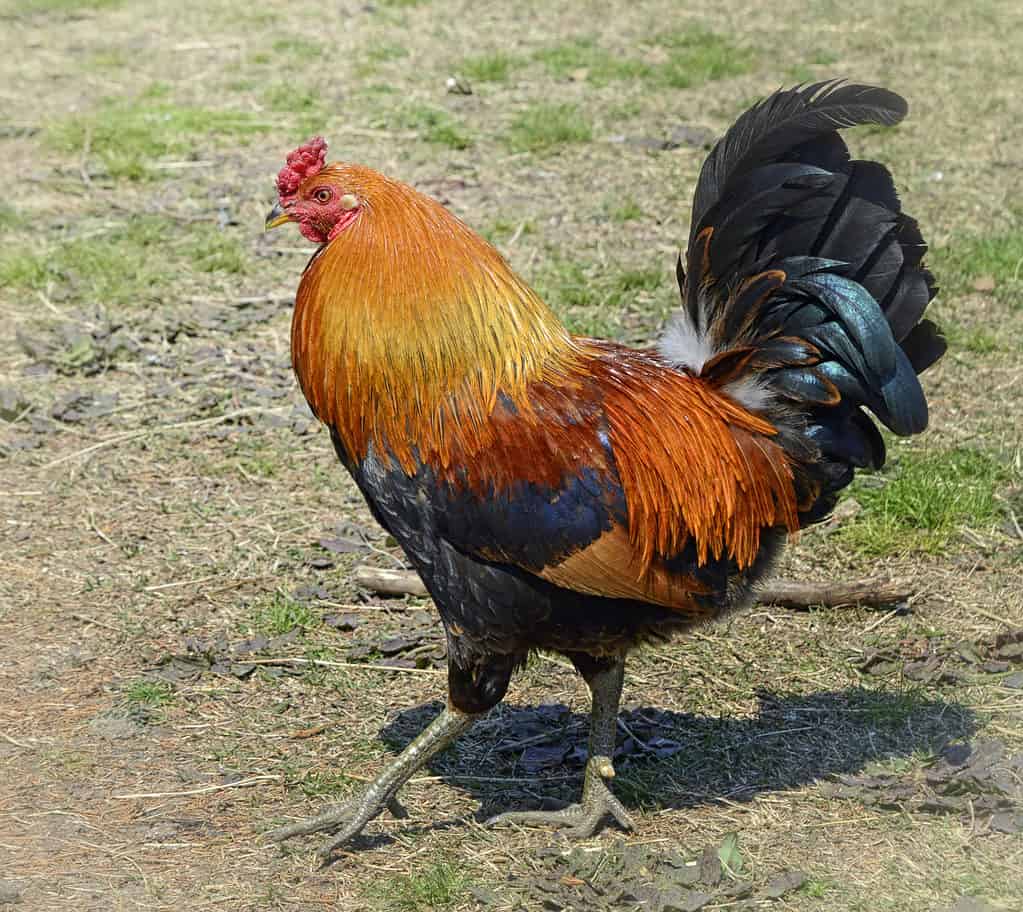
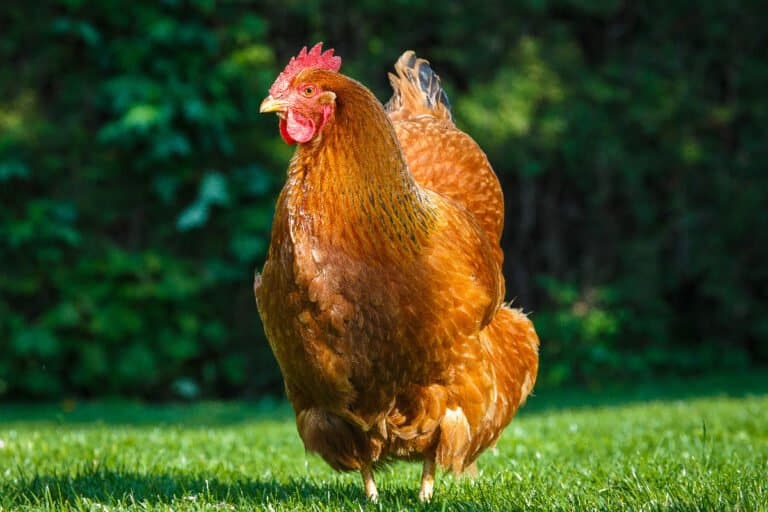
Female chickens consider the alpha rooster first as a mate, as they want the best genes for their chicks.
©iStock.com/Lois_McCleary
When a rooster has chosen a hen, he will do a little dance around her to show her that he is interested. The rooster often raises and lowers one wing to the ground as he dances in a circle. Sometimes he will be rejected several times before he finds an interested female. Once he has begun courting a hen, he will continue until she accepts him. During mating season, roosters may fight several times to secure a willing female.
How Chickens Reproduce
Chicken reproduction is a competitive process. Hens will only mate when they are good and ready, regardless of the amount of dancing and noise from the roosters. Also, some hens never submit to a rooster. However, when a hen is ready, she will go into a squatting position to signal to the rooster that she is submissive. She will also hold out her wings slightly, and her head and body will be closer to the ground. She will do this because it helps the rooster to maintain his balance while he is on top of her.
A rooster does not have a penis, so chicken reproduction is different from many other species. Rather they have a small bump called a papilla that is found inside his cloaca. Therefore, the rooster cannot penetrate the hen, so he gives her what is known as a cloacal kiss. Once he is on top of her, he must make sure that he is in the correct position so that their cloacas can touch. To do this, the female will lean forward while he leans backward. When their cloacae touch, he will deliver his sperm to the hen’s cloaca, which has turned outward to receive it. This whole process normally takes less than 30 seconds. Afterward, he will walk away, and she will continue whatever she was doing before.
The Process of Fertilization and Egg Formation
A hen is born with two ovaries, but the right one normally atrophies and dies, so the left ovary will carry all the eggs she will lay. The hen’s ovary has multiple egg follicles, including the ripening egg. When the egg is ready, it is released into the infundibulum of the oviduct, where it will start its descent. Then, sperm from the rooster is deposited in the hen’s cloacal area and moves to her vagina, where it is stored in “pockets” in the oviduct wall.
The rooster’s sperm is viable for 10 to 14 days, but it is best when it is fresh. Sperm that reaches the infundibulum will fertilize the egg. A hen’s oviduct is about 25 to 27 inches, so the sperm travels about 24 to 26 inches to reach the infundibulum. Once there, it will deliver the genetic code to the germinal disc of the egg.
When the DNA from the rooster reaches the germinal disc, it will fuse and become a fertilized egg called a zygote. Then, it takes about 5 hours for cell division to start, and the resulting structure is called an embryo or blastoderm. After cell division and expansion, the fertilized egg will go through all the stages needed to become an egg. These stages include:
- Laying down albumin
- Building the shell
- Applying the bloom

It can take up to a week for the chicken to lay the first fertilized eggs.
©Tsekhmister/Shutterstock.com
Egg Laying and Incubation
After mating, it can take between 27 hours and seven days for the first fertilized egg to be laid. The eggs will leave the hen via an orifice called the vent. There are two ways to determine whether an egg is fertilized. The first is to crack the egg open and look at the yolk. An unfertilized egg will have a small white spot called the germinal spot.
A fertilized egg will have larger germinal spots that appear as a circle with a white outline. However, if you want to know before you break the egg, you can candle the egg. Candling will let you see inside the egg without breaking it. This can be done by using a flashlight in a dark room after the egg has been incubated for 7 to 10 days.
If you hold up the egg to the flashlight and see a dark web inside, the egg is fertilized. However, if there is no structure inside the egg, it is not fertilized. An egg can be laid whether it has been fertilized or not. However, only fertilized eggs will result in chicks.
How Often Do Hens Lay Eggs?
If the hen is interested in being a mother, she will nest in a dark and quiet place. Also, she will start storing her eggs until she has enough to start incubating them. A hen will lay one egg per day until she has about 12, also known as a clutch. In wild fowl, if her eggs are taken away each day, she will continue to lay eggs to reach 12; however, modern domestic hens are bred for continuous laying and may not follow this same pattern. Once she has laid an egg, she will leave her nest, and the embryo will cool down, suspending its development.
However, as long as the temperature of the nest is warm enough, the embryo can survive for up to two weeks until she has managed to lay a full clutch. Once she has her full clutch, she will start brooding. If she is not broody, she will not sit on the eggs long enough. Brooding involves sitting on her eggs for three weeks to develop the embryos. In doing this, all the eggs will hatch at the same time.
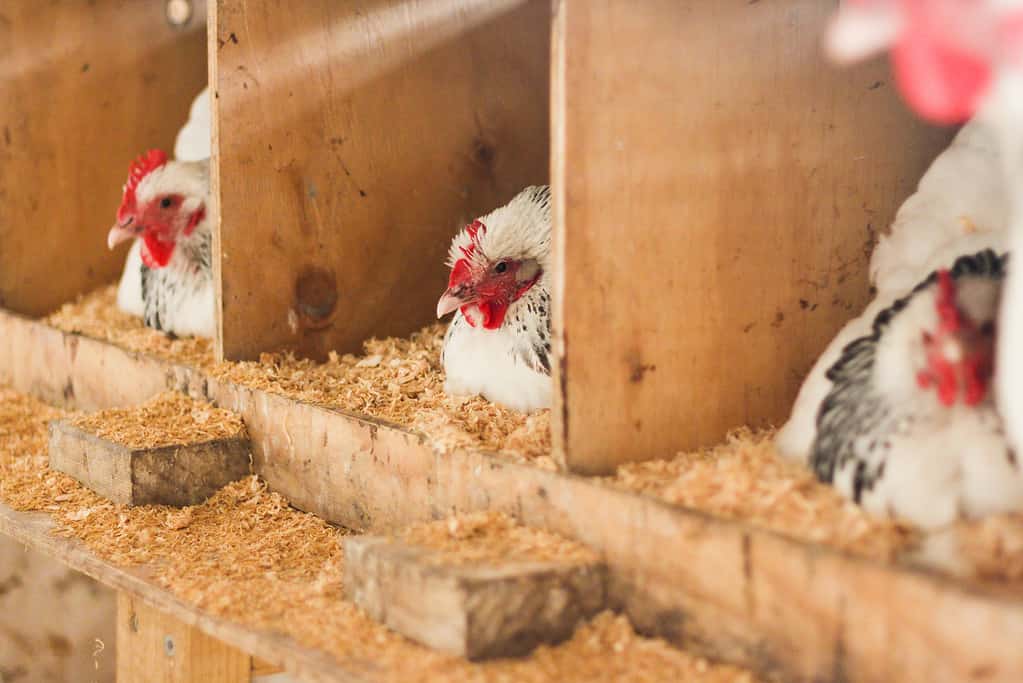
A hen will lay one egg per day until she has 12, also known as a clutch.
©iStock.com/nedjelly