


R
Species Profile

Rooster

Gallus gallus domesticus

Rooster: the dawn herald of the flock
Dep Converse/Shutterstock.com

Rooster Distribution

Click a location to explore more animals from that region

Origin Location

This map shows the native origin of the Rooster. As a domesticated species, they are now found worldwide.

Loading map...

Size Comparison

Human 5'8"
Rooster 1 ft 8 in

Rooster stands at 29% of average human height.

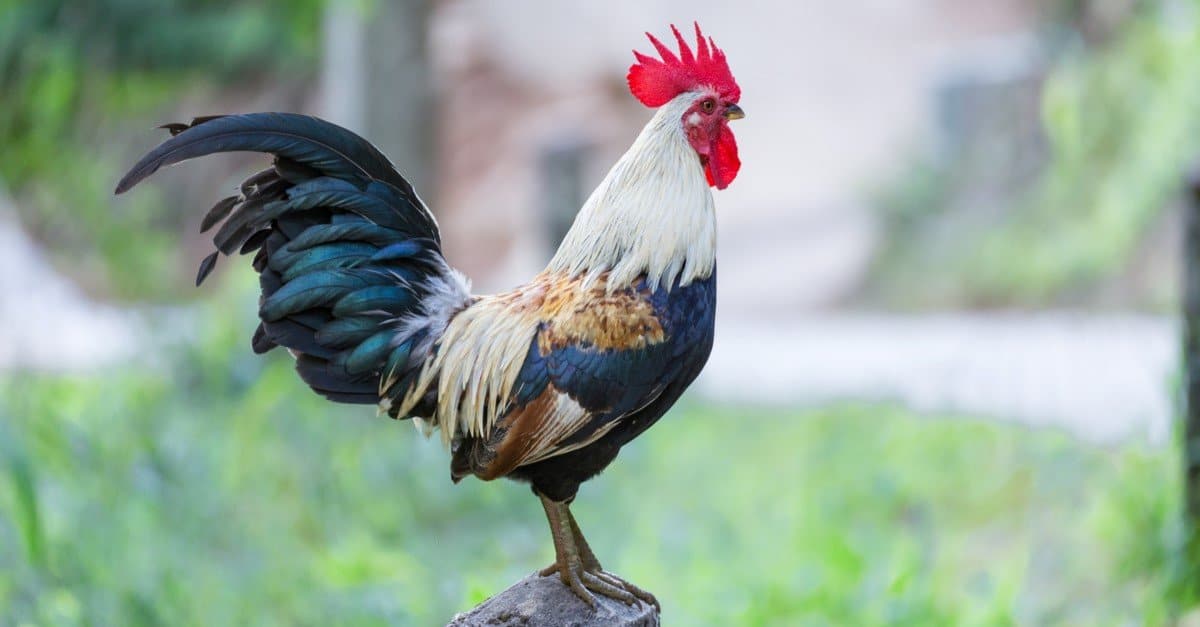
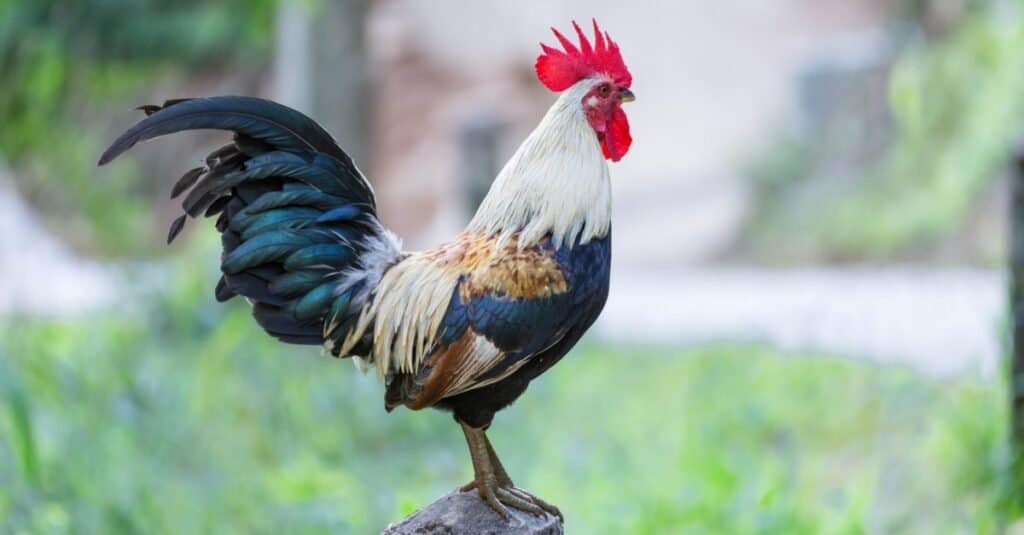
Rooster standing on a pole and crowing.

At a Glance

Domesticated
Also Known As fowl, domestic fowl, poultry, chook, biddy, yardbird, cock, hen
Diet Omnivore
Activity Diurnal+
Lifespan 2 years
Weight 6 lbs
Status Not Evaluated
Did You Know?

Roosters are adult male chickens (not a separate species); hens are adult females, and "cockerel" is a young male.

Scientific Classification

A rooster is an adult male domestic chicken. Domestic chickens are widespread human-associated birds kept for eggs, meat, and other uses; roosters are characterized by male secondary sexual traits and reproductive role in flocks.

Kingdom
Animalia
Phylum
Chordata
Class
Aves
Order
Galliformes
Family
Phasianidae
Genus
Gallus
Species
gallus

Distinguishing Features

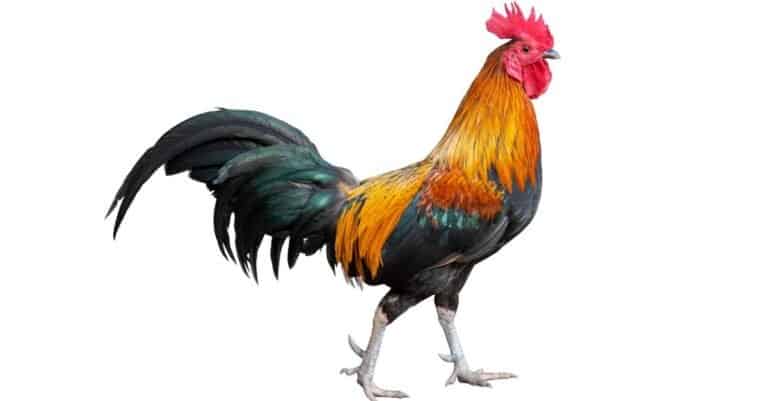
  • Prominent comb and wattles (often larger than in hens)
  • Long, curved sickle tail feathers and pointed hackle/saddle feathers
  • Typically larger body size and more conspicuous plumage than females
  • Crow vocalization and territorial/sexual display behaviors

Physical Measurements

Males and females differ in size

Height
1 ft 10 in (1 ft 6 in – 2 ft 4 in)
1 ft 4 in (1 ft 2 in – 1 ft 6 in)
Length
2 ft 2 in (1 ft 10 in – 2 ft 6 in)
1 ft 7 in (1 ft 6 in – 1 ft 8 in)
Weight
7 lbs (6 lbs – 9 lbs)
4 lbs (3 lbs – 6 lbs)
Tail Length
11 in (8 in – 1 ft 2 in)
6 in (5 in – 7 in)
Top Speed
9 mph
running

Appearance

Primary Colors
Secondary Colors
Skin Type Feathered integument over most body; bare keratinized comb and wattles; scaly keratin skin on shanks/toes; horny beak; occasional feathered shanks in some breeds.
Distinctive Features
  • 'Rooster' is an adult male domestic chicken (not a separate species); female is a hen.
  • Domesticated form derived primarily from red junglefowl (Gallus gallus); extensive artificial selection produces high morphological variability.
  • Prominent single or other comb forms and paired wattles (size and shape breed- and sex-dependent).
  • Adult males commonly develop long, pointed hackle and saddle feathers and curved 'sickle' tail feathers.
  • Tarsal spurs typically larger in adult males; used in dominance and fighting.
  • Stout, laterally compressed body with short rounded wings; strong legs adapted for scratching and walking.
  • Bill short and robust; feet anisodactyl with strong claws for foraging/scratching.
  • Behavior-linked appearance cues: males often adopt upright posture, elevated tail carriage; crowing accompanies territorial display.
  • Plumage and bare-skin coloration (comb/wattle) can be influenced by hormones, health, and genetics; strong variation across breeds.

Sexual Dimorphism

Marked sexual dimorphism: adult males (roosters) usually have larger combs/wattles, longer hackle/saddle and sickle tail feathers, and larger spurs with brighter, more contrasting plumage. Females (hens) are typically smaller with shorter, rounder plumage and reduced spurs.

  • Larger, more brightly colored comb and wattles (often taller and more turgid).
  • Long pointed hackle and saddle feathers; elongated neck 'cape' appearance.
  • Curved sickle tail feathers; tail often higher and more arched.
  • More prominent tarsal spurs; thicker shanks in many strains.
  • More contrasting/iridescent plumage in many varieties (e.g., red/gold with black-green sheen).
  • Smaller comb and wattles; typically less developed and less upright.
  • Shorter, rounder neck and saddle feathers; no long sickle tail feathers.
  • Tail shorter and less arched; overall silhouette more compact.
  • Spurs usually absent or small rudiments compared with males.
  • Plumage often more cryptic or uniform within many strains, though highly variable by breed.

Did You Know?

Roosters are adult male chickens (not a separate species); hens are adult females, and "cockerel" is a young male.

Domestic chickens have 2n = 78 chromosomes, a count typical for many bird species.

Embryonic development is tightly timed: standard incubation is ~21 days (hatch typically day 21).

A hen can store sperm in specialized oviduct tubules and continue laying fertilized eggs for roughly 2-3+ weeks after a single mating (duration varies).

Chicken vision is tetrachromatic and includes ultraviolet sensitivity, expanding what they can see compared with humans.

Rooster crowing can be very loud; measurements commonly report peak levels on the order of ~90 dB at ~1 m (study methods vary).

Natural social life centers on a stable "pecking order," a term coined from early poultry behavior studies.

Unique Adaptations

  • Comb and wattles act as heat exchangers: richly vascularized skin structures help shed heat; size and redness also signal sexual condition and health.
  • Powerful gizzard: swallowed grit plus strong musculature mechanically grinds food-an adaptation for processing hard seeds and varied farmyard diets.
  • Crop storage: an expandable esophageal pouch allows rapid foraging and later digestion-useful when food access is intermittent.
  • Hard-shelled amniotic egg: enables laying on land; typical incubation is ~21 days, with chicks hatching precocial (mobile and downy).
  • Sperm storage tubules in hens: allow fertilization over multiple eggs from one mating, supporting flock breeding when mating is infrequent.
  • Tight, maneuverable flight bursts: although not long-distance fliers, chickens retain strong pectoral muscles for short flights to roost or escape.
  • Sexual dimorphism in roosters: enlarged comb/wattles, iridescent hackle and sickle tail feathers, and leg spurs support display and combat in male-male competition.

Interesting Behaviors

  • Crowing and timekeeping: roosters crow at dawn and also throughout the day; crowing functions in territorial advertisement and social signaling among males.
  • Tidbitting courtship: a rooster may pick up and drop food while making rapid vocalizations to attract hens to a food source (a courtship/attention behavior).
  • Alarm calls with context: chickens give distinct calls for aerial vs. ground threats; roosters often lead vigilance and may position themselves between flock and danger.
  • Flock leadership and "herding": roosters commonly guide hens to shelter or food, and may intervene in conflicts to maintain order.
  • Dust bathing: birds work dry soil through feathers to absorb oil and deter ectoparasites; this is a highly motivated, routine maintenance behavior.
  • Broodiness (hen behavior) still appears in many lines: a broody hen persistently sits, plucks breast feathers to form a brood patch, and aggressively defends the nest.
  • Dominance dynamics ("pecking order"): stable rank reduces chronic fighting; newcomers are often challenged until hierarchy re-stabilizes.

Cultural Significance

Domestic chicken (Gallus gallus domesticus) is a common bird kept by people used for eggs, meat, and small farm income. Roosters (adult males) stand for dawn, being watchful, and national symbols, appear in art and festivals, and are tied to cockfighting; they are used for feathers, manure, and weather‑vanes.

Myths & Legends

Greek myth of Alectryon: a youth posted as a lookout for Ares falls asleep; as punishment he is transformed into a rooster destined to announce the sun's return.

Chinese Zodiac lore: the Rooster is one of the twelve zodiac animals, celebrated for punctuality and confidence; folk stories often link its place in the zodiac to the great race that set the calendar order.

Christian tradition: the rooster's crow is tied to the Gospel story in which Peter denies Jesus three times before the cock crows; church "rooster" weather vanes became reminders of vigilance and repentance.

Zoroastrian tradition: the rooster (often called Parodarsh, "foreseeing") is a sacred herald whose crowing drives away darkness and evil influences at dawn.

Japanese myth of Amaterasu: in some tellings of the sun goddess's return from a cave, loud birds (often interpreted as roosters) are used to lure or signal her emergence, restoring light to the world.

Medieval European bestiaries: the cockatrice (a deadly creature said to be born from a rooster's egg hatched by a serpent/toad) appears in legend and heraldic imagination, reflecting the rooster's powerful symbolic charge.

Folk superstition across parts of Europe and the Americas: a rooster crowing at unusual hours (especially at night) is treated in local tradition as an omen-sometimes of visitors, changing weather, or misfortune, depending on region.

Conservation Status

NE Not Evaluated

Has not yet been evaluated against the criteria.

Population Stable

Life Cycle

Birth 10 chicks
Lifespan 2 years

Lifespan

In the Wild
0.5–5 years
In Captivity
3–16 years

Reproduction

Mating System Polygyny
Social Structure Managed Domestic
Breeding Pattern Transient
Fertilization Internal Fertilization
Birth Type Internal_fertilization

In managed flocks a rooster typically services a harem of ~8-12 hens, performing repeated mount-and-cloaca contact copulations (internal fertilization). Hens can store sperm ~2-3 weeks and lay clutches incubated ~21 days; no stable pair bond.

Behavior & Ecology

Social Flock Group: 20
Activity Diurnal, Matutinal, Vespertine
Diet Omnivore Energy-dense grains (especially cracked maize/corn) and highly palatable invertebrates (e.g., mealworm-type larvae)

Temperament

Linear dominance hierarchy ("pecking order") was formally described by Schjelderup-Ebbe (1922).
Individual recognition supports stable hierarchies; chickens can distinguish many conspecifics (reported at least about 100; e.g., Guhl & Ortman, 1953).
Roosters show higher rates of aggression, territoriality, and mate-guarding; intensity varies by breed and density.
Hens vary widely in broodiness/maternal care by breed and selection; broodiness reduced in many commercial lines.
Neophobia is common (hesitation to approach novel objects/foods), but social facilitation increases feeding and exploration.
HUBS: Cohesion via synchronized foraging and dusk roosting; social stability declines with crowding and frequent mixing.
Lifespan (management-dependent): smallholder/pet birds commonly ~5-10 years; commercial birds often culled at ~1-2 years for production.

Communication

Crowing: long-range male advertisement/territorial signal; also occurs in social challenge contexts.
Contact clucks/purrs: low-amplitude cohesion calls during foraging and close-range movement.
Food calls ("tidbitting" context): rooster vocalizes while offering/indicating food to hens.
Egg-laying cackle: loud, repeated calls around/after oviposition.
Distress calls: high-amplitude calls in chicks and adults during restraint or threat.
Alarm calls: context-specific calls for aerial vs. ground threats E.g., Evans & Marler, 1995
Maternal clucks: hen guides chicks; chicks respond with approach/following vocalizations.
Visual dominance displays: hackle raising, upright posture, wing spreading, wattle/head emphasis.
Courtship display: tidbitting (rapid pecking/head bob), circling, wing-droop to attract hens.
Agonistic signaling: staring, lateral threat, charging, jumping/spur use; reduces once ranks stabilize.
Tactile interactions: pecking/sparring; brooding provides prolonged physical contact between hen and chicks.
Spatial/behavioral cues: approach-avoidance patterns and preferred roosting proximity maintain social relationships.

Habitat

Biomes:
Tropical Rainforest Tropical Dry Forest Savanna Mediterranean Temperate Grassland Temperate Forest Temperate Rainforest Boreal Forest (Taiga) Alpine +3
Terrain:
Plains Hilly Plateau Valley Coastal Island Riverine Mountainous +2
Elevation: Up to 14763 ft 9 in

Ecological Role

Human-associated omnivorous ground-forager and opportunistic predator/scavenger in farmyard and free-range agroecosystems.

Invertebrate suppression (consumes pest insects and larvae in gardens/pastures) Weed-seed reduction via granivory Nutrient cycling and soil disturbance through scratching, manure deposition, and incorporation of organic matter Minor seed dispersal when consuming fruits/berries and defecating viable seeds Carrion cleanup when given access to animal remains (opportunistic scavenging behavior)

Diet Details

Main Prey:
Adult insects Insect larvae Earthworms Termites Ants Snails and slugs Small vertebrates +1
Other Foods:
Cereal grains Seeds green plant material Legume seeds Fruit and berries Vegetable matter and garden plants

Human Interaction

Domestication Status

Domesticated

Domestic chicken (Gallus gallus domesticus) is a domesticated form of the red junglefowl (Gallus gallus), with some genes from other Gallus species. Domestication began in South/Southeast Asia and spread quickly by trade and migration to East Asia, the Middle East, Africa, and Europe. People keep chickens for meat, eggs, backyard flocks, culture/religion, shows, pest control, manure, and (sometimes illegal) cockfighting.

Danger Level

Moderate
  • Traumatic injury from rooster aggression (pecking, jumping, spur lacerations); risk increases during breeding season, territorial defense, or if handled incorrectly.
  • Zoonotic enteric pathogens associated with poultry handling and environments (notably Salmonella enterica and Campylobacter spp.); transmission risk is primarily fecal-oral via contaminated hands/surfaces.
  • Respiratory exposure risks from dust/dander in coops (can aggravate asthma/allergies; contributes to "poultry worker" respiratory symptoms in high-exposure settings).
  • Avian influenza and other poultry diseases: human infection is uncommon in backyard settings but becomes a higher biosecurity concern during outbreaks and in occupational exposure.

As a Pet

Suitable as Pet

Legality: Generally legal to keep domestic chickens in many areas, but rules are local and commonly restrict flock size, require permits, or prohibit roosters due to noise; some municipalities allow hens only. Animal welfare, zoning, and nuisance ordinances (noise/odor) often apply.

Care Level: Moderate

Purchase Cost: Up to $75
Lifetime Cost: $1,500 - $7,000

Economic Value

Uses:
Food production Agriculture and smallholder livelihoods Biomedical and laboratory use Cultural and recreational uses Waste-to-resource (manure/fertilizer)
Products:
  • meat (broilers, stewing fowl, capon in some systems)
  • eggs (table eggs; hatching eggs)
  • breeding stock (commercial lines, heritage breeds)
  • feathers/down byproducts (limited commercial value compared with other poultry)
  • manure/compost (nitrogen-rich fertilizer)
  • ecosystem service: insect and weed-seed reduction in managed settings

Relationships

Related Species 7

Red junglefowl Gallus gallus Shared Species
Green junglefowl Gallus varius Shared Genus
Grey junglefowl Gallus sonneratii Shared Genus
Sri Lankan junglefowl Gallus lafayettii Shared Genus
Common pheasant Phasianus colchicus Shared Family
Wild turkey
Wild turkey Meleagris gallopavo Shared Family
Japanese quail Coturnix japonica Shared Family

Ecological Equivalents 4

Animals that fill a similar ecological role in their ecosystem

Wild turkey
Wild turkey Meleagris gallopavo Large, ground-dwelling, omnivorous galliform that forages on seeds, mast, and invertebrates and forms dominance hierarchies. Overlaps with domestic chickens in human-modified landscapes and faces similar predation pressures from terrestrial mesopredators and raptors.
Common pheasant Phasianus colchicus Occupies a similar niche as a ground-foraging, edge‑habitat galliform that uses cover to avoid predators. Comparable behaviors include dust‑bathing, flocking outside the breeding season, and opportunistic omnivory on seeds, green plant matter, and invertebrates.
Helmeted guineafowl Numida meleagris Functional equivalent in many rural and agroecosystems: a diurnal, ground-foraging bird kept around humans that consumes mixed plant material and arthropods. Exhibits similar anti-predator strategies (alarm calling, flock cohesion) and reliance on roosting sites at night.
Japanese quail Coturnix japonica Smaller-bodied but occupying a strongly convergent niche as a ground-dwelling, seed- and invertebrate-feeding galliform commonly associated with grasslands and agricultural mosaics. Exhibits similar rapid reproduction and susceptibility to many of the same raptors and mesopredators.

Quick Take

  • Achieving a global presence of 26.5 billion birds requires a sophisticated social structure.
  • Surpassing the 4-month age threshold triggers vocalization patterns that create significant habitat challenges.
  • It is surprising that roosters intentionally delay personal feeding to alert the group.
  • Initiating the circle dance is the critical event that begins the flock’s reproduction.

A rooster is an adult male chicken (Gallus gallus domesticus), which is the domesticated subspecies of the red jungle fowl. A rooster might also be called a cock (or, if castrated, a capon), while a young male is a cockerel. A hen is an adult female chicken, while a pullet is a young, sexually immature female. Some roosters that are bred for fighting are known as gamecocks.

An educational infographic titled 'Rooster' featuring illustrations of the bird, its anatomy, habitat, and life cycle on a multi-panel layout.
From sacrificing their own meals to guarding the gates of the underworld, the secret life of the world's most populous bird is far more complex than a morning wake-up call. © A-Z Animals

5 Amazing Rooster Facts

  • Roosters make sure their hens eat before they do.
  • A rooster protects his flock and will warn the other chickens if he senses danger.
  • Hens and roosters look identical as chicks.
  • If there is no rooster in a flock, a hen will step up to take charge.
  • A hen may choose to mate with a rooster if she finds his comb attractive.

Scientific Name and History

The rooster’s scientific name, like that of all chickens, is Gallus gallus domesticus. The chicken is a member of the Order Galliformes, which is the order of ground-feeding birds like turkeys and quail. Chickens are descended from the red junglefowl (Gallus gallus).

Chickens are thought to have been domesticated about 8,000 years ago in Southeast Asia, probably Vietnam or Thailand. There is a long history of their spread from there to the rest of the world,

Appearance
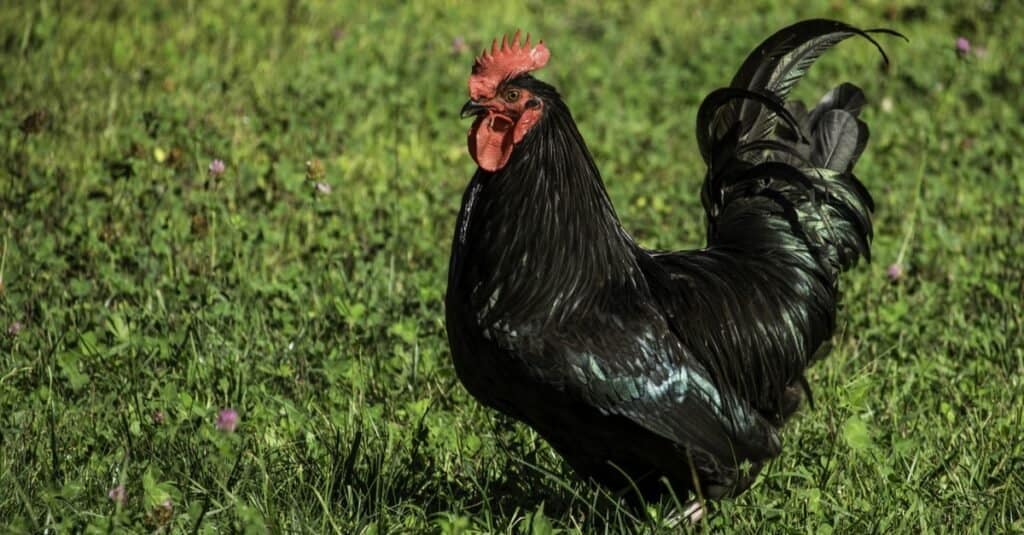
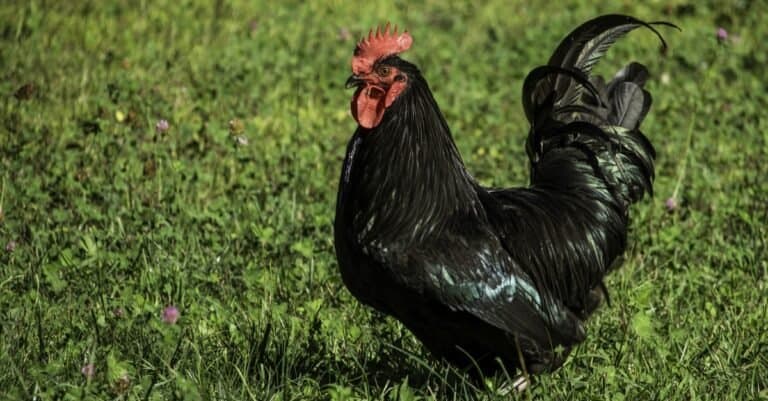
A Black Australorp rooster walking along eating in a field of grass and clover.

This Black Australorp rooster comes in classic black with the curving tail feathers that are a distinctive mark of roosters.

Roosters have a strutting attitude to go with their feathers that are usually in brighter colors than their companion hens, but not in every breed. Rooster feathers come in many colors, including white, brown, black, and red. Some roosters are speckled or spotted. A rooster typically has large wattles and a comb. The bird’s stand-out tail is often large and colorful, and continues to grow and get more colorful as the rooster gets older.

A rooster’s body looks very much like that of a chicken, and it can be hard to tell them apart when they’re young. The adult rooster, however, has these significant differences:

  • More muscular build
  • A larger comb that sits high on his head
  • Large wattles under his beak
  • Hackles on his shoulders. (Hackles are long, pointed neck feathers that run along the rooster’s back. Hens have shorter, more rounded hackles.)
  • Tail feathers: Curving tail feathers are a distinctive mark of roosters.
  • Spurs: A rooster has spurs on its legs, and these grow throughout its life.

Roosters in Culture
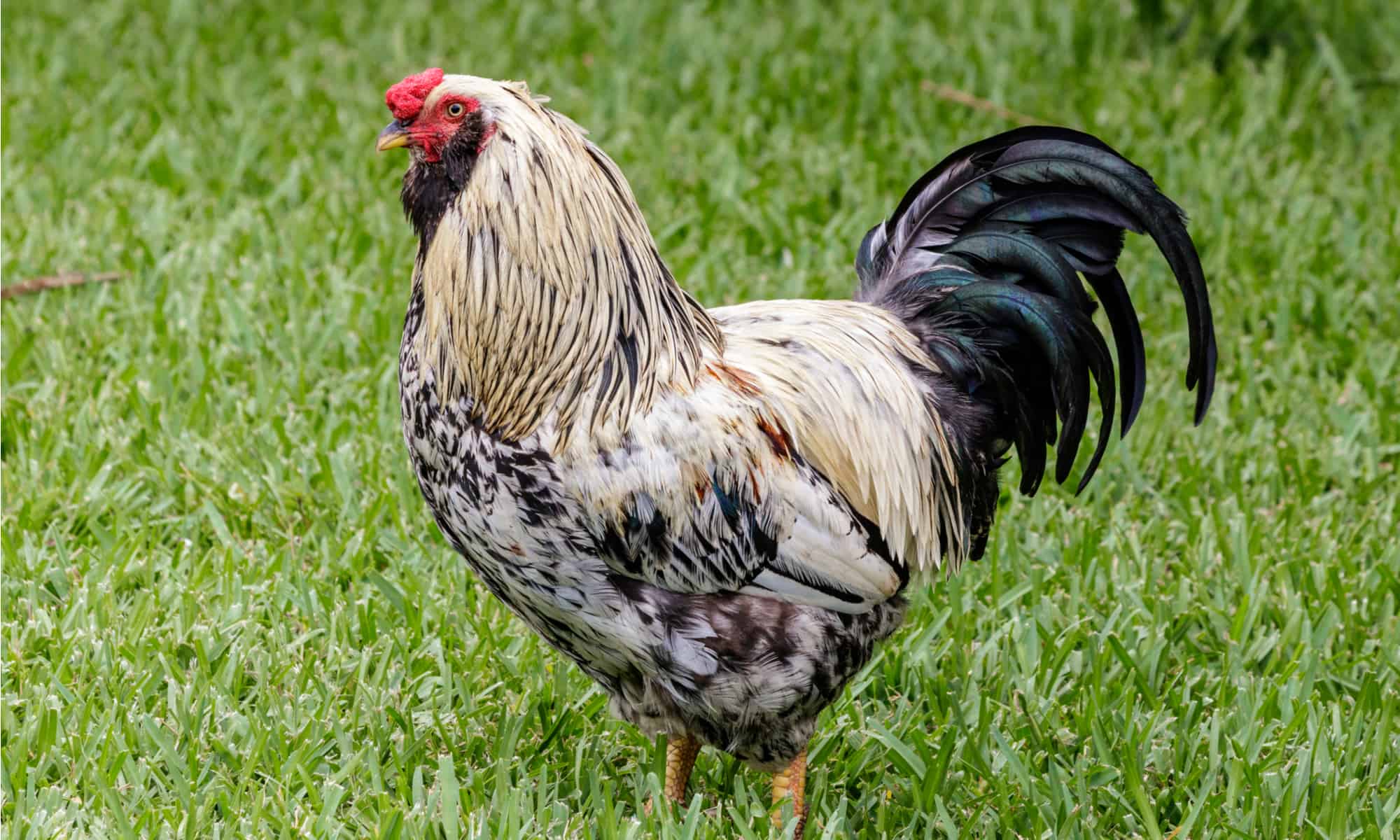
chicken dewormer

This Sussex Rooster, appearing highly dignified and handsome, exemplifies the symbolic rooster of myth and legend.

Roosters are important symbols in many cultures. A sailing tradition holds that a rooster tattoo brings good luck to sailors.

The rooster is the 10th sign of the Chinese Zodiac, and people born in this year are said to be polite, punctual, and faithful.

In Celtic and Norse mythology, roosters are messengers of the underworld. They believe these birds call out the names of those who have fallen in battle.

In Greek mythology, the god Ares asked a soldier named Alectryon (Greek for rooster) to guard the room where he was meeting the goddess Aphrodite in secret. Alectryon fell asleep, and the god turned him into a red rooster as punishment. According to the myth, this is the reason the rooster never fails to wake up at dawn.

The rooster is the national animal of France. A rooster is a classic emblem used when decorating in a country or French country style.

Foghorn Leghorn, a cartoon character, was a white rooster with a red head and tail. He appeared in Looney Tunes and Merrie Melodies cartoons and films from Warner Brothers Studios and had his own TV show.

Behavior
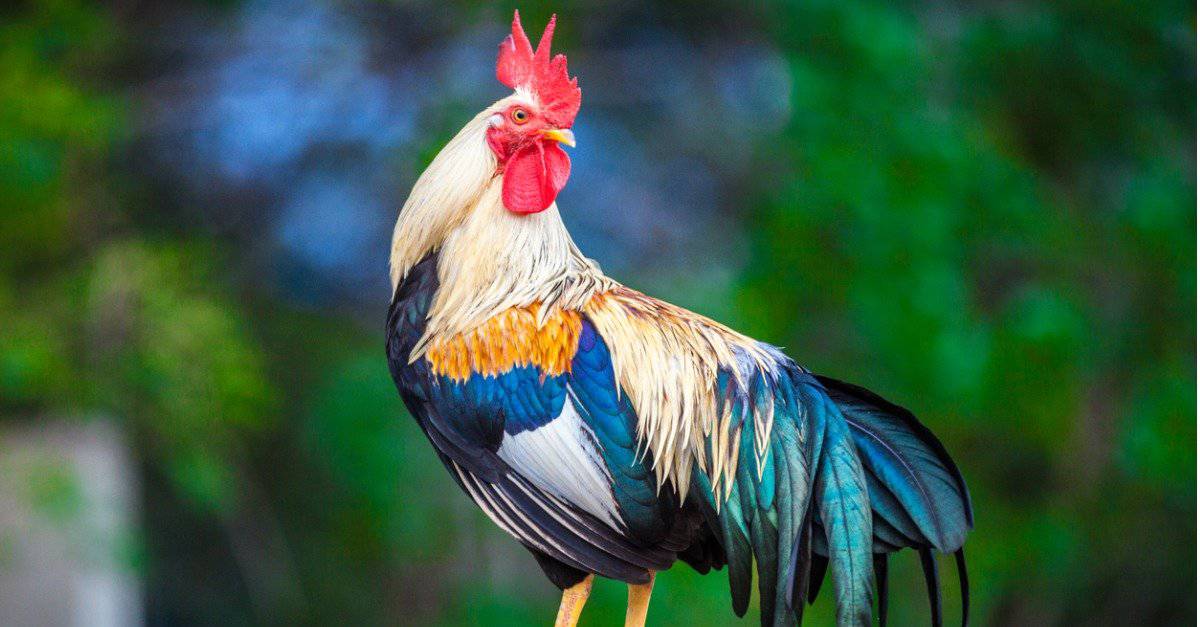
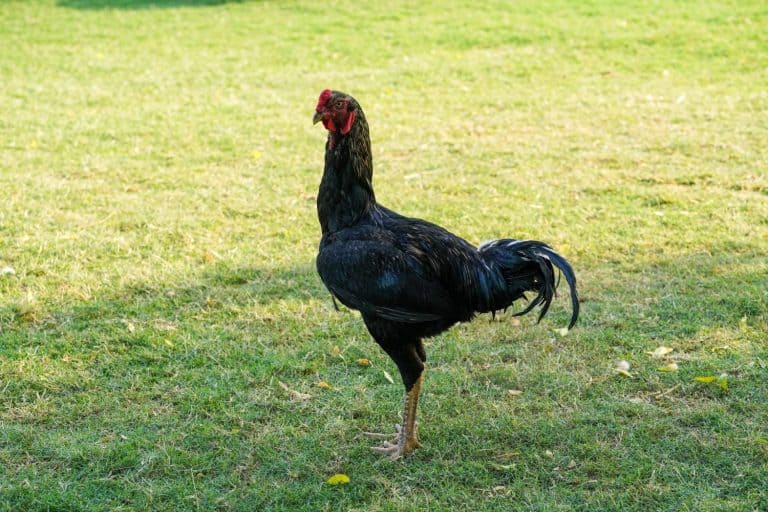
beautiful rooster standing

Some roosters crow at only around 90 decibels, the same as a barking dog.

The rooster is most famous for his crow, which he uses to alert his flock to food, mark his territory, or warn the flock about potential danger. Most roosters can crow by the time they are four months old. Strange as it seems, roosters really do crow at sunrise; they seem to have an internal clock that lets them know when dawn is about to arrive.

Roosters are the leaders of their flocks. Their job is to protect the flock and mate with the hens. A rooster mates with as many hens as he can, and he also maintains the pecking order in the coop.

Chickens are sociable animals who enjoy living in groups. They share food and resources.

When a rooster finds food, he calls the other chickens over to eat first. The rooster may cluck loudly or pick up the food with his feet and drop it. Mother hens engage in the same behavior, trying to get their chicks to eat.

Habitat
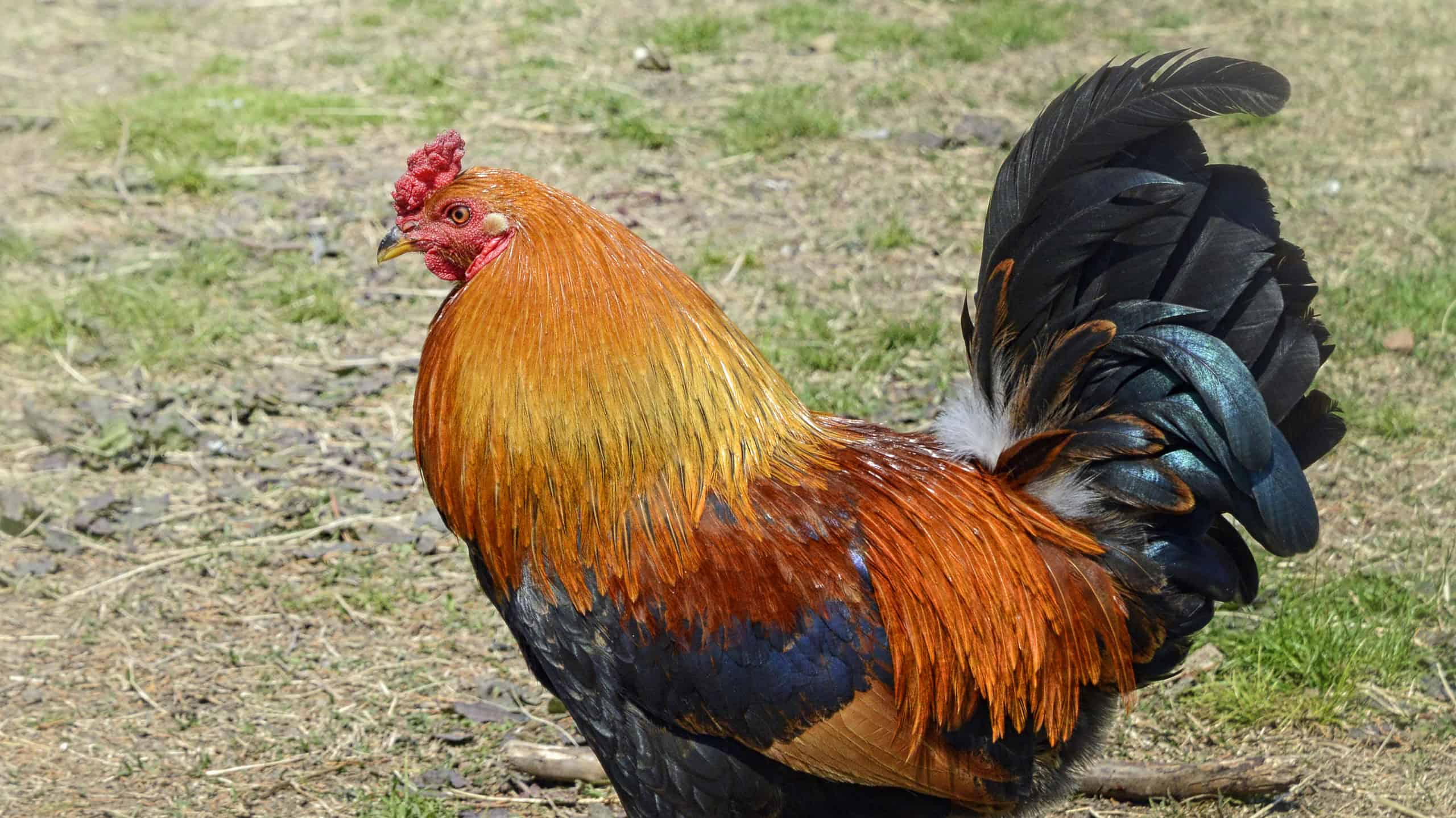
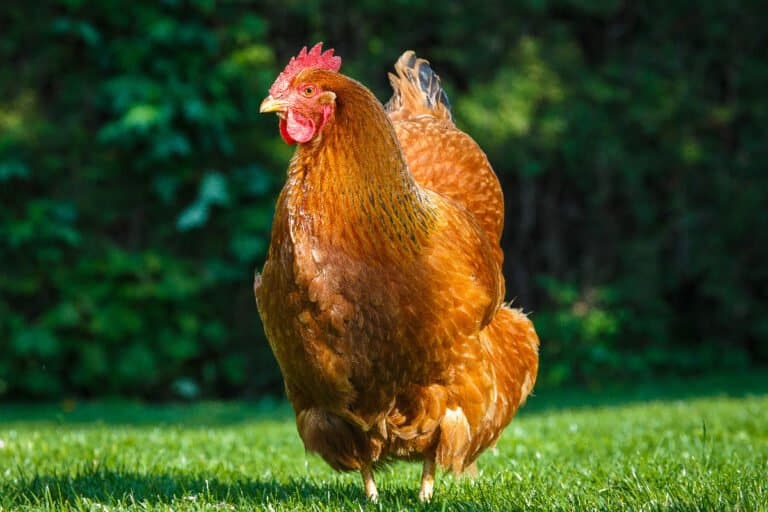
Rhode Island Red Rooster isolated

The Rhode Island Red is a famous type of rooster, popular among hobbyists and show roosters because it is so colorful.

Roosters live on farms and in suburban chicken coops. They primarily live with their flocks. Hens will lay eggs without a rooster, but a rooster is necessary to fertilize the eggs.

Some people raise roosters as a hobby. The Rhode Island red is a famous rooster breed. There are other highly prized breeds, including:

  • Chinese Silkie
  • Buff Orpington
  • Barred Plymouth Rock
  • East Frisian Gull
  • Old English Game
  • Black Australorp
  • Iowa Blue

Diet

Do Birds Pee

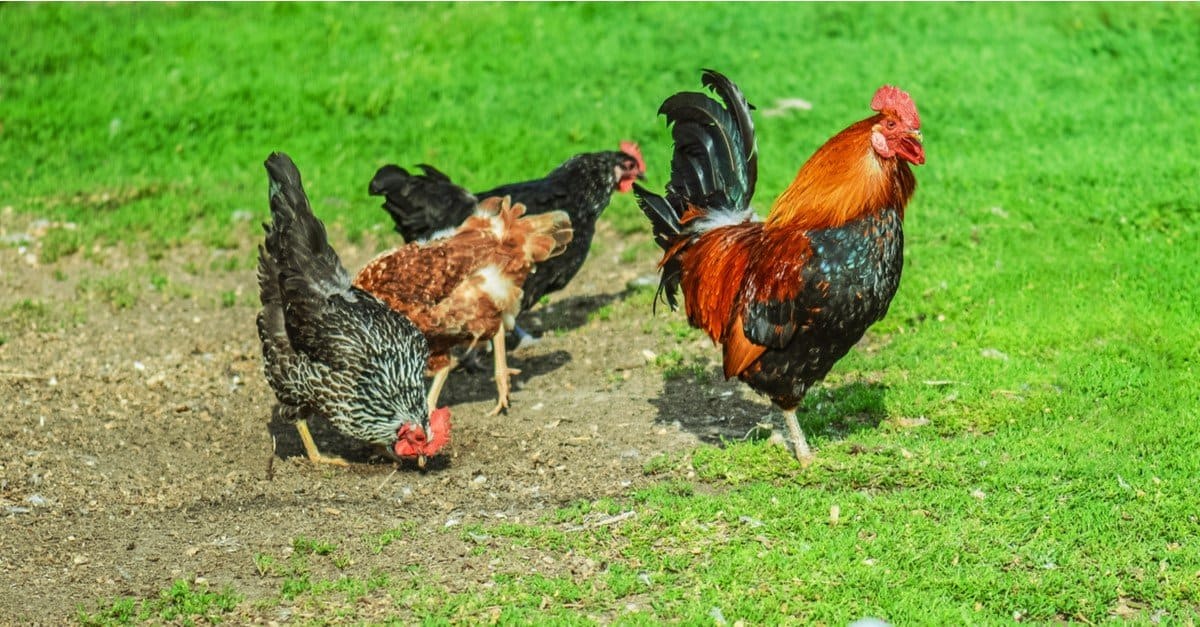
A rooster and his chickens are picking at the ground for food and grit.

Roosters are omnivores, and they are not fussy about what they eat. However, they have certain nutritional requirements. Most roosters prefer to be free-range and forage for their food. This is more natural for roosters and easier for people who keep them. In winter, it’s necessary to feed them a prepared diet from feeders.

Rooster diets should include the following.

  • Grit: Because there are no rooster teeth, these birds need the grit to break up their food. You can buy commercially prepared grit or grind your own from rocks and bones.
  • Calcium: Oyster shells are a good source of calcium. This is mostly necessary for laying hens.
  • Balanced diet: Roosters need the right balance of carbohydrates, proteins, fats, starches, vitamins, and minerals. Many people use commercially prepared feed or supplements to ensure their roosters are getting the right balance.

Predators and Threats

Humans are the biggest predators of roosters. They regularly slaughter them for food. Some people also make them fight to the death in cockfighting matches, which are illegal in many countries.

Other predators include raccoons, coyotes, and foxes, who may try to raid chicken coops for eggs and young chicks. Roosters will protect their coops, and some roosters have been known to fight to the death trying to fend off predators.

Reproduction and Life Cycle
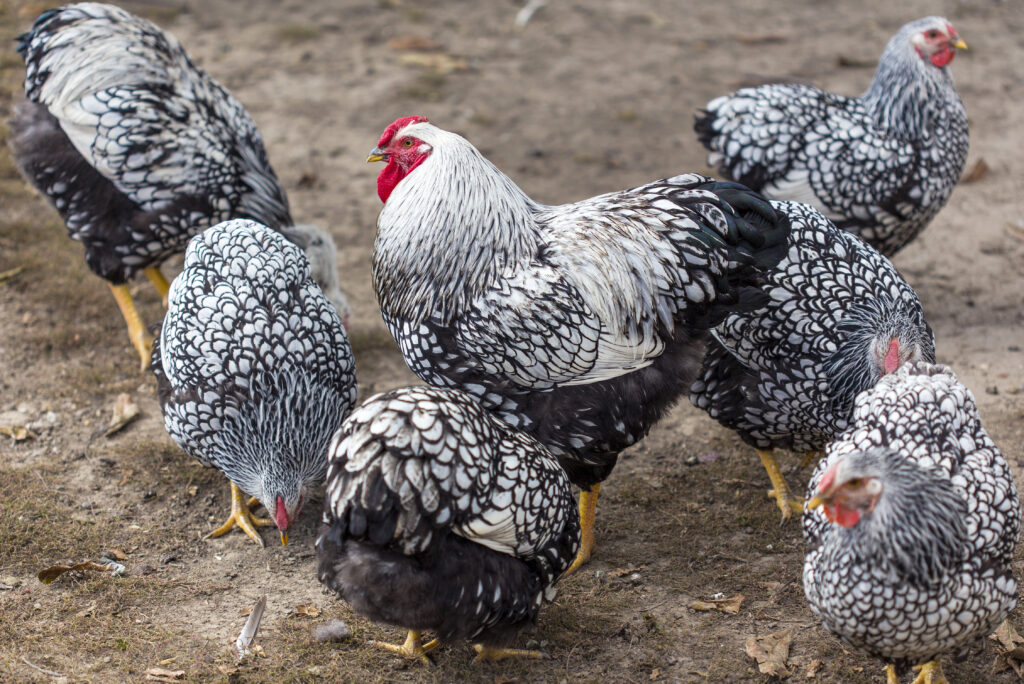
Wyandotte rooster and hens in backyard enclosure.

This Wyandotte rooster will mate with probably all of the hens in his harem.

As the flock leader, the rooster mates with many of the hens in his harem. A rooster may use a courting dance to signal his interest in a hen. This is known as a circle dance. Once the hen responds with a cluck or call, the rooster mates with her.

The female creates or finds a nest. It is common for chickens to reuse nests, and some hens lay their eggs in another hen’s nest.

Incubation lasts about 21 days. Chickens continue caring for their chicks for several weeks. At that point, they are old enough to start eating on their own.

Population and Conservation Status

Chickens and roosters live around the globe. There are over 26.5 billion chickens, so they are far from endangered. Instead, they are the most populous bird in the world.

View all 181 animals that start with R

Sources

  1. Heritage Acres Market / Accessed December 20, 2021
  2. Backyard Poultry / Accessed December 20, 2021
  3. Stack Exchange / Accessed December 20, 2021
  4. Chickens and More / Accessed December 20, 2021

Thank you for reading! Have some feedback for us?


Rooster FAQs (Frequently Asked Questions)

Roosters have several distinctive features that set them apart from hens. They are larger, and they have large wattles and combs. They have large, bushy tail feathers and spurs on their feet.