
Quick Take
- Male sea turtles initiate mating by approaching and biting the female’s neck and flippers. If she accepts, he climbs on and grasps her carapace.
- Female sea turtles lay 70 to 200 eggs per nest and lay multiple nests per season.
- Nest temperature determines hatchling sex. Warmer sand yields females and cooler sand yields males.
When it’s time for turtles to find love, the process isn’t something most people get to see. But it happens like clockwork every year. Whether it is a massive loggerhead in the sea or a common snapping turtle in your local lake, turtles instinctively know when it is time to mate. And when it’s time, they have the moves to make romance happen.
While they don’t book a table at a fancy restaurant or send a bouquet of roses, they do have instinctive strategies to help them find the perfect match. But they’re not really looking for romance — they’re mating to keep their species alive. Let’s dive in and discover what it takes to bring the next generation of hatchlings into the world.
Turtles on the Hunt for Love
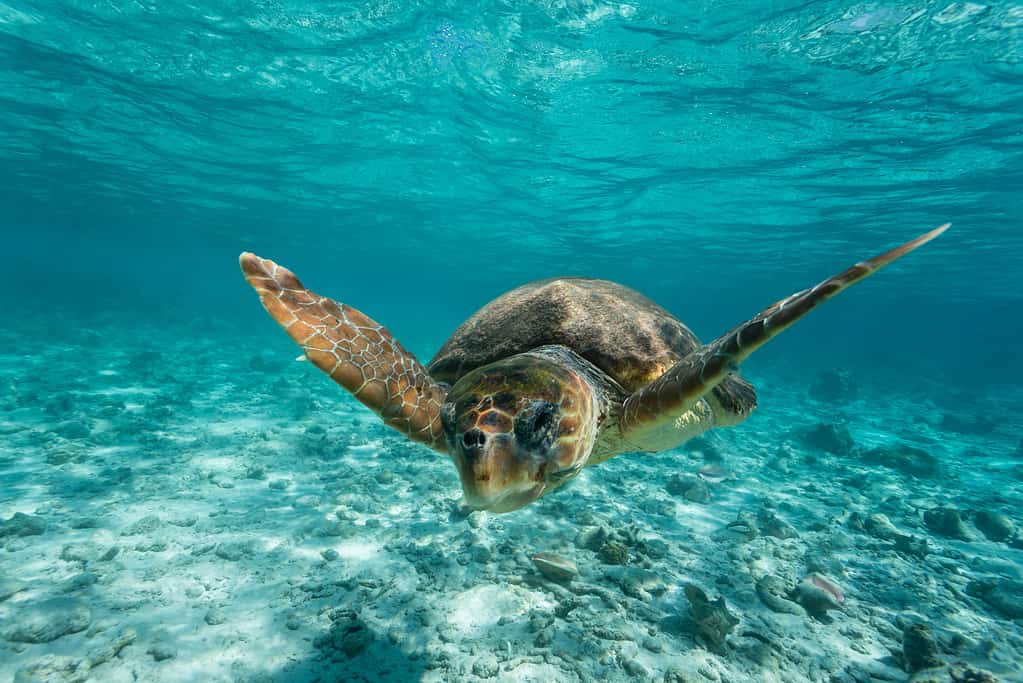
Female loggerhead turtles reproduce every two to three years.
©pniesen/iStock via Getty Images
Sea turtles are, by their very nature, solitary creatures. They spend most of their time roaming the salty seas alone, swimming, feeding, and migrating thousands of miles from where they were born. But once they reach reproductive maturity, they intuitively begin a migration back to their birthplace.
Female sea turtles make the return trip only once every two to three years. They use the off years to recover from laying eggs. During those years, they simply continue their pattern of swimming, eating, and resting in faraway waters.
Male sea turtles, however, return to nesting areas annually. Unlike females, who need time to recover from laying eggs, males do not take years off and return each year to the vicinity of nesting beaches, hoping to find receptive females.
Freshwater turtles don’t need to swim nearly as much. They tend to live in smaller bodies of water and hang out in groups, unlike their solitary saltwater cousins. They also don’t have to migrate thousands of miles. They can often just check out the dating options on the next log over.
What Does Turtle Courtship Look Like?
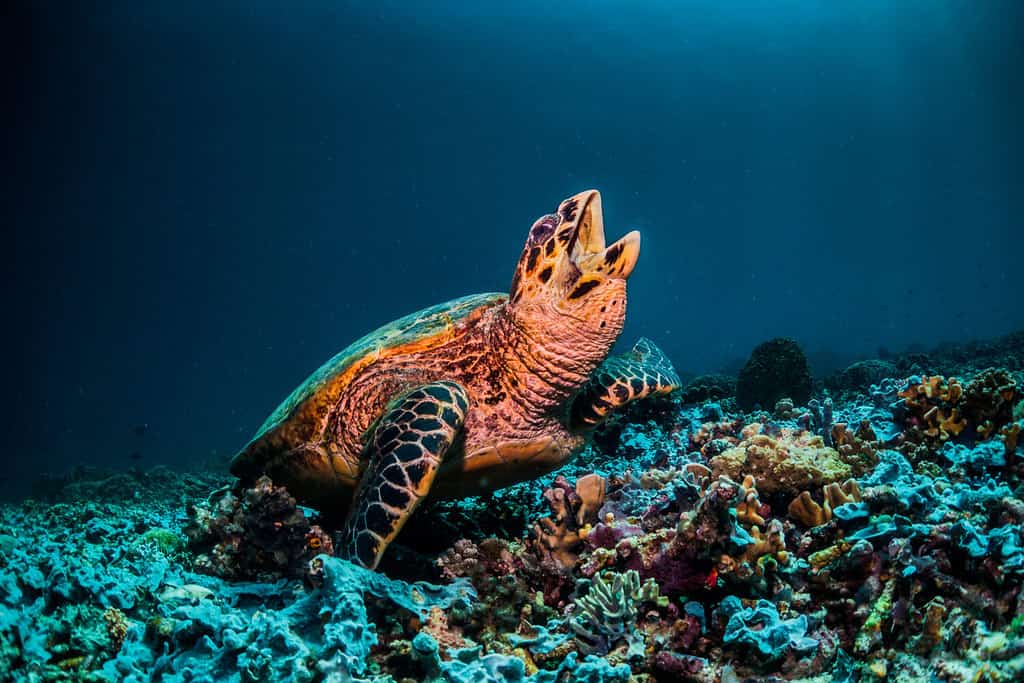
Each turtle species has its own courtship rituals.
©Aaronejbull87/Shutterstock.com
Courtship isn’t a one-size-fits-all approach for turtles. Each species has its own rituals to rely on when wooing a partner. What is common, though, is that it’s up to the male to make the first move. To do that, the males use a series of unique behaviors to attract the female turtle’s attention. What that looks like differs from species to species.
Take common snapping turtles, for example. During courtship, snapping turtles use head movements, biting, and wrestling moves to test the water with a potential mate. Other species, like the spiny soft-shell turtle, take a slightly different approach. Since males are much smaller than females, the male begins by gently nudging the female to gauge interest. If she’s not interested, the female will bite the male with her sharp beak — a clear signal that he should look elsewhere for love.
Then there is the male Blanding’s turtle. Their repertoire of moves includes chasing, chin-rubbing, swaying, and gulping. That last move has the male squirting water over the female’s snout to get her attention. Some species, like the map turtle, even have specially-adapted body parts to aid in courtship. The male map turtle has extra-long front claws, substantially longer than female map turtle claws. The male runs his lengthy claws along the female’s face, vibrating them rapidly in an effort to capture her affection.
But when it comes to courtship rituals, sea turtles take things to another level. Their entire courtship ritual takes place in the open ocean. For some, this process can be downright dangerous. Male sea turtles start by approaching a female and biting her on her neck and flippers. If she’s not interested, she swims away. If she’s receptive, she sticks around. This is when it gets dicey for the female.
The male climbs on her back and grabs hold of her carapace with the long, sharp claws on his front flippers. While the female’s hard shell offers some protection from the male’s claws, the soft parts of her body are often injured. The male then stays attached, sometimes for hours.
While the male is holding on tight, it’s the female’s job to keep the duo alive. Sea turtles often stay underwater for long periods, but they do need air at the surface to stay alive. During mating, that’s no different. What does change, though, is that during mating, it becomes the female’s sole responsibility to swim to the surface so both she and her mate can grab some fresh air. And she has to swim for two, since the male doesn’t lend a flipper to help.
Even when mating is complete, the female’s responsibility for breathing survival might not end. The male often keeps hanging onto the female after mating is complete to ward off other males from trying to mate with her. This can be exhausting for the female sea turtle, and there’s a risk of drowning if she can’t get to the surface often enough to breathe.
Where Do Turtles Lay Their Eggs?
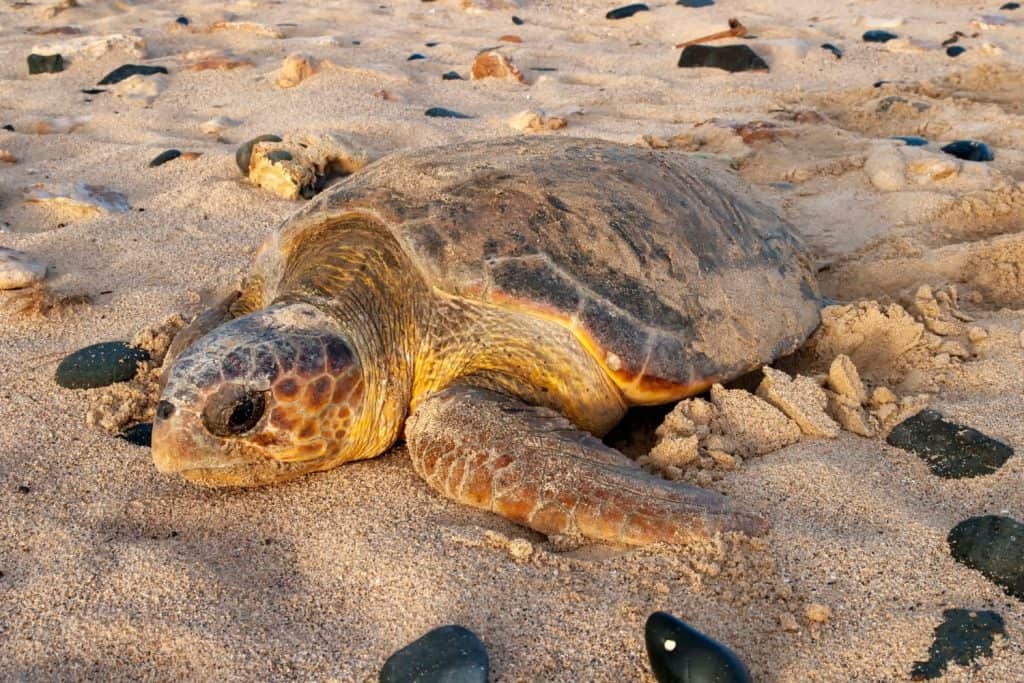
A female loggerhead turtle lays her eggs in a deep hole on the beach.
©Manuel Ocen/Shutterstock.com
Once mating is complete, it’s the female sea turtle’s job to find a suitable spot to lay her eggs. The female slowly leaves the water and makes her way onto the sandy beach, usually near where she herself was hatched. Since sea turtles are born to live in the water, they move on land very slowly and are vulnerable to threats.
Most sea turtles come ashore overnight to minimize risks. But a few, like the Kemp’s ridley, come ashore during the day. The Kemp’s ridley’s strategy seems to be safety in numbers. Groups of more than 100 Kemp’s ridley turtles often come ashore together. These groups are called an arribada or arrival.
Once the female finds the perfect location, she digs a hole and begins laying her eggs in it. This can take hours, during which time she enters a trance-like state. When she’s finished, she covers the hole and slowly makes her way back to the sea. She can repeat this process multiple times in one mating season.
One place where you can find abundant sea turtle nesting activity is the southern Caribbean island of Bonaire. According to Kaj Schut, Manager at Sea Turtle Conservation Bonaire, “A variety of species, including loggerhead, hawksbill, and green turtles visit Bonaire’s waters to mate and nest. Loggerheads are the first to arrive, usually in March, followed shortly after by hawksbill turtles and then green turtles.”
Female sea turtles might mate with multiple males in a single season. They store the male’s sperm and use it to fertilize eggs throughout the nesting season. This means that a single nest’s hatchlings might be fathered by more than one male.
Schut continues, “On Bonaire, females typically lay between 100 and 200 eggs per nest and can lay four to six nests in a single season.” In between nests, the female returns to the ocean to rest and recover. She comes back to the beach when she is ready to produce another nest. Once she has finished laying all the nests for the season, she makes one final trip to the sea and returns to her foraging home.
The nests — and future hatchlings — are completely on their own, as the mother sea turtle will never return to the nests she creates. However, they aren’t always without guardians. Sea Turtle Conservation Bonaire, like similar organizations found throughout regions where sea turtles actively nest, monitors and protects the nests throughout the incubation period.
Freshwater turtles, like the common snapping turtle, follow a similar pattern. They seek out sandy soil that is easy to excavate, then dig holes where they deposit approximately 20 to 40 eggs. The female covers the hole, leaving the eggs to incubate and hatch on their own. Just like sea turtles, freshwater female turtles won’t return to the nest or provide any further assistance to their hatchlings.
On Bonaire, females typically lay between 100 and 200 eggs per nest and can lay four to six nests in a single season.
Kaj Schut, Manager at Sea Turtle Conservation Bonaire
Hatchlings Make Their Way Into The World
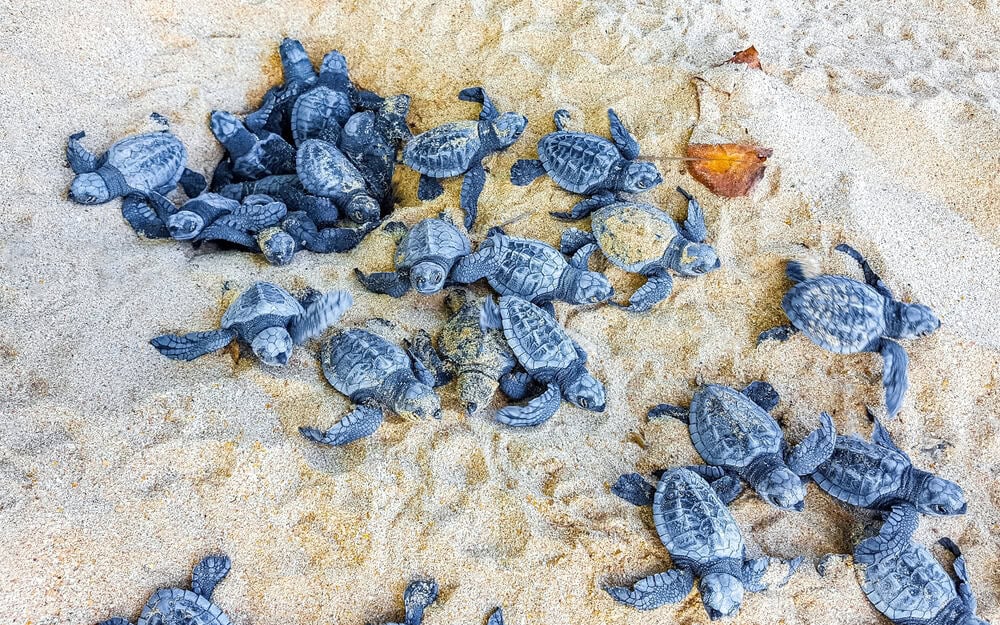
A clutch of baby sea turtles leaving their nest.
©Arkadij Schell/Shutterstock.com
It takes several months for a nest of turtle eggs to hatch. Timing depends on the temperature of the nest, air temperature, and the species of turtle. For example, common snapping turtle nests hatch between 45 and 90 days. But nests laid in colder climates can take longer, with some nests even overwintering and hatching the following spring.
Sea turtle nests usually hatch between 45 and 70 days. Warmer sand temperatures can expedite the hatching timeline. Nest temperature also influences something else. The temperature determines the sex of the hatchlings! Warmer nest temperatures produce females, while cooler temperatures produce males.
As Schut notes, “The nests can be deep and have varying temperatures, with warmer sand toward the top and cooler sand closer to the bottom. It is unlikely an entire nest would be all male or all female. What does change, based on temperatures, is how many hatchlings of each sex are produced in a single nest.”
She adds that turtle researchers have a saying for this phenomenon: ‘Hot chicks, cool dudes.’
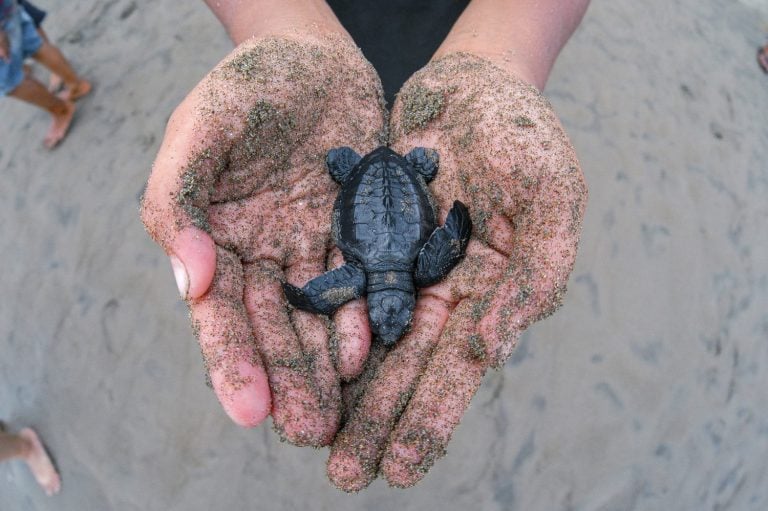
When the eggs are ready to hatch, each hatchling uses a specialized egg tooth to fight its way out of its shell, then claws its way through the sand or soil to reach the surface. Once there, the hatchling instinctively makes its way to the nearest source of water. For sea turtles, this is the open ocean. For freshwater turtles, it’s the closest lake, pond, or river.
I was lucky enough to watch a hawksbill turtle nest hatch on a Bonaire beach — on my birthday, no less! The process took much of the late afternoon and was supervised by experts from Sea Turtle Conservation Bonaire, who helped guide the hatchlings safely to the sea and kept onlookers from crowding their progress. By sunset, all the hatchlings had made their way to the ocean. It’s a cool feeling to know that somewhere in the Caribbean Sea, there are young turtles that share my September birthday. What a gift!