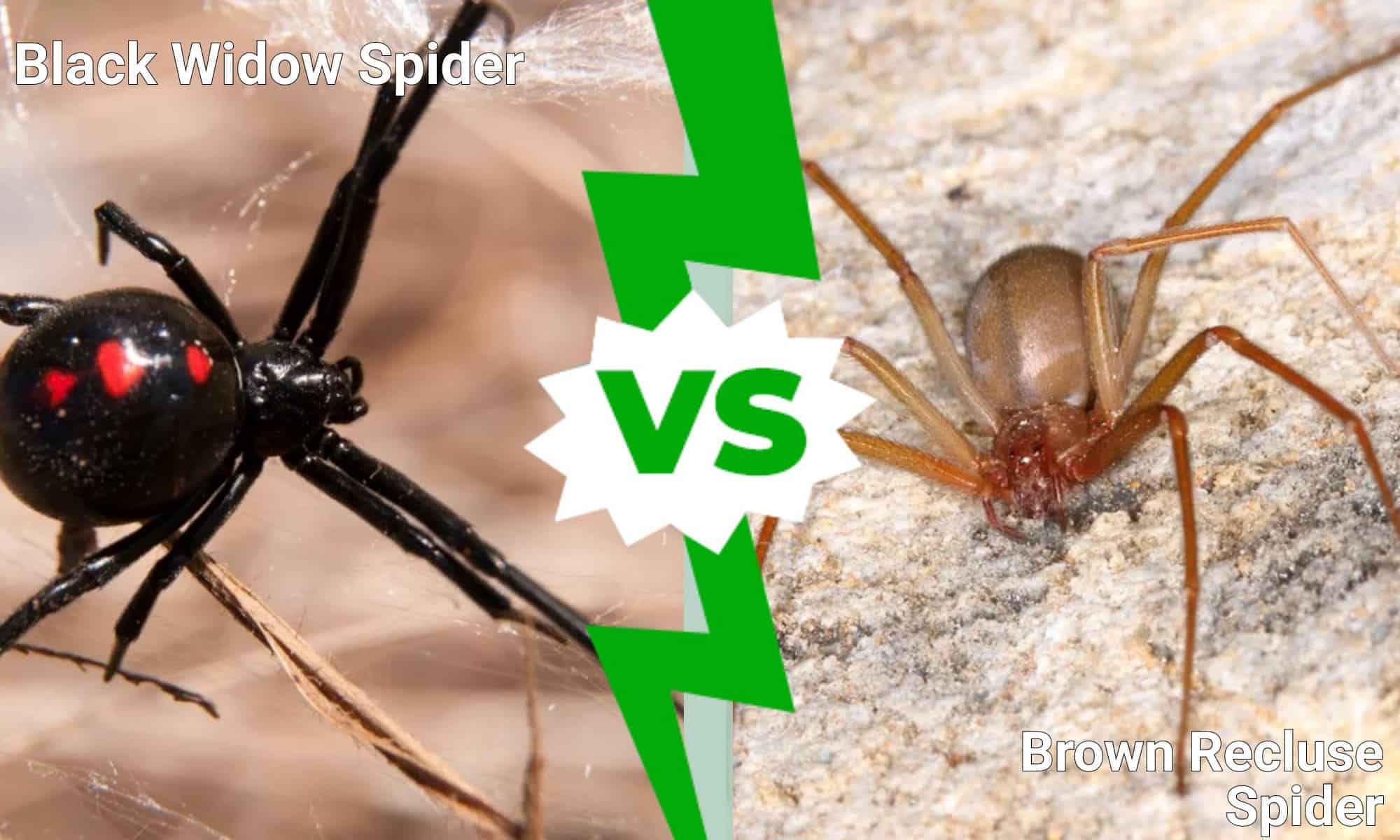

When it comes to spiders, two species in particular tend to spark the most fear: the black widow and the brown recluse. Both of these spiders have earned their reputations as the most dangerous species in North America, largely because of their potent venom and its effects. Yet despite being grouped together in the “venomous spider” category, these arachnids have many differences, including their appearance, range, and the type of venom they inject, among others. Understanding these differences not only helps clear up common misconceptions but also gives you the knowledge you need to recognize and avoid these spiders. Read on to find out what really sets a black widow spider apart from a brown recluse.
Comparing a Black Widow Spider vs. a Brown Recluse Spider
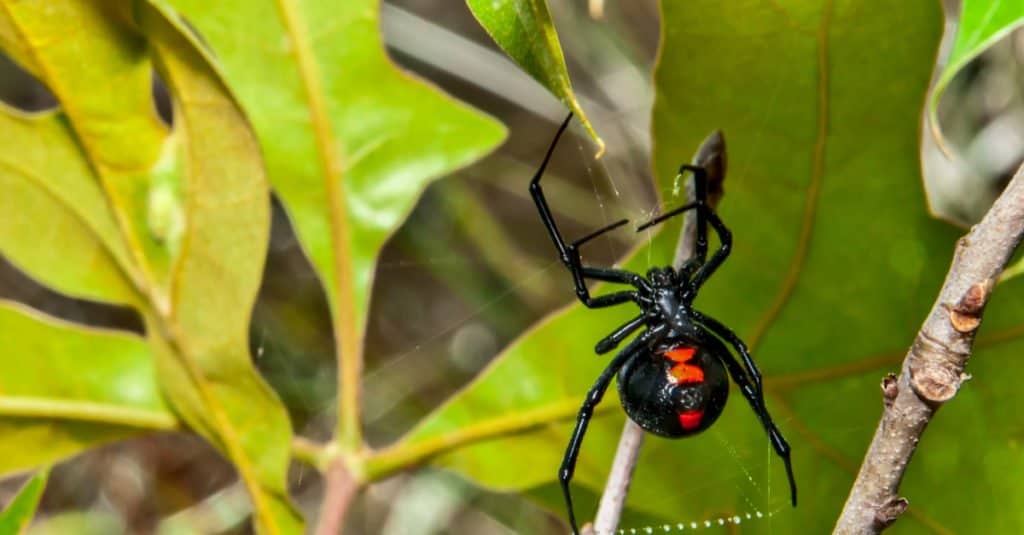
Black widow spiders are not naturally aggressive towards humans and prefer to avoid a confrontation.
©Jay Ondreicka/Shutterstock.com
| Black Widow Spider | Brown Recluse Spider | |
|---|---|---|
| Size | Adult females measure up to 0.50 inches long with a leg span of 1.5 inches | Adult females are around 0.50 inches long with a leg span of around 1 inch |
| Appearance | Shiny black bodies; females have trademark red hourglass underneath their abdomen; 8 eyes | Brown or tan in color with a dark violin-shaped mark on the cephalothorax; has 6 eyes and fine hairs on legs |
| Distribution and Habitat | Three species of black widows found across North America; prefers warm, dark, undisturbed areas near the ground; both indoors and outdoors | One species found in South Central and Midwestern states; prefers warm, dry, undisturbed spaces; may be found inside or outside |
| Reproduction | Females often eat the males after mating; they lay multiple egg sacs, each containing 200-250 eggs | Females do not cannibalize the males; they lay 1-5 egg sacs with 40-50 eggs each |
| Venom Type and Effects | Neurotoxic venom that attacks the nervous system | Cytotoxic and hemolytic venom contains enzymes that break down tissue |
Key Differences Between Black Widow Spider vs. Brown Recluse Spider
There are many key differences between black widow spiders and brown recluse spiders. These include size, appearance, distribution and habitat, reproduction, and venom type and its effects. Take an in-depth look at each of these characteristics in the following sections.
Size
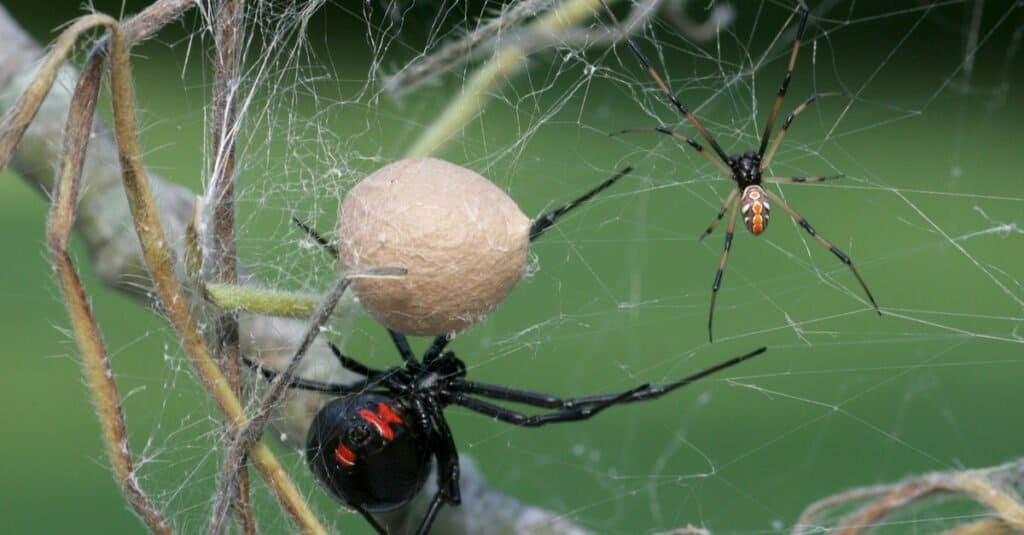
A male black widow, shown on the right, is much smaller than a female.
©Mark_Kostich/Shutterstock.com
Black widows and brown recluses have about the same size bodies, but black widows have a wider leg span. Adult female black widows can reach up to 0.50 inches long with a leg span of 1.5 inches. Male black widows are much smaller than the females. They measure up to 0.20 inches in body length and a total length of 0.70 inches. However, male black widows’ legs are longer in proportion to their body size when compared to females.
Adult female brown recluses also measure about 0.50 inches long in body length, but they have a leg span of only 1 inch. Sexual dimorphism in brown recluses is not as pronounced as with black widows. Males are about half the females’ size, with a body length of about 0.25 inches. Like black widow males, brown recluse males also have legs that are proportionally longer than females.
Appearance
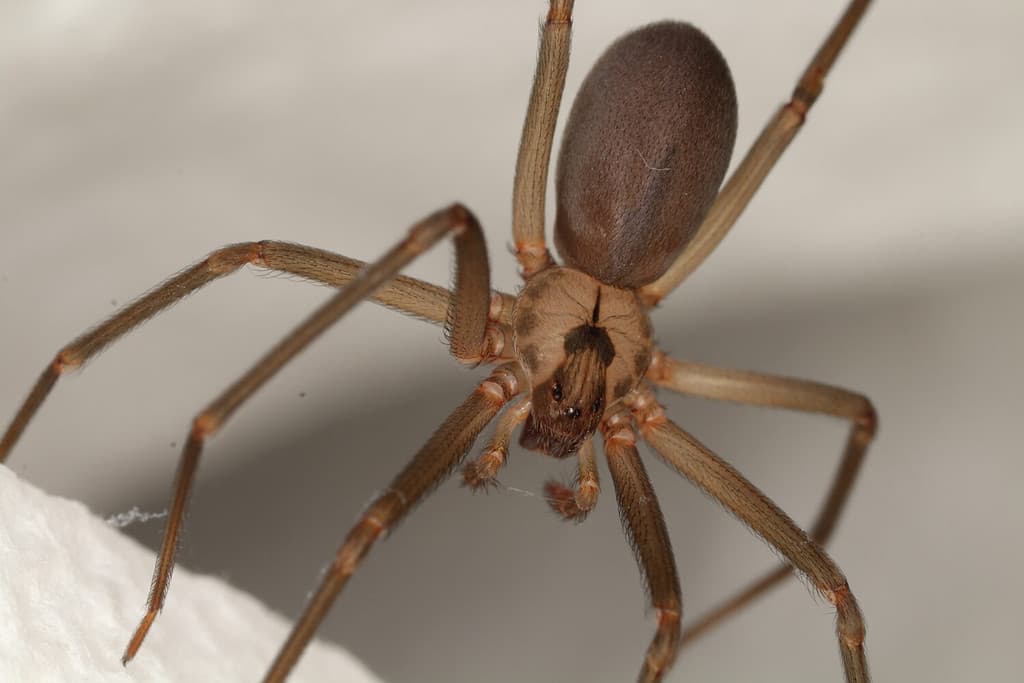
Brown recluses have a dark, violin-shaped mark on the cephalothorax.
©Nick626/Shutterstock.com
These two spiders are very easy to tell apart. Black widow spiders have glossy black bodies. Female black widows, specifically southern and western black widows, are well-known for the reddish colored hourglass shape on the underside of their abdomens. Southern and western black widows may also have up to four reddish-colored spots on the dorsal side of their abdomens. In northern black widows, the hourglass on the underside typically appears more like separate triangles. The top may have a row of red spots or triangles, occasionally with white stripes along the sides. Males are generally brown or gray with small orange, yellow, or white spots on the top or sides of the abdomen. They also have banded legs.
Brown recluses have brown to tan bodies with a dark, violin-shaped mark on the cephalothorax. The wide body of the violin is closer to its eyes, while the narrower neck of the violin is closer to its abdomen. The abdomen has no markings and may sometimes appear darker than the cephalothorax, depending on its contents. Brown recluses have fine hairs on their legs. They also have six eyes arranged in three pairs, while black widows have eight eyes, like most spiders. Males look similar to females when it comes to coloring, and they have the characteristic violin-shaped marking.
Distribution and Habitat
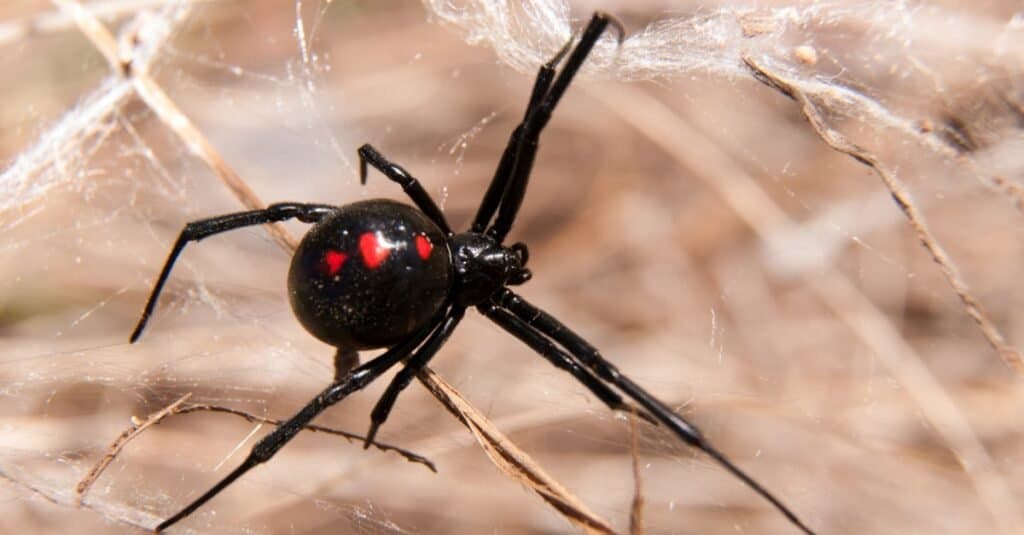
There are three species of spiders referred to as “black widows” in North America.
©Sari ONeal/Shutterstock.com
Widow spiders in the Latrodectus genus can be found around the globe. However, the northern black widow (Latrodectus variolus), southern black widow (Latrodectus mactans), and western black widow (Latrodectus hesperus) are exclusively found in North America. Northern widows are primarily found in the Eastern U.S., southern black widows are the most common throughout the Southeast and Midwest, and western black widows are found from west Texas to the Pacific coast. Widow spiders generally prefer warm, dry, dark, sheltered, undisturbed areas near the ground to build their webs. They can be found both indoors and outdoors.
There are 11 recluse species in the genus Loxosceles native to North America, but only one spider is referred to as a brown recluse (Loxosceles reclusa). These spiders are established in at least 16 states across the South Central and Midwestern U.S. Brown recluses also favor warm, dry, dark, sheltered, and undisturbed places. However, they prefer more humid atmospheric conditions, which is why they are so prevalent across the Southeast. They can be found indoors and outdoors, but they are most commonly found indoors in places like closets, basements, and attics.
Reproduction
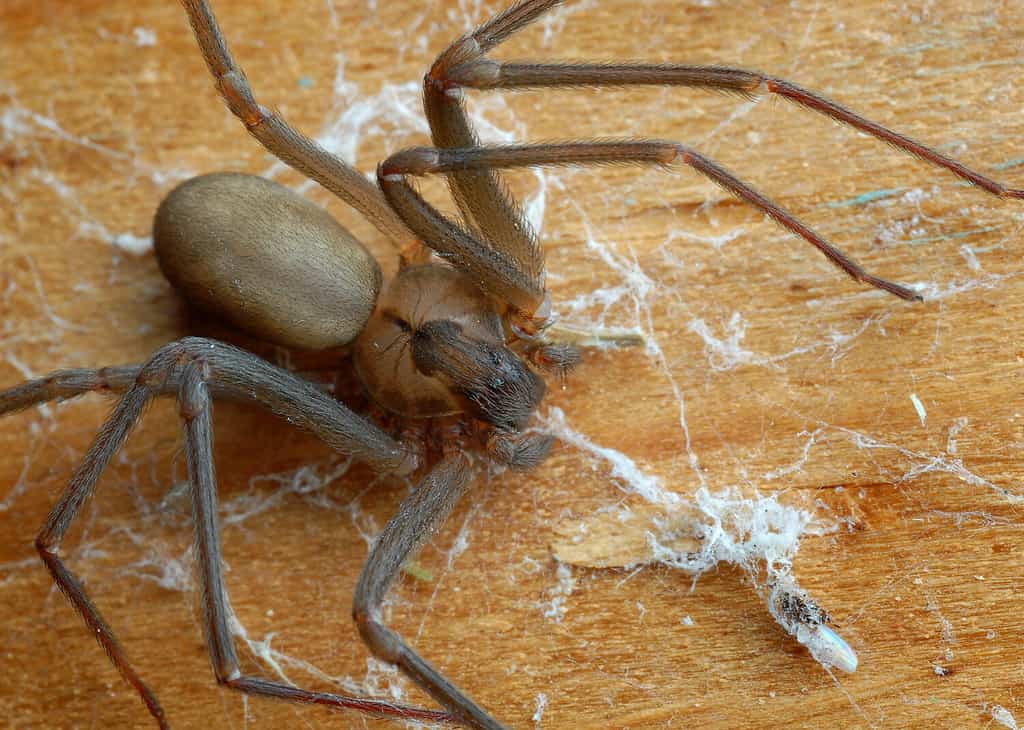
Brown recluse spiders do not eat the males after mating, unlike black widows.
©Miles Boyer/Shutterstock.com
Both arachnids are prolific reproducers. Black widow spider mating takes place in spring or summer. The courtship ritual involves the male vibrating or plucking the female’s web. If she is receptive, they will mate. The male will try to escape immediately afterward to avoid being eaten, as black widow females frequently eat the males after mating. The eggs are typically laid during the summer. The female is able to store sperm from the mating event, so she can lay multiple egg sacs, each containing 200-250 eggs. Eggs typically hatch in 14-20 days. The little spiderlings will reach maturity in about six to nine months.
The female brown recluse usually mates in summer. During courtship, the male announces himself by plucking the female’s web. Then, he does a dance that involves waving his appendages and abdomen. If the female signals her acceptance, he approaches and she submits to his advances. Unlike black widow females, female brown recluses do not eat the males after mating. The female then lays 1-5 egg sacs, each containing 40-50 eggs. Eggs take about one month to hatch, and offspring will take 12 months to grow to full maturity.
Venom Type and Effects
Black widow spiders have neurotoxic venom that attacks the nervous system.
©Jay Ondreicka/Shutterstock.com
One final difference between black widow spiders and brown recluse spiders focuses on the type of venom they have and its effects. Fortunately, neither of these spiders is naturally aggressive, and both prefer to avoid confrontation. They typically only bite when trapped against the skin or when they feel threatened. Only the females can bite, as males are too small to break the skin. Black widow spiders have neurotoxic venom that attacks the nervous system. This can cause pain, muscle cramps, and flu-like symptoms. It can also cause an elevated heart rate, high blood pressure, and difficulty breathing.
In contrast, brown recluse venom is cytotoxic and hemolytic. It contains enzymes that break down cells and cause tissue damage, or necrosis, at the site of the bite. Additional enzymes help the venom spread and cause an inflammatory response. Hemolytic components can cause red blood cells to burst. Symptoms include localized pain, redness, swelling, and flu-like symptoms. A blister or wound may develop at the bite site. Fortunately, bites from either of these spiders are rare. However, if you suspect you have been bitten by a black widow or a brown recluse, seek medical attention.