
There are over 1,000 species of sharks living throughout the world, but bull sharks (Carcharhinus leucas) and great white sharks (Carcharodon carcharias) are two of the most widely distributed. They’re both large sharks and apex predators in their respective habitats. However, there are many differences between these two animals. The most obvious difference is size. Great white sharks are much larger than bull sharks. Also, they live in different parts of the ocean. However, which shark is more dangerous? Which is faster? Read on to discover the answers in our comparison of bull sharks and great white sharks.
Comparing Bull Sharks vs. Great White Sharks
The following chart highlights some of the most significant differences between these two sharks.
| Bull Shark | Great White | |
|---|---|---|
| Size: | 7-11 feet; 200-500 pounds; Females are larger than males | 11-21 feet; 1,500-4,500 pounds; Females are larger than males |
| Appearance: | Gray to brown with paler undersides; blunt, rounded snouts | Dark gray, blue, or brown with a stark, white underside; conical snouts |
| Speed: | 25mph | 35mph |
| Bite Force: | 1,300PSI | 4,000PSI |
| Distribution: | Tropical and subtropical waters all over the world, inland rivers | Temperate and subtropical oceans all over the world |
| Habitat: | Shallow, coastal waters | Offshore and coastal waters |
| Social Behavior: | Often solitary, but can form long-term companionships | Often solitary, but may be found in groups during migration and feeding, can form long-term associations |
| Hunting Style: | Bump and bite | Vertical attacks followed by a bite and wait strategy |
| Diet: | Opportunistic, they consume fish, dolphins, birds, turtles, and even other sharks | Opportunistic, they eat fish, invertebrates, and marine mammals |
Physical Characteristics
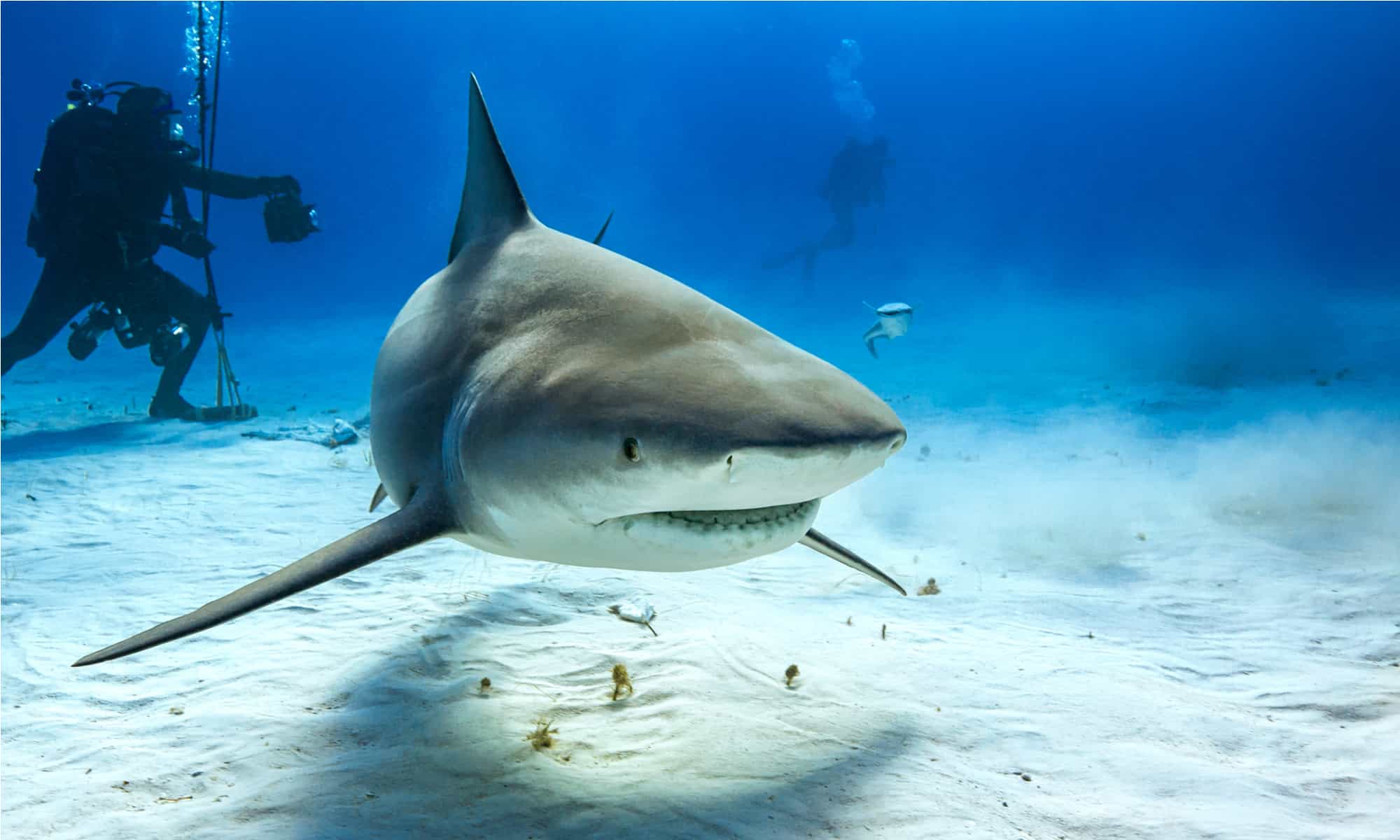
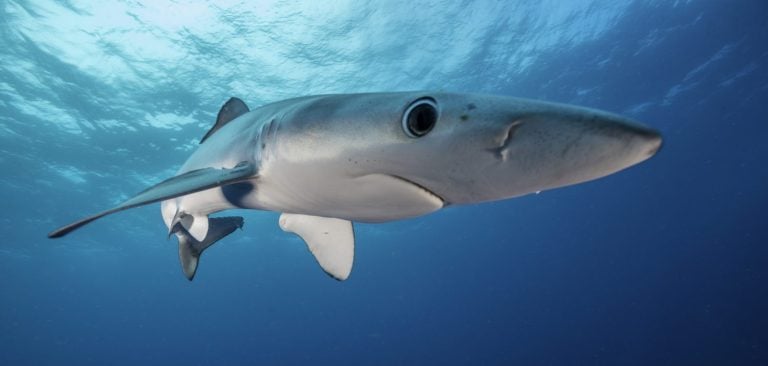
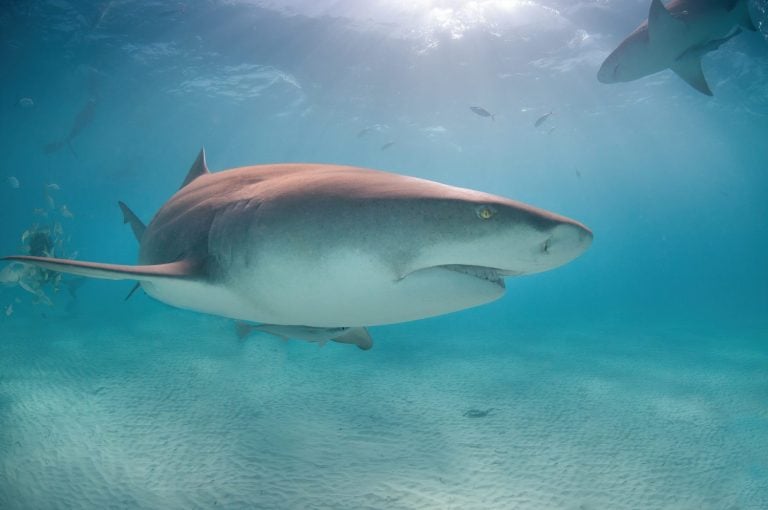
Bull sharks have blunt, rounded snouts.
©Carlos Grillo/Shutterstock.com
Although these two sharks share some superficial similarities, they differ significantly in size and appearance, including color, body shape, snout, and fins. Let’s take a closer look at these features below.
Size
Great white sharks can grow much longer than bull sharks. Female bull sharks can measure over 11 feet in length, while males reach about 7 feet. In contrast, adult female great white sharks can grow from 15 to 21 feet long, while males measure 11 to 13 feet long.
The impressive size of a great white shark doesn’t stop with its length. Great white sharks can weigh up to 4,500 pounds or more when fully grown. In contrast, adult bull sharks weigh only between 200 and 500 pounds.
Appearance
The upper part of a bull shark’s body is gray or brown. A great white shark’s upper body is generally dark gray, blue, or brown. Both sharks have light-colored underbellies. The dark and light coloration helps both sharks to camouflage themselves in the ocean waters. Looking up from below, a shark’s light underbelly helps it to blend in with the sunlight filtering through the surface of the water. Someone looking into the ocean from above would not be likely to see a shark with its dark upper body.
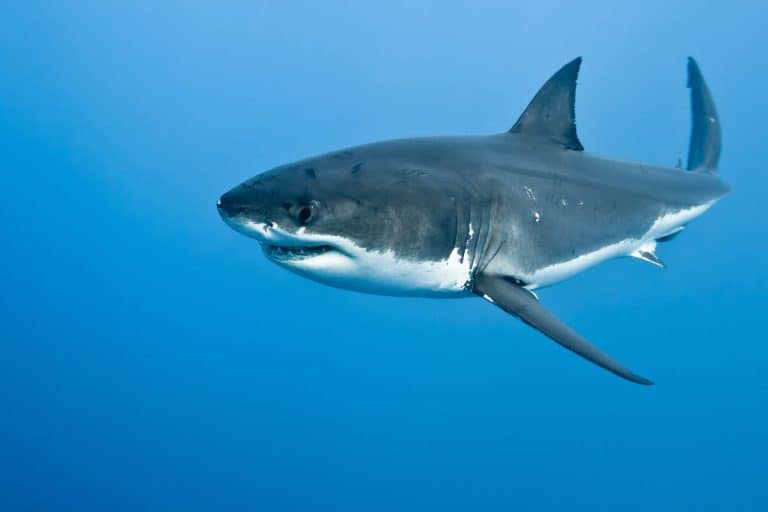
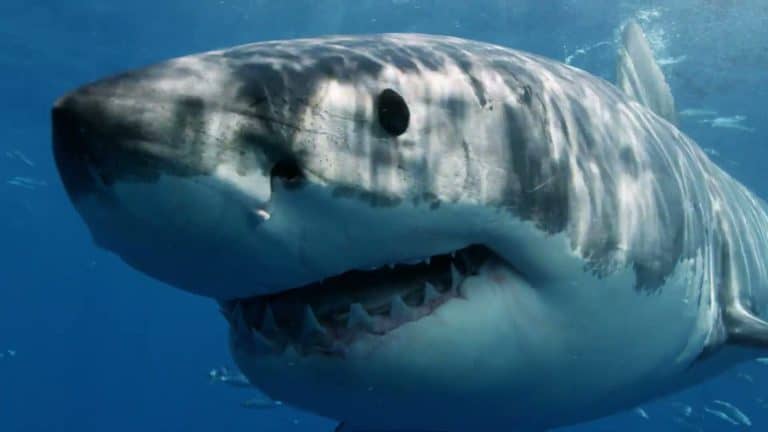
These sharks are also shaped differently, with different snouts and fins. Bull sharks have stocky bodies and blunter, more rounded snouts. They also have longer and lower caudal fins compared to great whites. Great white sharks have more streamlined, torpedo-shaped bodies with pointier, more conical snouts. They frequently have black tips on the underside of their pectoral fins. Only juvenile bull sharks have dark-tipped fins, which fade as they mature.
Physical Abilities
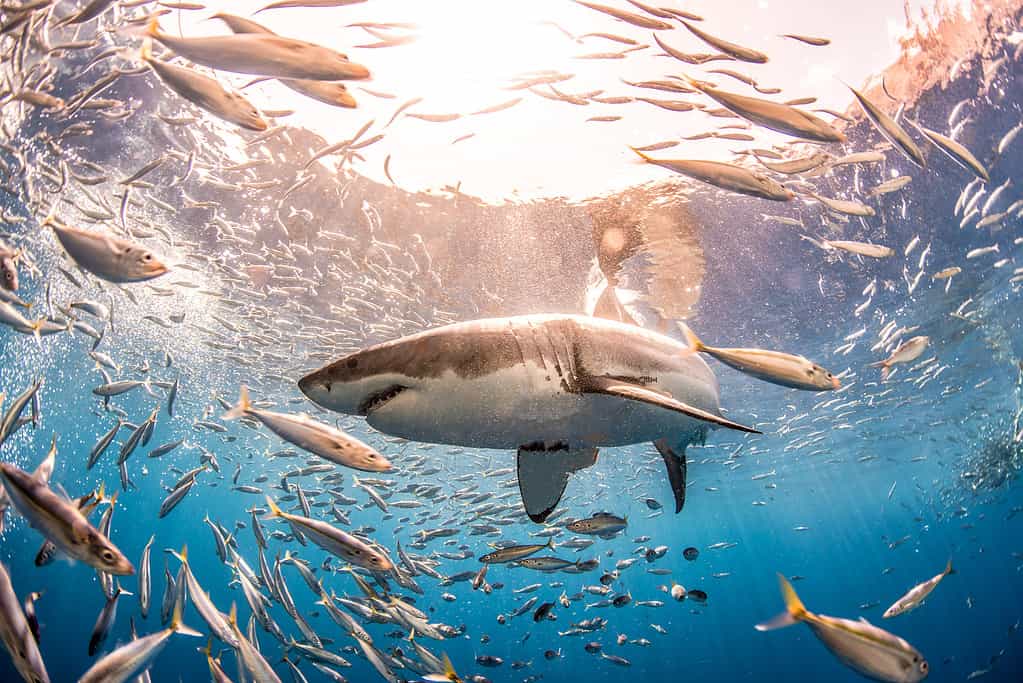
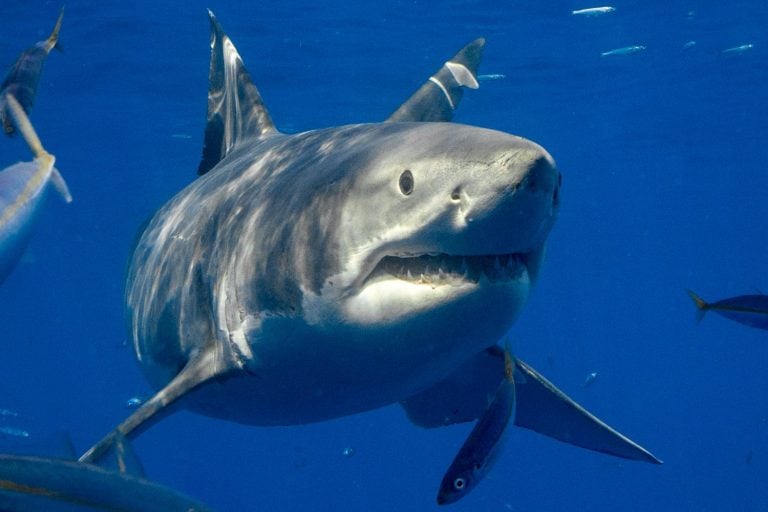
Great white sharks can reach speeds of up to 35 mph.
©Howard Chen/iStock via Getty Images
Both of these sharks are quick and powerful, but the great white has the advantage over the bull shark when it comes to physical abilities. Here, we see how they measure up when it comes to speed and bite force.
Speed
Both of these sharks are known for being quick, powerful swimmers, but bull sharks are not as fast as great whites. Bull sharks typically reach speeds of up to 12 mph, with a top speed of about 25 mph in short bursts. However, the great white shark can swim up to 35mph. Both sharks swim at a cruising speed of 2 to 3 mph.
Bite Force
The bite force of an animal relates to the strength and pressure of its bite. It’s often gauged in PSI, or pounds per square inch. A bull shark has a bite force of 1,300PSI. Researchers indicate that bull sharks have the strongest pound-for-pound bite of any shark. However, a great white shark has a bite force of 4,000PSI, which is one of the strongest bites in the entire animal kingdom.
Distribution and Preferred Habitats
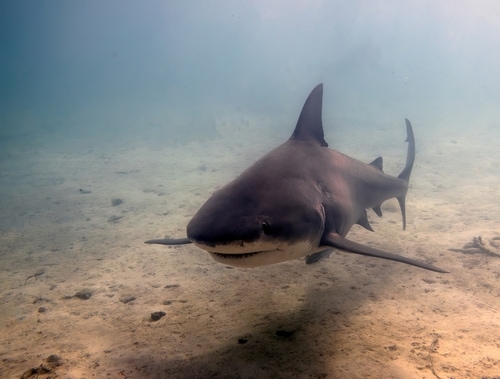
Bull sharks can live in both freshwater and saltwater environments.
©Rob Atherton/Shutterstock.com
Both sharks have a wide distribution, living in oceans throughout the world. They tend to live in different habitats, but their paths do cross in coastal and offshore environments. Let’s take a closer look at the differences in their preferred habitats.
Distribution
Both of these sharks can be found throughout the world. Bull sharks are found in the Indian Ocean and in both the Atlantic and the Pacific. They can also be found in inland lakes and rivers, including Lake Nicaragua, the Amazon, the Mississippi, and the Zambezi Rivers. Great whites are found in all of the oceans in the world, except the Arctic and Southern Oceans of the polar regions.
Habitat
Bull sharks are typically found swimming in relatively shallow tropical and subtropical waters near coastlines worldwide. They are also one of the few shark species that can tolerate freshwater for any length of time. Bull sharks have been found to migrate north in the summer, then back south when the water turns cooler.
Great white sharks are only found in marine habitats. They are usually found in temperate or subtropical offshore waters, although they can also be found in near-shore waters. Great whites often migrate seasonally to areas with warmer waters.
Differences in Behavior

Great white sharks have complex social behaviors and can form long-term associations.
©solarseven/Shutterstock.com
Bull sharks and great whites behave differently toward conspecifics, as well as toward humans. Their different diets also necessitate different hunting styles. You’ll learn more about these differences in the following paragraphs.
Social Behavior and Behavior Toward Humans
Bull sharks are typically more aggressive, territorial, and solitary. It was previously believed they only interacted with other bull sharks at feeding events or during mating. However, some sharks have been shown to form long-term companionships with other sharks, which may have been fostered by contact during feeding events. Due to their aggressive natures and their tendency to live in coastal and freshwater environments, they are believed to be the most dangerous sharks to humans.
Great white sharks were also thought to be mostly solitary, except during feeding events, migration, or mating. Researchers have yet to determine whether they are truly territorial, but they do have home ranges. Great white sharks also demonstrate complex social behaviors when in groups, and may also form long-term associations. Although there are more documented great white attacks on humans, great whites are less aggressive and less likely to come into contact with humans than bull sharks.
Hunting Style
The hunting styles of these two sharks are another aspect that sets them apart. Bull sharks favor the bump and bite method. They often hunt in murky water with low-light conditions, so they will bump their prey to investigate or stun their prey, then they follow up with a bite.
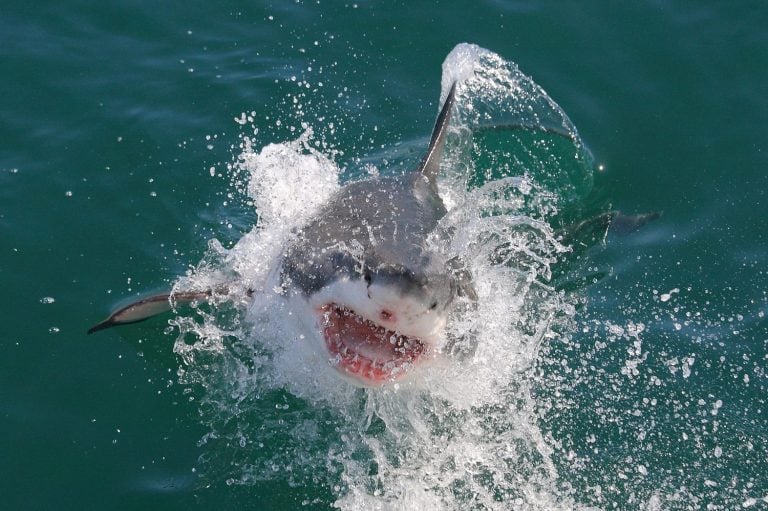
Great whites stalk their prey from below, often targeting fast-moving marine mammals. Then, they launch themselves out of the water to ambush their prey. After the initial bite, they may release their prey and follow it until it bleeds out before consuming it.
Diet
Bull sharks are opportunistic predators. Small sharks, bony fishes, and schooling fishes make up most of a bull shark’s diet. It commonly feeds on fishes such as mullet, catfish, gar, tarpon, jacks, mackerel, and snappers. Bull sharks may also consume stingrays, as well as the occasional dolphin, turtle, crab, or seabird.
Great whites are also opportunistic predators. They feed on marine mammals, fish, and invertebrates. They generally eat seals, sea lions, porpoises, tuna, mackerel, rays, and squid. Great white sharks may also consume turtles, seabirds, and even other sharks — including bull sharks.