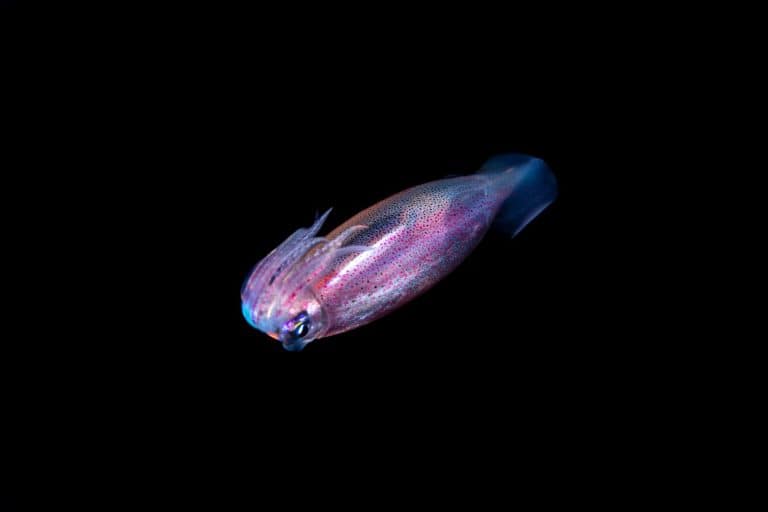

Giant squid (Architeuthis dux) and colossal squid (Mesonychoteuthis hamiltoni) are large cephalopods that live in the deep ocean. Relatively little is known about these species due to the difficulty in studying them. They share characteristics in common with all squid species, such as soft, muscular, tube-shaped bodies, large eyes, and beaks. However, despite some superficial similarities, there are significant differences in distribution, habitat, size, physical appearance, adaptations, and hunting styles. Keep reading to learn more about the differences that set these squids apart.
Problems Studying Large Squids
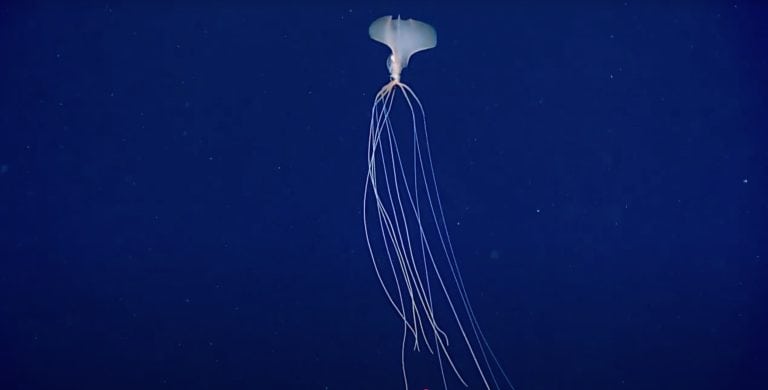
The major hurdle in studying large squid species is their habitats. The deep oceans they inhabit are cold, dark, and virtually inaccessible to scientists and their equipment. Although researchers had known of their existence since the 1870s, the first capture of a live giant squid was not until 2002. It was not captured on video in its natural habitat until 2012.
Since 1925, only nine specimens of colossal squid larger than juveniles have been reported. A colossal squid had not been seen in its natural habitat until March 2025. Most of what researchers know about colossal squid has been determined from dead specimens that have washed ashore or from the stomach contents of their predators, which include the sperm whale. So, while there may still be some uncertainty about specific data, the information below reflects the current scientific consensus.
Comparing Giant Squid vs. Colossal Squid
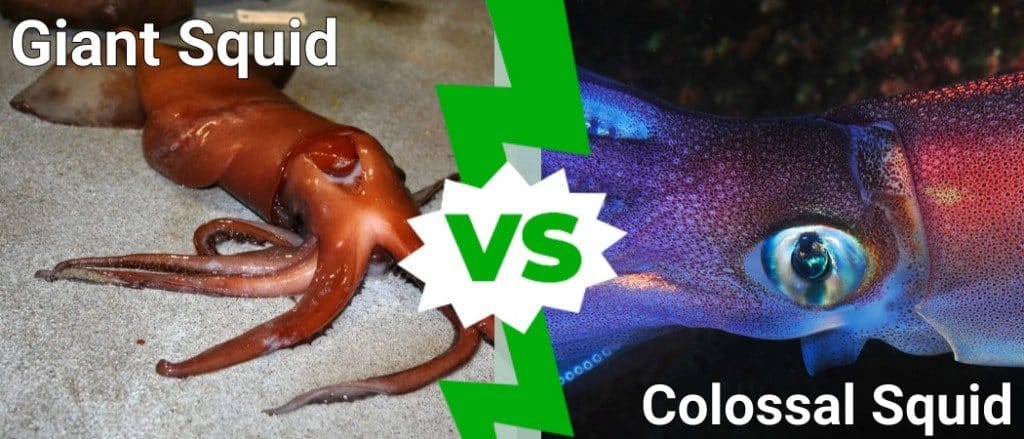
| Giant Squid | Colossal Squid | |
|---|---|---|
| Distribution | All of the world’s oceans, but rarely in tropical or polar regions; Often seen in the North Atlantic | The Southern Ocean around Antarctica as far north as the tips of South America, Africa, and New Zealand |
| Habitat | Depths of 980–3,280 feet; prefer continental shelves and island slopes; avoid deep, open ocean | Deep ocean primarily at depths of 1,640 feet to over 6,561 feet |
| Size | Around 600 pounds and up to 43 feet in length | 1,091 pounds and up to 23 feet in length |
| Physical Appearance | Longer, more slender bodies with longer arms and much longer tentacles | Bulkier, wider bodies with relatively short arms and tentacles |
| Adaptations | Tentacles lined with circular sucker cups with teeth | Club-like tentacle tips; Arms and tentacles have hooks and suckers |
| Hunting Style | Active ambush hunters | Predicted to be passive ambush predators |
The Main Differences Between Giant Squid vs. Colossal Squid
Despite similar-sounding names in English and a few shared characteristics, these two animals are not very closely related. Giant squid belong to the family Architeuthidae and have their own genus, Architeuthis. Colossal squid are members of the family Cranchiidae, known as the glass squids. They also have their own genus, Mesonychoteuthis. These squids are also found in different oceans and at different depths. They do not look alike, have different adaptations, and are believed to have different hunting styles. Take a closer look at these aspects in the paragraphs below.
Distribution

Colossal squid are found in the Southern Ocean around Antarctica.
Giant squid have been found in all of the world’s oceans, although they are rarely found in tropical or polar regions. Some giant squid hotspots include the North Atlantic off Newfoundland, the coast of southern Africa in the South Atlantic, the North Pacific off Japan, and around New Zealand and Australia in the Southwestern Pacific.
Colossal squid have a much smaller range. They are native to the Southern Ocean around Antarctica, stretching north only as far as the tips of South America, Africa, and New Zealand. An area between the Weddell Sea and the Kerguelen archipelago in the Antarctic Convergence Zone has been speculated to be a hotspot for colossal squid.
Habitat
As mentioned previously, giant squid inhabit the deep ocean. However, unlike colossal squid, giant squid avoid the deep, open ocean. They prefer continental shelves and island slopes. Giant squid can typically be found at depths of 980–3,280 feet.
Colossal squid can also be found in the deep ocean, although young squid are more likely to be found closer to the surface. In general, colossal squid are believed to favor depths of 1,640 feet to over 6,561 feet. Smaller juveniles with mantle lengths of less than 1.5 inches are mainly found near the surface down to depths of 1,640 feet. Larger juveniles and adults can reach depths of up to 6,561 feet or more.
Size
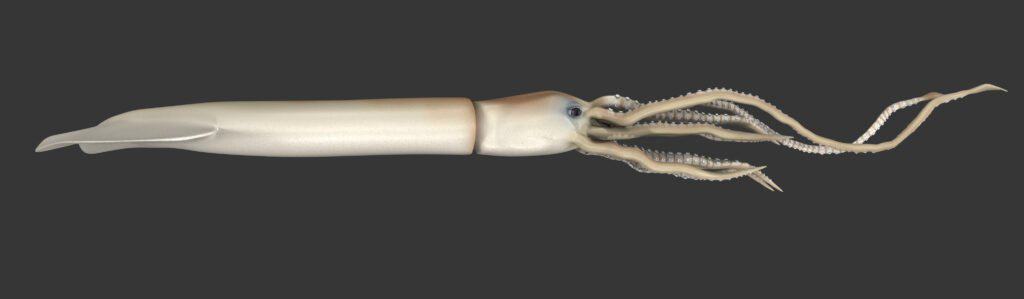
Giant squid can reach over 40 feet in length.
©sciencepics/Shutterstock.com
Size is another key difference between giant squid and colossal squid. Giant squid grow much longer than colossal squid but are not as heavy. These squid can weigh up to approximately 600 pounds and grow up to 43 feet in length. The longest reliably recorded mantle length is 9.15 feet.
As alluded to above, colossal squid are much heavier but much shorter. These massive squid can weigh up to 1,091 pounds and reach up to 23 feet in length. Their mantle lengths are estimated to be similar to the average giant squid at 8.2 feet. Colossal squid are the largest invertebrates on the planet.
Physical Appearance
Both of these squid species have two eyes as large as dinner plates, a beak, 10 appendages, and a funnel (or siphon) that aids in locomotion. However, as noted in the previous section, giant squid are much longer. They have narrow, tubular bodies and eyes that measure about 10 inches in diameter. They have eight arms and two extremely long feeding tentacles that can be the same length as the rest of their bodies.
Colossal squid are much stockier and more muscular than giant squid, but their arms and tentacles are shorter. Colossal squid also have tentacles with club-like ends. Their eyes are larger than the giant squid’s, measuring up to 12 inches in diameter, making them the largest eyes of any animal on Earth.
Adaptations
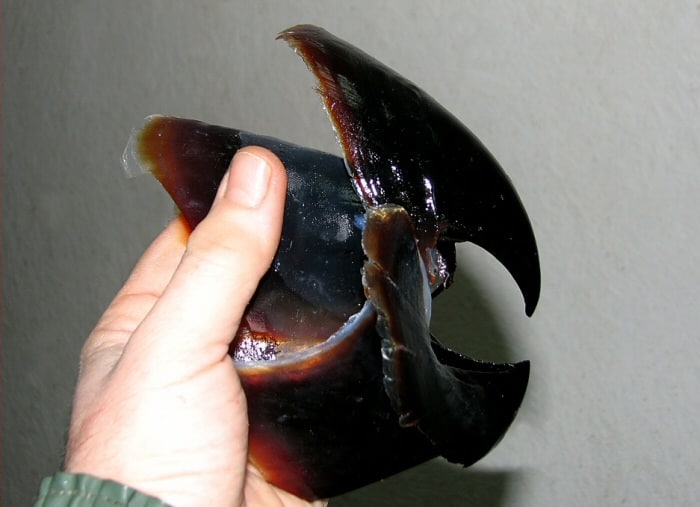
Squid beaks, like the colossal squid beak shown above, are sometimes found in sperm whale stomachs.
On their arms, giant squid have 2-inch-wide, serrated, chitinous suckers for holding prey and guiding it to their beaks. Their extremely long feeding tentacles are used for grabbing prey. Their tentacles are also tipped with hundreds of strong, sharp-toothed suckers. The giant squid’s enormous eyes are adaptations to help them hunt for prey in the low-light conditions of the deep ocean. Their eyes are positioned on the sides of their heads, which provides the giant squid with a wide field of view to detect predators.
Unlike giant squid, they do not have teeth-lined suckers on their arms. The colossal squid’s eight arms are lined with hundreds of suckers and non-swiveling hooks to hold prey and pull it toward the beak. On the club-like ends of their feeding tentacles, they have two rows of smaller, swiveling hooks in the middle of the club, with a row of serrated suckers above and below the hooks. Like giant squid, their massive eyes let in more light to allow them to locate prey deep in the ocean. However, the colossal squid’s eyes are forward-facing, which gives them binocular vision. They also have bioluminescent photophores on the rear of their eyeballs that emit constant light, which some researchers have likened to searching for prey in the dark using headlights.
Hunting Style
Both the giant squid and the colossal squid have similar diets of fish, crustaceans, and other cephalopods. However, researchers believe they have different hunting styles. Giant squid are active ambush hunters. They have been recorded to stalk and ambush their prey, lunging forward and projecting their tentacles to snatch prey from a distance.
In contrast, colossal squid are predicted to be more passive ambush predators. Although they also project their tentacles to grab prey from a distance, they rely on camouflage to remain invisible in the dark. Their large eyes and light-emitting photophores provide them with enough light to see their prey. When the prey comes into range, they reach out with their tentacles to snatch it.