Quick Take
- Scientists were wrong about what reef manta rays do when monsoons hit, and the real behavior turns out to be far more surprising. See the unexpected findings →
- Two of the tagged rays did something in December that shattered the study's own surprising baseline numbers. Explore the tracking data →
- There's a geographic quirk around these islands that removes a pressure most other manta population have to deal with. Discover the upwelling geography →
- Knowing where these rays remain year-round could help conservationists protect them more effectively. See the conservation impact →
For giant reef manta rays that call the shallow waters of Papua New Guinea home, radical weather is nothing new. The island’s location north of Australia, surrounded by large bodies of water, exposes it to ocean conditions that can change in an instant.
For a long time, scientists had assumed manta rays simply headed for calmer seas when monsoon-driven weather hits the island. New research published in PLOS One tells a different story. These majestic creatures don’t actually leave. They just head into deeper water.
Discover the Reef Manta Ray
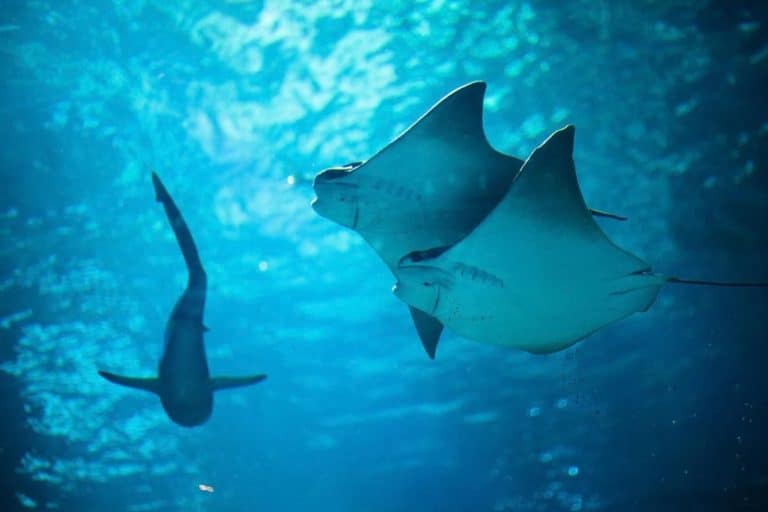
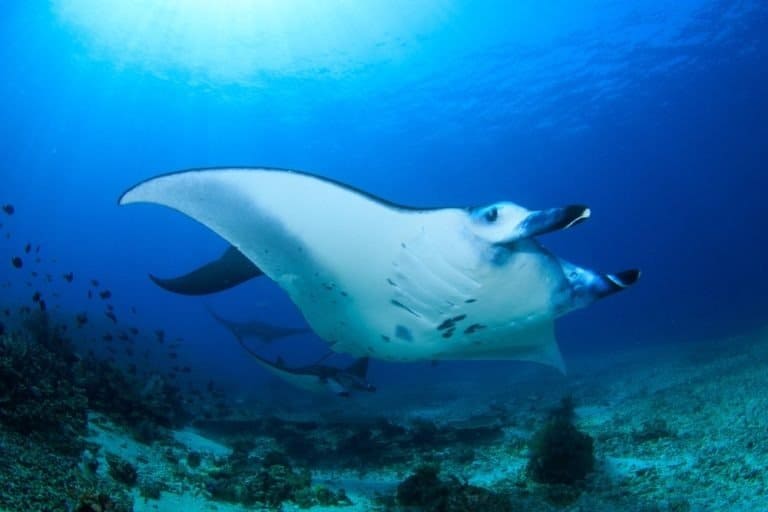
Mobula alfredi, the reef manta ray, is one of the most unmistakable ocean species. These black and white creatures can weigh nearly 1,900 pounds and have a wingspan of almost 15 feet. They glide, turn, and flip gracefully on coastal reefs across the Indian and Pacific oceans.
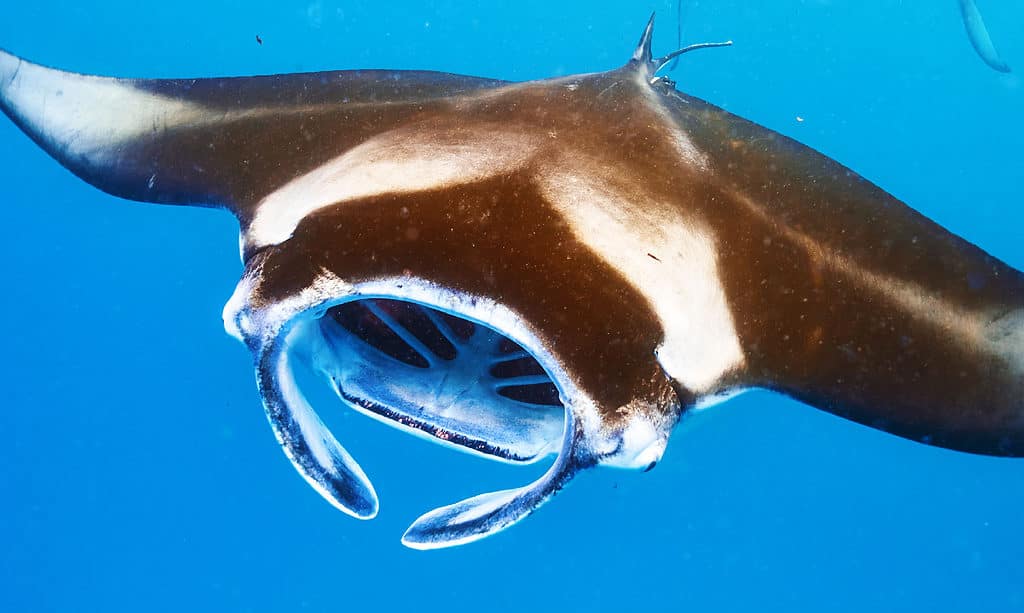
Reef manta rays live primarily in the Indian and Pacific oceans.
©haveseen/Shutterstock.com
Although their large size may seem intimidating, reef manta rays are actually quite harmless. They feed on zooplankton that they filter from the water. They’re also listed as vulnerable on the IUCN Red List. Their populations are small and geographically isolated. That, combined with their slow reproduction schedule, puts them at even greater risk of extinction.
What the Study Found
The study was led by Anna Knochel, then a Ph.D. student at the University of the Sunshine Coast in Australia. It was the first study dedicated exclusively to the reef mantas of coastal Papua New Guinea.
To get the data, Knochel’s team fitted ten individual adult rays with satellite-linked archival tags called SPLASH10. The tags are designed to automatically pop off, so they pose no long-term threat to the rays. The team tagged the rays in the Samarai Islands in southeastern Papua New Guinea.
The tagged rays were tracked between 2016 and 2018. The tracking sessions were broken up into two per year, focusing on two different monsoon seasons. One was the northwest monsoon season between November and April, and the other was the southeast monsoon season that occurred between May and October.
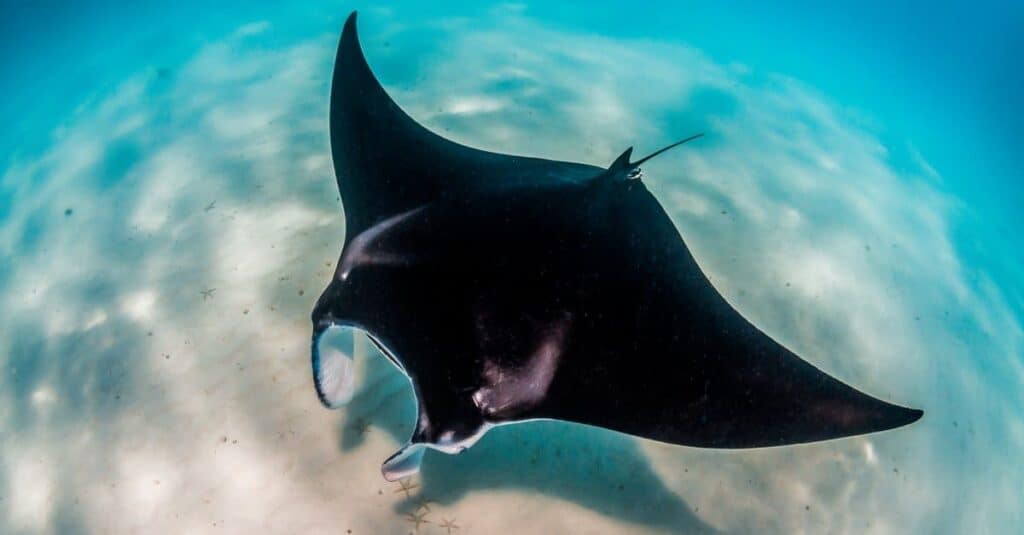
Manta rays feed on zooplankton.
©Aaronejbull87/Shutterstock.com
The tags collected data on two types of ray movement — horizontal and vertical. Horizontal movement tracking included GPS and Argos positions, while vertical behavior monitored maximum dive depths and depth histograms.
The team collaborated with researchers from The Manta Trust, Conservation International Asia-Pacific, Re:wild, the University of Plymouth, and Columbia University. National Geographic and Conservation International each provided study funding.
The Big Surprise
The researchers expected the data to prove that reef mantas embarked on long-distance journeys once rough weather arrived in the area. That behavior is consistent with how other marine species react when monsoons descend on the islands.
But the mantas gave researchers a surprise. Rather than leaving the area, the rays just went deeper — much deeper — into the local ocean waters. Even when some rays traveled horizontally, an indicator that they were moving to new locations farther away, the maximum distance measured on any of the rays was only just over 50 miles. Other ray populations routinely travel between 300 and 715 miles away from their home base.
The rays also exhibited similar behavior regardless of the monsoon season, remaining consistent throughout the year.
“Despite two distinct monsoons, 75 percent of the group stayed within about six miles of the original tagging site in Milne Bay,” said Knochel, the lead study author, in a news story discussing the study. “The furthest swum only about 50 miles, much shorter than their capabilities.”
Going Down Instead of Out
The tagged mantas’ deep-diving behavior most surprised researchers, especially since the depths they reached varied depending on the monsoon season. The mantas went significantly deeper during the NW monsoon season, averaging about 207 feet down. In the SE monsoon months, they averaged just 161 feet deep.
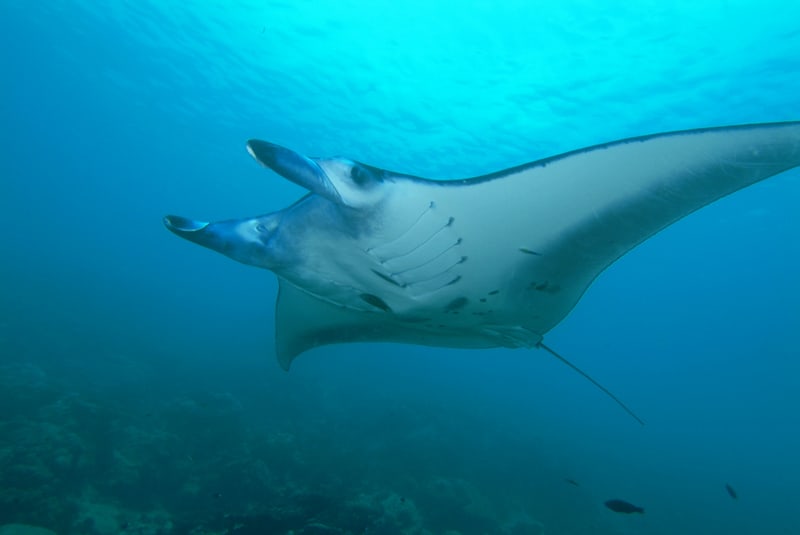
Reef manta rays don’t migrate in monsoon seasons; they dive deeper into their local waters.
©Bartek.cieslak at pl.wikipedia / Creative Commons – Original
There were several outliers, though. Two tagged mantas exceeded depths of 1,300 feet in December.
The researchers were curious as to what prompted the different approaches to depth across monsoon seasons. It has to do with where the mantas’ food supply of zooplankton is most likely found. During the NW monsoon, the ocean’s surface productivity drops and zooplankton concentrates at much greater depths. The mantas were simply following their food source.
During the SE monsoons, surface productivity rises, keeping the zooplankton in shallower water. During those months, the mantas didn’t have to go very deep to find their next meal.
But the question remained as to why reef manta rays don’t migrate elsewhere when stormy weather hits the Samarai Islands. The answer is in the geography. The island chain sits in an upwelling zone at the edge of the Coral Sea. The constant flow of colder water toward the surface makes the waters a naturally productive spot for zooplankton. This eliminates the need for this manta species to leave in search of an abundant food supply.
As Knochel said in the news story, “The data shows that the mantas expanded their vertical use of the water column rather than leaving the region to find prey.”
What This Means for Conservation
Reef mantas face direct risks from overfishing and human hunting. The Gulf of Papua prawn trawl fishery, in particular, regularly poses a threat of mantas being caught in trawling nets. At least one documented case of this bycatch has been reported.
Knowing that this species of manta sticks close to a specific location year-round allows conservationists to be more precise in their conservation efforts.
“The fact that these animals remain closely associated with the Samarai Islands and surrounding waters highlights just how important this habitat is for the species,” said Dr. Guy Stevens, co-founder and CEO of The Manta Trust, in the same news story. “By identifying the areas that manta rays rely on most, we can better inform conservation measures and support the long-term protection of these vulnerable animals.”