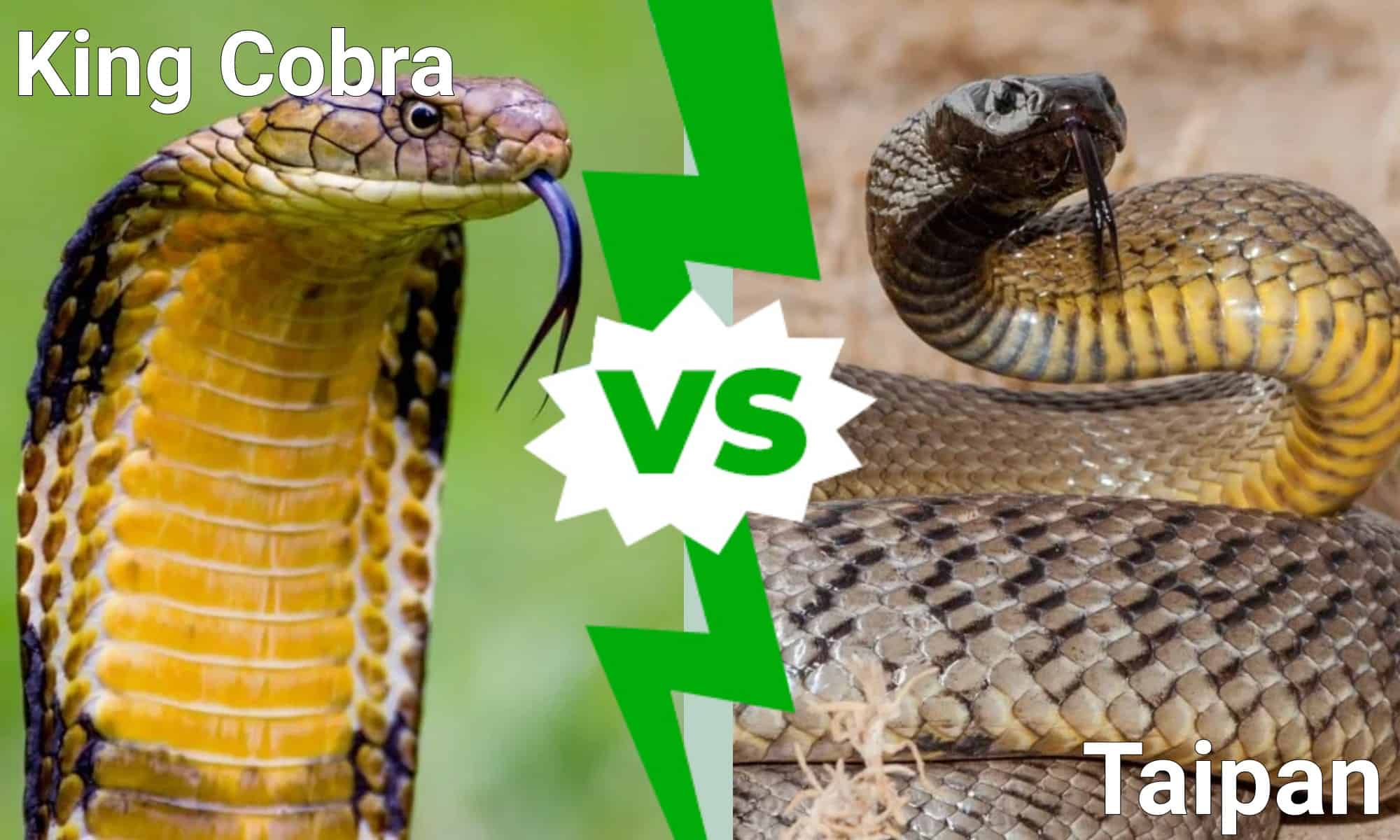

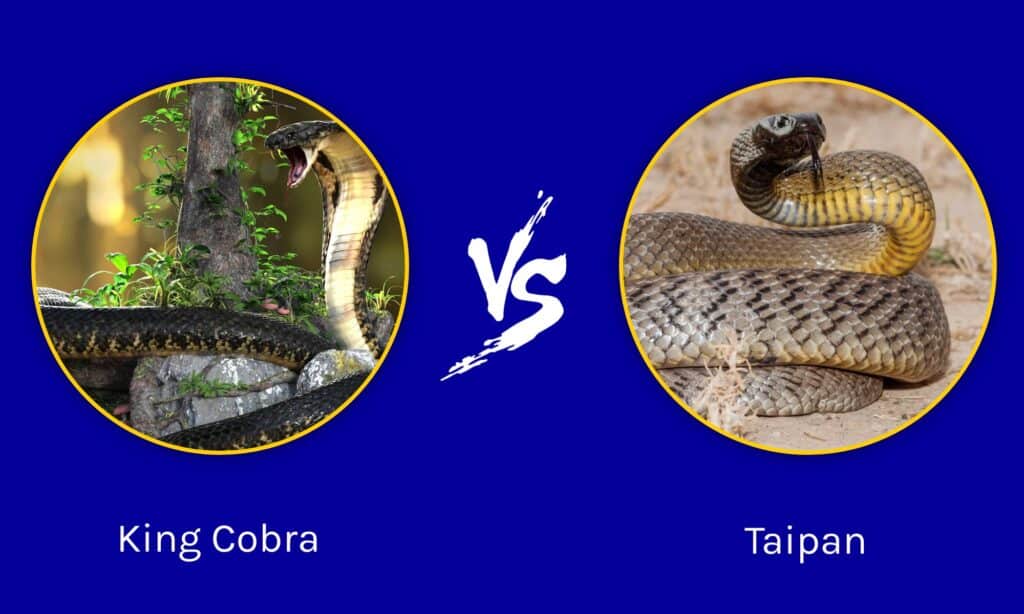
The world is home to many venomous snakes. Among the most venomous snakes in the entire world are king cobras and inland taipans. Although the inland taipan snake, also known as the fierce snake, has incredibly powerful venom, that doesn’t mean it is the most dangerous to other snakes. The king cobra’s scientific name, Ophiophagus hannah, means “snake-eating king.” So, which animal would win in a fight between a king cobra vs. an inland taipan? Keep reading to find out.
Comparing a King Cobra and a Taipan
| King Cobra | Inland Taipan | |
|---|---|---|
| Size | Weight: 10-15 pounds Length: 10-19 feet | Weight: 3-4.4 pounds Length: 6-8 feet |
| Attack Method | Hides and strikes quickly when prey comes into range; bites the back of its prey’s head and holds on until prey is immobilized | Corners target before rapidly delivering multiple bites |
| Venom | 0.5-inch fangs; up to 1000mg of venom; a single bite can kill 20 humans | 0.25-inch fangs; up to 110 mg maximum load; a single bite can kill 125 humans |
| Defenses | Large size; threat display that includes hood spread, growling, and raising its upper body 3-4 feet in the air | Curves upper half of its body into an S-shape; scale color aids camouflage; remains still to avoid notice |
| Predatory Behavior | Ambush predator; specializes in killing other snakes | Ambush predator; primary prey is small mammals |
Key Factors in a Fight Between a King Cobra and an Inland Taipan
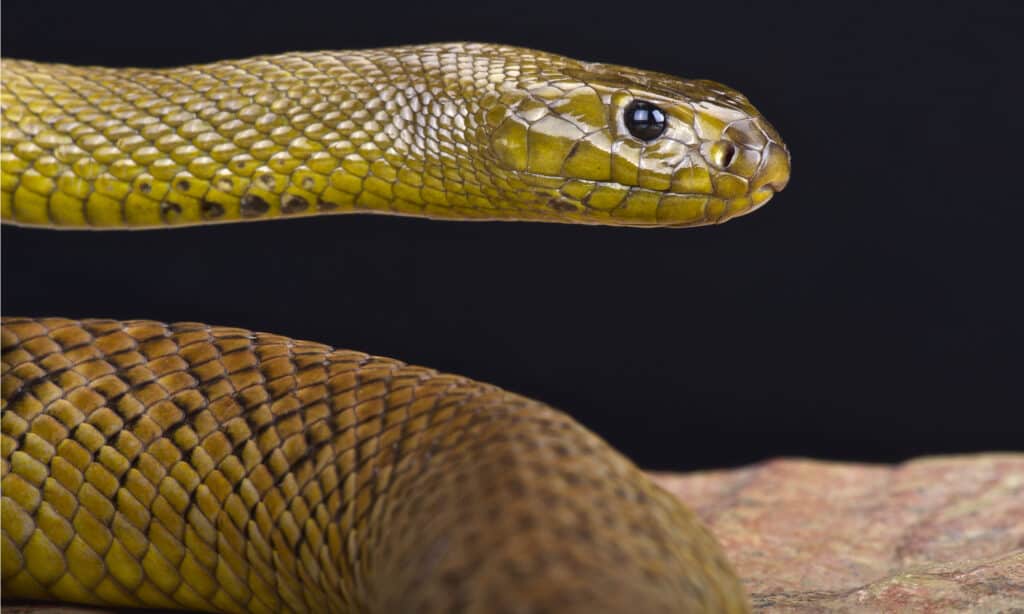
The inland taipan is the deadliest land snake on the planet.
©reptiles4all/Shutterstock.com
The most important factors in a battle between a king cobra and an inland taipan (Oxyuranus microlepidotus) are size, attack method, venom, defenses, and predatory behavior. Take a look at each of the factors in the paragraphs below.
Size
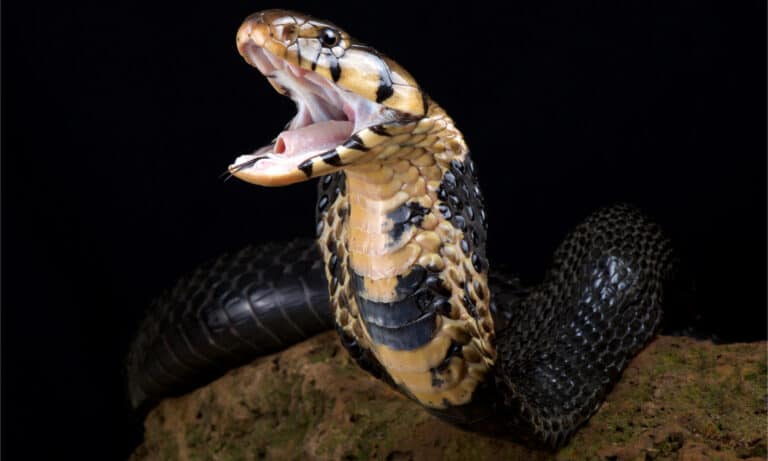
The king cobra is larger on average than an inland taipan. Most king cobras are 10-12 feet long, with the longest king cobra measuring about 19 feet. They are also robust snakes with large bodies and can weigh from 13-22 pounds.
The average inland taipan snake only measures between 4-6 feet, with the longest reaching about 8 feet in length. They also weigh significantly less than a king cobra at only 3-4.4 pounds. So the longest, largest inland taipan snakes are much smaller than even the average king cobra.
Attack Methods
The king cobra typically hides in vegetation and strikes quickly when prey comes into range. It bites the back of its prey’s head and holds on until prey is immobilized. King cobras may also rear back and lift the front of their bodies 3-4 feet off the ground. That allows them a better position to attack, lunging forward and striking several times in succession. King cobras can strike up to one-third of their body length from that position and their strikes are lightning fast.
The inland taipan corners its target before rapidly delivering multiple bites. It curves the upper half of its body into an S-shaped stance before attacking. It lashes out at blinding speeds, injecting its prey with the deadliest venom of any land snake.
Venom
The king cobra’s venom may not be as potent as the inland taipan’s, but the king cobra compensates by injecting massive amounts of venom. King cobras have 0.5-inch long fangs that allow them to inject up to 1,000mg of venom into their prey. This neurotoxic and cytotoxic venom is said to be powerful enough to kill 20 humans, or even an elephant, in a single bite. King cobras are also believed to deliver such large amounts of venom per bite because they require more venom to overpower other snakes.
Inland taipan snakes have 0.25-inch fangs that can deliver up to 110mg of venom. While that is only about one-tenth the amount of venom that the king cobra delivers, a single bite from an inland taipan snake is believed to be enough to kill 125 humans. The venom is a combination of neurotoxins, hemotoxins, and chemicals that increase the venom’s uptake in the body.
Physical Defenses
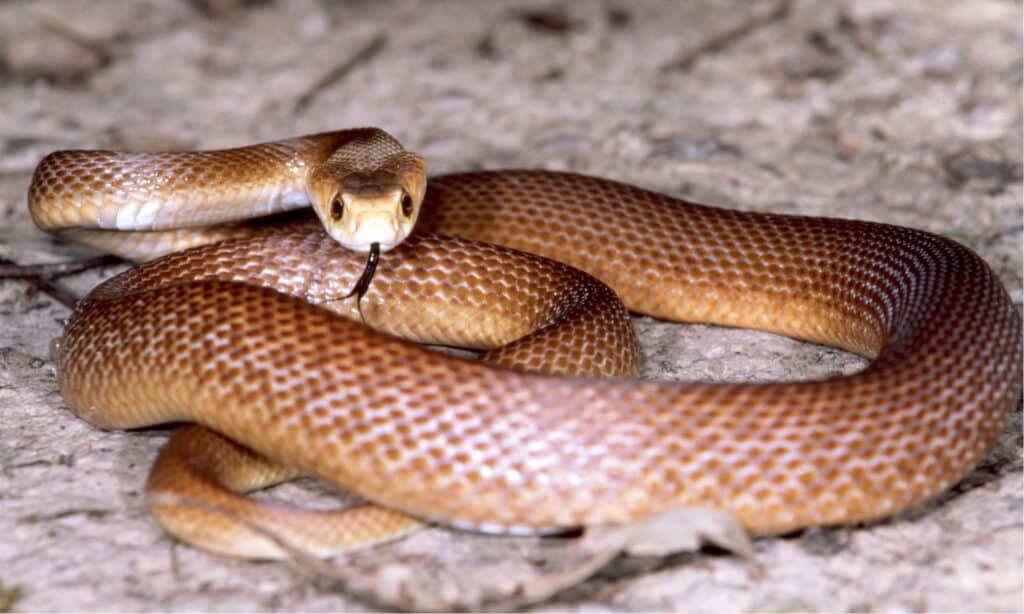
Inland taipans are highly venomous snakes that prefer to hide rather than fight.
©Ken Griffiths/Shutterstock.com
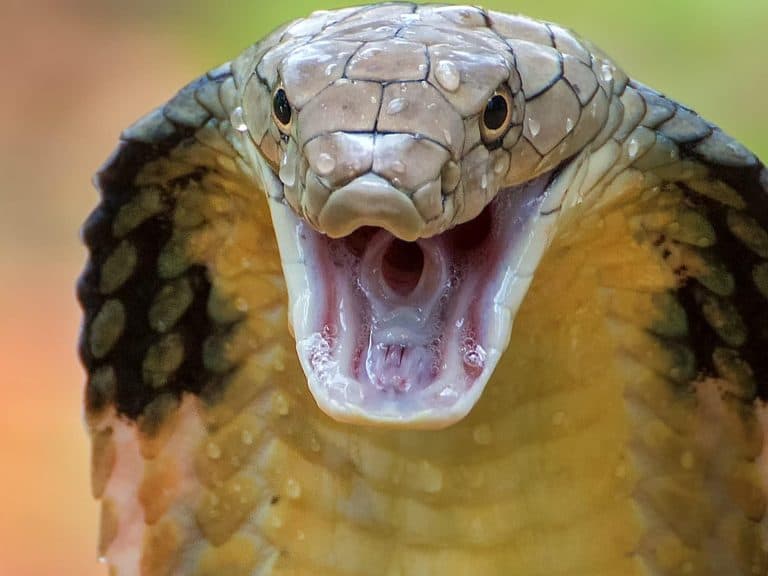
The king cobra’s large size and intimidating threat display are its primary defenses prior to attacking. Most animals or humans that come across this massive, growling, hooded snake will back away because they know it’s a losing battle. King cobras have special pouches in their trachea that allow them to make low-pitched growling sounds. However, the king cobra is not an aggressive snake and would rather avoid a fight.
The inland taipan is also a shy snake and would also rather slither away than fight. It relies on camouflage to stay hidden and often retreats into holes or cracks in the ground when a threat appears. If it cannot run and hide, it pulls into its S-shaped threat posture to warn intruders before striking.
Predatory Behavior
Both king cobras and inland taipans are ambush predators. They prefer to sneak up on their prey or wait for it to come to them. However, the king cobra is unique in that it specializes in ambushing and attacking other snakes, including other venomous snakes.
As mentioned above, inland taipan snakes corner their prey, often in the prey’s burrows, before striking. These snakes typically feed on small to medium-sized mammals, including rodents and marsupials.
Which Snake Would Win in a Fight Between a King Cobra and an Inland Taipan?
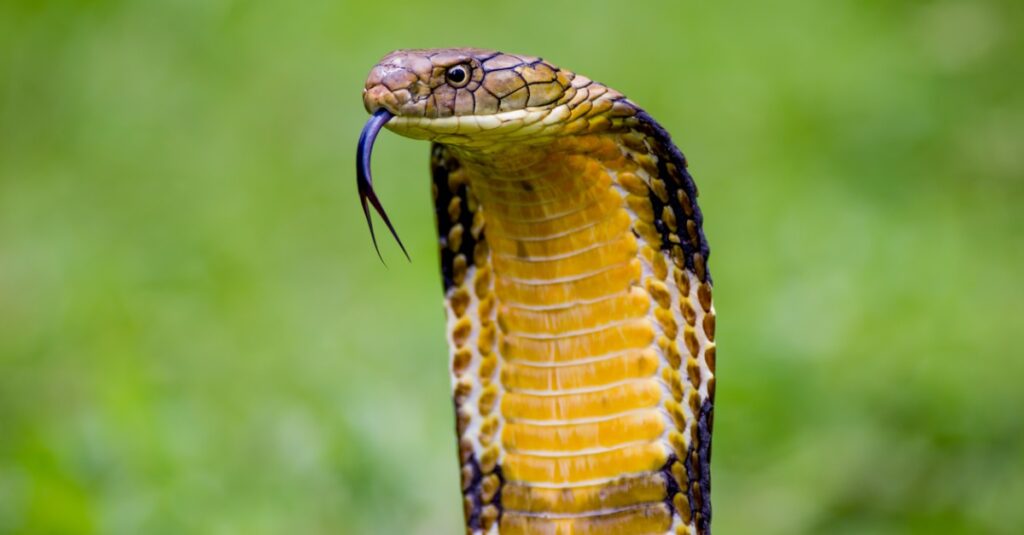
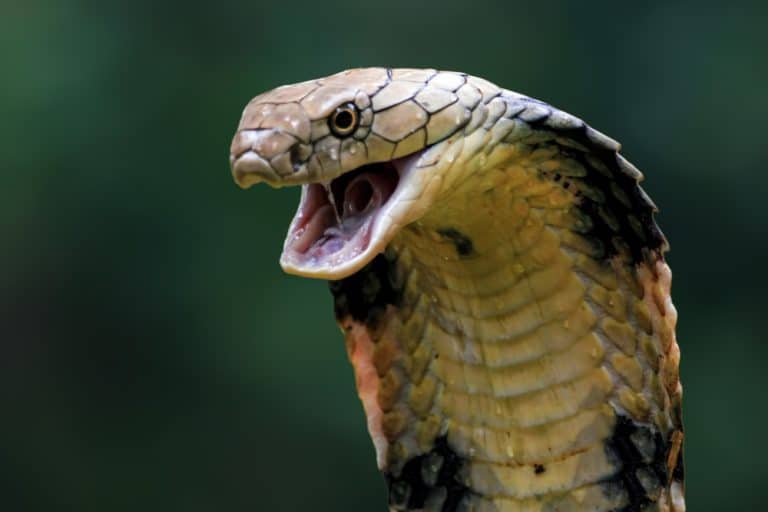
King cobras are snake-killers, which would help them win against the inland taipan.
©iStock.com/takeo1775
The king cobra is found across Asia and Southeast Asia, while the inland taipan snake is located in Australia’s outback, primarily in the provinces of Queensland and South Australia. So, these snakes do not share the same habitat. Both snakes would also rather flee than fight. However, if we were to imagine a fight between the two, the king cobra would likely emerge victorious over the inland taipan. While the inland taipan has much deadlier venom, its venom potency would not necessarily be enough to overcome the advantages of the king cobra’s vast experience in attacking and killing other venomous snakes.
Although these snakes are both elapids, which are snakes with fangs fixed in the upper jaws, they are from different genera and different regions, so they have no resistance to one another. For example, king cobras are resistant to the venom of other local elapids like true cobras and kraits, which is partially why king cobras can prey on other snakes. However, the king cobra would not be resistant to the venom of the inland taipan.
Both snakes are ambush hunters and are known to strike extremely quickly, but if one snake ambushed the other, that snake would be in the best position to win. Yet, if they encountered each other in the open, then the king cobra has a massive advantage. This snake is much larger on average and has a longer reach. It also regularly fights fast snakes. If the king cobra managed to bite the taipan’s head, the fight would be over, and the king cobra would not be at risk. It would bite and hold on to prevent a counterattack. If the cobra struck the inland taipan’s body, then the taipan could counterattack. If both snakes were bitten, it is likely that both would die. However, the inland taipan is less likely to prevail against the king cobra’s superior size and experience.