
Quick Take
- Great blue herons are large wading, water birds.
- Great blue herons and bald eagles have very similar, large wingspans.
- Both male and female great blue herons protect the nest and incubate their eggs.
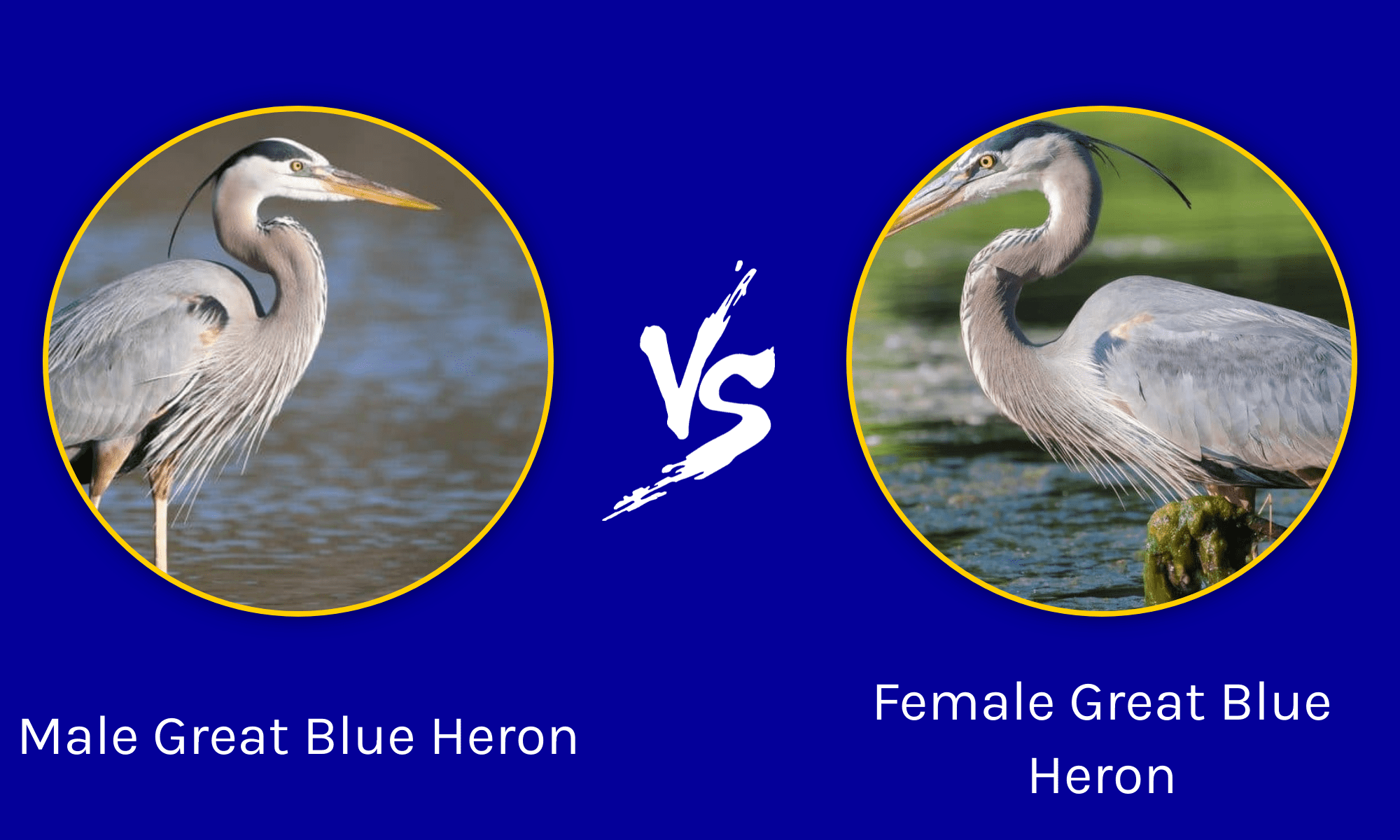
The larger of the two heron species in the genus Ardea native to North America, the great blue heron (A. herodias), is well known for its distinctive long legs, long neck, and stunning grey-blue plumage. These magnificent water birds weigh five to six pounds, stand up to 4.5 feet tall, and have wingspans approaching seven feet. Because they look incredibly similar, it can be difficult to distinguish between female and male great blue herons. Continue reading to discover their key differences and the most reliable way to differentiate a female great blue heron from a male.

The key differences between male and female great blue herons are size, nesting behavior, juvenile appearance, and mating behavior.
©flownaksala/iStock via Getty Images
The Key Differences Between Male and Female Great Blue Heron
Great Blue Herons are tall wading birds that live near rivers, marshes, lakes, and ponds. They use their long legs and sharp bills to hunt fish and other aquatic life, though they also forage on land. They are known for patiently standing or walking in shallow water to catch prey. While female and male great blue herons look remarkably similar, there are key differences between the two sexes, including their size, nesting behavior, and mating behavior.
Size
Great blue herons exhibit sexual dimorphism, which means that different sexes of the same species are of different sizes.

Male great blue herons are heavier and longer than the females.
©Joseph Scott Photography/Shutterstock.com
Male great blue herons are larger than the females. ‘Males are generally heavier, averaging around five to six pounds, while females typically weigh between 4.5 and 5.5 pounds. Males are also slightly longer than females, with great blue herons ranging from 38 to 54 inches in length overall, and males tending toward the upper end of this range. Males tend to have a slightly longer wingspan than females, with great blue herons generally ranging from 5.5 to 6.6 feet in wingspan. Males are also slightly taller than females, though the difference is difficult to spot unless the birds are standing side-by-side.
Mating Behavior
One of the most important aspects of a great blue heron’s life, and to the survival of the species, is the choosing of a mate. Great blue herons do not mate for life; instead, they form monogamous pairs that remain together for the breeding season, choosing new mates the following year. To choose a mate, great blue herons undertake a courtship ritual in which the roles of the males and females are very different.

Behavior differentiates male and female great blue herons more than appearance.
©jo Crebbin/Shutterstock.com
Great blue herons nest in large colonies, and the males usually arrive at the nesting grounds before the females in order to choose a suitable nest location. They fly in huge circles above the nesting grounds while calling to the females in an attempt to woo them. During this circular flight, the males tend to beat their wings slowly and fly with their necks fully extended. Fights often break out between males as they fight for the attention of the females, but these fights are rarely fatal. While the males are doing their utmost to show themselves off as the most suitable mate, the females sit in one spot and call to them until the right mate presents himself.
Nesting Behavior
The roles of the males and females during the nesting process are very different. The males tend to choose the nest site before the females arrive at the nesting grounds. Sometimes he chooses an entirely new location for a nest to be built from scratch, while other times he selects an old nest. Once the male and female have successfully bonded, the male then selects the materials needed to build the nest and brings them to the female. Quite often, they present the twigs and leaves to the female with a bit of a performance. This might include dropping the nesting materials in front of her while shrieking.

Both male and female great blue herons participate in the incubation process.
©mark smith nsb/Shutterstock.com
Once the male provides the female with the necessary materials, the female great blue heron takes sole responsibility for building or repairing the nest. This activity can take up to a week to complete, which is not surprising, considering how large these nests are. Great blue heron nests are approximately two feet wide when they are first built, while older nests can be three feet wide and three feet deep.
Once the nest is complete, the female will lay up to 6 eggs. The incubation duties are shared by both parents. The eggs take 25 to 30 days to hatch, although they won’t all hatch at the same time. Instead, they hatch over a period of several days, with the first chick born being the strongest. The firstborn chick also grows the fastest and is the most aggressive.
Male Vs. Female Great Blue Heron: Summary
| Male | Female | |
|---|---|---|
| Size | 6 to 8 pounds Up to 54 inches long | 4.5 to 6 pounds 34 to 40 inches long |
| Develop white feathers on head before females. Legs turn bright orange at beginning of breeding season | ||
| Mating Behavior | Fly in large circles above the nesting grounds while calling loudly. Fight off other males for their chosen female | Remain in one place while calling to the males |
| Nesting Behavior | Chooses the nest site and bring nesting materials to the female | Builds the nest using the materials the male provides for her |