
Raccoons (Procyon lotor) and Virginia opossums (Didelphis virginiana), commonly called possums, are mammals native to North America. Although they do not look similar, they have some similar traits. Both animals are nocturnal, are adapted to urban and suburban areas, and are often seen as nuisance wildlife because they like to help themselves to your garbage cans. However, they don’t just differ in physical characteristics. Find out what sets these two animals apart in our comparison of raccoons vs. possums.
Comparing Raccoons vs. Possums
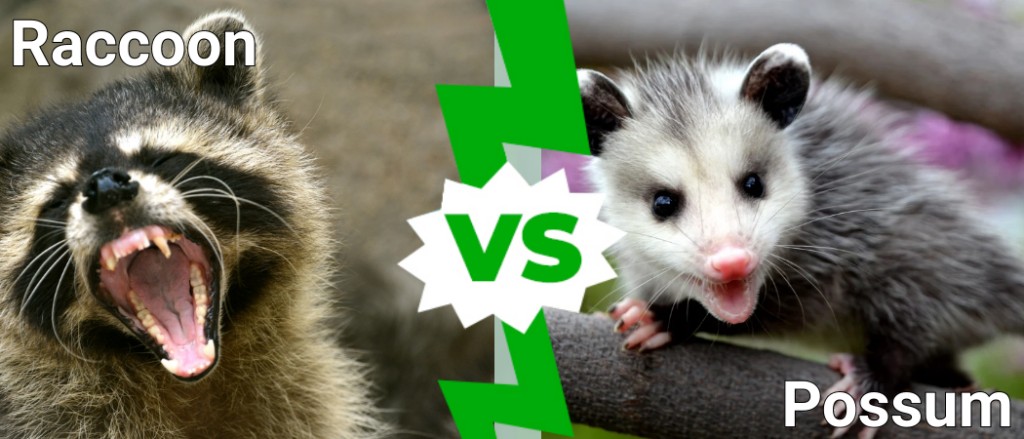
Comparing Raccoons and Possums
| Raccoon | Possum | |
|---|---|---|
| Distribution and Habitat | North America, South America, and parts of Europe | North America and Central America |
| Size | 20-30 inches long including the tail; typically weighs 10 to 25 pounds | 24-36 inches including the tail; weighs 4-12 pounds |
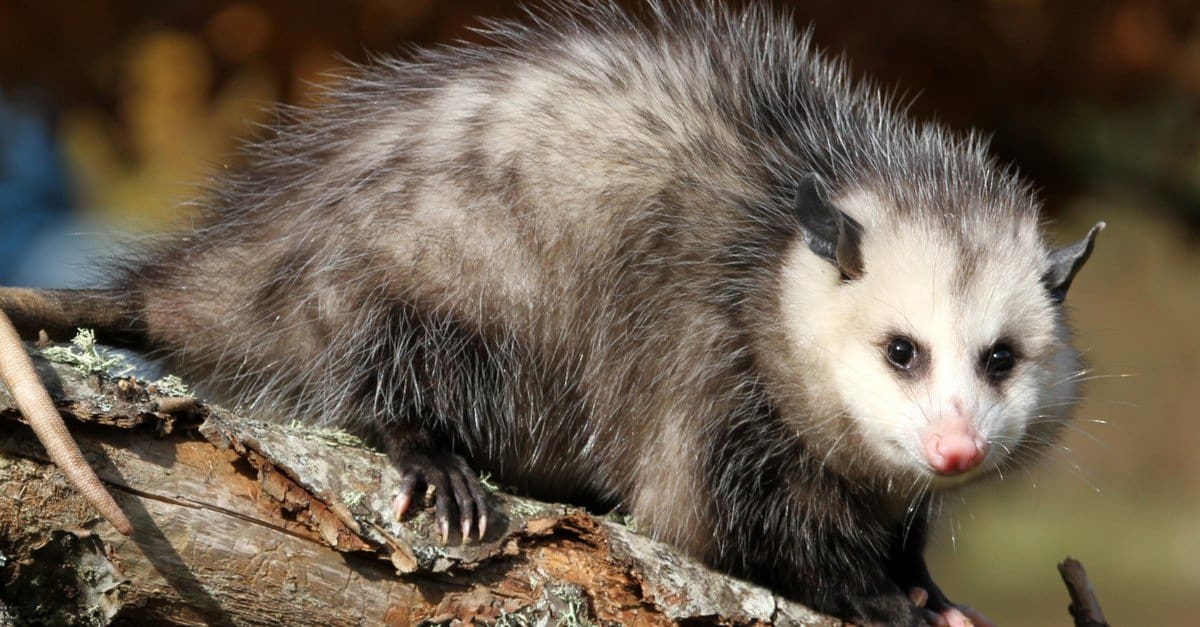
| Physical Characteristics | Typically gray and black with a black “mask” on their face; bushy, banded tails | Gray, white, and black; white face with narrow snout and pink nose; hairless, prehensile tail |
| Reproduction | Placental mammal with live birth | Marsupial; young finish development in mother’s pouch |
| Threat Responses | Threat displays; snarling and growling; fleeing | Hissing and growling; playing dead; fleeing |
| Lifespan | 2-3 years in the wild; up to 20 years in captivity | 1.5 to 2 years old in the wild; 3 to 4 years in captivity |
The 6 Key Differences Between a Raccoon vs. Possum
Possums resemble rodents due to their body shape, hairless tails, and prominent eyes, while raccoons are more often mistaken for cats because of their triangular faces, bushy tails, and similar ears. There are several other key differences between them, including distribution and habitat, size, other physical characteristics, reproduction, threat responses, and lifespan. Explore each of these elements in greater depth in the upcoming sections.
Distribution and Habitat
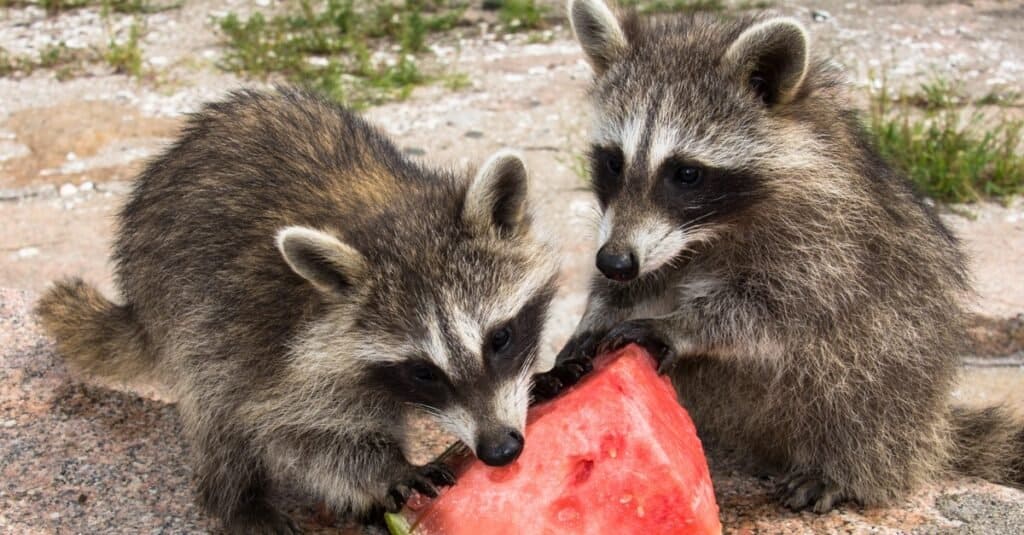
Raccoons are widely distributed across the U.S.
©Landshark1/Shutterstock.com
The ranges of the raccoon and the possum overlap in North America, but raccoons also live in South America and have been introduced in Europe, where they have become an invasive species. Both animals can be found in southern Canada, northern Mexico, and the U.S., where raccoons are widespread throughout the country. Raccoons prefer riparian areas along lakes, streams, swamps, and marshes. They can also be found near farmland and in suburban and urban neighborhoods. They generally den in hollow trees, leaf and brush piles, and burrows.
In North America, the Virginia possum primarily lives in the eastern U.S., parts of southern Canada, and Mexico. They also live in some parts of Central America. Recently, possums have made their way to the West Coast of the U.S., including California, where they face many challenges from parasites in their habitat. Possums prefer forests, open woods, and farmland, as well as riparian areas along swamps, marshes, and river bottoms. They can also be found in suburban and urban areas. Like raccoons, they often den in tree cavities.
Size
Raccoons may be slightly shorter than possums because of their tail length, but they are typically much heavier. Raccoons generally measure about 20 to 30 inches long from the nose to the tip of the tail. Adult raccoons average between 10 to 25 pounds in weight, but some males in the northern part of their range can exceed 30 pounds.
Possums typically range from 24 to 36 inches long, including their tails. They weigh between 4 and 12 pounds. Larger possums are found further north in their range, while smaller possums live in warmer climates.
Physical Characteristics
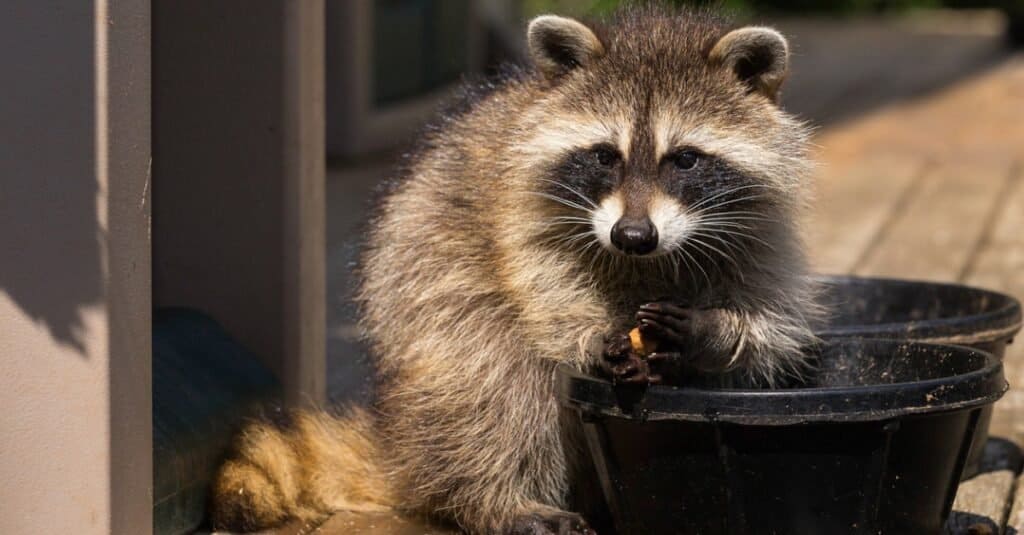
Raccoons are known for the dark colored mask on their faces.
©AEWD/Shutterstock.com
Raccoons are known for their unique coloration, especially on their face. Although raccoons can be black, white, gray, cinnamon, brown, and other colors, they are mostly black and gray with a darker colored mask on their faces. Their noses are also usually black. Raccoons often have bands of color on their bodies, alternating between lighter and darker colors, especially on their bushy tails.
For the most part, possums show less variation in color. They have white faces, pink noses, and a mix of gray, white, and black fur without any patterns. A possum’s tail is hairless but is also much more useful than a raccoon’s tail. Possum tails are prehensile, meaning they can be used to grasp surfaces when the possum is climbing.
Reproduction
One of the biggest differences between raccoons and possums is in their reproduction and development. Raccoons are placental mammals, and possums are marsupials. That means raccoons give birth to live young that finish their development inside their mother’s body. Raccoons breed from around January to the middle of March. After a gestation period of about two months, they give birth to 2 to 5 kits. The kits are weaned between 8 and 12 weeks of age. They typically only give birth once a year.
Possums are marsupials, so they give birth after a much shorter gestation time of about 12 to 14 days. Around 7 to 11 young possums then crawl into their mother’s pouch, called the marsupium, and attach to a teat for the next two months. The babies are weaned at around 100 days, but they will begin leaving the pouch and eating solid food before being fully weaned. Possums may give birth to two or three litters per year.
Threat Responses
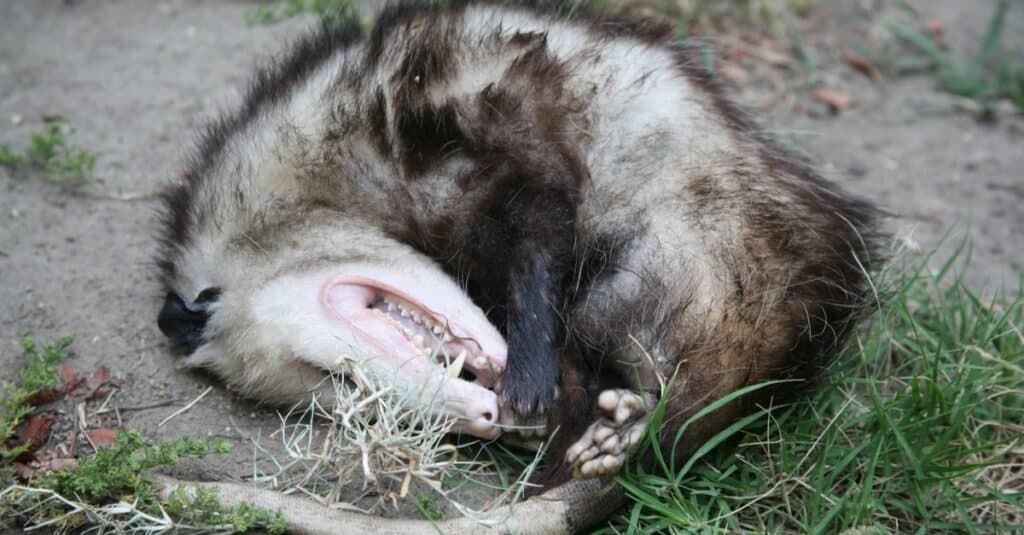
The possum’s threat response to play dead is involuntary and can last up to four hours.
©iStock.com/ScrappinStacy
When threatened, raccoons will typically exhibit defense displays similar to cats. This includes snarling, growling, hissing, thrashing their tails, and arching their backs while puffing up their fur to look larger. Most of the time, they will flee from a threat if they can. Raccoons also have sharp claws and teeth, which they use if forced to fight. Raccoons can transmit diseases like rabies, so it is best for humans and pets to avoid a confrontation.
Most people have heard the phrase “playing possum,” which comes from the possum’s habit of playing dead when faced with potential threats. They first open their mouths wide and growl or hiss. They may attempt to flee or bite when protecting their young. If a predator grabs a possum, particularly a young one, it pretends to be dead, stiffening its body, defecating, and excreting a foul-smelling substance. However, this is an involuntary response, and the possum may remain in this catatonic state for up to four hours. Possums rarely carry rabies, but they can carry other diseases, so humans and pets should avoid them.
Lifespan
In the wild, raccoons do not live much longer than possums, but in captivity, they live far longer. In the wild, raccoons usually only live for 2 to 3 years. Some sources suggest they can live up to 16 years in the wild, but this is extremely rare. However, in captivity, raccoons have been known to live as long as 20 years.
Due to high levels of predation, possums typically only live for 1-2 years in the wild. Some sources claim they can live to 7 years or even longer in captivity, but most experts believe the average lifespan in captivity is closer to 3 or 4 years.