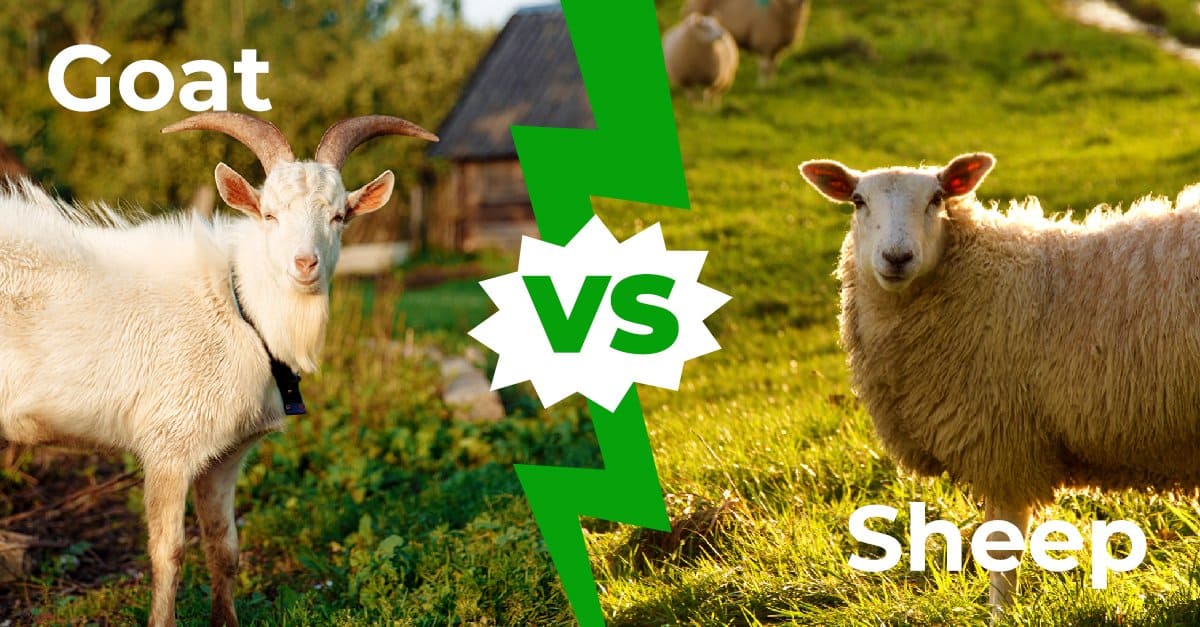

Have you ever looked into the eyes of a sheep or goat? Sheep and goat eyes appear very similar on the surface, but they are actually quite different. In this article, we’ll analyze sheep eyes vs. goat eyes and learn about their appearance, including shape and color, as well as functionality.
Comparing Sheep Eyes vs. Goat Eyes
| Characteristics | Sheep Eyes | Goat Eyes |
|---|---|---|
| Pupil Shape | Rectangular but more slit-like in appearance | Wider and more pronounced rectangular shape |
| Color | Brown or greenish-tan | Light brown or blue |
| Field of Vision | Up to 320 degrees | 320 to 340 degrees |
| Vision Functionality | Poor depth perception, significant blind spot in front of their noses | Limited depth perception and minor front blind spot |
Key Differences Between Sheep Eyes and Goat Eyes
You may not see much of a difference in sheep and goat eyes just by looking at them. However, there are distinct differences, especially in functionality. Most differences are hidden from the naked eye and are only known because of scientific studies. Let’s take a closer look at these differences below.
Differences in Eye Shape
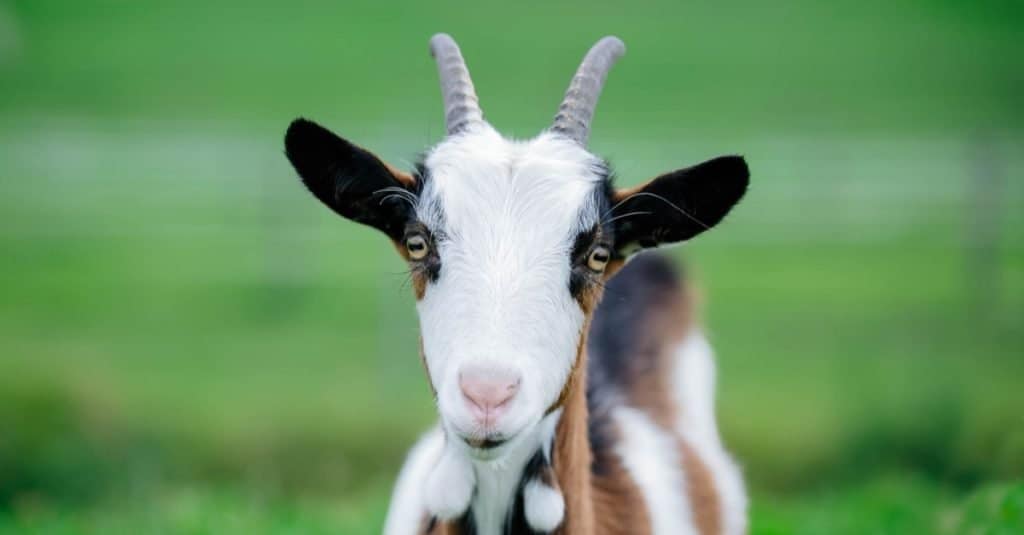
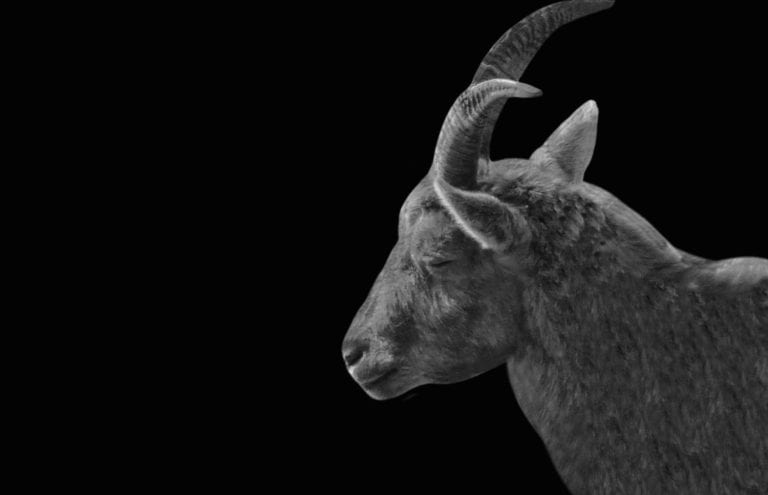
Goats and sheep have rectangular pupils that allow them to see more clearly at ground level.
©Daria-Borovleva/Shutterstock.com
Both goats and sheep have rectangular pupils that look like horizontal slits. However, goats’ eyes have wider and more pronounced rectangular pupils, while sheep eyes can appear more slit-like. People have described their eyes as unusual and unsettling. While they may differ significantly from human eyes, their appearance serves a purpose. If you look closely as a sheep or goat rotates its head, you will notice that its eyes remain perfectly parallel to the ground — a phenomenon known as cyclovergence.
Their oddly shaped pupils enhance the amount of light and image quality they perceive, helping them see more clearly at ground level. However, goats and sheep are not the only animals with rectangular-shaped pupils. Many grazing animals, such as deer, also have slitted pupils that rotate to keep their eyes parallel to the ground.
A comparative study performed on sheep and goat eyes found that the size and shape of their optic discs are also different, which impacts their blind spots. A blind spot occurs at the optic disc, which is where the optic nerve exits the eye. Goats and sheep both have a blind spot directly behind them. However, sheep have a significant blind spot directly in front of their noses, while goats only have a small blind spot.
Eye Color
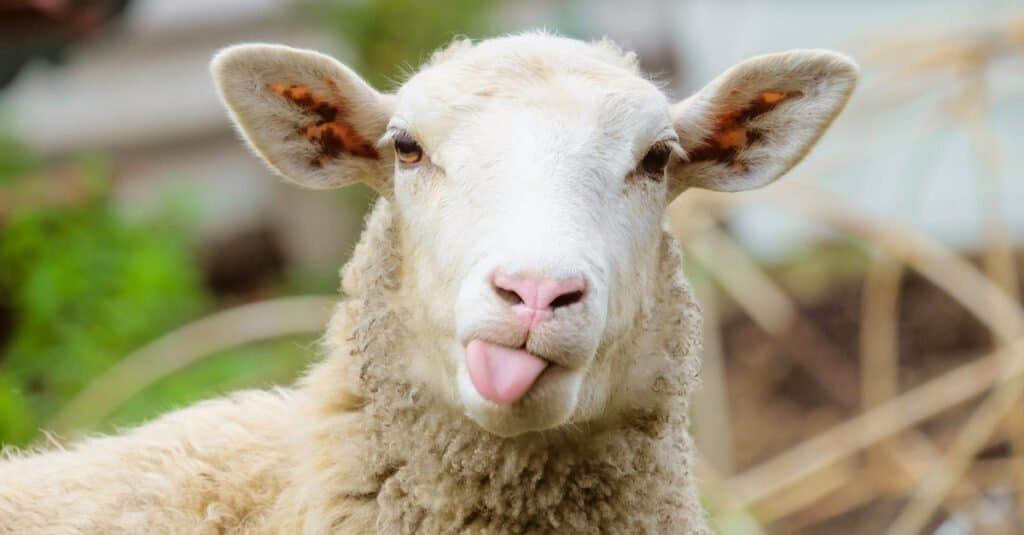
Goats have blue and brown eyes, while sheep’s eyes are shades of brown.
©N-sky/Shutterstock.com
Goat eye color ranges from light blue to light brown, and even to amber. Blue eye color is a dominant trait most typically seen in the Nigerian dwarf breed. It is common for goats to have almost completely white irises with a speck of blue. In rare occurrences, you may see goats with marbled eyes — brown and blue mixed together — or with two different colored eyes, one brown and one blue.
Sheep eyes are usually found in various shades of brown. They can range from light brown to a darker amber color. Some sheep’s eyes take on a more green color mixed with brown. Lambs’ eyes are often a golden yellow to light brown color.
Vision Functionality
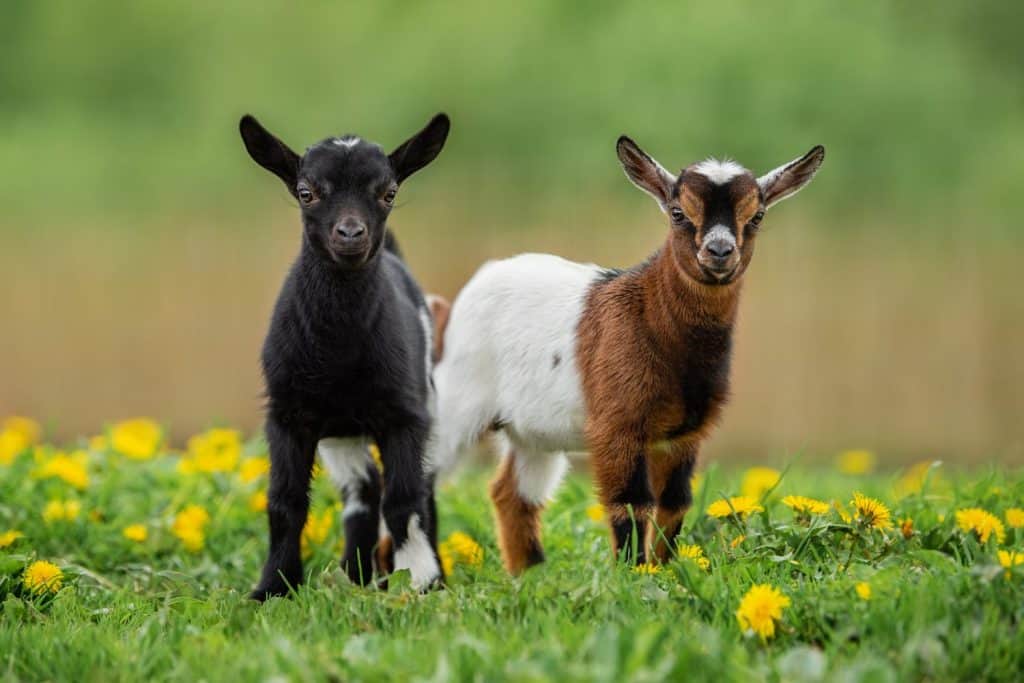
Both goats and sheep have a wide field of view, allowing them to see almost all the way around them.
©Rita_Kochmarjova/Shutterstock.com
Sheep and goats have excellent vision. The elongated pupils, combined with the placement of their eyes on the sides of their heads, allow for a wide field of view. These animals can see almost all the way around them. Goats have a field of vision between 320° and 340° of their surroundings. Sheep also have good peripheral vision, with a field of view up to 320°. Sheep have poor depth perception, while goats have better, but still limited, depth perception. Because of their wide-angle vision, these grazing animals are extremely sensitive to motion. The slightest movement nearby them may startle them.
Both sheep and goats have adequate night vision and will graze in the dark. However, they still see better in the daytime. As in humans, the shape of their pupils controls the amount of light that enters the eye. They also have a tapetum lucidum, a reflective layer that aids vision in low-light conditions.
Contrary to popular belief, goats and sheep can see some colors. However, because they only have two types of color receptors, they cannot see the full color spectrum. Sheep are red-green colorblind, so they generally see blue and yellow hues. Goats have a similar type of red-green colorblindness and can see blue and yellow. However, one study found goats can distinguish between yellow, orange, blue, violet, green, and various shades of gray.