






Quick Take
- The animal most Americans picture as a mountain goat isn't actually a goat at all, and the difference turns out to matter more than you'd think. See the true goat classification →
- Goats have a built-in biological clock hidden on their horns, and reading it requires no tools. Read about goat horns →
- A luxury cosmetics ingredient found in high-end beauty products has a surprisingly unglamorous origin, one that exists entirely because of goats.
- Domesticate a goat for thousands of years, then set it free, and something unexpected happens almost immediately. Explore domestication history →
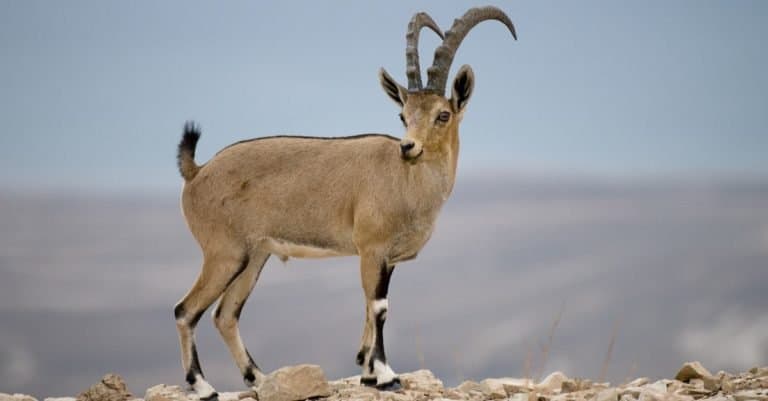
The goat is a type of ungulate (hoofed animal) with big horns and a distinctive beard. Traversing some of the most rugged and forbidding terrain in the entire world, the goat is an expert mountaineer and climber. Its astonishing ability to ascend cliffs and other vertical surfaces has few equals in the animal kingdom.

4 Incredible Goat Facts
- These animals were originally domesticated around 10,000 years ago for their meat, milk, and hair. There are over 300 distinct breeds of domesticated goats alive in the world today, with all manner of different traits and adaptations. However, despite being one of the earliest domesticated animals, they will quickly revert to a feral type if they are released into the wild.
- The Damascus goat, a domesticated breed named after Damascus, the capital of Syria, and found across Syria, Lebanon, and Cyprus, is well-known for its strange-looking, misshapen head. But in fact, the Damascus goat is an excellent producer of milk and meat.
- In many cultures, these animals are one of the most common sacrificial animals for religious ceremonies. The goat also has spiritual significance as a spirit animal and a representation of the sign of Capricorn in Western astrology.
- Well-suited for inhospitable conditions, they can survive for a long time on only sparse food.
Classification and Scientific Name
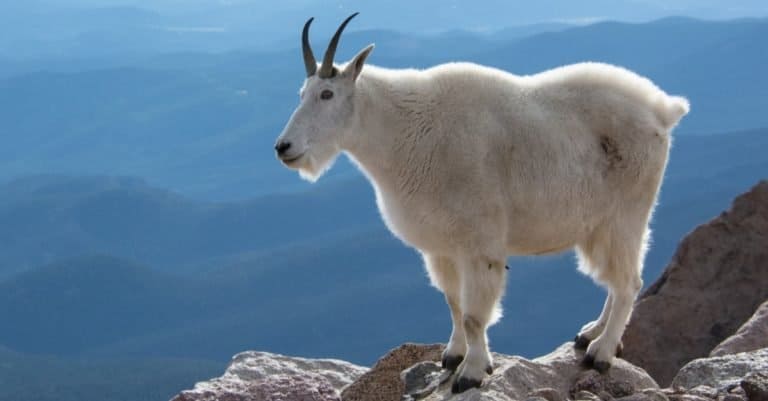
In taxonomical terms, these animals are defined as a collection of approximately nine distinct species that belong to the genus Capra (which is the Latin term for the goat). These nine species originated exclusively from the Old World. The North American mountain goat, which many Americans may be familiar with, is not considered to be a “true goat” at all; it’s more closely related to the antelope in a separate genus. Regardless, all species belong to the family of Bovidae, which also contains sheep, buffalo, antelopes, and domestic cattle.
Evolution
The genus Capra evolved during the Ice Ages, eventually becoming today’s goat species, with several ibex species. It’s believed that the bezoar ibex was the earliest goat to be domesticated in the Zagros Mountains by Neolithic farmers. These goats were used for meat and milk production, as well as providing materials to build shelters and tools.
Today, there are over 300 breeds of goats that are used in many ways, but most are typically used for either their milk, meat, skin, hair, or a combination of these.
Appearance
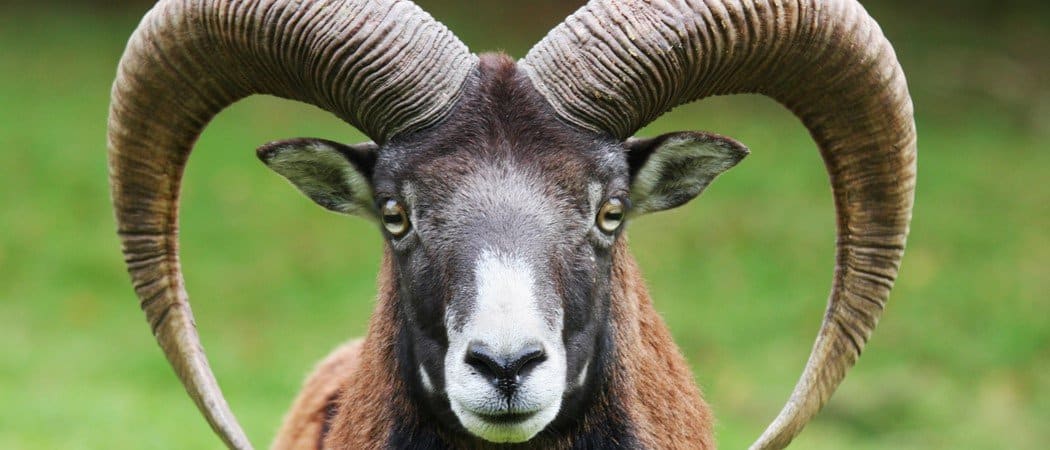
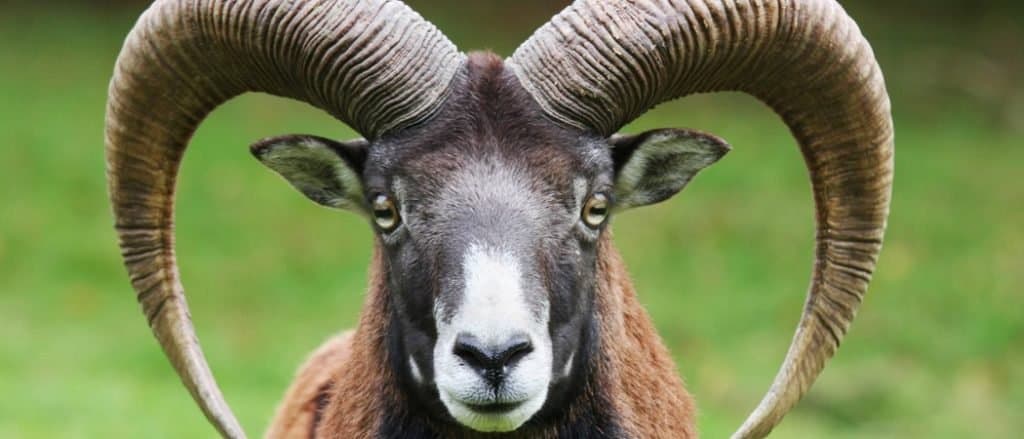
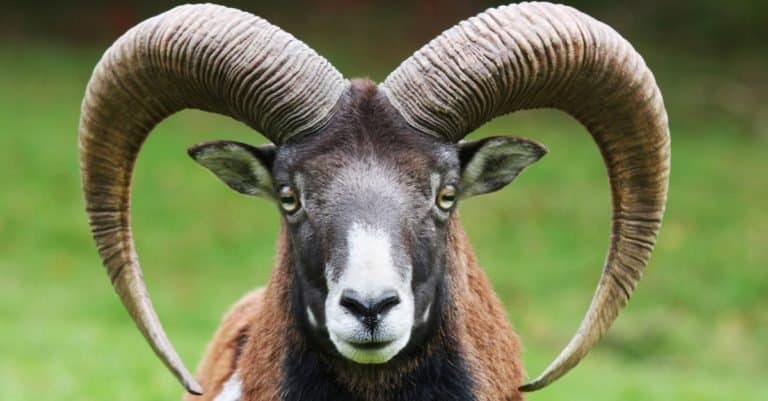
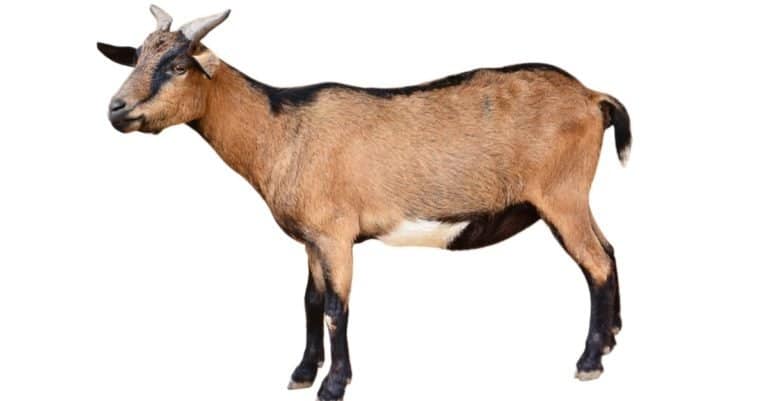
Many physical qualities make a goat, including the split hoofs, the horizontal pupils, the long, scraggly beard, a narrow body and skull, scent glands, and horns. These horns come in many different shapes and sizes, including straight, corkscrew, and curved, though most bend backward. They are composed of keratin, the same substance as hair and fingernails, and grow throughout the animal’s lifetime. It is possible to tell the goat’s age just by counting the growth rings. As a member of the even-toed ungulates, goats walk on their third and fourth toes. Some also have a vestigial dewclaw, or a nail that grows from farther up the leg, like a dog.
These animals bear a very strong resemblance to sheep, which isn’t too surprising given their close evolutionary relationship. Some species of goats and sheep are notoriously difficult for a non-expert to tell apart. The main differences with the sheep are the woollier coat, a downturned tail, and, on occasion, they lack horns entirely, or have looped horns that spiral outward from the head (though goats can sometimes have these too). Despite the physical similarities, goats and sheep have different numbers of chromosomes, which makes it very difficult to breed them together to produce a viable hybrid. They also seem to forage in slightly different ways: the goat tends to browse, while the sheep grazes for food on the ground.
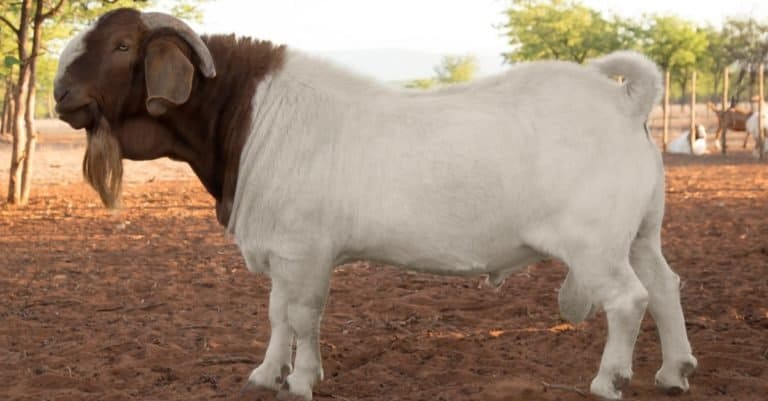
Most species and breeds of goats weigh between 40 and 300 pounds and stand up to 42 inches at the shoulders. That’s the difference between the American pygmy goat and the massive Boer goat. Coat markings also exhibit a wide degree of variation, but they’re usually some combination of black, white, brown, tan, or red. Males can be distinguished from females by the larger size of the body and the horns.
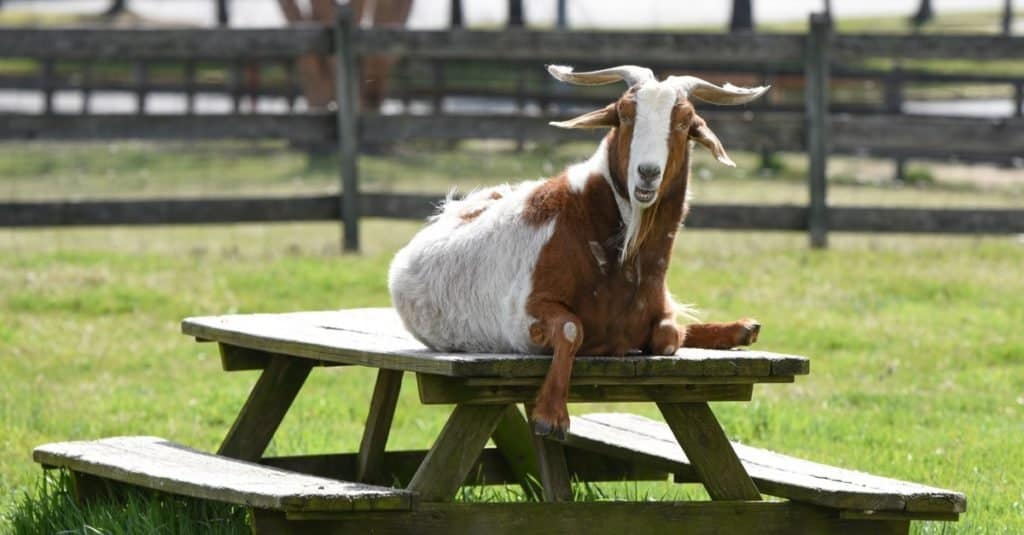
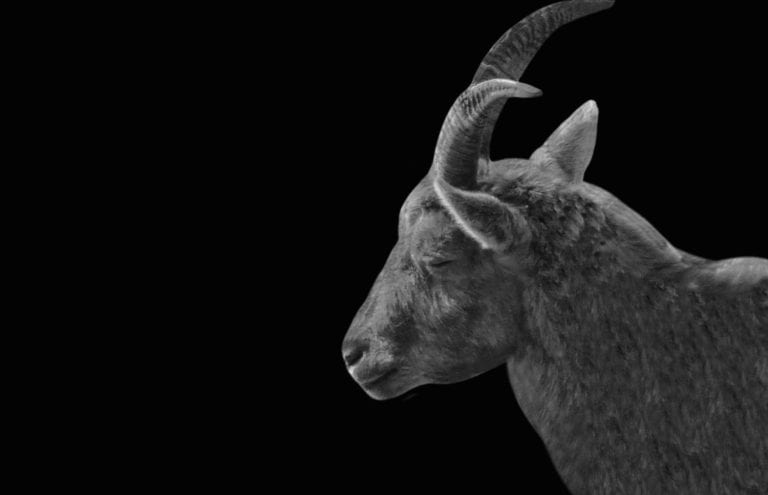
Goats are characterized by split hoofs, horizontal pupils, a long, scraggly beard, a narrow body and skull, and horns.
©Gretchen Blair Madden/Shutterstock.com
Behavior
The one behavior that sets goats apart from most other animals, including the closely related antelopes and cattle, is the ability to climb steep mountains and near-vertical surfaces. Mountain goats can live at altitudes of greater than 13,000 feet. The slim physique (which provides balance), the specialized hoofs (which can grip irregular surfaces), and the muscular structure all seem to play a vital role in allowing the goat to ascend steep areas without falling. These animals can also leap some 5 feet into the air to reach otherwise inaccessible areas.
Females, called does or nannies, live with their young in large groups. These herds usually have a distinct hierarchy with a matriarch at the head. She has the responsibility to lead and protect the entire group. The male billy or buck, as it’s called, lives alone or in a small bachelor group and only comes into contact with the females for the breeding season. The bucks start to become more aggressive at this time of year and fight with each other for access to the females. The scent glands around the skull, feet, and tail appear to play an important role in their communication, particularly as it pertains to the acquisition of a mate. They also make several bleating noises to communicate their thoughts or mood. Herd mates seem to recognize when another goat is happy or sad.
It is often noted that, unlike sheep, these animals are naturally curious and independent creatures. They will wander around to investigate their surroundings and frequently bite objects with their mouths to interact with them. Humans have found all kinds of unusual roles for the goat. In Morocco, people have found that goats are attracted to the fruits of the argan tree. After eating the fruits, the goats either spit out or excrete the hard nuts inside whole, which are then gathered and cold-pressed to produce argan oil used in cosmetics. There also appear to be some therapeutic benefits for people interacting with goats. This has spawned the idea of goat yoga businesses in a few places around the United States. The goats are free to interact with and even climb on people as they do yoga poses, though they might provide a distraction from the actual yoga.
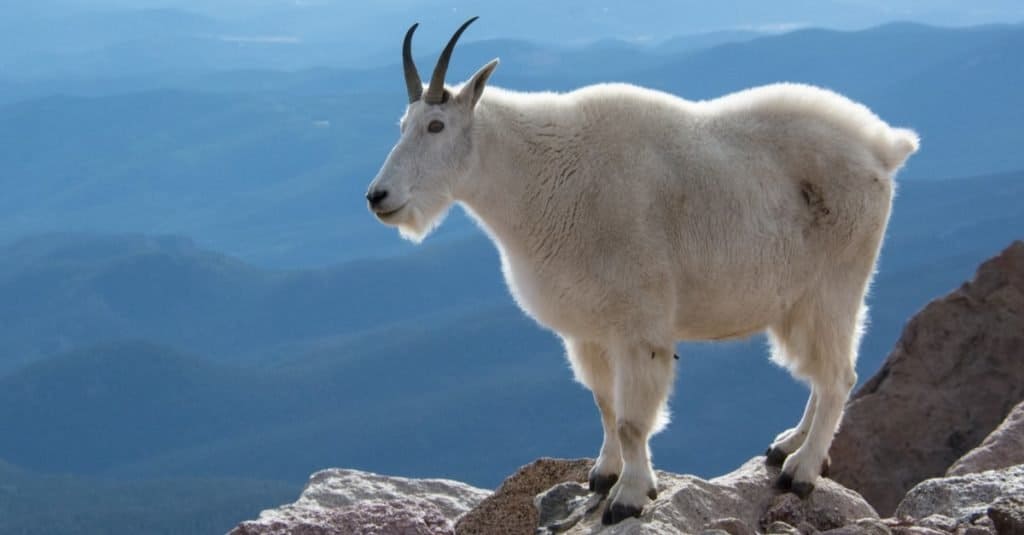
With the ability to climb steep mountains, mountain goats can live at altitudes of greater than 13,000 feet.
©Eivor Kuchta/Shutterstock.com
Habitat
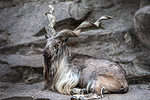
These animals inhabit elevated mountain habitats all over Asia, but also in small parts of Europe and Africa as well. Usually, the range is indicated by the name of the species: the West Caucasian and the East Caucasian tur, the Siberian ibex, the Ethiopian or Walia ibex, the Spanish ibex, the Alpine ibex, and the Nubian ibex (Nubia is in Egypt, but this species also exists in the Arabian Peninsula) all have their distinct geographical range. In addition, the markhor goat is endemic to Central Asia, and the wild goat, from which the domestic goat was first bred, inhabits a stretch of territory between Turkey and Pakistan.
Domesticated goats, which are a subspecies of the wild goat, can be found in almost any ecosystem or climate where people want to rear them. The length and consistency of their coat can be altered via artificial selection to help them cope with the specific habitats in which they’re raised.
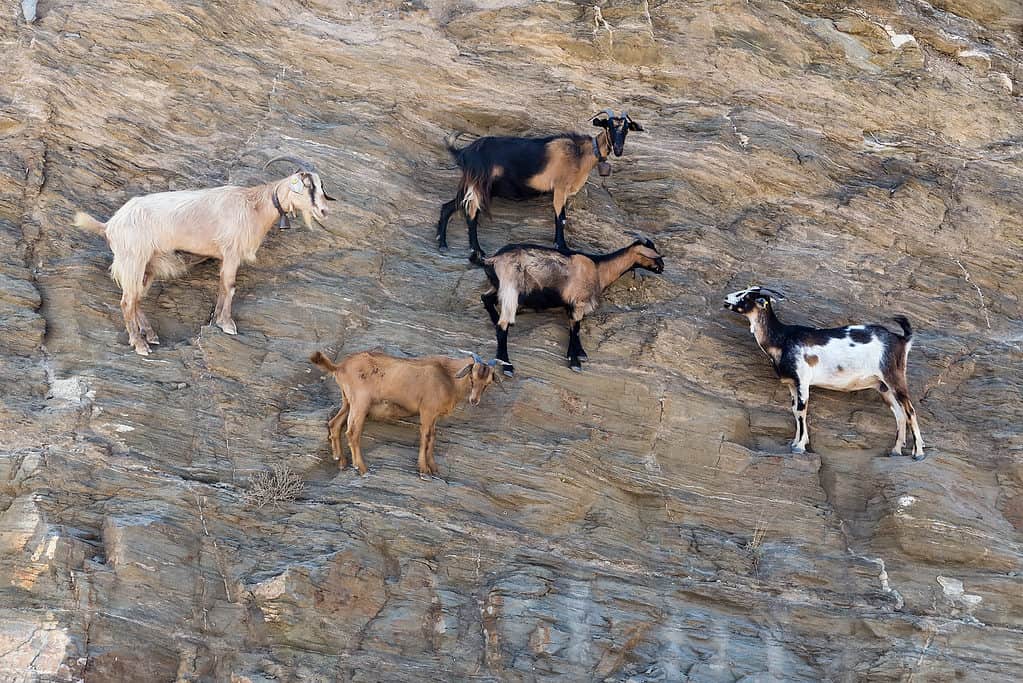
Goats inhabit elevated mountain habitats all over Asia, but also small parts of Europe and Africa.
©Ververidis Vasilis/Shutterstock.com
Diet
These animals are a type of “ruminant” that digests plant material with a four-chambered stomach. The first two stomachs are like large fermentation vats. The microbes contained within them break down the tough cellulose of plants into smaller carbohydrates. After the food is digested in the first stomach, the animal will regurgitate it, chew on it with the cheek teeth in their skull, and then swallow it once again to help break it down further. Many of the nutrients are absorbed in the goat’s intestines, which can stretch to around 100 feet or more in total length. Since digestion is such a long and arduous process, the animal’s stomach works constantly at almost all hours of the day. It takes about 11 to 15 hours for the food to fully pass through the goat’s digestive system.
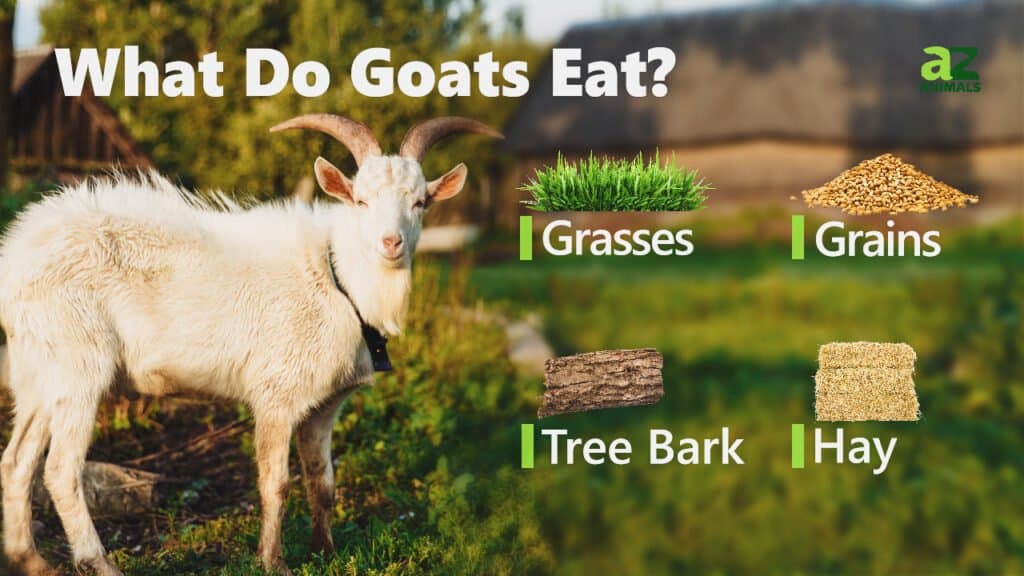
What does the goat eat?
These animals will eat almost any kind of hay, grains, weeds, tree bark, and sometimes even grasses. They supplement this with salts from mineral deposits. They tend to be browsers, meaning they consume vegetation from shrubs, trees, and other plants above the ground.
Predators and Threats
Wild goats appear to be threatened most of all by poaching (their horns are still prized as trophies) and habitat loss. While some of them are protected from habitat destruction by their extreme elevations, the loss of some natural land to human agriculture and ranching is a persistent problem that threatens some species.
What eats the goat?
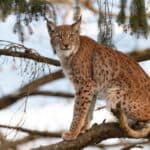
Both adult and juvenile goats are preyed upon by large carnivores such as wolves, leopards, lynxes, and brown bears. The protection of the herd and the high elevation do offer some natural defenses against predators. The horizontal pupils also give them a wide field of view to detect nearby predators.
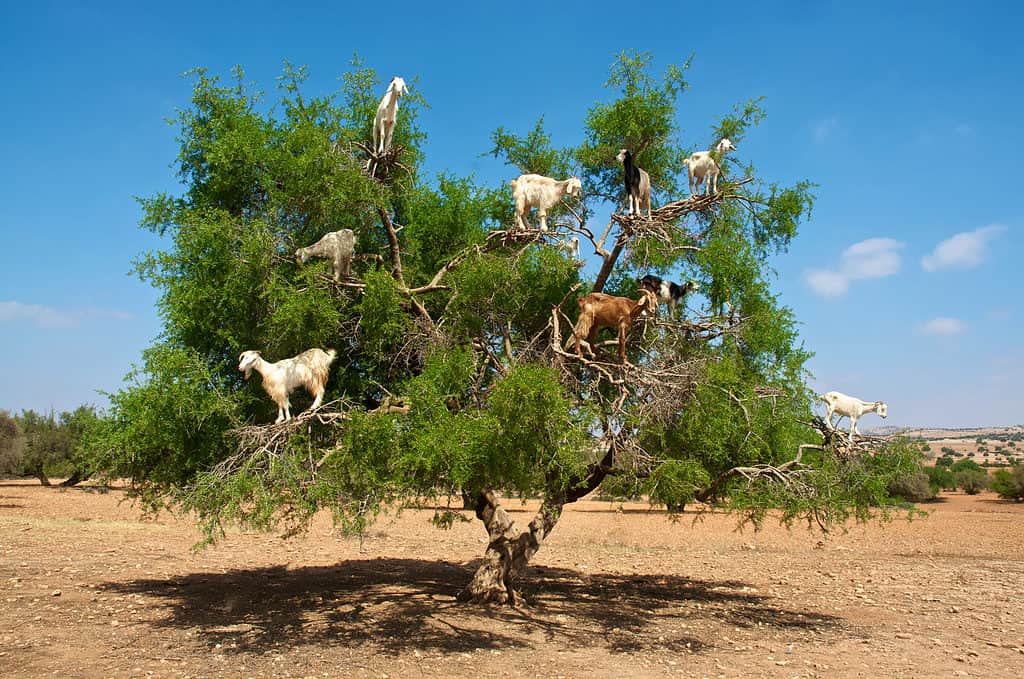
Moroccan goats are well known for their tree-climbing skills, which can help them escape some predators.
©iStock.com/aerostato
Reproduction, Babies, and Lifespan
When breeding season arrives, males become more aggressive with each other and start emitting a pungent odor. The largest and strongest male that prevails in a fight will usually have near-exclusive breeding rights to the females in a single herd. This ensures that the best characteristics tend to be passed down from one generation to the next.
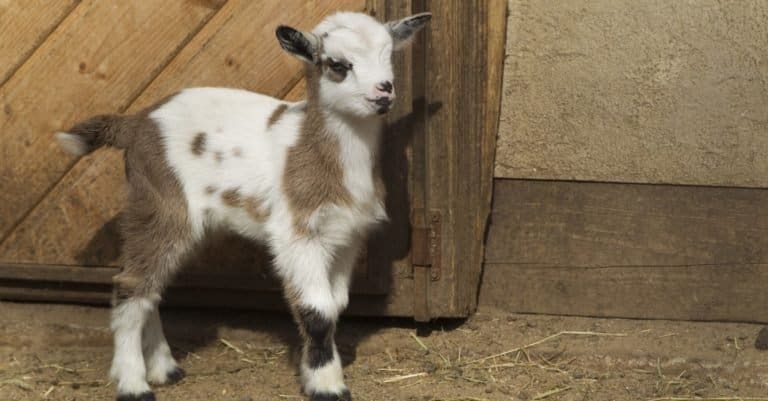
Many species breed in the fall and produce a single offspring (and sometimes twins or triplets) in the spring. Goats are pregnant for about 5 months on average. When the female is ready to give birth to the baby, she briefly departs from the group and finds a safe, isolated location where she won’t be disturbed. The new offspring is called a kid, and once it is old enough to walk (almost always shortly after its birth), the baby will rejoin the group and enjoy the protection it offers.
The baby is weaned at about four to six months of age, but may remain with its mother for the first year of life. Females tend to stay with the group, while males depart and seek out their own territories. It takes a few years for a goat to reach sexual maturity, and depending on the species or breed, they tend to have a life expectancy between six and 24 years.
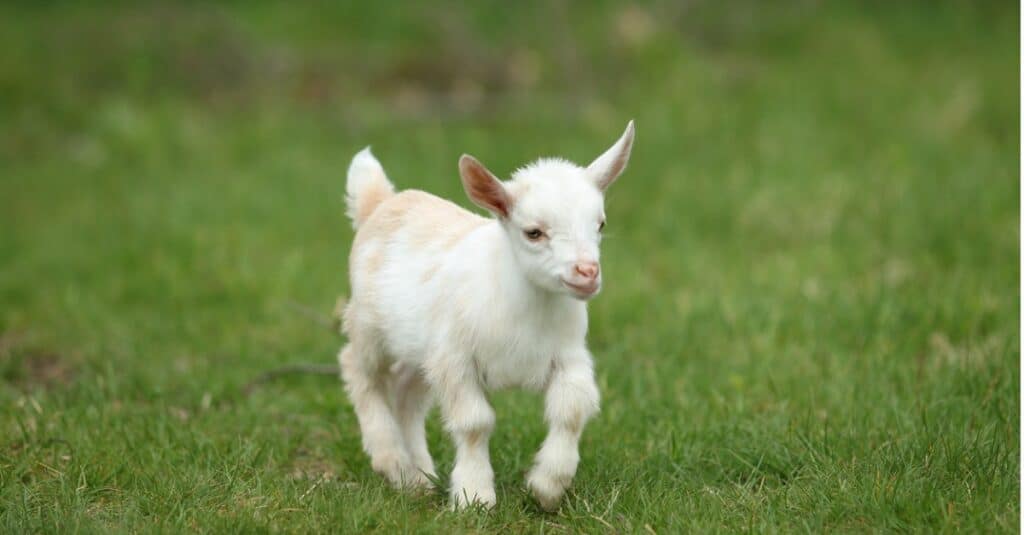
A baby goat is weaned at about four to six months of age, but may remain with its mother for the first year of life.
©iStock.com/flySnow
Population
Both the conservation status and population numbers vary quite a lot by species. The Siberian ibex is categorized as near threatened by the IUCN Red List, with between 102,000 and 150,000 mature individuals remaining in the wild, while the near-threatened wild goat has some 70,000 adults remaining. At the other end of the population spectrum, the Western Caucasian tur is endangered, with only about 3,000 to 4,000 adults remaining in the wild. By contrast, the total number of wild goats is dwarfed by the number of domestic goats, which may be as high as one billion.
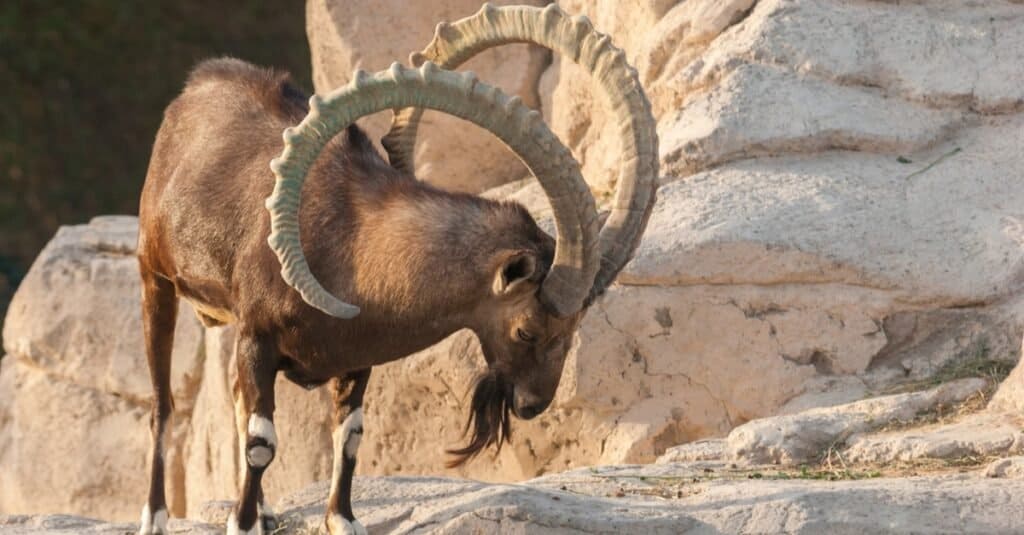
The Siberian ibex is categorized as near threatened by the IUCN Red List.
©Photonell_DD2017/Shutterstock.com
Goats in the Zoo
The goat is a very popular exhibit across many of America’s zoos. The San Diego Zoo has a Nubian ibex in its Africa Rocks exhibit, while the Columbus Zoo has a markhor goat in its Asia Quest area. Zoo Atlanta, Oregon Zoo, and Smithsonian’s National Zoo in Washington, DC keep domestic goats in their respective farm sections, including the American pygmy and Nigerian dwarf goat. Some of these zoos may allow visitors to get up close and even feed their domesticated goats. The pygmy goat offers a small, approachable, friendly package.
Types of Goat Species
There are many species of goats, both wild and domesticated.
Wild Goat Species
36 different types of wild goats can be found around the world, which include the following:
- Barbary Sheep (Ammotragus lervia): Native to Africa, it’s listed as Vulnerable.
- Arabian Tahr (Arabitragus jayakari): Native to Asia, it’s listed as Critically Endangered.
- Takin (Budorcas taxicolor): Native to Asia, it’s listed as Vulnerable.
- Wild Goat (Capra aegagrus): Native to Asia, listed as Vulnerable.
- West Caucasian Tur (Capra caucasica): Native to Asia, listed as Critically Endangered.
- Eastern Tur (Capra cylindricornis): Native to Asia, listed as Near Threatened.
- Markhor (Capra falconeri): Native to Asia, listed as Critically Endangered.
- Alpine Ibex (Capra ibex): Native to Europe, listed as Least Concern.
- Nubian Ibex (Capra nubiana): Native to Africa and Asia, listed as Vulnerable.
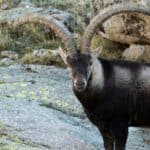
- Spanish Ibex (Capra pyrenaica): Native to Europe, listed as Least Concern.
- Siberian Ibex (Capra sibirica): Native to Asia, listed as Least Concern.
- Walia Ibex (Capra walie): Native to Africa, listed as Critically Endangered.
- Japanese Serow (Capricornis crispus): Native to Asia, listed as Least Concern.
- Southwest China Serow (Capricornis milneedwardsii): Native to Asia, listed as Near Threatened.
- Red Serow (Capricornis rubidus): Native to Asia, listed as Near Threatened.
- Sumatran Serow (Capricornis sumatraensis): Native to Asia, listed as Vulnerable.
- Formosan Serow (Capricornis swinhoei): Native to Asia, listed as Least Concern.
- Himalayan Serow (Capricornis thar): Native to Asia, listed as Near Threatened.
- Himalayan Tahr (Hemitragus jemlahicus): Native to Asia, listed as Near Threatened.
- Nilgiri Tahr (Nilgiritragus hylocrius): Native to Asia, listed as Critically Endangered.
- Red Goral (Naemorhedus baileyi): Native to Asia, listed as Vulnerable.
- Long-tailed Goral (Naemorhedus caudatus): Native to Asia, listed as Vulnerable.
- Himalayan Goral (Naemorhedus goral): Native to Asia, listed as Near Threatened.
- Chinese Goral (Naemorhedus griseus): Native to Asia, listed as Vulnerable.
- Mountain Goat (Oreamnos americanus): Native to North America, listed as Least Concern.
- Muskox (Ovibos moschatus): Native to Europe and North America, listed as Least Concern.
- Argali (Ovis ammon): Native to Asia, listed as Near Threatened.
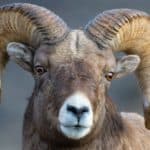
- Bighorn Sheep (Ovis canadensis): Native to North America, listed as Least Concern.
- Desert Bighorn Sheep (Ovis canadensis nelsoni): Native to North America, listed as Endangered.
- Dall Sheep (Ovis dalli): Native to North America, listed as Least Concern.
- Snow Sheep (Ovis nivicola): Native to Asia, listed as Least Concern.
- Mouflon (Ovis orientalis): Native to Asia, listed as Vulnerable.
- Tibetan Antelope (Pantholops hodgsonii): Native to Asia, listed as Critically Endangered.
- Bharal (Pseudois nayaur): Native to Asia, listed as Least Concern.
- Dwarf Bharal (Pseudois schaeferi): Native to Asia, listed as Endangered.
- Pyrenean Chamois (Rupicapra pyrenaica): Native to Europe, listed as Least Concern.
- Northern Chamois (Rupicapra rupicapra): Native to Asia and Europe, listed as Least Concern.
Domestic Goat Species
There are over 300 breeds of domestic goats worldwide. Learn about 168 breeds of domestic goats on our list, found below:
- Abaza: Native to Turkey. Other names: Abkhazian, Abkhazskaya. Short, soft-haired breed that’s pinkish-white in color, with markings around the mouth, eyes, and legs. Horns of males are long, flat, and scimitar-shaped, whereas females are polled. Used for milk and meat.
- Abergelle: Native to semi-arid pastoral areas of Amhara and Tigray regions in Ethiopia. Medium-sized, reddish brown colored fur.
- Afar: Native to Ethiopia. Other names: Abyssinian short-eared, Adal, Danakil. Short, fine coat with variable color. Most males have beards, and both sexes can have wattles.
- Agew: Native to Ethiopia.
- Agrupación de las Mesetas: Native to Spain. Breed is adapted to rustic living and extreme environments. Goats have mostly black fur with white markings.
- Albatinah: Native to Oman. Other names: Aamil.
- Algarvia: Native to Portugal. Short-haired multi-colored breed, most being white with brown spots.
- Aljabal Alakhdar: Native to the Al Jabal Al-Akhdar Mountains in Oman. This breed is said to be the largest in size among all domestic goat breeds.
- Alpine: Native to the French Alps. Other names: Alpine polychrome, American Alpine, French Alpine. Known as milking goats, with no set colorings.
- Altai Mountain: Native to the Gorno-Altai Autonomous Soviet Socialist Republic region of the Soviet Union. The breed was developed from 1944 to 1982 for wool production. Goats have black fur that turns brown or grey with age.
- Anatolian Black Goat: Native to Turkey. Other names: Adi Keçi, Kilgoat. This breed is mostly black, but some are brown, gray, or pied. It has long lop ears and is used for milk, fiber, and meat.
- Andaman Local: Native to the Andaman Islands. This breed has fur colored black, brown, or white, with short to medium legs and compact bodies.
- Anglo-Nubian: Native to Great Britain. Other names: Nubian. This large goat breed has long legs, a convex facial profile, and long, pendulous lop ears. Horns are polled or curve downward. Found in over 60 countries worldwide. Used for milk and meat.
- Angora: Native to Anatolia in Turkey. Present in many countries of the world, it produces mohair.
- Appenzell: Native to Switzerland. This rare and endangered breed features medium to long white hair and polled horns. Used for milk.
- Aradi: Native to Saudi Arabia. Other names: Ardi, Aardi, A’ardiyah. Desert goat with long black hair that can reach the ground and long lop ears. Known to give birth to twins.
- Arapawa: Native to Arapaoa Island off the coast of New Zealand. Other names: Arapawa Island Goat. One of the rarest goat breeds in the world; small with solid-colored fur, facial markings, and a lighter-colored chest. This dual-purpose goat is critically endangered.
- Argentata dell’Etna: Native to Sicily, Italy. It’s named for the volcano Mount Etna and for its silvery grey coat. Used for milk.
- Arsi-Bale: Native to Ethiopia. The coat length is short but longer in higher altitudes, and color is varied, with white most common in males and brown in females. Some have long pendulous ears. They are utilized for milk, meat, and skin.
- Asmari: Native to Afghanistan. They are typically white with a black neck and shoulders. Males and females have horns that reach their shoulders. They’re used for milk and meat.
- Aspromonte: Native to Calabria in southern Italy. Used for milk and meat, these goats usually have tassels, beards, and flattened, lyre-shaped horns. Their coats are long with a Cashmere-type undercoat, varied colors including red-and-white, black-and-white, grey, brown, brown-and-red, and parti-colored.
- Assam Hill: Native to India. This is a smaller goat breed in colors white, brown, black, gray, or black and white. They have erect ears, horns curved backward, and sometimes long hair on their body coat. Used for meat.
- Aswad: Native to Saudi Arabia.
- Attappady black: Native to India. Black, slender, medium height.
- Attaouia: Native to Morocco.
- Auckland Island: Native to the Auckland Islands. Bred for meat.
- Australian Brown: Native to Australia.
- Australian Cashmere: Native to Australia. Covered in long, dense cashmere wool.
- Australian Heritage Angora: Native to Australia.
- Australian Melaan: Native to Australia.
- Australian Miniature: Native to Australia. Used for pets and milk.
- Azpi Gorri: Native to Spain.
- Azul: Native to Brazil.
- Bagot: Native to England.
- Banatian White: Native to Banat in Serbia.
- Barbari: Native to India and Pakistan. Used for meat.
- Beetal: Native to the Punjab region of Pakistan and India. Used for meat and milk.
- Belgian Fawn: Native to Belgium. Used for milk.
- Benadir: Native to Somalia. Used for meat and milk.
- Bhuj: Native to Brazil. Used for meat and milk.
- Bilberry: Native to Waterford, Ireland. Breed of feral goats.
- Bionda dell’Adamello: Native to Lombardy, Italy. Used for milk.
- Black Bengal: Native to India and Bangladesh. Used for meat and goatskin. Small, usually black, but also white, brown, and gray colors.
- Boer: Native to South Africa. Other names: Africander, Afrikaner. Used for meat.
- British Alpine: Native to England. Used for milk.
- Brown Shorthair: Native to the Czech Republic. Used for milk.
- Canary Island: Native to the Canary Islands. Other names: Agrupación caprina canaria. Used for milk.
- Canindé: Native to Brazil. Used for meat.
- Carpathian: Native to Southeast Europe. Used for meat and milk.
- Chyangra: Native to Nepal and the Himalaya. Used for wool and meat.
- Chamba: Native to the Himalaya.
- Chamois Colored: Native to Switzerland. Used for meat and milk.
- Changthangi: Native to Tibet, Southwest China, and Myanmar. Used for fiber, meat, and milk.
- Chappar: Native to Sindh in Pakistan. Used for meat.
- Charnequeira: Native to Portugal. Used for meat and milk.
- Chengde Polled: Native to Hebei, China. Used for fiber and meat.
- Chengdu Brown: Native to Sichuan, China. Used for meat and milk.
- Chigu: Native to India. Used for fiber and meat.
- Chué: Native to Brazil. Used for meat.
- Corsican: Native to the Island of Corsica. Used for milk.
- Dera Din Panah: Native to Pakistan. Used for milk.
- Damani: Native to Pakistan. Used for milk.
- Damascus: Native to Syria. Used for milk. Other names: Aleppo, Baladi, Chami, Damascene, Halep, Shami.
- Danish Landrace: Native to Denmark. Used for milk.
- Don: Native to the Don River, Russia. Used for milk, goatskin, and fiber.
- Drežnica: Native to Slovenia. Used for milk and meat.
- Duan: Native to GZAR, China. Used for meat.
- Dutch Landrace: Native to the Netherlands. Used for milk.
- Dutch Toggenburg: Native to the Netherlands. Used for milk.
- Erzgebirge: Native to Saxony. Used for milk.
- Fainting: Native to the United States. Other names: Myotonic. Tennessee Fainting Goat. This breed has a hereditary condition called myotonia congenita, which causes it to stiffen or fall over when excited or startled. It was bred in Tennessee in the 1800s.
- Flemish: native to Belgium. Used for milk and meat.
- Frisa Valtellinese: Native to Italy. Used for meat.
- Finnish Landrace: Native to Finland. Has a thick coat that is usually gray, pied, or white. Used for milk.
- Garganica: Native to Gargano, Italy. Other names: Agrigentina. Used for milk and goatskin.
- Girgentana: Native to Northern Afghanistan, Balochistan, and Kashmir. Used for milk.
- Göingeget: Native to Sweden.
- Golden Guernsey: Native to the Island of Guernsey in the English Channel. Used for milk.
- Grisons Striped: Native to Switzerland. Used for milk.
- Guddi: Native to the Himalayas.
- Hailun: Native to Heilongjiang, China. Used for milk.
- Haimen: Native to Zhejiang, China. Used for meat.
- Hasi: Native to Albania. Used for meat and milk.
- Hejazi: Native to the Arabian Peninsula. Used for meat.
- Hexi Cashmere: Native to Gansu, China. Used for fiber.
- Hongtong: Native to Hongdong County, China. Used for milk.
- Huaipi: Native to Henan, China. Used for meat.
- Huaitoutala: Native to Qinghai, China. Used for fiber.
- Hungarian Improved: Native to Hungary. Used for milk.
- Icelandic: Native to Iceland. Other names: Settlement Goat. Dates back to the settlement of Iceland more than 1100 years ago. It has coarse, long guard cashmere hair. Used for fiber and meat.
- Irish: Native to Ireland. Used for meat and milk.
- Jamnapari: Native to India. Used for milk.
- Jining Grey: Native to Shandong, China. Used for fiber and goatskin.
- Jonica: Native to Taranto, Italy. Used for milk.
- Kaachan: Native to Pakistan. Used for milk and meat.
- Kaghani: Native to Hazara, Pakistan. Used for meat.
- Kalahari Red: Native to South Africa. Used for meat.
- Kalbian: Native to Australia. Used for meat.
- Kamori: Native to Sindh, Pakistan. Used for milk.
- Kempic: Native to Belgium. Other names: Kempense. Used for milk.
- Kinder: Native to the United States. The breed is moderate-sized, has a sturdy body inherited from the American Pygmy, but with longer legs. Its coat is short but has varied colorations.
- Kiko: Native to New Zealand. Used for meat.
- Korean Black: Native to Korea. Used for meat.
- Kri-kri: Native to the Eastern Mediterranean. Other names: Cretan, Agrimi, or Cretan Ibex. Used for meat.
- American Lamancha: Native to the United States. Other names: Lamancha. Used for meat and milk.
- Laoshan: Native to Shandong, China. Used for milk.
- Majorera: Native to the Canary Islands. Used for milk.
- Malabari: Native to Malabar, India. Other names: Tellicherry goat. Used for meat and milk.
- Maltese: native to Malta. Used for milk.
- Massif Central: Native to France. Used for milk and meat.
- Markhoz: Native to Iran. Other names: Maraz. Used for milk and mohair.
- Messinese: Native to Messina Province, Sicily, Italy. Other names: Nebrodi. Used for milk.
- Mini Oberhasli: Native to the Pacific Northwest, U.S. Other names: Oberian, Miniature Oberhasli. The breed coloring is “chamoisee” for resembling the colors of the wild Alpine chamois. The coat is bay or mid-brown, with two black facial stripes through the eyes to the muzzle, a black forehead, a black dorsal stripe, and black belly and lower limbs. Used for milk.
- Mountain: Native to Brazil and Northwestern America. Lives in high elevations and sure-footed climber. Used for meat.
- Murcia-Granada: Native to Spain. Used for milk.
- Murciana: Native to Spain. Other names: Murcian, Murcien, Murciene, Royal Murciana. Used for meat and milk.
- Nachi: Native to Punjab. Used for meat.
- Nigerian Dwarf: Native to West Africa. Used for milk.
- Nigora: Native to the United States. Used for fiber and milk.
- Nera Verzasca: Native to Switzerland. Used for meat and milk.
- Norwegian: Native to Norway. Used for meat and milk.
- Oberhasli: Native to Oberhasli, Switzerland. Other names: Swiss Alpine. Used for milk.
- Orobica: Native to the Italian Alps. Used for milk.
- Peacock: Native to Switzerland. Used for milk.
- Pinzgauer: Native to Austria. Used for milk.
- Philippine: Native to the Philippines. Used for milk.
- Poitou: Native to France. Used for milk.
- Pridonskaya: Native to Russia. Used for meat, milk, and wool.
- Pygmy: Native to Africa. Other names: African pygmy, American pygmy. This short, stocky breed was imported to the U.S. from 1930 to 1960. Used for milk, meat, and as pets.
- Pygora: Native to Oregon, U.S. Used for three distinct types of wool.
- Pyrenean: Native to France and Spain. Used for meat and milk.
- Qinshan: Native to Jining, China. Used for goatskin.
- Red Boer: Native to South Africa. Used for meat and as pets.
- Red Mediterranean: Native to Syria. Used for milk.
- Sokoto Red: Native to Nigeria and the Niger Republic. Other names: Maradi Red, Red Sokoto. Used for meat, skin, and milk.
- Repartida: Native to Brazil. Used for meat.
- Rove: Native to France. Used for meat.
- Russian White: Native to Russia. Used for milk.
- Saanen: Saanen, Switzerland. Used for milk.
- Sable Saanen: Native to the United States. Used for milk.
- Sahelian: Native to West Africa. Used for meat.
- Valdostana: Native to Italy. Used for meat and milk.
- Sahelian: Native to West Africa. Used for goatskin, meat, and milk.
- San Clemente Island: Native to San Clemente Island, California.
- Sarda: Native to Sardinia, Italy. Used for milk.
- Short-eared Somali: Native to Africa.
- Sirohi: Native to India. Used for meat and milk.
- Swedish Landrace: Native to Sweden. Used for milk.
- Somali: Native to Somalia, Djibouti, and northeastern Kenya. Used for milk, meat, and goatskin.
- Spanish: Native to Spain. Used for meat.
- Stiefelgeiss: Native to Switzerland. Used for meat.
- Surati: Native to India.
- Syrian Jabali: Native to Syria.
- Tauernscheck: Native to Austria. Used for meat.
- Thuringian: Native to Germany. Used for milk.
- Toggenburg: Native to Switzerland. Used for milk.
- Uzbek Black: Native to Uzbekistan. Used for meat.
- Valais Blackneck: Native to Switzerland. Used for milk and meat.
- Vatani: Native to Afghanistan.
- Verata: Native to Andalusia, Spain. Used for milk and meat.
- West African Dwarf: Native to West and Central Africa.
- White Short-haired: Native to the Czech Republic. Used for milk.
- Xinjiang: Native to Xinjiang, China. Used for meat, milk, and fiber.
- Xuhai: Native to Jiangsu, China. Used for meat.
- Yemen Mountain: Native to Yemen.
- Zalawadi: Native to India. Used for meat, milk, and fiber.
- Zhiwulin Black: Native to Shaanxi, China. Used for fiber and meat.
- Zhongwei: Native to China. Used for fiber and pelt.
Goat Pictures
View all of our Goat pictures in the gallery.

Reinhold Leitner/Shutterstock.com
Sources
- David Burnie, Dorling Kindersley Animal, The Definitive Visual Guide To The World's Wildlife / Accessed November 10, 2008
- Tom Jackson, Lorenz Books The World Encyclopedia Of Animals / Accessed November 10, 2008
- David Burnie, Kingfisher The Kingfisher Animal Encyclopedia / Accessed November 10, 2008
- Richard Mackay, University of California Press The Atlas Of Endangered Species / Accessed November 10, 2008
- David Burnie, Dorling Kindersley Illustrated Encyclopedia Of Animals / Accessed November 10, 2008
- Dorling Kindersley Dorling Kindersley Encyclopedia Of Animals / Accessed November 10, 2008
- David W. Macdonald, Oxford University Press The Encyclopedia Of Mammals / Accessed November 10, 2008