
Quick Take
- Baby coyotes do something surprising before they ever learn to play, and what they do reveals more about their wild nature than their cute faces suggest. See the surprising behavior →
- Coyotes hold a record among North American wild animals that their scientific name literally spells out, though most people have no idea. Discover their vocal record →
- A coyote pup can be born to parents of completely different species, and the consequences for that pup are serious. Learn about hybrid pups →
- Coyote dens serve a far more specific purpose than most people assume, and parents have an unexpected reason for abandoning them quickly. Explore den use and abandonment →
Coyotes (Canis latrans) are canines that are native to North America. These smaller cousins of wolves range from Alaska and Canada, throughout most of the U.S., and south through Mexico to Panama in Central America. Fluffy and irresistibly cute, baby coyotes are captivating little creatures. Born during the springtime, these endearing, small, fuzzy bundles of energy overflow with curiosity, exhilaration, and playfulness as they take on the world around them. Let’s take a closer look at some adorable pictures and incredible facts about baby coyotes.
1. Baby Coyotes Are Called Pups
Coyotes, especially baby coyotes, look a lot like dogs. It’s no wonder, then, that baby coyotes are called pups. Although both dogs and coyotes are members of the genus Canis and have many similarities, coyotes are wild animals while dogs are domesticated. That means that even though they look adorable, baby coyotes are still wild animals. If you happen to come across a baby coyote, you should resist any urge to intervene, touch, or pet it. Most likely, the baby’s mother is nearby and will be returning soon. If you are worried that the pup is abandoned or it appears sick or injured, call your local wildlife rehabilitator or wildlife officer.

Baby coyotes are called pups, like many canine young.
©Lynn_Bystrom/iStock via Getty Images
2. Baby Coyotes Are Born Blind and Deaf
Newborn coyote pups are both blind and deaf when they are born. These precious creatures are completely reliant on their parents for protection and the nourishing milk of their mothers for their first two weeks of life. After around 12 days, they begin to open their eyes and explore the world around them little by little. When they are around 20 days old, baby coyotes can usually walk. Until they are eight to 12 months old, most baby coyotes remain close to their parents and families.

When coyote pups are born, their eyes are shut and their ears flop over.
©John Good, National Park Service / Public Domain – Original / License
3. Baby Coyotes Live in Families
Coyotes are highly social, gregarious animals. They typically live together in family units or loosely knit packs. Similar to wolves, coyotes possess significant social structures that revolve around family and shared territories. A coyote pack includes an alpha pair along with three to eight other family members, although the pack size often depends on their territory and how much food is available. Typically only the alpha pair breed, and the rest of the pack members help to care for and raise the young coyote pups. With not only their parents but aunts, uncles, and older siblings, baby coyotes are always well-cared-for and receive plenty of supervision.

In some packs, the aunts and older siblings spend the most time playing with and teaching baby coyotes.
©Betty4240/iStock via Getty Images
4. Coyotes Are Tiny When They Are Born
Fully grown coyotes weigh about 15 to 44 pounds, depending on the subspecies. Although they are formidable predators as adults, when baby coyotes are born they are extremely small, weighing only 0.5 to 1 pound. Female coyotes are pregnant for about 63 days and give birth to baby coyote pups in the spring. Baby coyotes are usually born sometime between March and May, with around 4–7 pups in a litter on average. They usually sleep most of the time, waking up every few hours to nurse. When they are around four weeks old, baby coyotes begin to eat solid and regurgitated food from their mother and father.

Coyote pups are completely dependent on their parents for the first few weeks of life.
©Lynn_Bystrom/iStock via Getty Images
5. Baby Coyotes Have Excellent Parents
Male and female coyotes are strictly monogamous, both working as equal partners to care for their young. When a female coyote is pregnant, she will build or find a den and line it with soft materials. Male coyotes go out and hunt, bringing back food for the female. Once the babies are born, coyote mothers are extremely attentive, providing excellent care for their young pups. For the first several weeks of their lives, baby coyotes are completely dependent on their mothers, who remain by the pups to keep them safe, warm, and well-fed. Coyote fathers also help by hunting and bringing back food for the mother and pups.

Coyote parents are extremely devoted to the care and welfare of their babies.
©Tom Tietz/iStock via Getty Images
6. Baby Coyotes Fight Before They Play
Although they may resemble wolf pups, coyote pups have their own distinctive approach to fighting. In fact, before engaging in play or any playful behaviors, baby coyotes start with serious fights. Interestingly, even at just three weeks old, these feisty pups display less inhibition when it comes to biting each other, a stark contrast to the behavior of wolf pups. Then, by the time they are four to five weeks old, baby coyotes establish dominance hierarchies, making them more inclined to engage in play rather than aggressive fights.
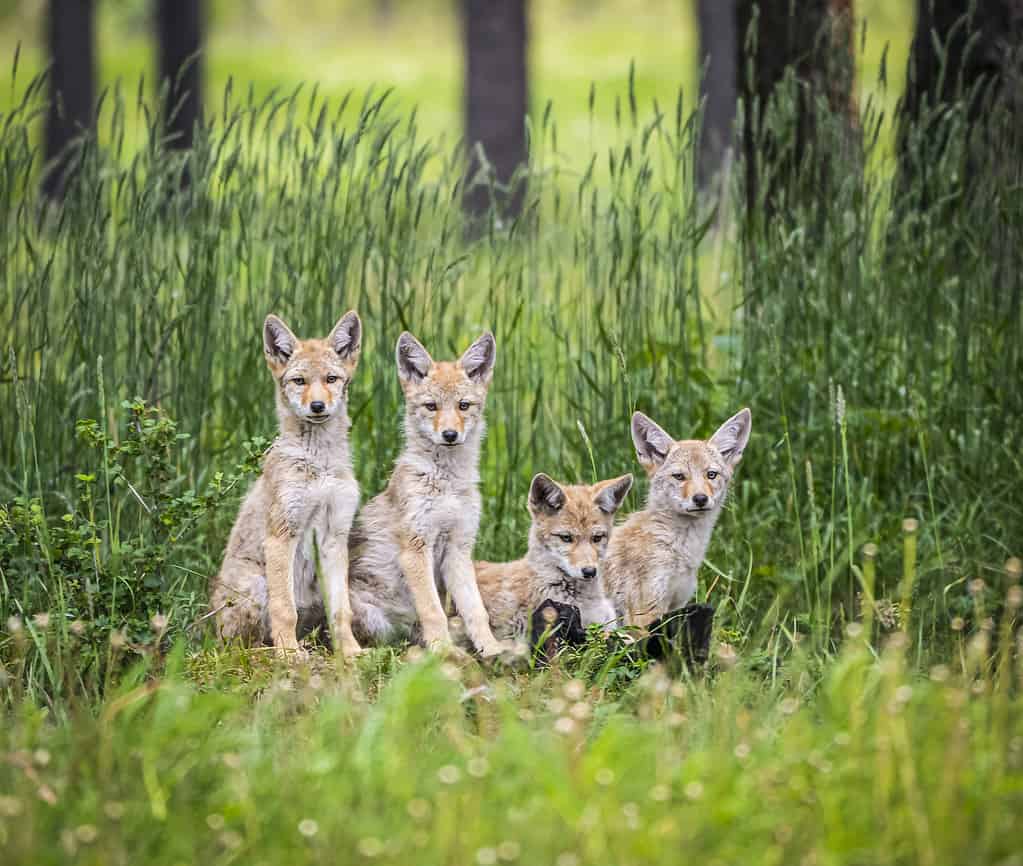
Coyote pups often engage in lively wrestling matches, playful chases, and other entertaining games.
©Annie Hewitt/iStock via Getty Images
7. There are Baby Coyote Hybrids
Although it is extremely uncommon, coyotes occasionally breed with domestic dogs and even wild wolves. Known as “coydogs” and “dogotes,” the offspring of coyotes and domestic dogs are very rare as the two species have different mating cycles, and coyotes don’t typically get along with dogs. However, the two species may breed when coyotes move into a new area where there are few breeding options. Coydogs have also been intentionally bred in various cultures, such as the ancient city of Teotihuacan in Mexico.
Unfortunately, the survival rate of hybrid pups is lower than nonhybrids. In addition, hybrid pups are harder to manage, and when they are older, their behavior is much less predictable than that of hybrid wolf-dogs.

Eastern coyotes (Canis latrans var.) are a unique wild hybrid with DNA from wolves, coyotes, and dogs.
©Fiona M. Donnelly/Shutterstock.com
8. Baby Coyotes Love to Talk
A unique claim to fame for the coyote is that it is the loudest and most talkative of all the wild animals in North America. That is why its scientific name, Canis latrans, actually means “barking dog.” Adult coyotes have at least 11 ways to communicate through sound, including growls, woofs, huffs, barks, yelps, howls, and high-frequency whines. Adults commonly use woofs in particular to warn baby coyotes to go back inside the den.
In addition to their many vocalizations, baby coyotes also communicate with their families using body language. Excited or happy pups, for example, may wag their tails, while pups who are feeling scared or submissive will flatten their ears.

Coyotes use several types of vocalizations and body language to communicate.
©mlharing/iStock via Getty Images
9. Baby Coyotes Don’t Stay in the Den Very Long
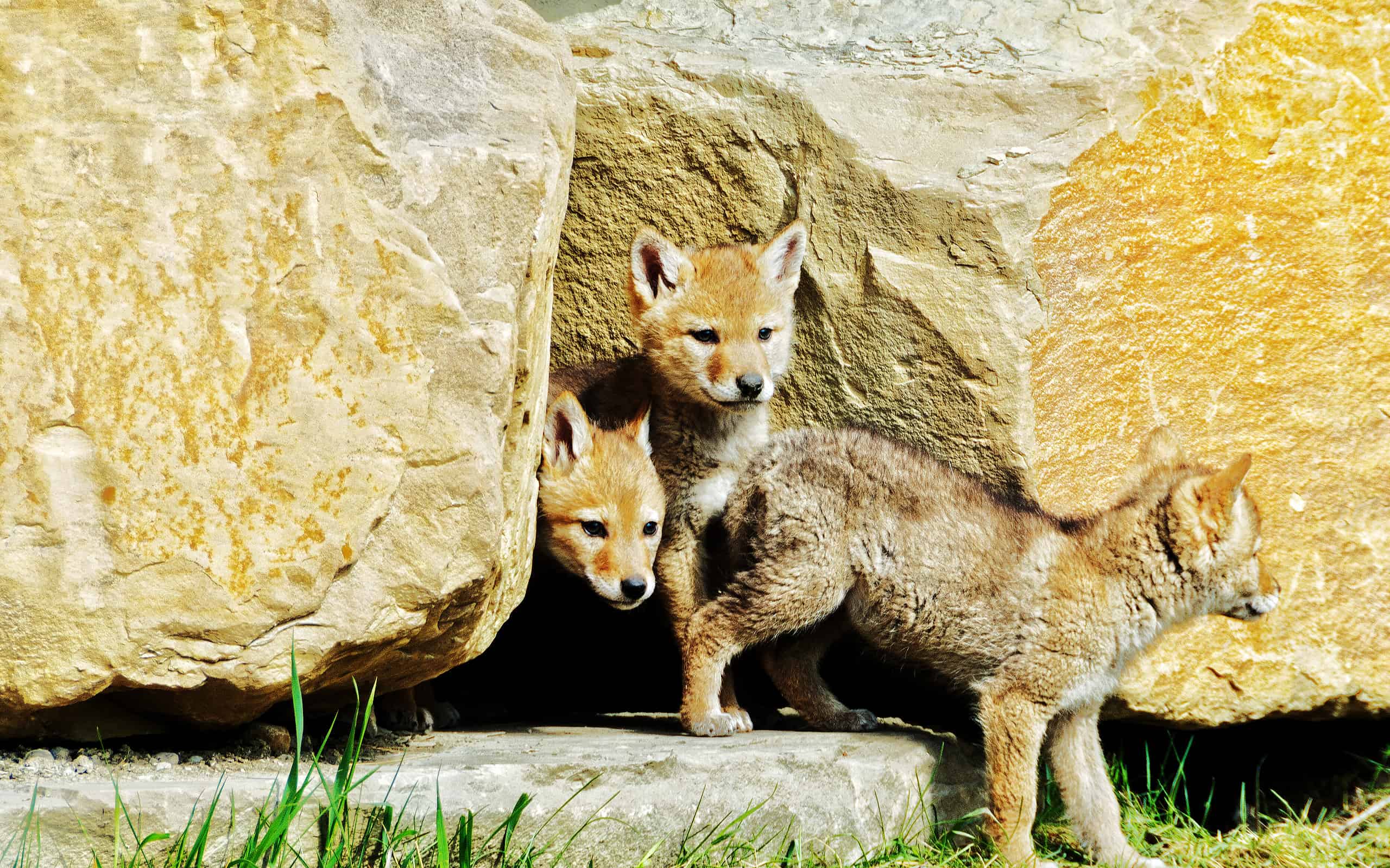
Coyotes only use dens when they are having pups. During the rest of the year, they sleep out under the stars and open sky. Dens serve only as safe havens for coyotes to give birth and as nurseries where pups are nursed by their mother. However, once these early stages are over, the pups don’t stick around in the dens for too long. They venture out and explore the surrounding areas, although they’ll still keep secret resting spots near the den site. In addition, parents regularly relocate the pups as a protective measure. This helps to keep them safe and evade flea infestations.

Once they are big enough, baby coyotes begin to explore the world around them.
©bobloblaw/iStock via Getty Images
10. There Are 19 Subspecies of Baby Coyotes
There are 19 distinct coyote subspecies, varying in appearance depending on where they live. The pups range in color from a blend of light gray with red or fulvous (tawny or brownish yellow) fur, accentuated by streaks of black and white.
Coyotes that live in eastern regions, like the northeastern coyote (Canis latrans thamnos) and the southeastern coyote (Canis latrans frustor), are usually darker and larger than those that live in the west and north. Coyotes along the Pacific coast tend to have brighter colors with shades of deep orange or brown, as seen in the California Valley coyote (Canis latrans ochropus) and the Northwest Coast coyote (Canis latrans umpquensis).
In parts of Northern Mexico and the Southwestern United States (sometimes referred to as Aridoamerica), subspecies like the Lower Rio Grande coyote (Canis latrans microdon) and Mearns’ coyote (Canis latrans mearnsi) are smaller. Further south, in Mexico and Central America, coyotes tend to have dark reddish fur and short muscles, like the Durango coyote (Canis latrans impavidus) and the Mexican coyote (Canis latrans cagottis).
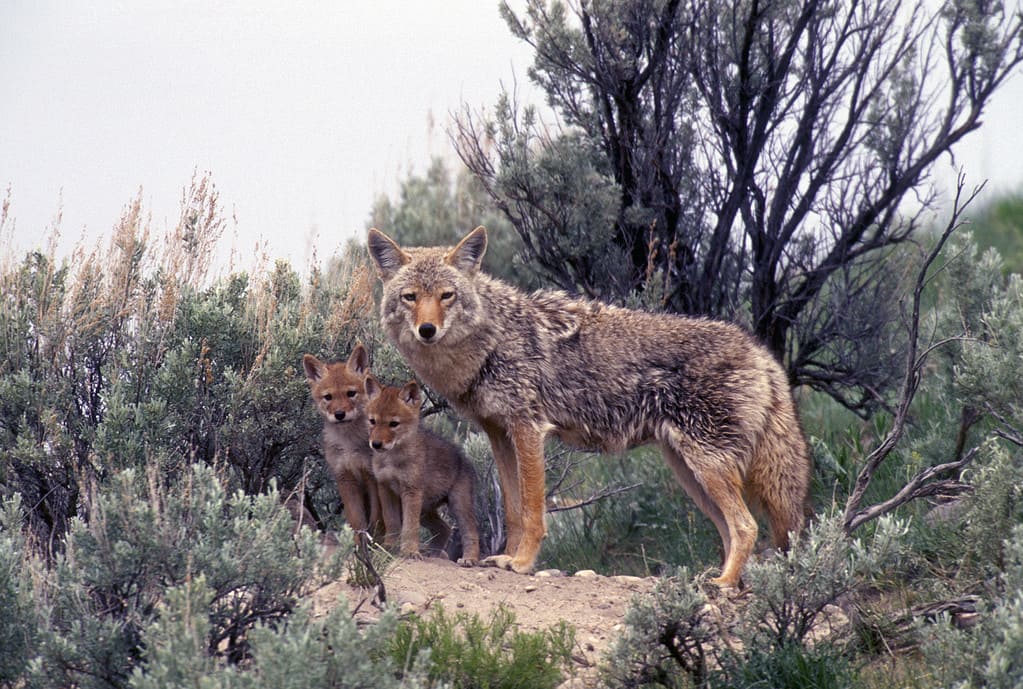
Some of the largest coyotes live in Yellowstone National Park in the northwest United States.
©KenRinger/iStock via Getty Images