
Quick Take
- Male and female crows look virtually identical, but one subtle physical trait can reveal a crow's sex at a glance. See the size difference →
- One sex consistently outperforms the other in intelligence tests, and it is probably not the one you would expect. Discover which sex is smarter →
- You can tell a male from a female crow just by listening, though the vocal cues are nothing like a typical bird call. Hear how to tell them apart →
- Male crows help raise their siblings, yet the burden of actual parenting falls somewhere unexpected. Explore parenting roles →
Of the 40 to 45 species of true crows in the genus Corvus, three are found in the United States. However, the American Crow (Corvus brachyrhynchos) is the most widespread species, found in almost every state in woods, fields, cities, and suburban areas. Crows have an extraordinary intellect that rivals that of chimpanzees and human toddlers, ranking them among the smartest animals on Earth. Although male and female crows are similarly intelligent, recent studies show that female crows have superior complex problem-solving and task mastery compared to males. However, this is not the only difference between male and female crows. Continue reading to discover four key differences between male and female crows.
Size
Although male and female American crows are visually identical in plumage, they exhibit a subtle size difference known as sexual dimorphism, where the males are marginally larger and heavier than the females.
Across the species, American crows typically range from 15.8 to 20.9 inches in total length, with a wingspan stretching between 33.5 and 39.4 inches. An adult male American crow generally falls toward the upper limits, with an average length of 20 to 21 inches and an average wingspan of 38 to 39 inches. The sleeker adult female American crow typically occupies the lower end of the spectrum, averaging a length of 16 to 17 inches and a wingspan of 34 to 35 inches.

Even though these blue-eyed American crows are juveniles, you can tell which is male and which is female by their size.
©Elizabeth Caron/Shutterstock.com
Behavior Differences
Male crows, like many male animals, are a bit more boisterous than females of their species. Male crows are the dominant sex and are braver, bossier, and more apt to bicker with other crows than are the females. The male crows will perch at the top of a tree, whereas the females are typically found on lower branches.
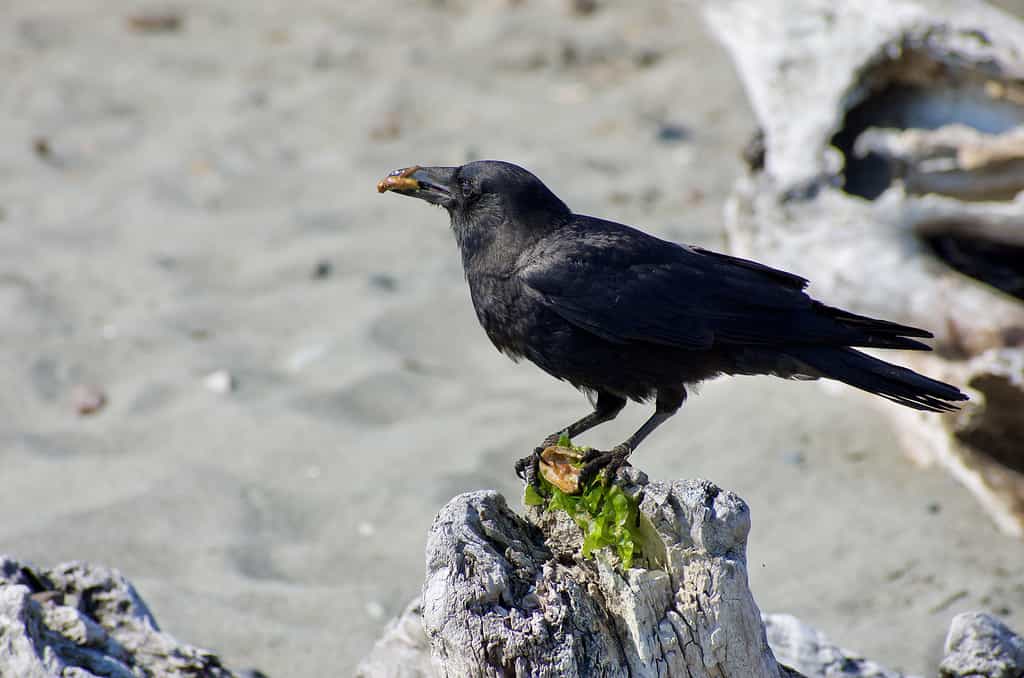
Without closely watching crows interact with each other, you might miss the subtle behavioral differences.
©iStock.com/DanielLacy
Some mature male crows stay near their parents and help raise younger siblings. The father and mother build the nest together, and the father will occasionally bring the mother food while she sits on the eggs, but that is where the parenting responsibility ends for the father. The older offspring still living with their parents may help with the younger chicks by guarding them or even bringing food home, but the majority of the parenting work falls to the female.
Female crows generally leave the nest once grown to start families of their own. Even though female offspring leave to start their own families, they remain close to their family unit and visit their parents frequently.
Vocal Differences
Although male and female American crows look virtually identical, you can often tell them apart by listening to their vocalizations. Female American crows are primarily responsible for the rapid, mechanical rattle call, a unique, wooden clicking sound used as a friendly contact signal between mates, and they tend to give higher-pitched, buzzy shudder caws while fluttering their wings near the nest.

The male American crow is responsible for making the familiar caw sound associated with crows.
©Elliotte Rusty Harold/Shutterstock.com
Male American crows typically have a deeper, more resonant pitch and are much more likely to deliver standard, loud territorial caws in a highly rigid, rhythmic cadence, typically three or four sharp beats in a row, while bowing their heads from a high perch.
Identifying sex by sound becomes more difficult when juvenile crows‘ voices are added into the mix. Both male and female juvenile crows have a higher-pitched, almost nasal-sounding caw.
Intellect Differences
This may ruffle some feathers, but female crows have proven to be more intelligent and learn new tasks more quickly than male crows. This is not to say male crows aren’t intelligent. Both sexes are very intelligent. Female crows are simply a bit quicker to pick up on problem-solving techniques than males.

Only female crows look after eggs and chicks.
©KrisDurlen/Shutterstock.com
Female crows adapt more quickly than male crows to obstacles and techniques. They can rapidly shift roles: from mother to member of crow society, to mate, to fierce defender.