
Quick Take
- Male pigeons have a reputation for leaving most incubating to females, yet a food shortage flips that dynamic in a way researchers didn't expect. See the surprising shift →
- A bird can lose 30 to 40% of its body mass in a single incubation session, which raises the question of how pigeons keep eggs alive when there is barely enough food to survive. Explore the energy costs →
- Urban pigeon feeding bans are designed to shrink populations, but they may be triggering an unintended biological workaround. Discover the unintended effect →
- Stable hatching rates during food shortages sound like good news, but that changes once you find out what happens next. Find out what happens next →
Being a parent is not easy, and that’s as true for pigeons as it is for people. The pigeons that roost in cities form pairs, and the male and female work together to raise their offspring. Most of the incubation duties are carried out by the female; that is, until there is a shortage of food. During times of limited resources, the male steps up to help. A fascinating new German study tells us all about pigeon parenting roles.
Pigeon Parenting Under Scrutiny
When animals reproduce, they pay a price. Reproduction uses up valuable energy and can put animals at risk of disease and predation. Because birds lay eggs that need incubating, they have to put in even more effort. Once the eggs are outside the mother’s body, they must be maintained at the optimal temperature for embryo development, which is between 37–38°C. In most environments, this is warmer than the egg’s surroundings. It means that one or both parents must use their own energy (body heat), together with the nest architecture, to keep the eggs warm. This process is called incubation. Of course, in hot environments, incubation has the opposite effect, keeping the eggs from getting too hot.
Sharing Parental Duties
Most bird species (over 80 percent) share the load of parenting duties with their partner. This is known as biparental care, and the parents divide up the task either by roles or by time. In some species, incubation is exclusively performed by the female, while the male forages for food. Alternatively, both sexes take turns performing the incubation duties. Time on the nest is roughly equal, with the non-incubating parent foraging for food, which can sometimes take days. The incubating parent effectively sits and waits for food to arrive; a bird can lose 30–40 percent of their body mass during each incubation session!

Pigeons usually lay two eggs at a time.
©Irit/Shutterstock.com
In some relationships, however, duties are not so equal. One bird may take advantage of their partner and spend free time away from the nest for their own well-being. The northern flickers (Colaptes auratus) can have multiple partners incubating eggs on multiple nests!
How Do Feral Pigeons Parent?
Feral pigeons (Columba livia) are a socially monogamous bird, which means that they form stable, long-term social pair bonds. The parents cooperate to raise the young, but infidelity (termed extra-pair matings) can occur. Female pigeons do most of the incubating, including at night, while the male does one long shift during the day. These birds can breed up to five times a year, laying two eggs in each clutch.
Pigeons are not always popular, and their urban populations are sometimes controlled by feeding bans. Such bans have been shown to reduce pigeon densities and reduce nestling survival. However, they do not affect clutch sizes or egg hatching success. This raises the intriguing possibility that pigeons may be compensating for a lack of food by altering their incubation strategy.
Studying Pigeon Incubation
Between July and November 2025, scientists observed 75 feral pigeon nests across the cities of Braunschweig, Munich and Würzburg in Germany. The pigeons were either in a ‘fed’ or a ‘control’ group. The ‘fed’ birds were provided with a good diet that they could access without having to leave the nest area. The control group had to forage for food on their own and away from their nesting area.
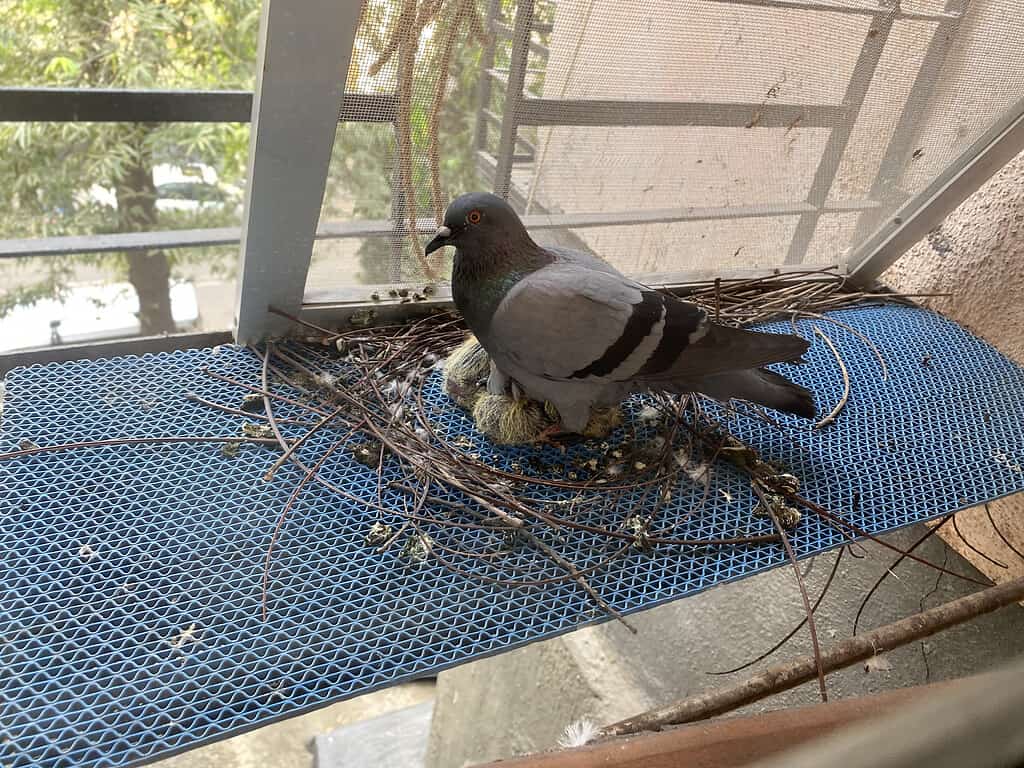
Pigeons incubate their eggs.
©iStock.com/Vatsal Sheth
All of the colonies were visited every 4 or 7 days and had their eggs replaced with dummies as part of population control. The researchers placed custom-built weight loggers under each focal nest. This allowed them to tell whether it was the male or female pigeon on the nest. They calculated the daily incubation effort of each sex. The researchers also quantified the number of shift changes daily.
Fathers Taking Over
This fascinating research showed that pigeons cope with a shortage of food by changing the way in which they usually divide the incubation effort. Generally, most of the incubation is carried out by the females. She spends between 75 and 81 percent of her day on her nest. The well-fed females spent 1.4 hours longer on the nest than the unfed females, and they were 10.3 percent heavier. These females did not have to travel very far to reach an ample supply of food.
In the control group, where less food was available, the males increased their incubation effort. This allowed the females time to go and forage for food themselves. It also meant that the eggs were not left unattended.
Importantly, this finding explains how pigeons maintain stable hatching rates even when there is a food shortage. It also highlights how the different mating and incubation practices of urban birds need to be taken into account when designing control measures. In the case of pigeons, the lack of food is unlikely to result in fewer eggs hatching. However, it does mean that more hatchlings will likely succumb to starvation, which raises ethical and welfare concerns. It may be preferable to intervene earlier in this process, for example, by removing the eggs and replacing them with dummies.