Quick Take
- These birds are technically monogamous, yet a staggering share of nests hide a secret that reveals just how strategically females play the mating game. See the infidelity data →
- A female chickadee cannot watch a male retrieve food from thousands of hidden caches, so how does she know which males are the smartest? The answer is hiding in plain sound. How females detect intelligence →
- A female's own cognitive test scores turn out to predict whether she'll seek an outside mate, a finding that reframes chickadee infidelity as something far colder and more calculated than it first appears. Explore female strategy →
- The smartest males father offspring across the population without shortchanging their own nest, and why that trade-off works reveals something fundamental about how intelligence shapes evolution. See the evolutionary payoff →
For mountain chickadees, being smart may be just as important as being strong. New research on wild mountain chickadees (Poecile gambeli) in California’s Sierra Nevada suggests that female birds may favor intelligence when choosing mates—even if that means straying from their social partners.
While these birds form socially monogamous pairs, researchers discovered that many females raised offspring fathered by other males. These “extra-pair” fathers consistently ranked among the smartest in the population, excelling at spatial learning and memory tests.
Because these chickadees rely heavily on spatial memory to find hidden food caches during harsh winters, smarts are crucial for survival. Mating with clever males allows females to pass these vital cognitive skills on to their offspring.
Continue reading
How Researchers Test a Wild Bird’s Intelligence
Scientists studied wild mountain chickadees in California’s Sierra Nevada across three breeding seasons. To test the birds’ minds without removing them from their natural habitat, researchers used tiny radio-frequency identification (RFID) leg bands paired with automated “smart” feeder stations.

Mountain chickadees are found in the western regions of North America.
©M. Leonard Photography/ via Getty Images
Each bird was assigned one specific feeder in an eight-feeder array. Over four days, researchers tracked how many wrong feeders a bird visited before finding its designated spot — fewer mistakes meant a sharper memory. Researchers also switched assigned feeder locations mid-study to see how quickly the birds could unlearn the old spot and adapt to a new one. Researchers took blood samples from adults and chicks to establish accurate genetic parentage. They then compared cognitive test scores against reproductive success metrics, including clutch size, hatching rates, fledgling weight, and overall chick survival.
Mountain Chickadees Aren’t Always Faithful
Despite their socially monogamous lifestyle, mountain chickadees frequently reproduce outside their social pair. Over three breeding seasons, 70 percent of monitored nests contained extra-pair young — chicks fathered by a male other than the nest’s social father — accounting for about 30 percent of all nestlings studied.
However, these encounters were far from simply random acts of infidelity. In nests with extra-pair young, the biological fathers consistently outperformed the social fathers on spatial intelligence tests. The smartest males did not just attract more mates — they fathered significantly more extra-pair offspring than less cognitively skilled males, on top of their own brood, giving them a clear evolutionary edge.
Smart Males Raise Stronger Offspring
Mountain chickadee eggs take a week longer to hatch than those of black-capped chickadees.
©Bartow Photography/Shutterstock.com
A male chickadee’s spatial memory is correlated with heavier offspring, which may improve their chances of survival. Males with sharper spatial memory sired significantly heavier chicks. Because these birds rely on spatial memory to retrieve hidden food during harsh mountain winters, heavier and healthier chicks are far more likely to survive the season.
Why Female Chickadees Seek Outside Mates
The research suggests that female behavior may be more strategic than simple mate swapping. A female’s likelihood of seeking an outside mate may also depend on her own cognitive test scores. Some evidence suggests that females with weaker spatial memory may be more likely to mate with high-performing males, potentially compensating for their own shortcomings and passing better cognitive traits to their offspring. Females also adjust their nesting effort based on their social partner’s intelligence. Those paired with smart males laid larger clutches and raised bigger broods.
However, environmental conditions dictate these patterns. During good breeding seasons, females actively invest more in smart partners. In harsh years, tough weather constraints cap their reproductive output regardless of how clever their mate is.
How Females Spot Smart Males
There is one obvious problem with selecting a mate for intelligence: a female chickadee cannot simply watch a male retrieve food from thousands of hidden caches and give him a cognitive score. So, how do they know which males are clever? They listen.

Male and female mountain chickadees are very similar in appearance.
©Charles Bergman/Shutterstock.com
Automated audio recorders revealed that a male’s song output directly reflects his spatial memory. Males that made fewer mistakes during the feeder tests sang more throughout the day and had stronger dawn chorus performances.
Song volume and frequency were specifically correlated with spatial learning and memory, but not with cognitive flexibility (how quickly a bird adapted to new feeder locations). Interestingly, poorer-performing males tried to compensate by concentrating a larger share of their singing efforts into the first hour of daylight. Although these males sang less overall during the day, they focused a greater proportion of their singing into the dawn chorus.
Song output may serve as an accessible and reliable indicator for females to assess a male’s intelligence, eliminating the need to observe his foraging behavior directly.
When Intelligence Becomes an Evolutionary Advantage
The findings offer a glimpse into how intelligence can drive evolution in the wild. For mountain chickadees, strong spatial memory may offer a double benefit. Remembering where food has been hidden can make the difference during a difficult winter. But the research suggests that cognitive ability may also influence which birds reproduce — and with whom — increasing a male’s reproductive success.

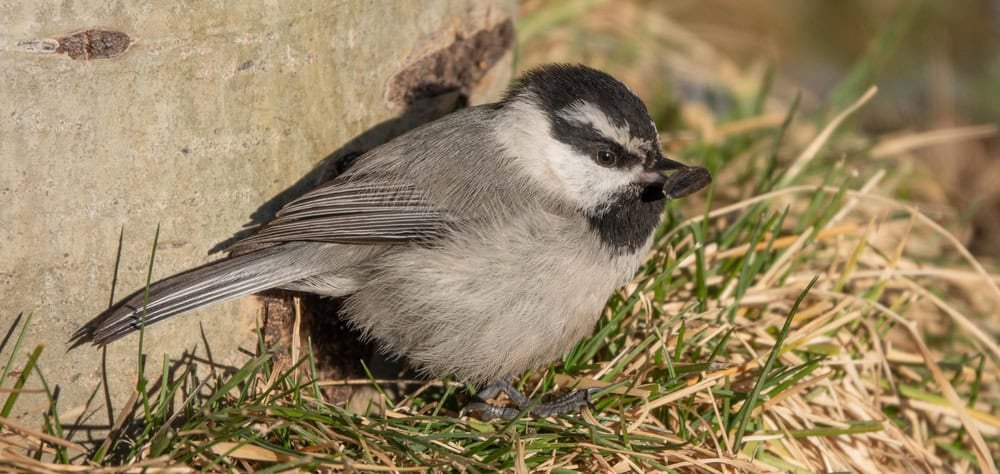
Although similar in appearance to black-capped chickadees, mountain chickadees have white eyebrow patterns.
©M. Leonard Photography/Shutterstock.com
In turn, extra-pair mating may allow females to acquire superior genetic traits for their offspring, directly boosting the next generation’s winter survival odds. In the world of mountain chickadees, then, brains may be more than a survival tool. They may also be a mating advantage — and sometimes, the smartest male in the flock gets to be the most prolific father.