
One is towering while the other has an unforgettable scent. They share some similarities, even growing to similar heights. But when it comes to sequoia vs. cedar trees, they each have their own unique qualities. Discover 12 differences between these towering giants!
Comparing Giant Sequoia vs. Cedar Trees
| Giant Sequoia | Cedar | |
|---|---|---|
| Classification | Sequoiadendron giganteum | Cedrus spp. |
| Origin | Sierra Nevada Mountains, CA | Varies from the Mediterranean to the Himalayas |
| Natural Habitat | Forests in the Sierra Nevada Mountains, CA | Depends on the species. Can be found in mountainous areas as well as coastal areas and forests |
| USDA Hardiness Zone | Zones 6 to 9 | Generally zones 6 to 9 |
| Conservation Status in the U.S. | Endangered, protected | Some species are endangered but conservation status varies |
| Size | Up to 300 feet tall (91 meters) | May reach over 100 feet tall depending on the species |
| Shape | Open oval shape; columnar, thick trunks | Straight trunks, some exceeding 10 feet in diameter; shape varies on species and may be conical, pyramidical, or a spreading canopy |
| Foliage | Needle-like foliage that spiral | Needle-like foliage but may also appear scale-like depending on the species |
| Wood | Soft and rather lightweight | Dense and heavy, decay-resistant |
| Cones | Approximately two inches; tightly closed scales | Large cones with easily distinguished shapes; scales open easily to release seeds |
| Uses | For visual admiration in natural reserves and parks | Furniture, aromatic products |
| Elevation Limit (Distance Above Sea Level) | Upper elevation limit 8,858 feet (2,700 meters) Lower elevation 2,723 feet (830 meters) | Depending on the species, could be in lower or higher elevations over 7,000 feet (2,133.6 meters) |
The Key Differences Between Giant Sequoia vs. Cedar Trees
There are a few key differences between the giant sequoia and cedar trees. How they’re classified, their natural habitats, size, shape, and foliage share some similarities, but they are starkly different if you look at them. How they’re used is also different as well as at what elevation limit they are found.
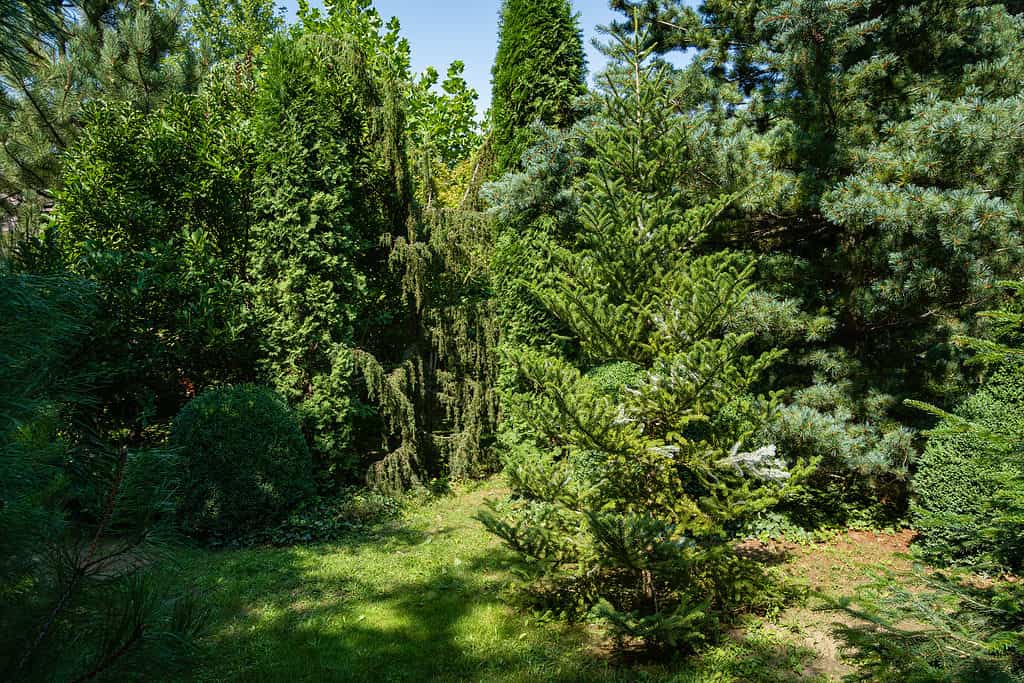
The northern white cedar is often called the ‘arbor vitae’ (the tree of life).
©Alexander Denisenko/Shutterstock.com
Giant Sequoia vs. Cedar Trees: Classification
The giant sequoia’s classification is Sequoiadendron giganteum and makes up part of the Sequoiadendron genus, belonging to the Cupressaceae family. The cedar tree’s classification is Cedrus spp. and makes up part of the Cedrus genus, belonging to the Pinaceae family.
Giant Sequoia vs. Cedar Trees: Origin
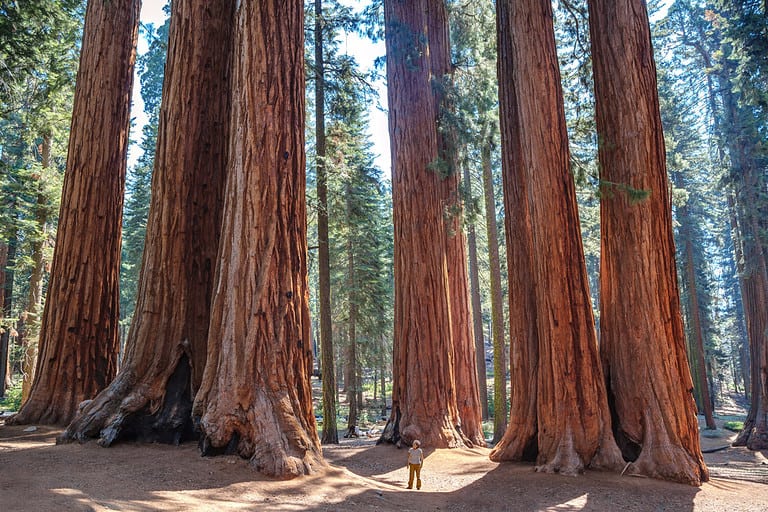
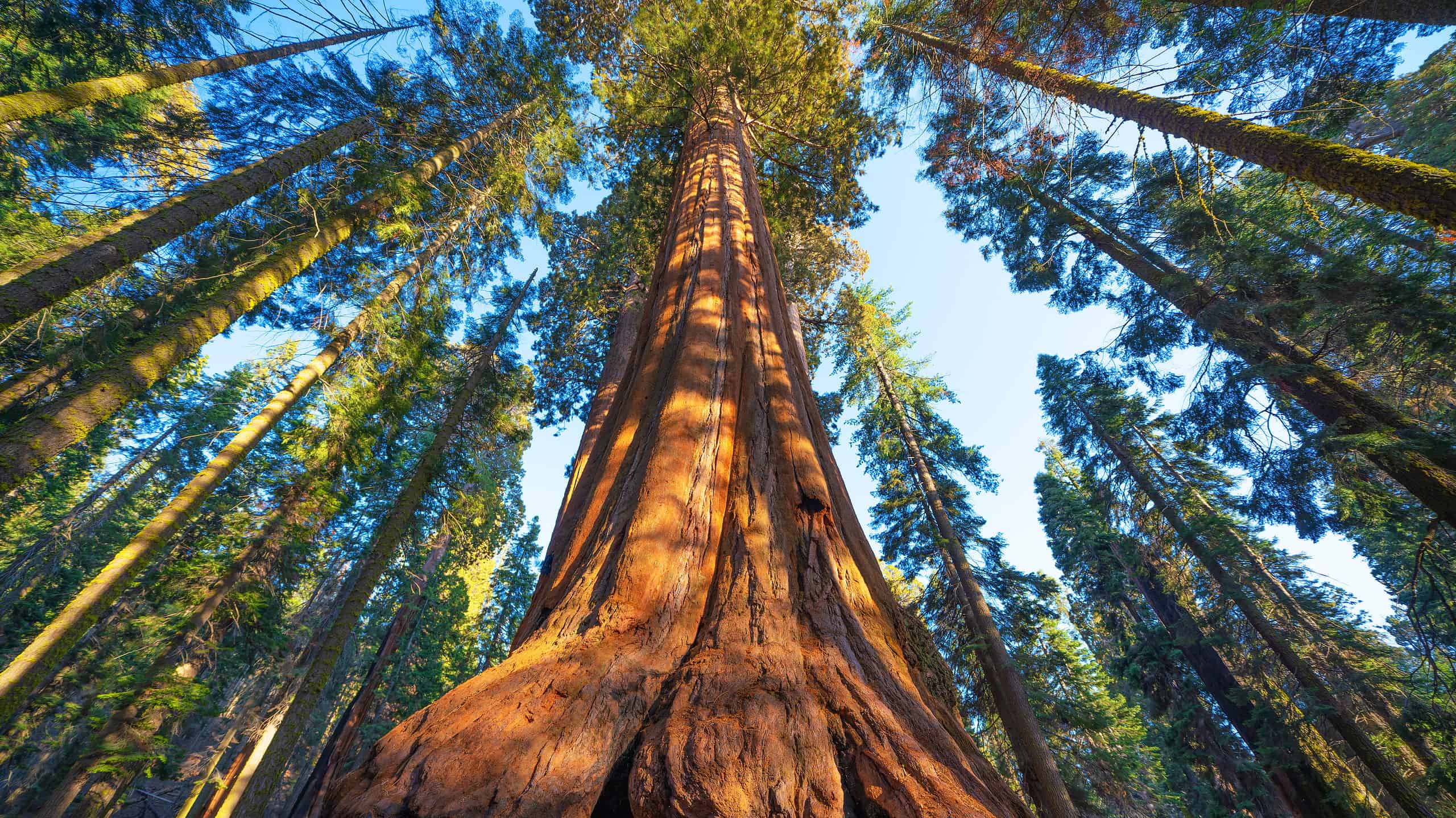
The giant sequoia trees are some of the oldest and most massive still in existence today. They are native to the Sierra Nevada Mountains in California. You can see them in all their splendor today, and many travel out to see them in person. The view is so incredible it leaves you breathless and in a suspended state of awe. You have to head over to the western slope of the mountains, however, as that’s where these magnificently towering trees are found.
Depending on the type of cedar tree, its habitat ranges. Some cedar trees are found in mountainous environments like the giant sequoia while others occur naturally in coastal regions. You can find cedar trees in forests as well. For example, Bermuda cedar trees once thrived in the forest on the island of Bermuda. Deodar cedar, on the other hand, is most commonly found in parks and other open areas.
Giant Sequoia vs. Cedar Trees: Natural Habitat
The sequoias thrive in moist environments. They do well in the Sierra Nevada Mountains as the climate is similar to the Mediterranean. They require well-drained soil for their deep roots. For their tightly closed cones to open and release seeds, they require the environment of the Sierra Nevada Mountains, where there is periodic dry heat.
There are a number of cedar species found worldwide. There are some in North Africa, countries like Lebanon, Syria, and Southern Turkey. They occur in Central and South America as well. They also thrive in the northwestern regions of Canada and the U.S. The western red cedar, for example, grows along the Pacific coast. The Atlas cedar thrives in the Moroccan Atlas Mountains where the soil is moist and well-watered.
Giant Sequoia vs. Cedar Trees: USDA Hardiness Zone
Zone 6 is suitable for sequoias with the exception of harsh winters, as they may be more sensitive around that time. Hardiness zone 7 is a highly beneficial zone that allows sequoias to thrive nicely. Zone 8 allows for sequoias to grow beautifully. These conditions are ideal.
The different species of cedar that grow in South America mimic that of the Mediterranean and the USDA zones 6 to 9 apply. Of course, where the cedar tree is located dictates the ideal hardiness zone but generally, zones 6 to 9 work well for these types of trees too.
Giant Sequoia vs. Cedar Trees: Conservation Status in the U.S.
There are conservation efforts in place for the sequoias that are found in California. Some of the measures in place are to prevent logging and activities that are harmful. There is ongoing research to help these beauties stay in one piece and continue their lives leaving humans in that mesmerized state of awe.
The conservation of cedar trees in the U.S. varies depending on the species. For example, in 2017, the U.S. Forest Service announced that the Port-Orford-cedar had been under attack by a root disease for decades. In Nebraska, eastern red cedar trees severely impacted wildlife resources, forests, and grasslands. In Maryland, the Atlantic white cedar has been planted to ensure conservation.
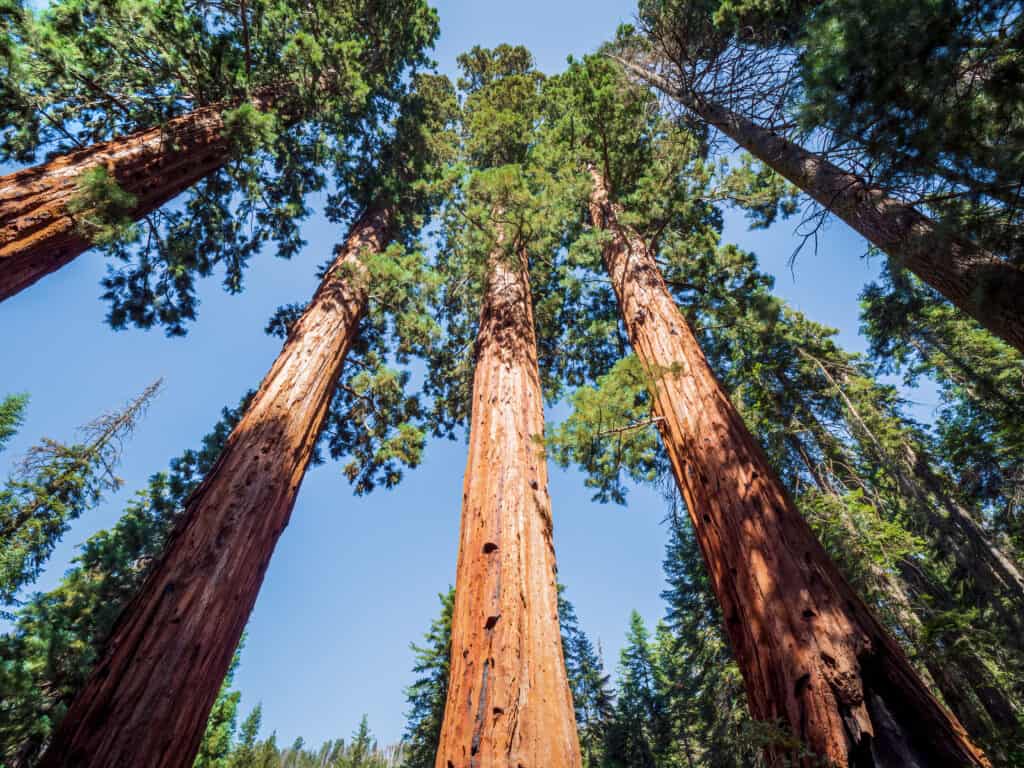
Most giant sequoias are protected in California.
©arkanto/Shutterstock.com
Giant Sequoia vs. Cedar Trees: Size
The giant sequoia lives up to its name, reaching into the sky up to 300 feet when it reaches maturity. The height of cedar trees varies, on the other hand, depending on the type. Atlas cedar extends upward approximately 60 feet while western red cedar trees reach up higher, sometimes up to 200 feet.
Giant Sequoia vs. Cedar Trees: Shape
When you’re talking about thick trunks, you have to point to the giant sequoia. It’s hefty with a distinctive columnar shape. The shape of cedar trees varies. Sometimes they have a pyramidal shape like the Atlas cedar and Lebanon cedar. Other times they’re conical like Bermuda cedar.
Giant Sequoia vs. Cedar Trees: Foliage
The foliage of giant sequoias is needle-like, appearing scaly. They are either a gray-green or blue-green color and are packed together, which causes overlapping and crowding. The foliage of cedar trees differs. For instance, the western red cedar has dense foliage with swooping branches. The needles of this tree are also scale-like and have both a darker and lighter side. When you rub them together, they give off a distinctive pineapple-like smell.
Giant Sequoia vs. Cedar Trees: Wood
The wood of the giant sequoia is surprisingly lightweight and soft. You’d think it would be dense and heavy based on stature alone but it’s not the ultimate go-to when considering construction. However, due to its weather-resistant quality, it makes a great addition to outdoor decks. The wood of cedar trees is hardier but still considered softwood. It makes for excellent use in furniture due to its durability and distinguishing scent.
Giant Sequoia vs. Cedar Trees: Cones
The cones of the giant sequoia are tightly packed together, appearing scaly. Without the right conditions in the Sierra Nevada Mountains, they wouldn’t open to release the seeds. Cedar trees have larger cones compared to that of the sequoia. They open more easily to release their seeds.
Giant Sequoia vs. Cedar Trees: Uses
The giant sequoia can certainly be used to build a gorgeous deck. However, they are appreciated primarily for their striking beauty in natural parks. They offer incredible ecological value, which is why they are conserved. Aside from furniture, cedar wood is also used in outdoor construction. Since it’s decay-resistant, it offers longevity.
Giant Sequoia vs. Cedar Trees: Elevation Limit
For giant sequoias, the elevation is over 8,000 feet. They need to be in a specific environment to flourish. Cedar trees, on the other hand, thrive in different environments. They can be coastal or as high as 7,000 feet above sea level.