
Quick Take
- Touching a frog with your bare hands might actually kill it, and the reason comes down to something your skin always carries. Why bare hands are dangerous →
- Some amphibians skip lungs entirely and rely on something far more unexpected to breathe. How skin breathing works →
- The line between poisonous and venomous sounds simple, but that assumption falls apart when you meet the species that's both. Poisonous vs. venomous explained →
- Frogs don't just change as they grow. They swap out entire body systems in a transformation reptiles never undergo. See the metamorphosis difference →
Amphibians and reptiles are commonly confused for one another. After all, they are both cold-blooded vertebrates that share similar anatomical features. But are frogs amphibians or reptiles? In this article, we’ll learn whether frogs are classified as amphibians or reptiles and discover the differences and similarities between the two types of animals.
The Differences Between Amphibians and Reptiles
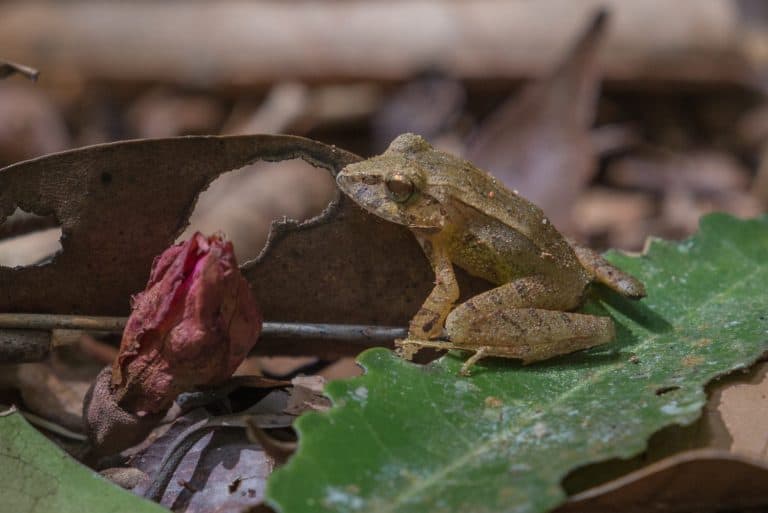
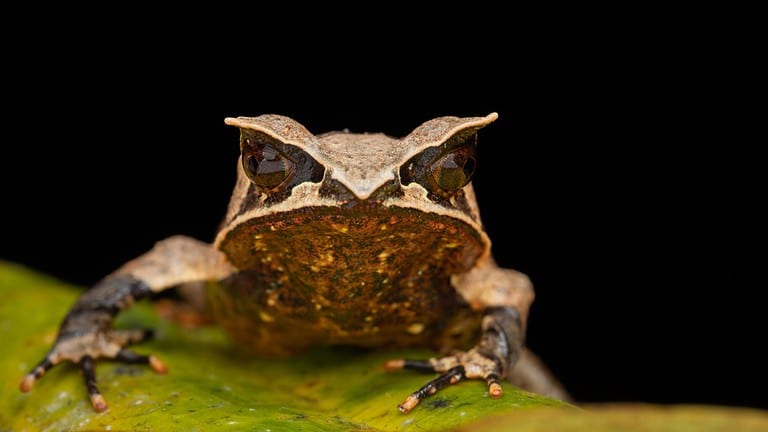
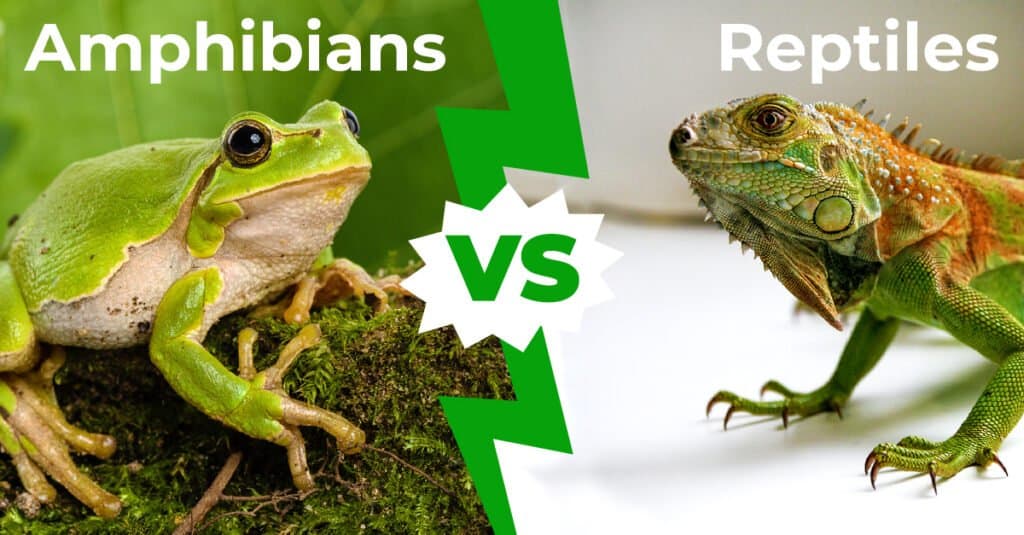
Frogs are amphibians. They have thin, mucus-covered skin that they can breathe through, lay shell-less, squishy-looking eggs, and typically go through a metamorphosis from tadpole to fully grown frog. All of these things set them apart from reptiles like turtles and snakes.
It can be difficult to know how to tell amphibians and reptiles apart. What is the difference, really? Here are five differences between amphibians and reptiles to help you identify them more easily.
1. Amphibians Literally Have Breathable Skin
Amphibians have the unique ability to breathe through their skin. Their skin is thin, porous, and contains many blood vessels near the surface. Amphibians also have mucus glands, which produce mucus to keep their skin moist.
If their skin were to dry out, they wouldn’t be able to filter oxygen, which would be detrimental to these animals. Although most amphibians have lungs as well, some of them, such as the salamanders in the lungless salamander family (Plethodontidae), breathe solely through their skin.
Reptiles, on the other hand, breathe through their lungs. Their skin is thick and protected by scales.
2. Amphibians Are More Fragile
As you may imagine, amphibians’ unique skin comes with a downside: it’s very fragile. These animals are especially at risk from predators and polluted environments. For instance, pollution can be absorbed from a pond and into a frog’s skin. Amphibians are also hunted by animals such as:
- Snakes
- Birds
- Fish
- Crayfish
- Otters
- Minks
- Beetles
- Spiders
- Newts
- Skunks
- Alligators
- Foxes
- Raccoons
- Monkeys
- Humans
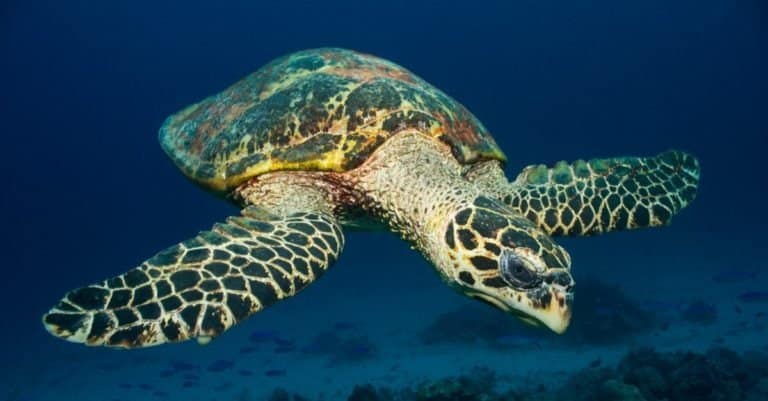
Reptiles are often prey animals too; however, they have more protection. From scaly snakes with other defense mechanisms to shelled turtles, a reptile’s skin is generally much more protective than that of sensitive amphibians.
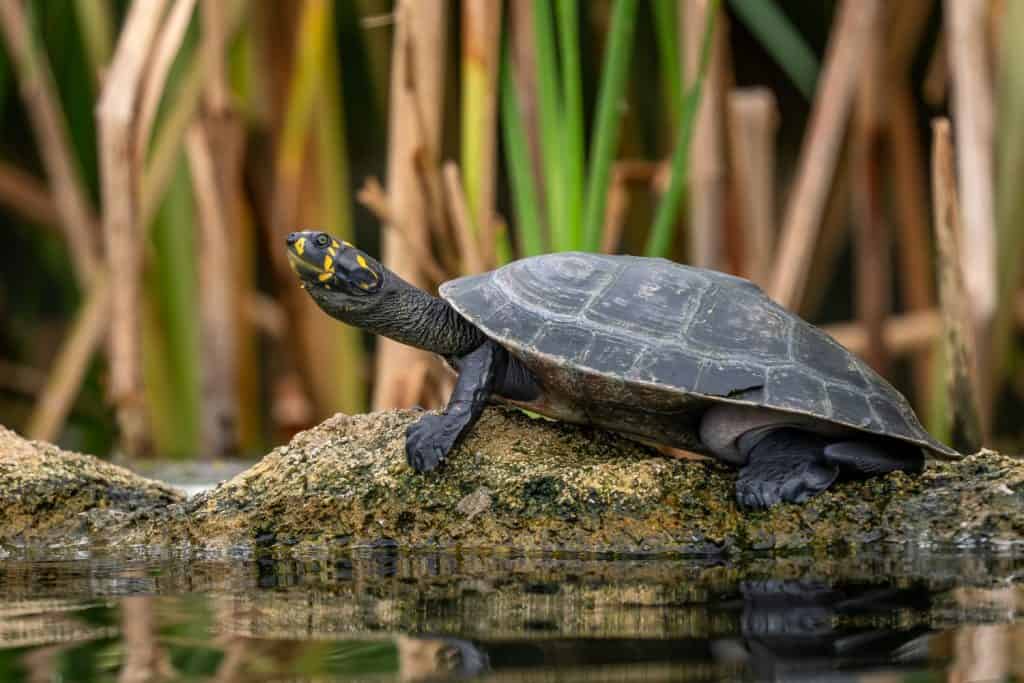
A turtle’s hard shell is one of its best defenses against predators.
©David Havel/Shutterstock.com
3. The Majority of Amphibians Go Through Metamorphosis
Think of how frogs begin their lives. They hatch from eggs as tadpoles: aquatic, gill-breathing larvae with no legs. Over time, the frog grows into a fully formed adult. It will lose its gills and gain lungs in their place. This is a huge transformation to make in one animal’s lifetime.
Reptiles do not go through metamorphosis. Reptiles hatch or are born looking like smaller versions of their adult selves.
4. Amphibians Have Squishy, Transparent Eggs
The way amphibians and reptiles begin their lives is also different. Amphibians lay eggs that are squishy and see-through, revealing the baby animal inside. Amphibians typically lay their eggs in water.
Reptile eggs, much like their skin, are built to be more protective. They have a hard outer shell, more like a chicken egg. Reptiles also typically lay their eggs on land. Even semi-aquatic reptiles like alligators lay their eggs on land.
5. Amphibians Only Live in Freshwater
Amphibians can only survive in freshwater conditions. This is because of their sensitive skin, which can be harmed by salt. Handling a frog with your bare hands can potentially hurt it, because salts, oils, and other chemicals naturally present on human skin can irritate a frog’s sensitive skin. As you can imagine, this means there’s no way a frog will survive being submerged in saltwater for very long.
Although some reptiles also favor freshwater, many reptiles can live in saltwater or brackish water, a mix of saltwater and freshwater. These reptiles have specialized salt glands to excrete excess salt. Unlike amphibians, they also have low-permeability skin.
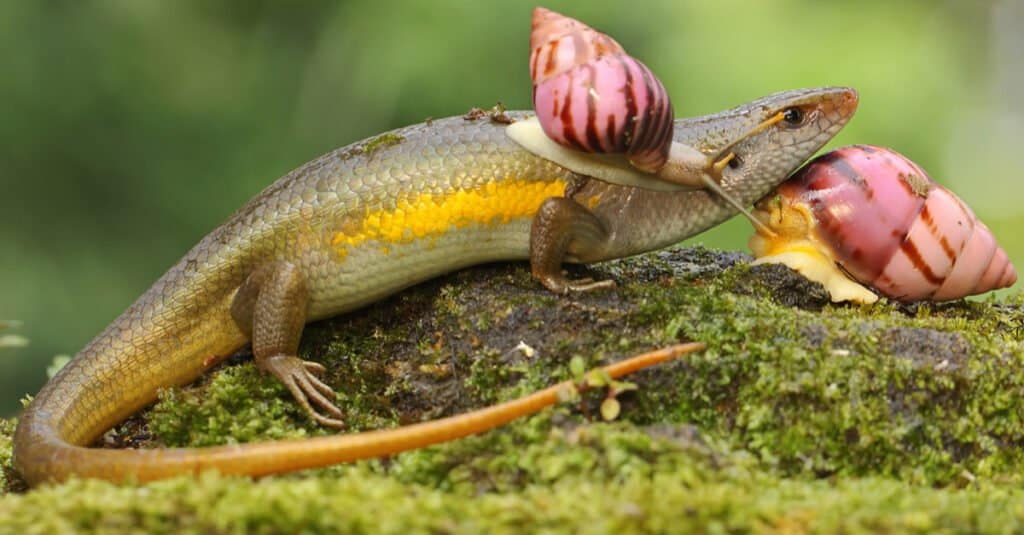
Reptiles and amphibians are grouped together as herpetofauna.
©I Wayan Sumatika/Shutterstock.com
How Are Amphibians and Reptiles Alike?
When grouped together, amphibians and reptiles are referred to as herpetofauna. As we discussed above, they are quite similar animals, which is why they get confused so often. But what exactly do these creatures have in common? Here are five similarities.
1. Amphibians and Reptiles Have Backbones
All of these creatures are vertebrates, meaning that they have backbones. Frog backbones do not connect to a tail, though ancient frogs may have had tails millions of years ago. Scientists believe this because of the urostyle, a rod-like bone of the pelvic girdle formed from fused tail vertebrae, at the end of their spine. While they do have backbones, frogs don’t have ribs — this makes their internal organs extremely delicate. You should never pick a frog up from its stomach.
Even reptiles like snakes have backbones. Turtles also have backbones. A turtle’s hard shell is made up of around 60 bones that include the ribcage, backbone, vertebrae, and breastbone fused together.
2. Both Amphibians and Reptiles Hatch from Eggs
As we discussed above, amphibians and reptiles have very different types of eggs. However, the majority of them are egg-laying animals who do not give birth to live babies.
However, there are some amphibians and reptiles that give live birth. For example, a Sulawesi fanged frog (Limnonectes larvaepartus) gives birth to live tadpoles instead of laying eggs. Around 20% of reptiles give live birth.
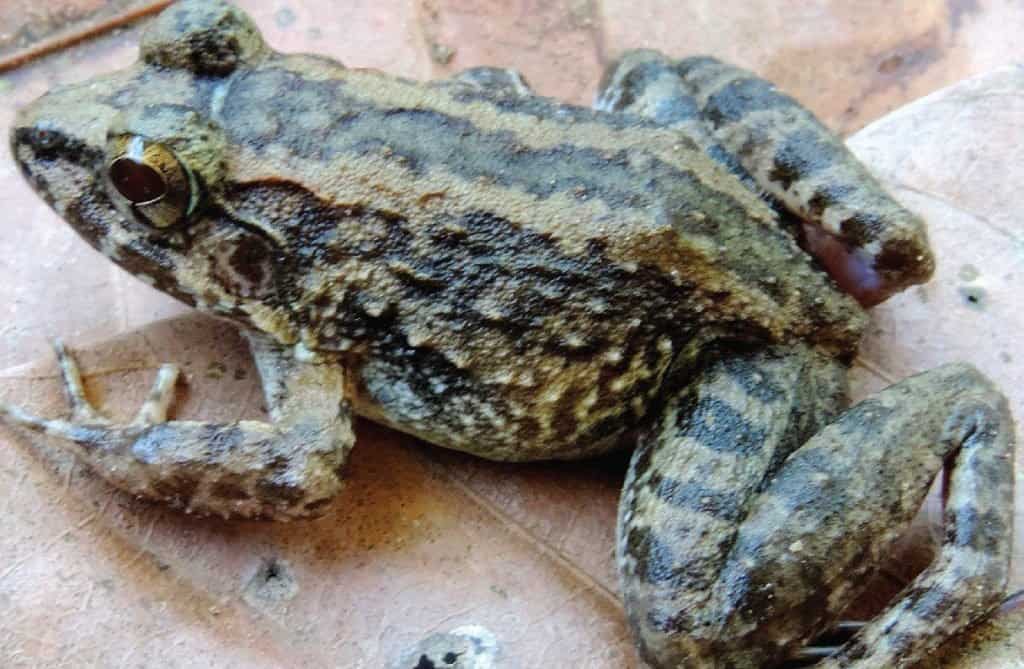
Limnonectes larvaepartus is a rare frog from Sulawesi, Indonesia that gives birth to live tadpoles.
©Mirza D. Kusrini, Jodi J. L. Rowley, Luna R. Khairunnisa, Glenn M. Shea, Ronald Altig / CC BY 2.5 – Original / License
3. They’re Found on Almost Every Continent
Amphibians and reptiles are common all around the world — the only continent on which they do not live is Antarctica.
Frogs are no exception, from the tree frogs found in the South American rainforests to the desert rain frog of South Africa.
4. Amphibians and Reptiles are Cold-Blooded
Amphibians and reptiles are cold-blooded animals. This means they cannot regulate their own body temperatures in the way that warm-blooded animals, like humans, can. Instead, they rely on their environment to keep them warm.
This is why you’ll often see amphibians and reptiles basking in the sun. It’s also why some frog species will dig deep into the soil when it’s too hot in the summer, or float at the bottom of a pond to hibernate when it’s below freezing outside. They seek out the ideal surroundings so that their temperature doesn’t rise too high or drop too low.
5. Both Amphibians and Reptiles Can Be Toxic
Not every amphibian or reptile is toxic, but many are. Amphibians are typically poisonous, while reptiles are venomous. Poisonous animals are dangerous to ingest or touch, while venomous animals are dangerous when they bite or sting.
Frogs, for instance, are often poisonous. Poison dart frogs are tiny, but some frogs, such as the golden poison frog (Phyllobates terribilis), have enough poison to kill ten adults. These frogs secrete toxins through their skin. The toxins enter the bloodstream through open wounds or through mucous membranes. This can lead to immediate cardiac or respiratory failure.
Snakes, on the other hand, are usually venomous. They inject venom into wounds when they bite. Most snakes are not dangerous to touch or for predators to consume, as long as the fangs can be avoided. However, some snakes, such as the tiger keelback (Rhabdophis tigrinus), are both poisonous and venomous.