
Quick Take
- One of Virginia's six nesting hawks has an owl-like face, but that's not even the strangest thing about it. Meet the owl-faced hawk →
- Virginia's most common hawk hides in plain sight, and most people drive past one every single day without knowing it. Virginia's most common raptor →
- One solitary hawk transforms into a flock of tens of thousands, though this happens only at a very specific time of year. See the massive migration →
- Virginia's smallest hawk has a size quirk between males and females that sets it apart from every other raptor on this list. Virginia's smallest hawk →
From the mountainous west to the central Piedmont and the coastal east, there’s no shortage of diverse habitats in Virginia. Virginia’s typically mild winter weather also allows many birds to remain in the state year-round instead of flying farther south. Around 400 bird species live and thrive there, including hawks. There are six hawk species that nest in the state of Virginia. Read on to learn more about Virginia’s native hawks, including how to identify them and where they can be found in the state.
Broad-Winged Hawk (Buteo platypterus)
| Characteristics | Measurements |
|---|---|
| Weight | 9.3-19.8 ounces |
| Length | 13.4-17.3 inches |
| Wingspan | 31.9-39.4 inches |
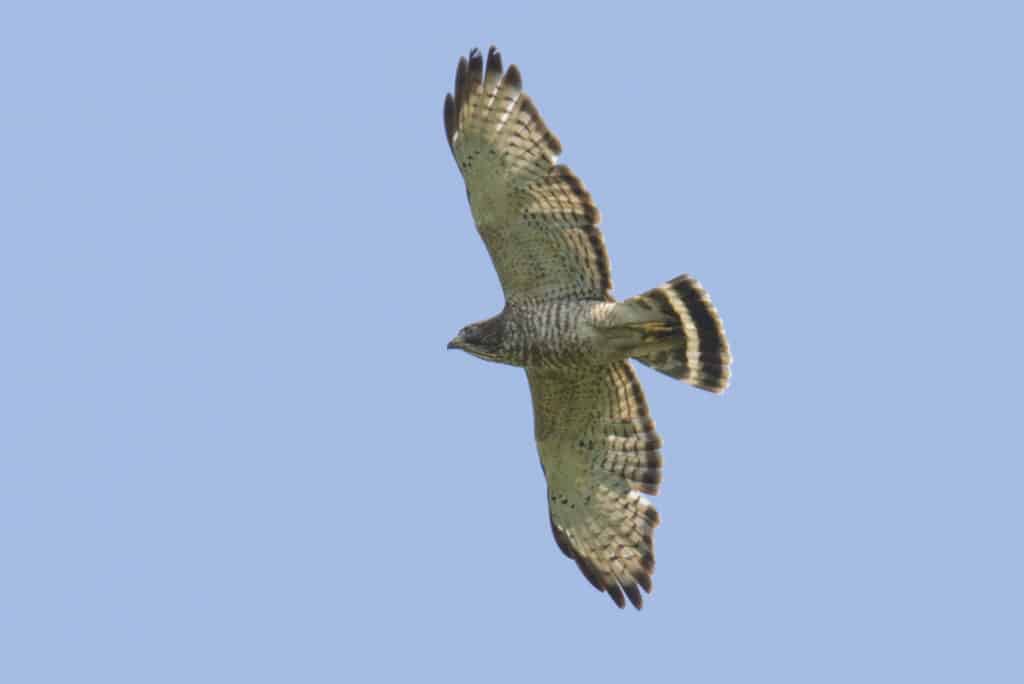
Broad-winged hawks are generally solitary, but they form large flocks during migration.
©iStock.com/lrh847
The broad-winged hawk is a small, stocky raptor with a large head and a short, square tail. These hawks have reddish-brown heads, dark brown backs, reddish-brown barred underparts, and black and white banded tails. They also have dark brown edging on the pale undersides of their wings. In flight, their wings taper to a point.
Broad-winged hawks prefer densely wooded areas, particularly deciduous or mixed deciduous-coniferous forests across the eastern U.S. and southern Canada. They are frequently found near water and along forest clearings or edges. These hawks are highly migratory, with most birds wintering in and around forests from southern Mexico, through Central America, and down to Brazil and Bolivia in South America. During fall and spring migration, they may form flocks that number in the tens of thousands.
Cooper’s Hawk (Astur cooperii)
| Characteristics | Measurements |
|---|---|
| Weight | 7.8-14.5 ounces (male); 11.6-24.0 ounces (female) |
| Length | 14.6-15.3 inches (male); 16.5-17.7 inches (female) |
| Wingspan | 24.4-35.4 inches (male); 29.5-35.4 inches (female) |
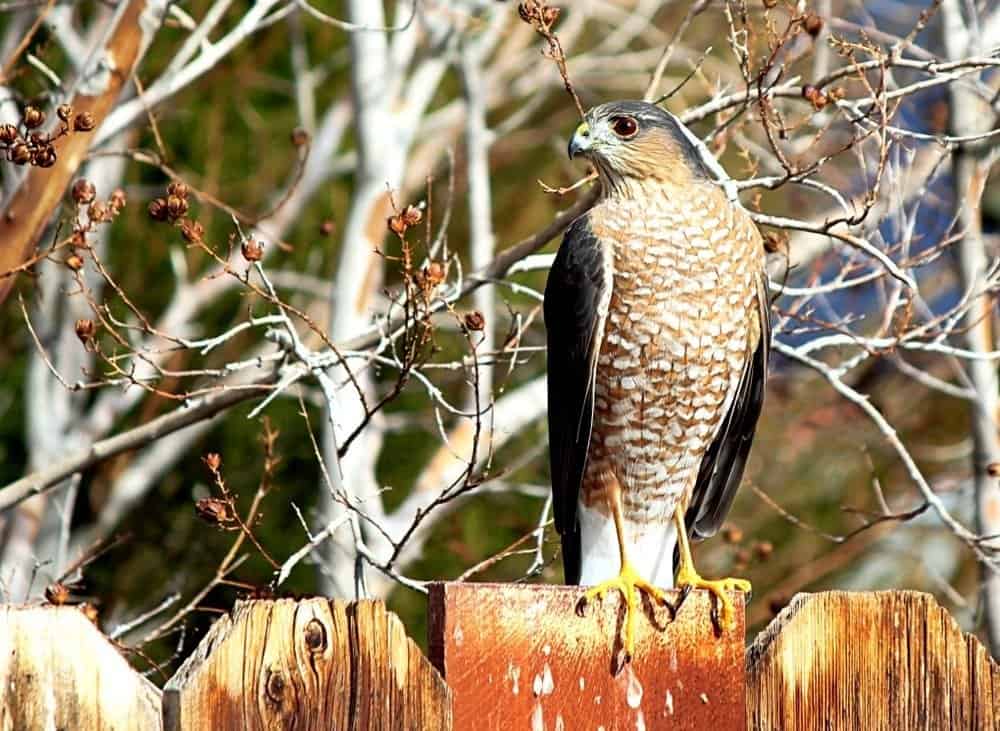
The Cooper’s hawk is a year-round resident of the state.
©Lilly P. Green/Shutterstock.com
Cooper’s hawks have blue-grey upper parts with reddish bars on their pale underparts and thick dark bands across their rounded tails. They are generally slender with short, wide wings and long legs, tails, and talons. These diurnal raptors prey on other birds. They were previously assigned to the accipiter genus, but they have recently been moved to astur to resolve taxonomic issues.
These birds favor coniferous, deciduous, and mixed wood forests, but they can also be seen in wooded suburban backyards, parks, and fields. They are found year-round throughout most of their range, including Virginia. The northernmost breeding birds move south for winter and migrate during the day. During fall migration, Cooper’s hawks can be seen along Appalachian Mountain ridges and the Eastern Shore.
Northern Harrier (Circus hudsonius)
| Characteristics | Measurements |
|---|---|
| Weight | 10.6-26.5 ounces |
| Length | 18.1-19.7 inches |
| Wingspan | 40.2-46.5 inches |
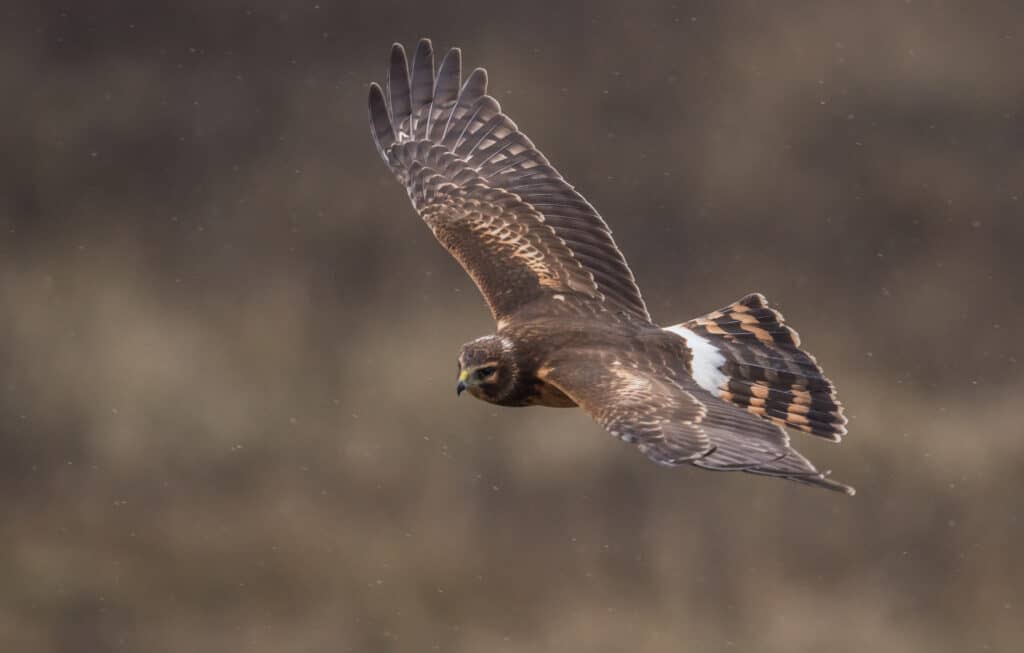
The northern harrier soars low and slow with its wings in a “V” shape.
©Harry Collins Photography/Shutterstock.com
The northern harrier is a slim bird with a long, rounded tail and long wings. These birds have small, sharp, hooked bills and flat faces similar to owls. Male birds are grey with pale undersides, black wingtips, dark wing edges, and a dark-banded tail. Females are brown and have pale undersides streaked with brown, as well as black banding on the tail. Both males and females have a white rump patch.
Southern birds are believed to be year-round residents, but northern birds move farther south, away from areas known to have heavy snow. In Virginia, they are common migrants and winter residents, especially along the Eastern Shore and coastal plain. These birds prefer both wet and dry open habitats, including tundra, prairies, marshes, and fields. They can be recognized by their low and slow flight with their wings angled into a “V” shape.
Red-Shouldered Hawk (Buteo lineatus)
| Characteristics | Measurements |
|---|---|
| Weight | 17.1-27.3 ounces |
| Length | 16.9-24.0 inches |
| Wingspan | 37.0-43.7 inches |
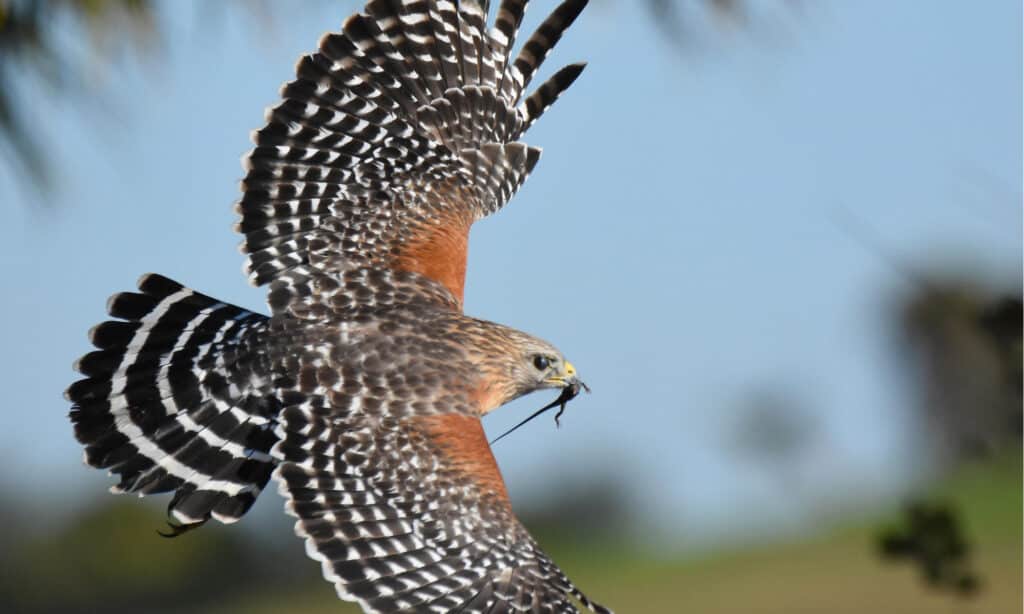
Adult red-shouldered hawks have a very rich, red coloration on their “shoulders” and chest.
©MTKhaled mahmud/Shutterstock.com
The red-shouldered hawk is a slender raptor with broad wings and a relatively long tail. These birds have dark brown to black-and-white checkered wings with black-and-white banded tails. They have reddish shoulders and chests. All ages show narrow, pale crescents near the wingtips in flight.
Red-shouldered hawks live in the state year-round. They can typically be found in tall, deciduous woodlands near water, in areas such as swamp forests and river bottoms. Hawks that migrate from further north can be seen high over mountain ridges or along the coast.
Red-Tailed Hawk (Buteo jamaicensis)
| Characteristics | Measurements |
|---|---|
| Weight | 24.3-45.9 ounces (male); 31.8-51.5 ounces (female) |
| Length | 17.7-22.1 inches (male); 19.7-25.6 inches (female) |
| Wingspan | 44.9-52.4 inches (male); 44.9-52.4 inches (female) |
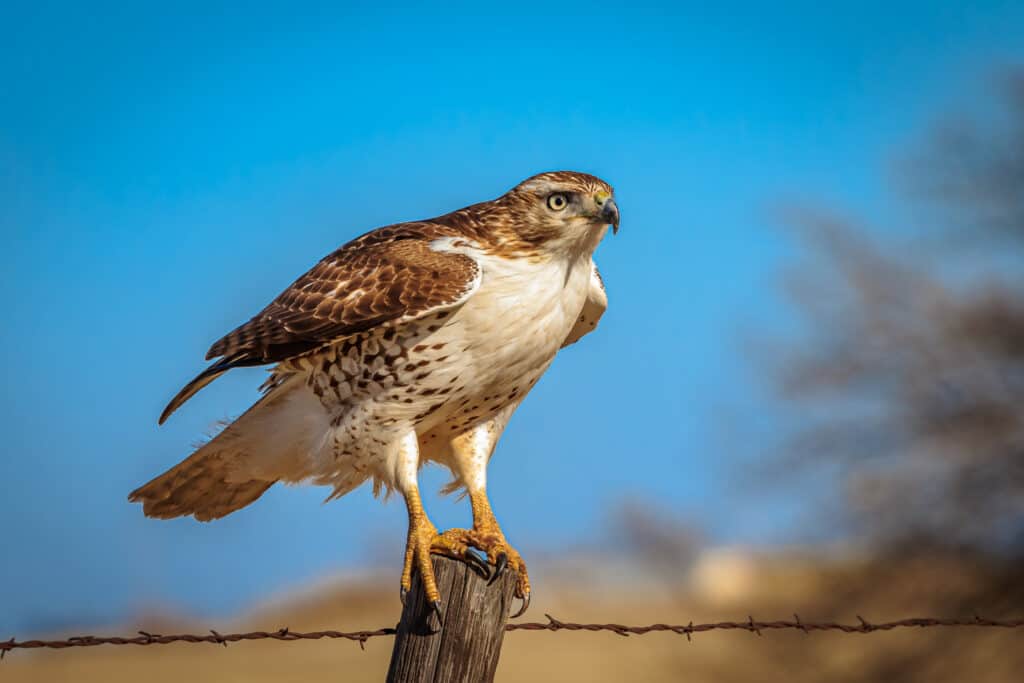
The red-tailed hawk can be found throughout Virginia year-round.
©Richard G Smith/Shutterstock.com
Red-tailed hawks are the most common and widely distributed raptors in the state. These large hawks have stout bodies, broad, rounded wings, and short tails. East of the Mississippi, they are typically brown with white chests and dark streaks on their bellies. Their cinnamon-colored tails are pale underneath, with dark marks at the shoulders and dark trailing edges on their wings.
Red-tailed hawks live throughout the state year-round. They can be found in any open habitat that offers room to hunt and places to perch, from woodland clearings to mountains to plains. They are often seen perched on trees, telephones poles, and fence posts or circling over wide open fields.
Sharp-Shinned Hawk (Accipiter striatus)
| Characteristics | Measurements |
|---|---|
| Weight | 3.1-7.7 ounces |
| Length | 9.4-13.4 inches |
| Wingspan | 16.9-22.1 inches |
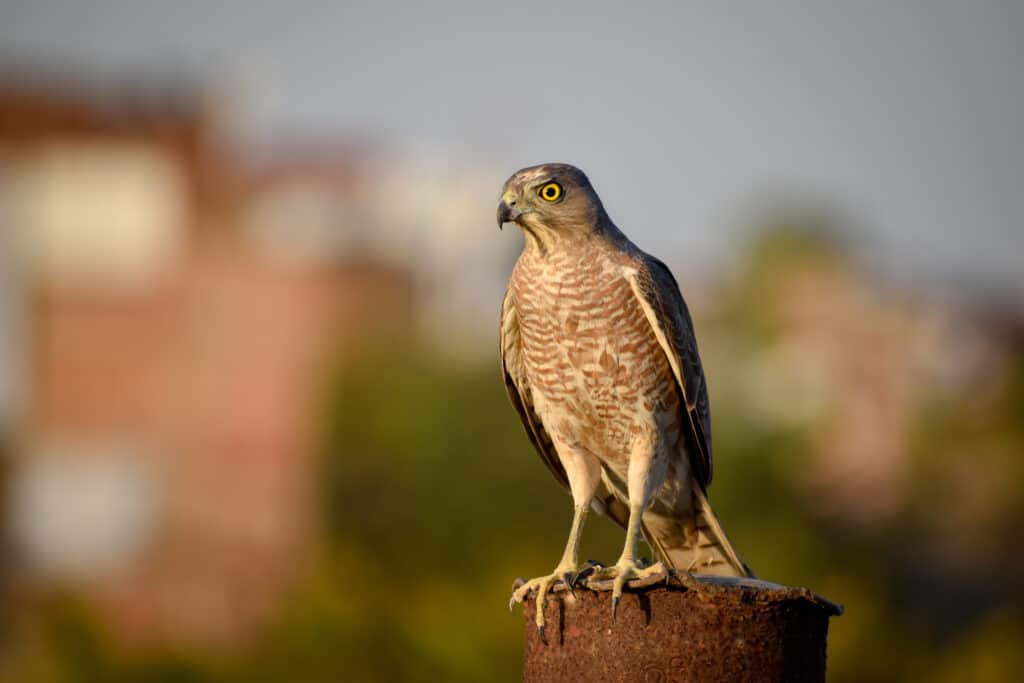
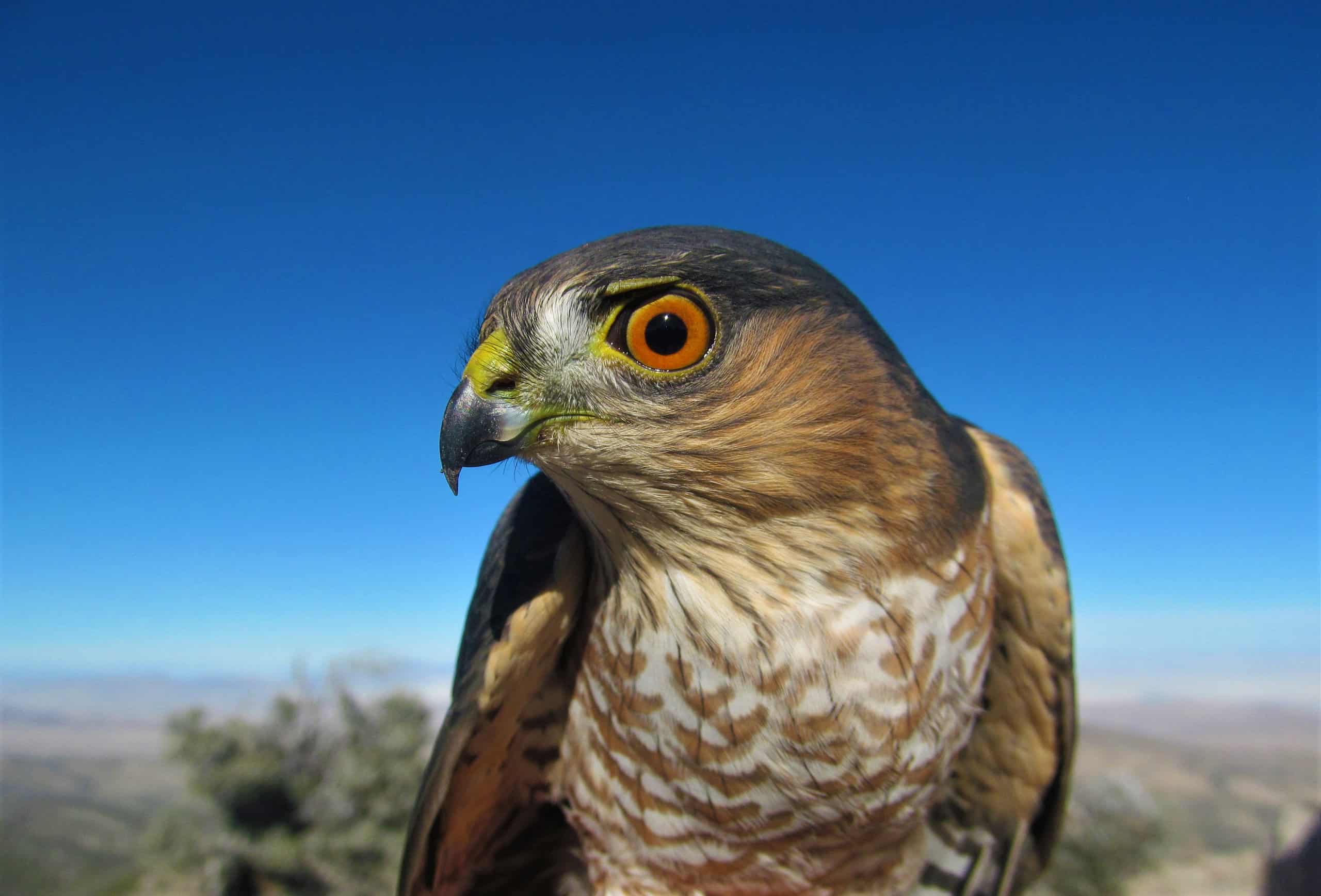
Sharp-shinned hawks primarily eat small birds.
©Vizz Effect/Shutterstock.com
The sharp-shinned hawk is the smallest type of hawk in Virginia. These hawks have short, rounded wings and long tails. They have blue-grey upper parts, horizontal reddish-orange bars on their pale breasts, and wide dark bands across their tails. Female sharp-shinned hawks are one-third larger than males.
Sharp-shinned hawks that live in the mountains, including the Appalachians of Virginia, may remain there year-round. Hawks that breed in northern parts of the U.S. and Canada fly south and may migrate as far as southern Central America. They are rarely seen in open country except during migration. While breeding, they prefer heavily forested mixed or coniferous woodlands.