
Quick Take
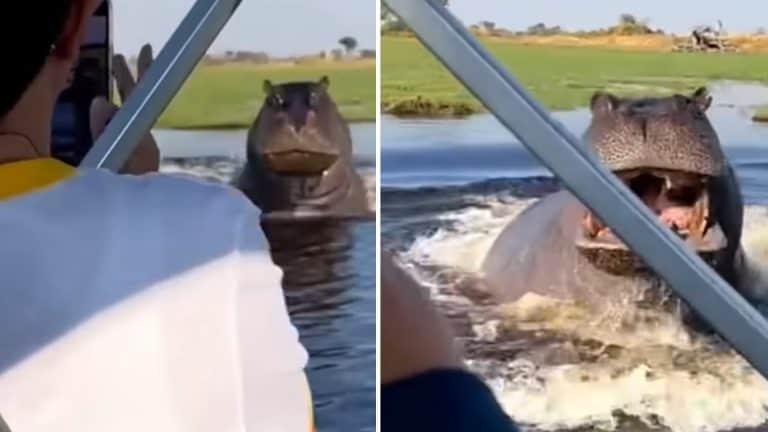
- Adult male hippos can open their mouths to nearly 180 degrees.
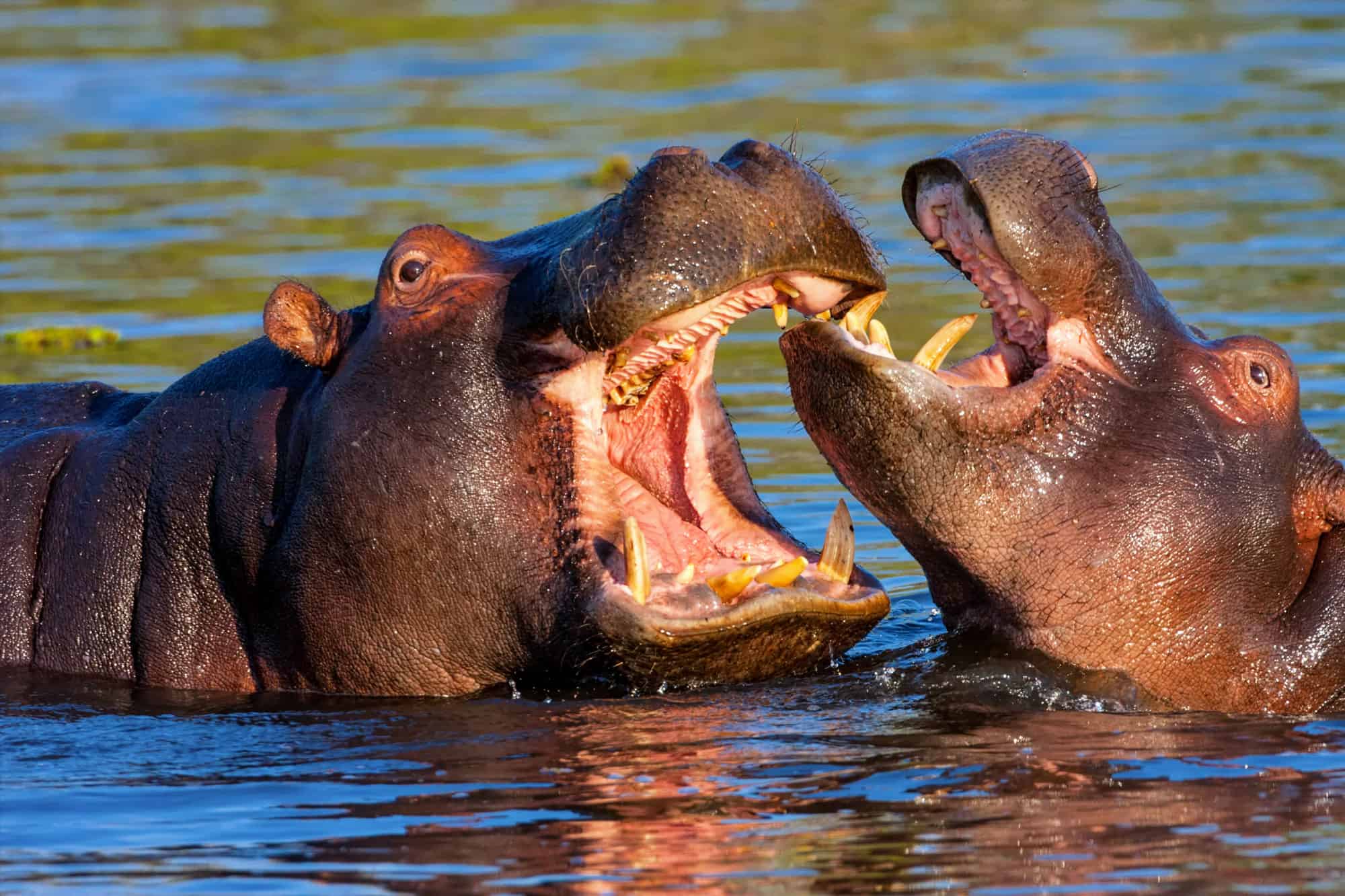
- Although it may appear to be a yawn, an open mouth is actually a threat display.
- Despite being herbivores, interlocking incisors actually prevent these massive animals from chewing efficiently.
- Hippos have tusk-like canines that can reach 1.5 feet in length.
Weighing around 3,500 pounds on average, common hippos (Hippopotamus amphibius) are some of Earth’s largest land animals. Although they are primarily herbivores and spend hours grazing each day, hippos have huge mouths, long teeth, and an impressive bite force. But why do hippos need such large mouths and strong teeth? Read on to learn more about hippo mouths and their unique adaptations.
The Size of a Hippo’s Mouth
Common hippos are known for their size, and their mouths may be their most defining characteristic. Although the blue whale holds the top spot for the largest mouth on earth, the hippo has the largest mouth of any land animal. Generally, a hippo’s mouth measures about two feet wide from left to right when closed. However, they can open their mouths from 150 to nearly 180 degrees, resulting in an average gape of around four feet in adult males.
The orbicularis oris is a muscle that surrounds the mouth. In hippos, this muscle unfolds, allowing them to open their mouths widely without causing tissue damage. This muscle may also play a role in protecting their respiratory tracts while they are submerged in the water.
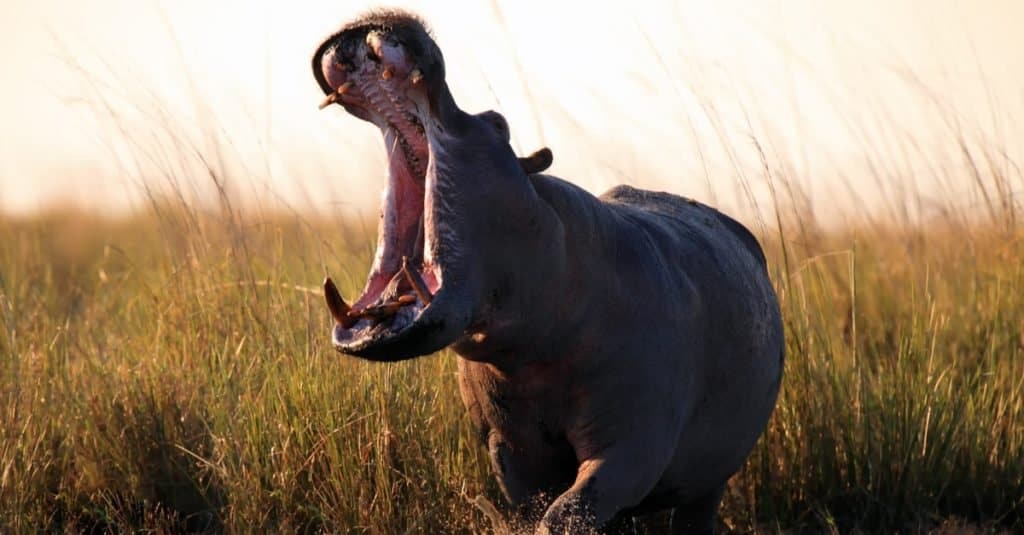
Hippo mouths can be up to four feet tall when open.
©Karel Bartik/Shutterstock.com
Why do hippos open their mouths to such an extent? Although it may appear to be a yawn, an open mouth is actually a threat display. Hippos are very territorial, so an open mouth is a warning for intruders to keep their distance. While this display is most commonly seen in dominant males, it also occurs in females protecting calves.
How Strong is a Hippo’s Mouth?
Hippos are also estimated to have one of the strongest bite forces among land animals. Their bite force is widely cited as 1,800 psi, likely based on measurements taken by Dr. Brady Barr on a National Geographic television program, “Dangerous Encounters.” Dr. Barr measured a female hippo’s bite force as 8,100 newtons, or 1,820.95 lbf (pounds-force). Barr was unable to measure a male’s bite force because of the animal’s aggressive behavior.
Male hippos are typically able to reach a maximum of around 4,550 pounds, while females can reach approximately 4,080 pounds. There are reports of male hippos reaching much larger sizes, and in zoos, the disparity is often greater than in wild populations. Although the size differences are not as extreme as in other hoofed animals, male hippos have larger heads and jaws that are 44% heavier than those of female hippos. This would certainly give a male hippo a stronger bite force than a female.
Hippo Teeth
Common hippos have 36 teeth, including 8 incisors, 4 canines, 12 premolars, and 12 molars. They have extremely long hypselodont canines and incisors, meaning these teeth are rootless and grow continuously throughout the animals’ lives. They have tusk-like canine teeth that are used in dominance fights and for defense. A male’s lower canines can grow to 1.5 feet in length, and they are around twice the size of a female’s. Their tusk-like teeth remain sharp due to the wear against their shorter upper canine teeth. The image below shows the complementary angles of the canine teeth, indicating where the wear occurs.
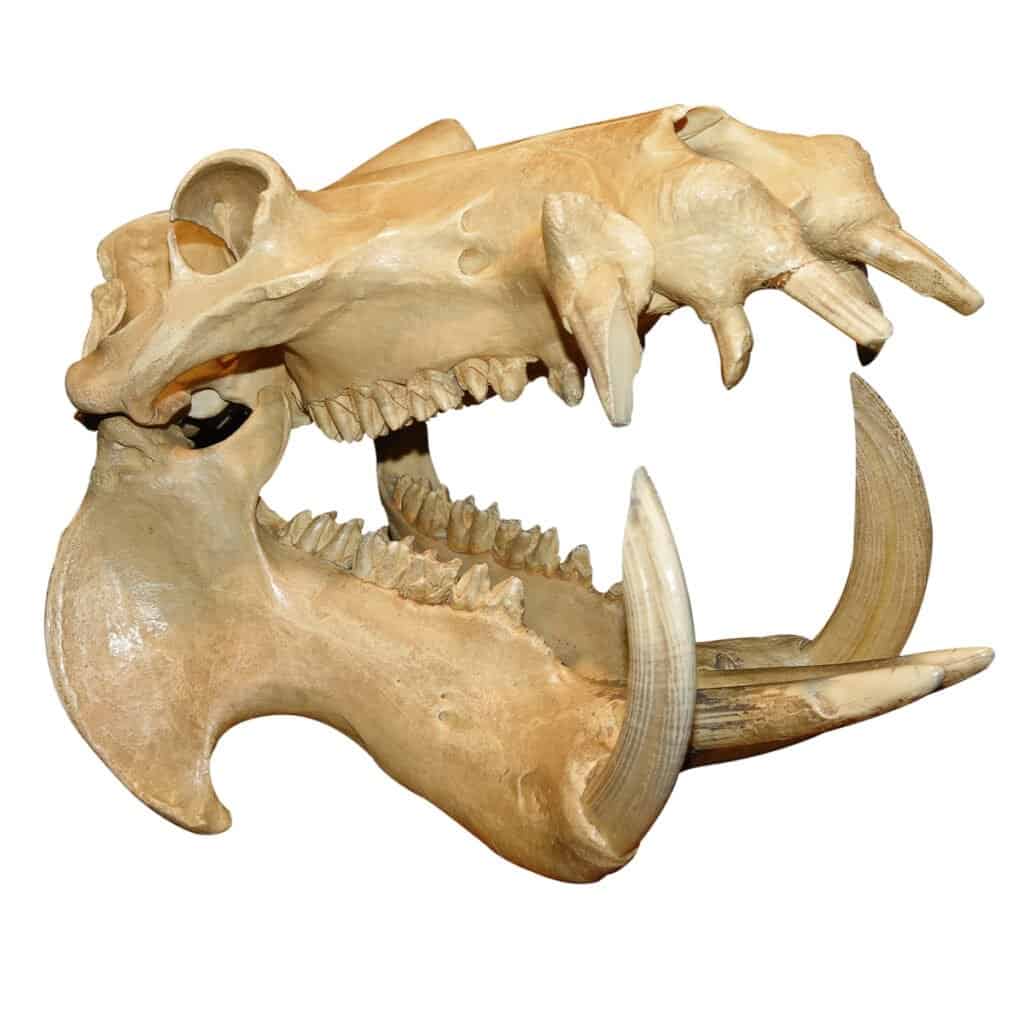
Hippo canine teeth can reach 1.5 feet in length.
©VINCENT GIORDANO PHOTO/Shutterstock.com
Hippos have interlocking upper and lower incisors that prevent side-to-side jaw movements necessary for grinding down fibrous vegetation. Although they have 24 total premolars and molars, hippos are inefficient at chewing. Because hippos cannot crush food into small pieces, digestion takes longer, which reduces their overall food intake. Researchers theorize that dentition adapted for sexual competition rather than efficient digestion may have limited hippos’ ability to compete with other land animals, thereby keeping them closely associated with aquatic habitats.