
Quick Take
- An engorged tick can change color so dramatically that the species becomes nearly unrecognizable, and this dramatic color shift is actually your best identification clue. See color changes after engorgement →
- Only one of these tick species carries Lyme disease, and it is not always the one people suspect. See which tick carries Lyme →
- The one body part that instantly separates an engorged deer tick from an engorged dog tick is hiding in plain sight. Compare leg and scutum color →
- Male ticks behave very differently from females after feeding, and that behavioral difference changes everything about when and how you find them on a host. Why only females engorge →
Tick bites are common, and with the rising incidence of Lyme disease and alpha-gal syndrome, engorged ticks are a concern. However, not all ticks are carriers of Lyme disease and alpha-gal syndrome. In the United States, there are approximately 90 identified species of ticks, the most common of which are the deer tick, the American dog tick, the brown dog tick, and the lone star tick. Of these tick species, the deer tick and the Western black-legged tick are both carriers of Lyme disease, while the lone star tick is a carrier of alpha-gal syndrome. Engorged ticks can look similar to the untrained eye. Below is a guide to help you identify the differences between engorged deer ticks and engorged dog ticks.
What are Ticks?
Ticks are external parasites that suck blood from their hosts. They belong to the Arachnid class of Arthropods, including scorpions, mites, and spiders. Ticks are small with two main body parts. They have four pairs of legs, are wingless, and have no antennae.

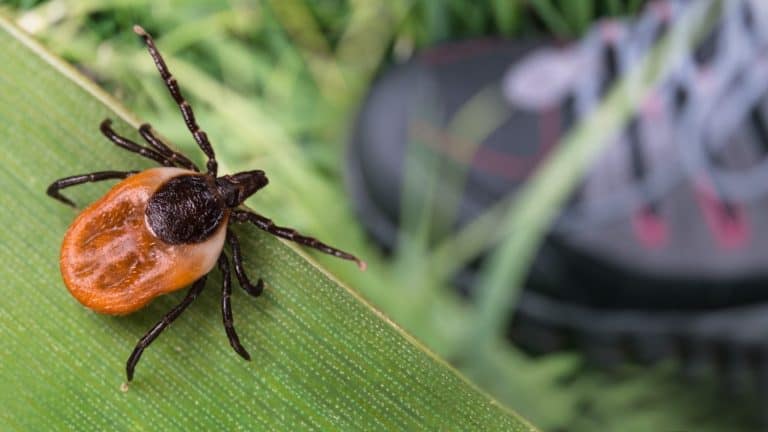
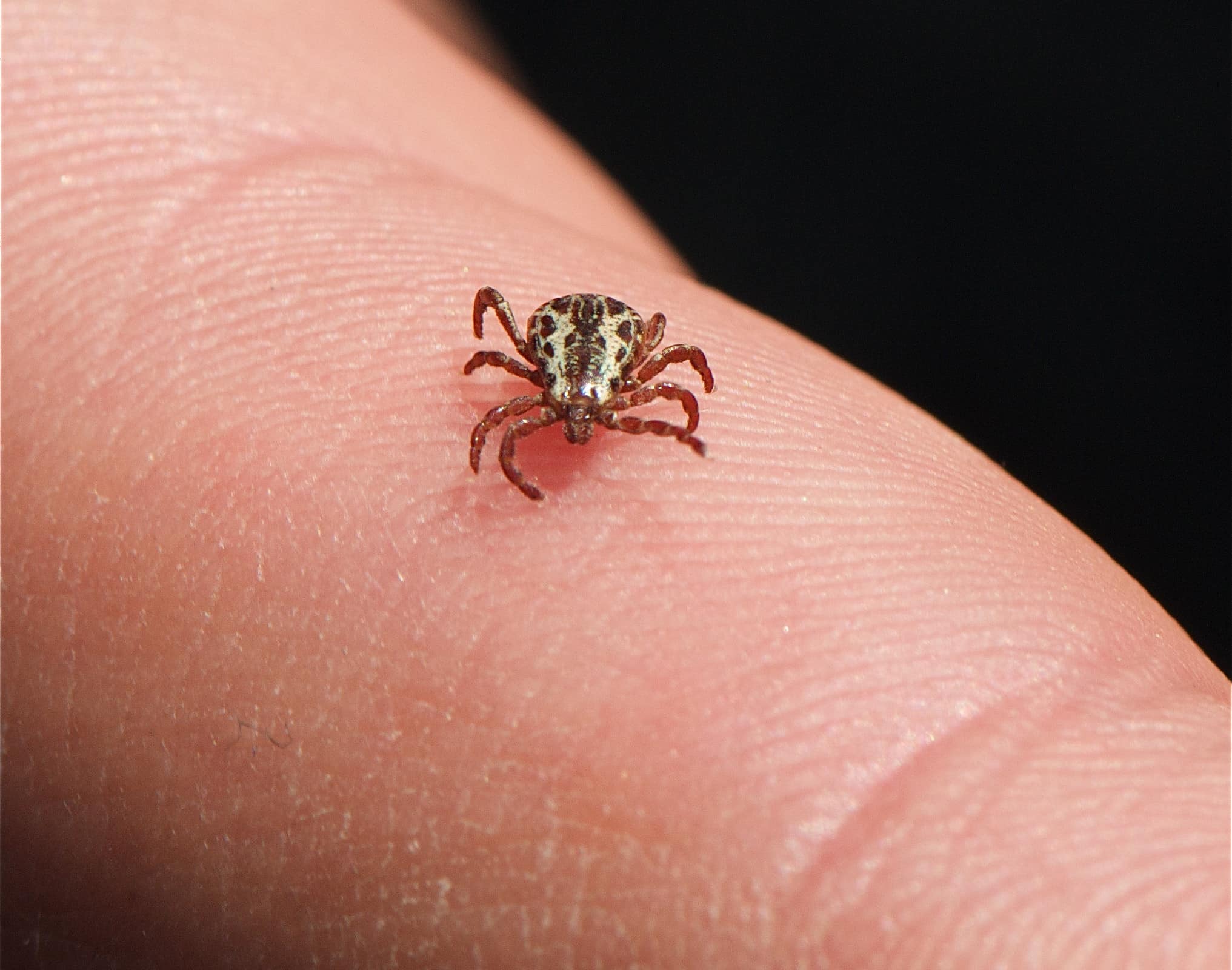
A deer tick has four pairs of legs, each with seven segments and claws at the tips.
©KPixMining/Shutterstock.com
Physical characteristics such as color patterns, appearance, and size among ticks vary according to species and gender. Ticks also change in appearance after feeding, and their bodies increase in size and shape after ingesting the host’s blood.
Anatomy
- Four pairs of legs, each with up to seven segments and having claws at the tips
- Wingless
- No antennae
- A small head is known as the capitulum
- A projecting set of mouthparts that has three main parts – chelicerae, palps, and hypostome
- An oval body called the idiosoma
- A darker, hardened plate on the back called the scutum
The scutum on ticks helps in identifying females from males. On a female tick, the scutum covers about 1/3 of its back; on males, it covers almost the whole back. Most ticks also have distinct color patterns on their scutum, which help identify individual species.
- Adult ticks range between 0.08 to 0.24 inches
- Nymphs range between 0.04 to 0.08 inches
After feeding, female ticks become engorged, increasing their size by over double. Male ticks don’t grow in size after feeding, as they don’t become engorged.
From the top, ticks are oval or teardrop shaped. On the side view, they are flat before feeding. After feeding, a female tick bears a coffee bean shape once engorged.
Color patterns of ticks vary depending on the species. Many ticks will have a black, gray, yellow, reddish-brown, or brown color.
What is an Engorged Tick?
Mature ticks survive by feeding on blood from vertebrates. A tick has four stages in life, egg, larva nymph, and adult. Nymphs attach to animals but don’t suck as much blood as an adult female.
Tick nymphs, like rodents, may seek smaller animals closer to their habitat in the early stages. They may also transfer from one animal to another. You can see an engorged tick across many hosts, including pets, wildlife, and farm animals.

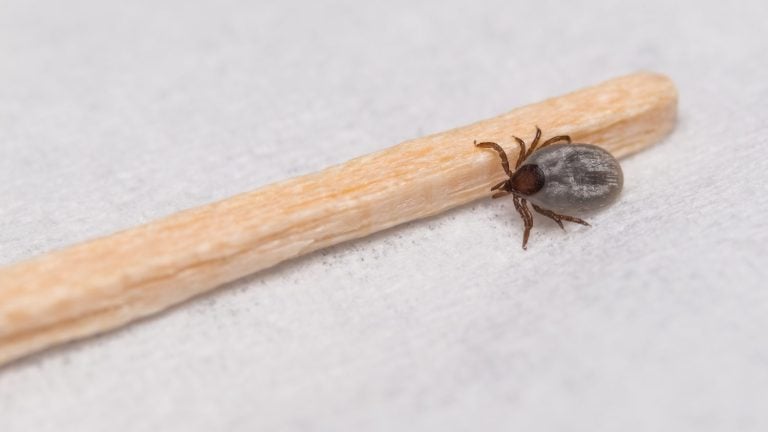
This dog tick is engorged after sucking the blood of its victim.
©Nitiphonphat/Shutterstock.com
An engorged tick is an adult female of any tick species noticed too late on a host. At this stage, the tick will be several times larger due tofilling with blood. Although male ticks also suck blood, they don’t stick to the host for long, dropping off in search of a mate. Females linger longer to gather enough food to support egg-laying.
A partially engorged tick looks big, roundish, and wrinkly, while an unengorged tick has a small, flat oval shape.
For a tick to transmit pathogens, a tick generally needs to be attached to a host for at least 36 to 48 hours. You can easily spot ticks on your loved ones and pets early before they become engorged. So, a thorough outdoor clean-up, regular body checks, and protective measures, such as wearing sufficient clothing and using repellent, will help keep you safe.
How to Identify an Engorged Deer Tick?
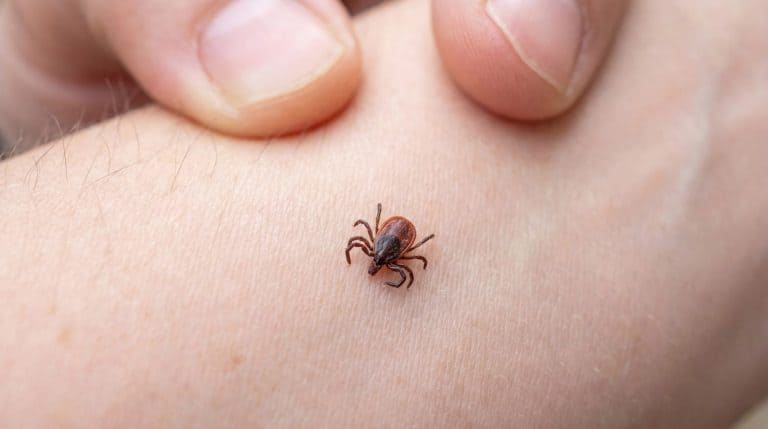
The deer tick (Ixodes scapularis), also known as the black-legged tick, is one of the smallest ticks found in forests, shrubs, or tall meadows in the United States. A fully grown adult reaches only up to 0.12 inches long.
Deer ticks are common in the Eastern United States. On the West Coast lives their closest cousin, the Western black-legged tick (I. pacificus). They are highly present in regions where white-tailed deer roam, their primary host.
They have a distinct orange-red color on their body and a black scutum. The species has dark legs that match its scutum.
Deer ticks have a life span of 2-3 years, which varies according to the environment. Adult females lay up to 4,000 eggs once in early spring before their death. The eggs incubate and hatch into larvae in late summer.
Larvae attach to small rodents to feed. An engorged deer tick larva remains dormant during fall using the excess stored blood feed as they evolve into a nymph.
The deer tick nymphs are mainly active in spring and more rampant in May and August. They seek new hosts and can infect their host as they suck blood with disease-causing pathogens if infected.
Deer tick nymphs are the primary transmitters of Borrelia burgdoreri and may go unnoticed due to their small size of 0.04 to 0.06 inches long. Engorged nymphs molt into adults during fall.
As deer tick nymphs metamorphose into female adults, they quest for other hosts for feed in preparation for mating. Only female deer ticks become engorged. Male ticks feed less and are always busy in search of mates. After mating, a male tick dies, just like a female after it lays eggs.
Deer Tick Appearance
Deer ticks have a brown-orange and black color and have an oval body that is flat before feeding. Their mouthparts are long and hexagonal. A female scutum is small and near the head, while a dark scuta almost covers the male dorsal.
Female deer ticks are more prominent than males and have a reddish color. Males have a dark brown or black color. Deer ticks lack other markings on their body like many other tick species.
An adult female engorged deer tick may appear dull green, grayish, or brownish with black legs matching its scuta.
The deer tick is the only species known to transmit Borrelia mayoni and B. burgdorferi, the bacteria that cause Lyme disease. The ticks also transmit other infections that cause disease in humans, dogs, and cats, including:
- Anaplasmosis
- Babesiosis
- Ehrlichiosis
How to Identify an Engorged Dog Tick?
The typical American dog tick (Dermacentor variabilis), and the Rocky Mountain Wood Tick (D. andersoni) are larger than the deer tick. Adult can reach a length of up to 0.20 inches in size.
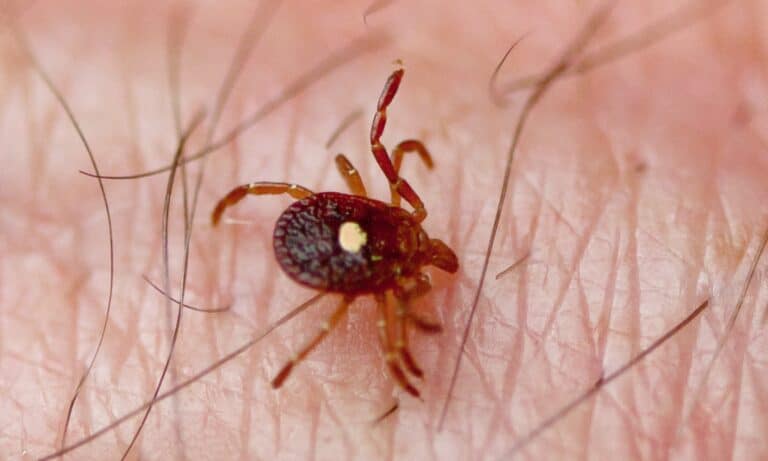
A distinctive feature of these ticks is the white markings on their backs. The white markings also help to determine sex. Males have the markings all over their backs, but in females, they only appear on their scuta.
American dog ticks have the same biological cycle as deer ticks.
American Dog Tick Appearance
The species nymphs have a lighter color (yellowish) before feeding and average 0.035 inches long. Adults are almost the same size as an apple seed with a reddish-brown color. They are primarily present along the west coast and east of the Rocky Mountains.
The females have a short scutum with white markings. The scutum on male American dog ticks covers most of the dorsal surface bearing the same white markings.
An engorged female American dog tick looks grayish-green in color and spots a scutum near the head with white markings.
The difference between engorged deer and American dog ticks is their scutum and feet.
- Deer tick – black legs with a black scutum
- American dog tick – reddish-brown legs and off-white scutum
Although the American dog ticks do not carry the Lyme causing bacteria, they can transmit other diseases to both cats and dogs:
- Rocky Mountain spotted fever
- Tularemia
- Tick paralysis
How to Identify an Engorged Brown Dog Tick?
The brown dog tick (Rhipicephalus sanguineus) is widespread worldwide. They are smaller than the American dog ticks, about the size of a sesame seed.
They are reddish-brown and have reddish legs. Adult females and males are almost equal in size and may look alike, but males have a darker color.
Dogs are the favorite hosts of brown dog ticks, though they bite and suck on other animals, including cats and humans.
Brown Dog Tick Appearance
Unfed adult brown dog ticks have a reddish-brown color and no markings. Their mouthparts are shorter compared to deer ticks.
Engorged brown dog ticks have a greenish or yellowish-green color. They have reddish legs, and their scutum is brown. By looking at the parasite body and leg colors, you can quickly tell the difference between engorged deer ticks and engorged brown dog ticks.
Brown dog ticks are not carriers of Lyme disease but can transmit ehrlichiosis and Rocky Mountain spotted fever to dogs.
Difference Between an Engorged Deer Tick vs. Engorged Dog Tick
Deer and dog ticks are the same species, but their characteristics differ.
| Trait | Deer tick | American dog tick | Brown dog tick |
|---|---|---|---|
| Adult Color | Brown, orange with dark legs | Reddish-brown legs match the body | Reddish-brown or yellowish-brown legs match the body |
| Engorged color | Green-silver | Gray or dark red | Green yellow |
| Scutum markings | None | Whitish spots | None |
| Female scutum | Small and dark | Small dark with white markings | Small and reddish-brown |
| Size | Nymphs are the size of a poppy seed. Unfed adults are like sesame seeds | Unfed adults equal the size of an apple seed | Unfed adults equal the size of a sesame seed |
| Location | Mainly in the Eastern U.S. in proximity to white-tailed deer habitats | Most common east of the Rocky Mountains and along | The most widespread tick globally |
| Where you encounter them | Overgrown areas, including forests and grasslands -on pets who frequent outdoors | Natural areas free of tree cover -On trails -Dog kennels and other areas where pets play or sleep | Within homesteads -Natural areas free of tree cover -On trails -Dog kennels |
| When active | From late spring through early fall -more rampant in May and August | April through August | Varies according to region |
| Potential health issues | Lyme disease, Anaplasmosis, Babesiosis, Ehrlichiosis | Rocky Mountain spotted fever, Ehrlichiosis, Tularemia, Tick paralysis | Rocky Mountain spotted fever, Ehrlichiosis |