
Quick Take
- Some of these moths don't just look like hummingbirds. They've also evolved a second disguise that fools an entirely different animal. See the bee mimicry →
- Two of these moths are so similar that the only reliable way to tell them apart has nothing to do with their appearance. Spot the key difference →
- What looks like a moth's wings at rest completely transforms the moment it takes its first flight, after which it never looks the same again. See how wings transform →
- If you think you spotted a hummingbird, one key detail in its flight pattern could reveal you're looking at something else entirely. Check the flight pattern →
Is it a moth? Is it a hummingbird? Sometimes they can be difficult to tell apart. Some moths look remarkably like hummingbirds. These moths, belonging to the Sphingidae family, are called sphinx moths or hawk-moths. Many of these moths even have some of the same behaviors as hummingbirds, such as drinking nectar from flowers and hovering near their food source. They are pollinators, making them valuable contributors to their ecosystems. If you think you’ve spotted a hummingbird, it’s worth taking a closer look. You might have seen one of these incredible moths instead.
Hummingbird Hawk-Moth
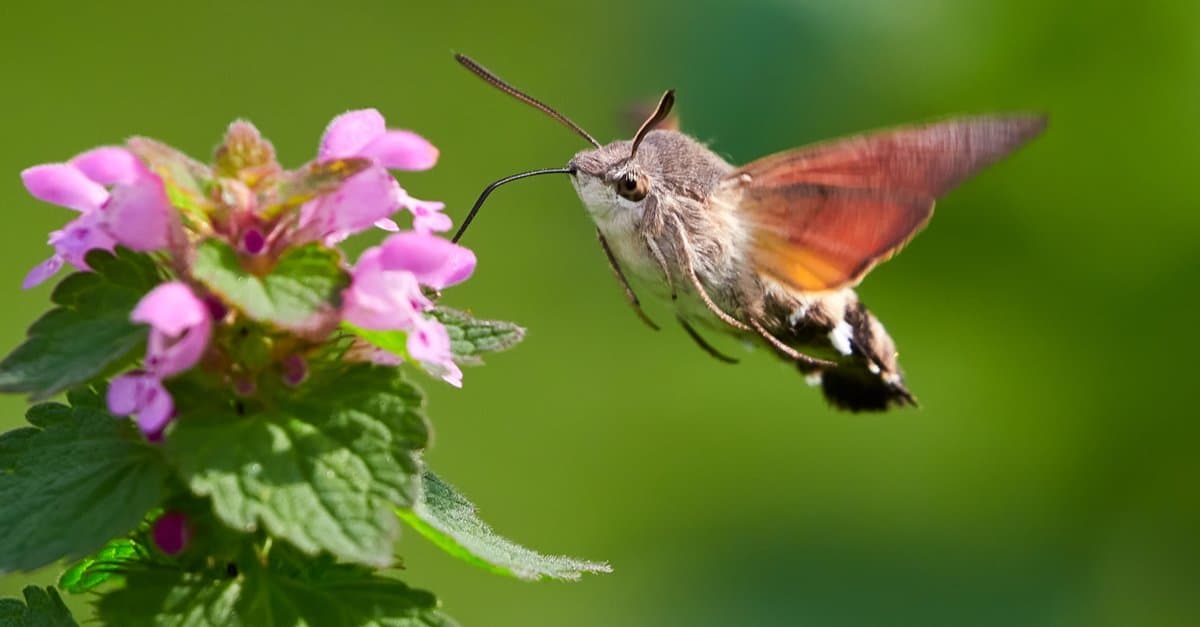
Often mistaken for true hummingbirds, Hummingbird hawk-moths (Macroglossum stellatarum) are medium-sized insects with a wingspan of approximately 1.6–2 inches. Like other sphinx moths, hummingbird hawk-moths have prominent forewings that move quickly to hover over flowers. Like hummingbirds, hummingbird hawk-moths have a long proboscis, which they unfurl to drink nectar from flowers.
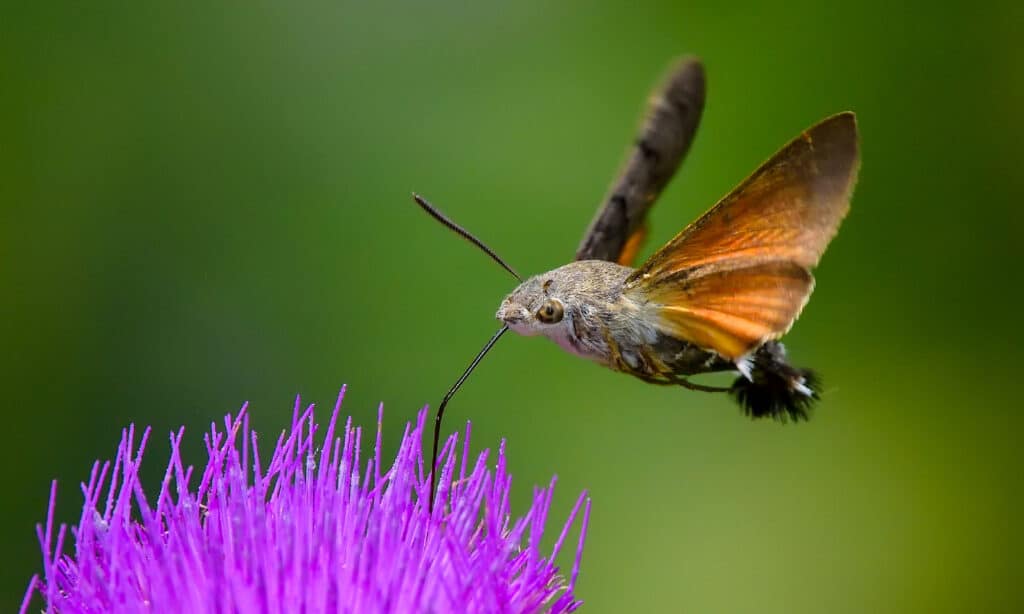
The hummingbird hawk-moth is widely distributed across temperate Eurasia and North Africa.
©aabeele/Shutterstock.com
The hummingbird hawk-moth’s hovering flight is one of the most telltale signs of this species, although it also makes these moths easy to confuse with true hummingbirds.
Snowberry Clearwing Moth
Snowberry clearwing moths (Hemaris diffinis) have clear wings, which give them a distinctive appearance. When snowberry clearwing moths emerge from their pupal cases (cocoons), their wings are completely covered in black scales. These scales provide vital protection during emergence, and most fall away during the moths’ initial flight. The scales remaining along the wing borders form a pattern that may help deter predators.

Like hummingbird hawk-moths, snowberry clearwing moths hover over flowers to drink nectar.
©Walter Coate/Shutterstock.com
Snowberry clearwing moths are stocky and covered in fine hairs. Their fuzzy yellow and black bodies resemble some bee species, a form of mimicry that deters predators, even though snowberry clearwing moths do not sting.
Snowberry clearwing moths have a wingspan of approximately 1.25 to 2 inches. Snowberry clearwing moths are widely distributed across North America.
Hummingbird Clearwing Moth
Hummingbird clearwing moths (Hemaris thysbe) have large, bulky bodies and notably large forewings. At first glance, these moths can easily be mistaken for hummingbirds. Like other members of their family, however, they are much smaller than most hummingbirds, measuring approximately 1.5 inches in length.

Hummingbird clearwing moths have dark red coloring, distinguishing them from other types of sphinx moths.
©Sam Hanrahan/Shutterstock.com
Like snowberry clearwing moths, hummingbird clearwing moths shed their wing scales, which protect them during emergence and fall away during their first flight.
White-Lined Sphinx Moth
The white-lined sphinx moth (Hyles lineata) is widely distributed across North and Central America. This moth’s body is brownish tan and furry, and its forewings are dark brown with white lines and a prominent diagonal tan band, while its hindwings are bright pink. These white lines and the vivid pink hindwings are among the moth’s most defining features.

White-lined sphinx moths will migrate from the southern part of their range to the northern areas in the springtime.
©Andy Reago & Chrissy McClarren, CC BY 2.0 , via Wikimedia Commons – Original / License
Rocky Mountain Clearwing
Rocky Mountain clearwing moths (Hemaris thetis), also called California clearwing moths, range primarily across western North America, from Alaska, British Columbia, and Alberta to California and Arizona, and east through the Rocky Mountains to Utah, Colorado, New Mexico, and Montana. These moths live in mountainous areas, feeding on nectar from flowering plants found in mountain meadows and forests.
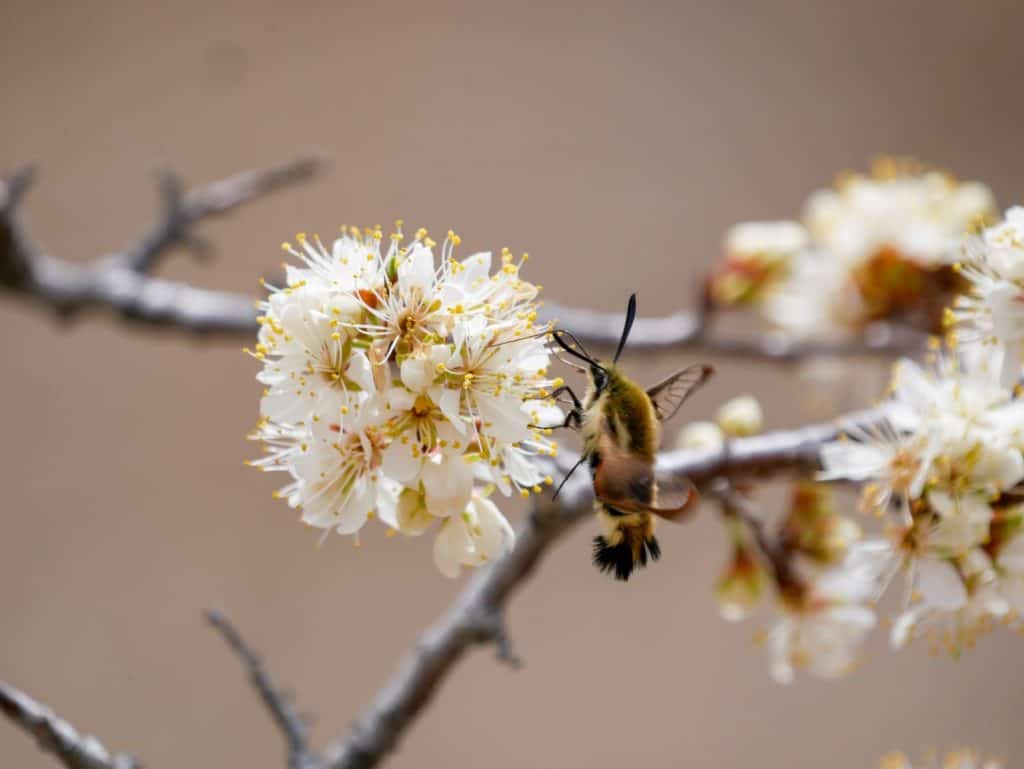
Like Snowberry clearwing moths, Rocky Mountain clearwing moths benefit from their resemblance to bees, which keeps predators at bay.
©Taxomony/Shutterstock.com
Rocky Mountain clearwing moths have fuzzy bodies banded in dark yellow and black or brown, closely resembling those of bees. Rocky Mountain clearwing moths closely resemble snowberry clearwings. The primary difference is in their geographic range. Rocky Mountain clearwing moths are found primarily in the western U.S., while snowberry clearwing moths are more common in the eastern U.S., east of the Continental Divide, though both species can overlap across a broader range.