Quick Take
- Imperial moths are large silkworm-moths with a 3 to 7 inch wingspan and leaf-like camouflage.
- Adults do not feed and live only to reproduce, often for a week or less.
- Caterpillars are polyphagous, feeding on many trees; pupate underground and have one annual brood.
Okay, I’ve seen a lot of moths in my life but what the heck is THIS thing?!?! If I saw that flapping its fuzzy wings around my porch light on a warm August night, I’d think I was in a deep sleep having a surreal dream. But this creature is very real. It’s the imperial moth, and despite its royal moniker, it is actually one of the more down-to-earth insects in North America, spending most of its life quietly munching leaves, hiding in soil, or posing on tree bark like nature’s own abstract art. In this article, we’ll take a closer look at what makes the imperial moth such a delightful and surprisingly impressive member of the nighttime forest crowd.
What is an Imperial Moth?
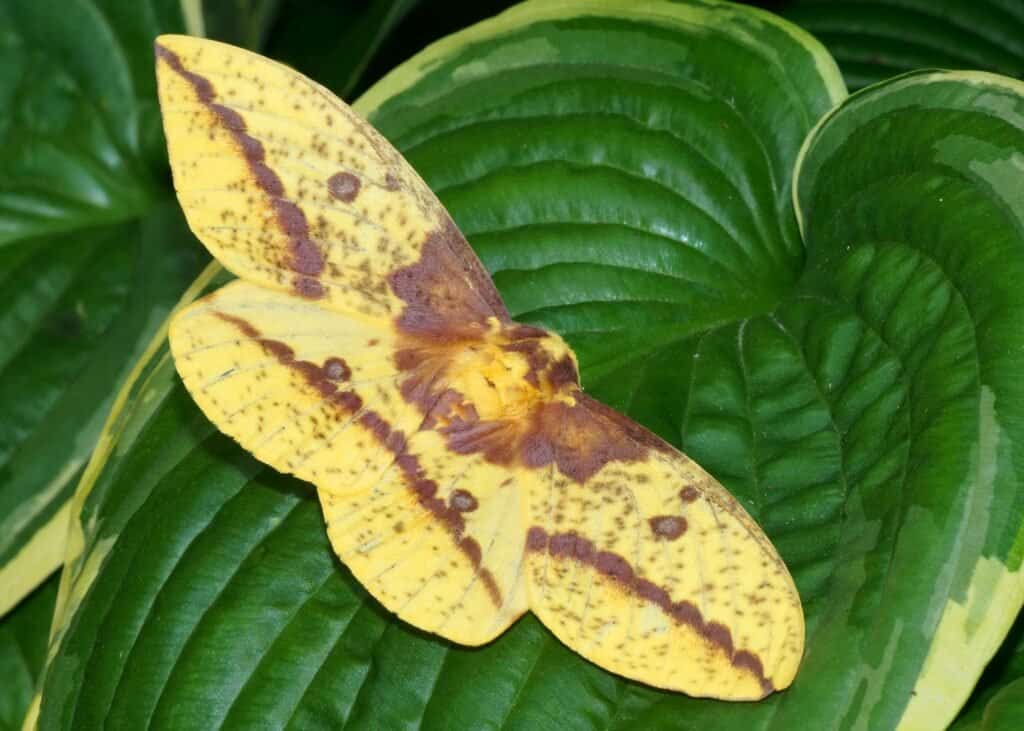
Imperial moths are notable for their up to 7-inch wingspan and yellow base with colorful splotches.
©Matt Jeppson/Shutterstock.com
The imperial moth is a large “silkworm-moth,” part of the family Saturniidae. Adults are often yellow with blotches and spots of red, brown, purple, or rust in various combinations. The overall coloration and blotchy patterning works as camouflage; when at rest during the day, the moth’s folded wings create a pattern that resembles dead or decaying leaves, which helps it avoid predators.
As you can see from the video, adult imperial moths are quite large, with wingspans typically ranging from a little over 3 inches to roughly 7 inches, though they can be a bit smaller depending on the region and subspecies. Males and females differ somewhat. Males tend to have more pronounced blotches and darker markings. They also have larger, broader antennae, which help them sniff out pheromones from females. Females, on the other hand, are generally a bit larger overall, particularly their abdomens, which are broader to accommodate egg production.
Imperial moths are remarkably widespread, their native range spanning much of the Americas. North to south they cover from southern Canada to central Argentina; west to east they’re found in the Rocky Mountains all the way across to the Atlantic coast. They are most common in forested, rural, and even some suburban habitats—basically any place where their host trees grow.
What Do They Eat?
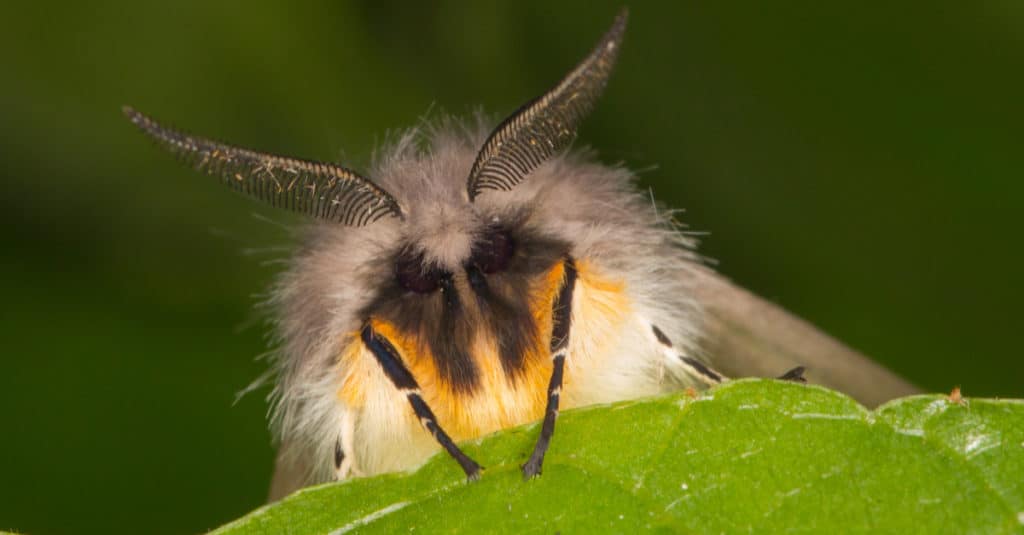
In their brief adult stage, imperial moths do not eat.
©W. de Vries/Shutterstock.com
There’s a big difference between the diet of the caterpillar and that of the adult moth. Caterpillars are what you’d call polyphagous, meaning they feed on a variety of host trees and shrubs. Commonly reported food plants include pines, oaks, maples, sweetgum, sassafras, and even some evergreens like spruce. Some sources also list elm, basswood, hickory, walnut, birch, cedar, and others. Basically, these caterpillars are pretty adaptable in their choice of foliage.
Adults have a far different diet. In fact, they have NO DIET AT ALL. They do not feed. Like many other giant silk moths, adult imperial moths have underdeveloped mouthparts and will not eat after emerging from the pupa. Their entire short adult life, often only a week or two, is devoted to reproduction.
Life Cycle
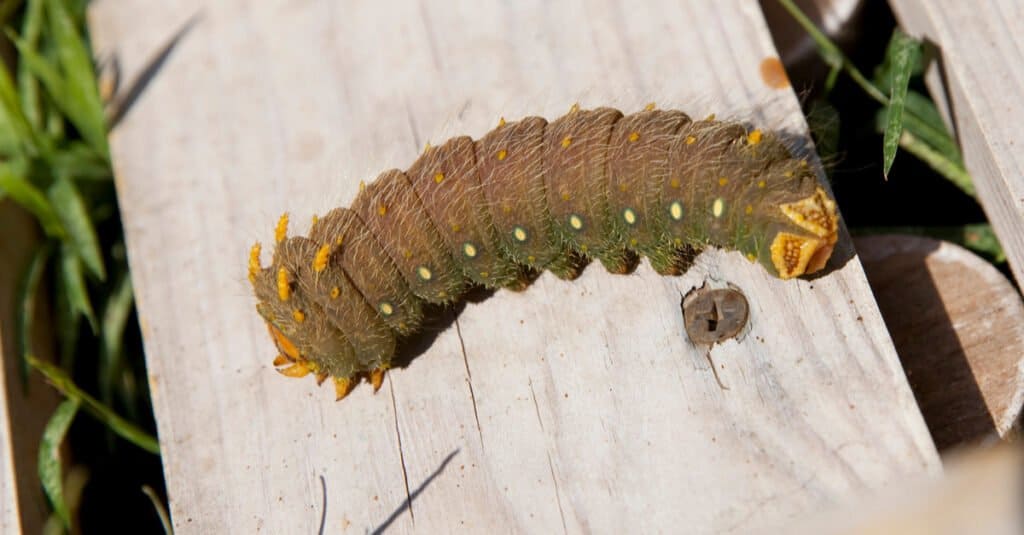
In its caterpillar stage, the imperial moth grows up to 5.5 inches long.
©Jeanne Raises/Shutterstock.com
The life cycle of the imperial moth follows the usual insect pattern: egg — larva (caterpillar) — pupa — adult. But some of the details are particularly interesting:
Eggs: A female lays eggs at dusk, either singly or in small clusters of 2–5 on the upper or lower surface of leaves of a host plant. Eggs typically hatch in about 10 to 14 days. Newly hatched caterpillars often begin by eating the eggshell they emerged from.
Larval Growth: Over the course of five instars (the growth stage of an insect between molts), the caterpillar increases dramatically in size, ultimately going from about ½ inch to about 3-5½ inches. At each molting, the larva may spin a bit of silk along a leaf vein to anchor itself before shedding its outer skin, or exoskeleton. Later instars may look very different from early instars, with colors morphing and patterns varying widely. For example: early instars may be orange with black bands and prominent spines, while later instars often become green or dark brown/burgundy, sometimes with contrasting spiracle-patch coloration of white or yellow, and with fine hairs covering their body. These caterpillars are robust and fat-bodied, capable of munching large amounts of foliage while still clinging tightly to leaves or needles.
Pupa: Unlike many other silk moths that spin silk cocoons, the imperial moth pupates underground. Once the caterpillar has eaten enough and grown to full size, it leaves the host plant, crawls down, then digs into the soil to pupate. The pupa winters in the soil and emerges as an adult the following growing season.
Adults: Adults typically emerge just before sunrise and are active at night. Mating usually happens well after midnight on the night of emergence. By dusk the next day, females lay eggs. Because they don’t feed, adults survive only long enough to complete reproduction, which is usually only a few days to around a week. Like most moths, imperial moths are attracted to nighttime light, which is often how humans encounter them.
Imperial moths are a univoltine species, which means they have one brood per year. Timing of emergence depends on region: in southern parts of their range, adults may emerge as early as spring; farther north, mid-summer is more common.
The imperial moth plays several important roles in forest ecosystems. As caterpillars, they help regulate foliage by feeding on tree leaves, contributing to nutrient cycling when leaves are eaten or dropped. As caterpillars they integrate into the food web by serving as prey for many animals, such as birds, small mammals, and parasitic insects. Because adults don’t feed, the larval stage is critical; any habitat loss or disruption in the availability of healthy host trees can drastically affect local populations. In some regions, that is already happening.
Still, globally the species remains relatively secure, thanks to its wide distribution and flexible diet.
Imperial Moth Fast Facts
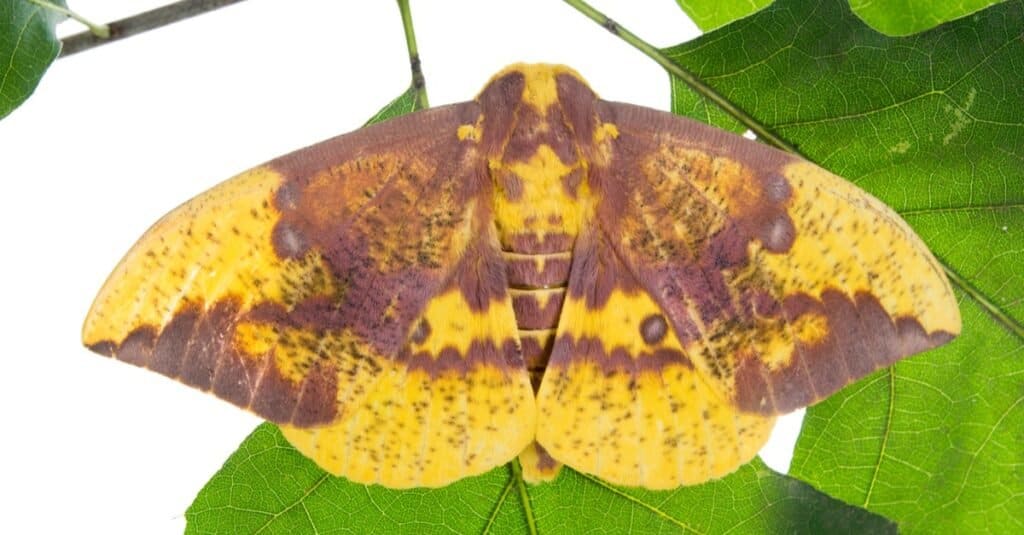
Looking like a fallen leaf is actually a defense mechanism for the imperial moth.
©IrinaK/Shutterstock.com
Leaf mimicry camouflage: One of the most striking aspects of the imperial moth’s adult form is how well it mimics a dead leaf. Folded wings, blotchy patterns, and muted colors combine to make it look almost like part of the forest floor or a dying leaf in a tree—a clever adaptation to avoid predators.
No adult feeding: Unlike many moths that sip nectar or feed on tree sap, adult imperial moths have reduced or nonfunctional mouthparts. Their sole mission is to reproduce. Everything the adults do—such as flying around, finding mates, and laying eggs—has to rely on the energy they stored up back when they were caterpillars.
No cocoon: Many of their relative silk moths spin protective cocoons of silk before pupating, but imperial moth caterpillars instead dig down into the soil and pupate underground. Their pupal stage lasts through the winter.
Wide dietary flexibility: As caterpillars, they are quite adaptable, feeding on a broad variety of trees, both deciduous and coniferous. This flexibility may help them thrive across wide climatic and regional ranges.
Sensitive to habitat change: In some parts of their range, especially at the edges (for example the northeastern U.S.), populations have declined. The causes are likely habitat fragmentation, loss of suitable host trees, pesticide use, and changes in land use.
A Brief Life, A Big Impact

©Jim and Lynne Weber/Shutterstock.com
The imperial moth is a striking example of how elegance, adaptability, and quiet ecological importance can exist in one unassuming creature, from tiny egg to massive caterpillar to underground pupa, and finally a brilliant adult that lives just long enough to reproduce. Its life reflects both fragility and resilience. If you ever come across a dead leaf of shimmering subtle yellows and purples, pause for a moment. That could be an imperial moth: a creature that doesn’t feed, but whose brief adult life links seasons and sustains forest ecosystems in countless unseen ways.