Quick Take
- One stink bug look-alike can actually send you to the hospital, and most people have no idea it's hiding in their yard. Meet the dangerous look-alike →
- Squash bugs, boxelder bugs, and leaf-footed bugs all smell foul and look similar, yet subtle body clues separate them instantly. See all stink bug impostors →
- Some of these stink bug impostors share its worst habits, like invading your home in winter, yet they behave very differently once inside. See the winter invader →
- The dangerous look-alike doesn't sting or visibly wound you, which is exactly why it's so easy to underestimate. Learn why kissing bugs are dangerous →
Stink bugs are known for their unpleasant odor and trademark shield-shaped bodies. There are around 200 species of stink bugs in North America. In addition to the many species of stink bugs, there are other bugs that look similar. In this article, we’ll discuss some stink bug impostors, including one that is actually dangerous.
What Is a Stink Bug?
Stink bugs are part of the true bug order, Hemiptera, in the family Pentatomidae. These bugs are known for the foul-smelling odor they emit this odor as a defense mechanism against predators. The brown marmorated stink bug, Halyomorpha halys, is among the most common stink bug species in North America. It is an invasive insect native to East Asia. This pest was first reported in the United States in the late ’90s. Since then, brown marmorated stink bugs have spread across the eastern United States, which are now a major agricultural pest.
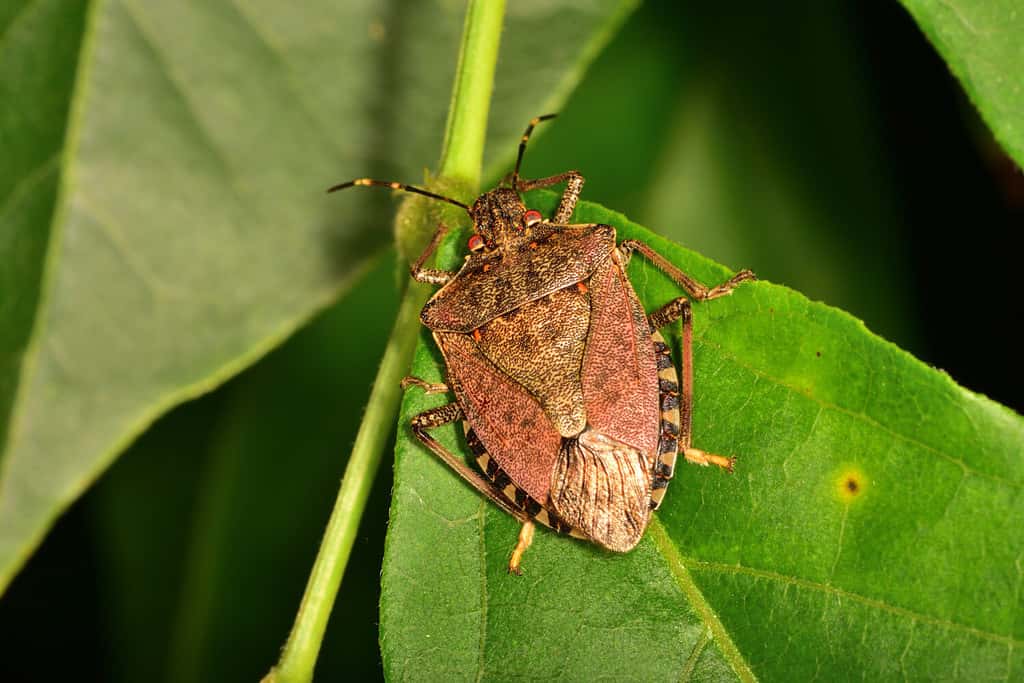
The brown marmorated stink bug
©Davide Bonora/Shutterstock.com
This species is an herbivorous pest, feeding on various plant species, including fruits, vegetables, and even ornamental plants. The brown marmorated stink bug is a mottled brown, black, and dark red on it back, with a lighter undersides. They have alternating light and dark bands on their five-segment antennae and around the edges of the abdomen. These bugs are 0.50-0.75 inches in length, not including appendages.
Other stink bug species you might encounter in North America are:
- One-spotted stink bug, known as Euschistus variolarius
- Green stink bug, known as Chinavia hilaris
- Red-shouldered stink bug, known as Thyanta custator
- Brown stink bug, known as Euschistus servus
Common Bugs That Look Like Stink Bugs
Stink bugs are recognizable because of their appearance, but several other types of bugs closely resemble them. While most are harmless to humans, some may have painful bites or even be dangerous. Below is a rundown of stink bug look-alikes.
1. Eastern Boxelder Bugs
Boxelder bugs are very similar to stink bugs in behavior and peskiness. Like stink bugs, boxelder bugs are attracted to warm surfaces, which is why you may find them congregated on the walls during colder months. They aren’t dangerous to humans or pets. However, they do have the potential to damage plants as they feed on the sap of deciduous trees like maple and box elder. If disturbed, these bugs secrete a dye that stains and leaves an unpleasant, musty odor like stink bugs.
So how do you tell if it’s a boxelder or a stink bug? You can tell the two bugs apart by their color and shape. Boxelder bugs have flattened oval-shaped bodies that taper at the end. They can be either black or brown, with reddish-orange markings on their bodies. These bugs have only four segments in their antennae. They are also slightly smaller than stink bugs, reaching only around 0.51 inches long.

Boxelder bugs have flattened oval-shaped bodies with tapering at the end.
©iStock.com/fusaromike
2. Western Conifer Seed Bug
Western conifer seed bugs are known for the unpleasant smell they emit when disturbed, just as stink bugs do. Another reason some mistakenly call the western conifer seed bug a stink bug is that these two species have similar behaviors. They are both most active in early spring and may congregate around your home looking for a place to overwinter. Once they find a crack or a potential opening, they will attempt to squeeze through.
Another shared trait is that both species are harmless to humans, meaning they don’t bite or sting. These bugs are also mottled dark browns and have alternating dark and light markings along the outer sides of the body. However, despite these similarities, there’s a way to tell the two bugs apart. Western conifer seed bugs are not only more rectangular in shape, they also tend to be longer and narrower, measuring 0.75 inches. They have a triangular “shield” at the thorax where their wings They have widened hind legs that give them a “leaf-like” shape. They only have four segments in their antennae. This helps differentiate it from the more symmetrical shield-shaped stink bugs.

Western conifer seed bugs are longer, narrower, and more rectangular than stink bugs.
©iStock.com/jscalev
3. Squash Bug
People often mistake a squash bug for a stink bug. They share some similarities in feeding behavior, and to some extent, they look similar. Both species are covered by hard, shield-like shells, emitting a foul odor when disturbed. Squash bugs can also be mistaken for stink bugs because of their coloration. Squash bugs are generally dark gray or brown, similar to stink bugs.
However, despite their similarities, you can distinguish the two by their body shape. Squash bugs have a more elongated body, making them appear narrower. They do not grow as large as stink bugs, measuring up to 0.65 inches. Squash bugs are also flatter than stink bugs and their antennae have only four segments and no banding. They are typically found on squash, pumpkins, melons, and cucumbers, while stink bugs are generalists and eat a wide variety of plants.

Squash bugs are found in gardens and vegetable patches where squash or pumpkins are grown.
©iStock.com/EzumeImages
4. Leaf-Footed Bug
Leaf-footed bugs are sometimes confused with stink bugs because they are similarly colored and emit a foul odor when disturbed. Both species also share the same behavior of overwintering as adults. They are often found in weedy areas, leaf litter, and under the bark of trees. They are similarly sized at about 0.75 inches long. Their bodies are also generally dark brown, bronze, or gray similar to stink bugs.
However, it is possible to tell them apart by looking at their legs. Leaf-footed bugs have enlarged, bowed hind legs that resemble leaf-like flaps. They only have four antennae segments. They are more oval-shaped, and much narrower than stink bugs. Some leaf-footed bugs can also be distinguished from stink bugs through the horizontal zig-zag pattern across their backs.
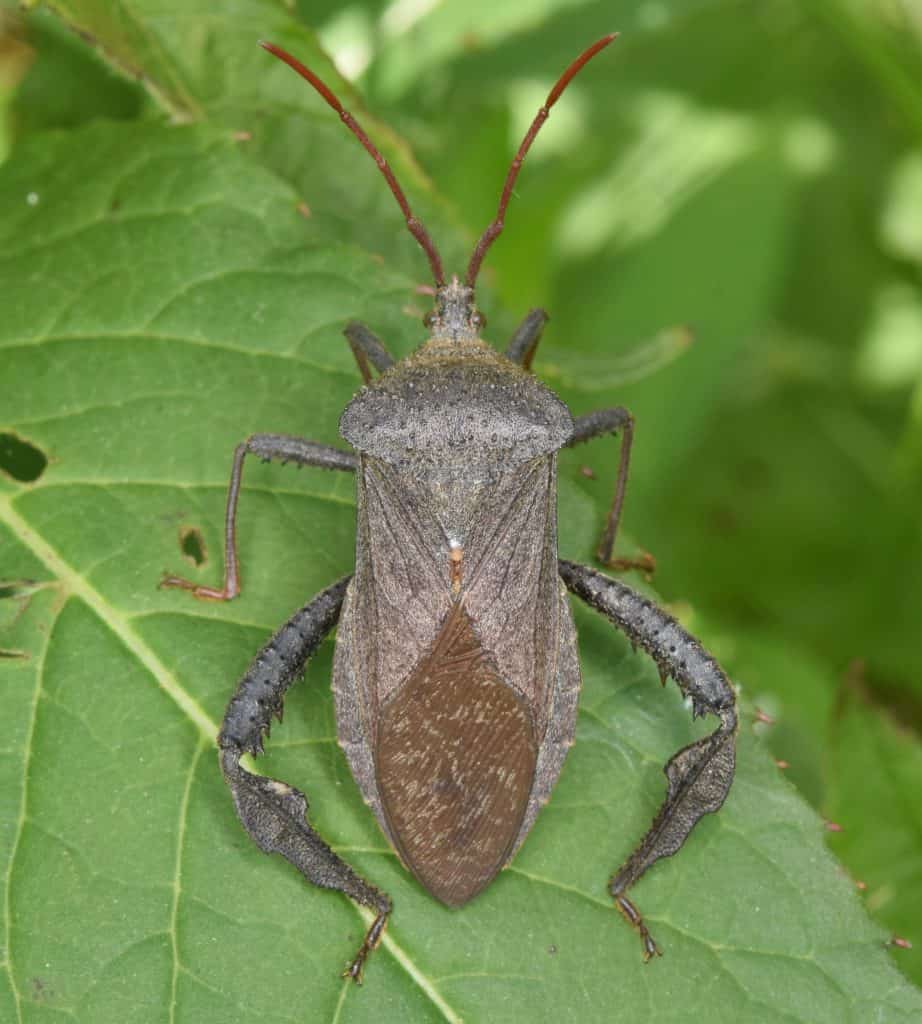
Like stink bugs, leaf-footed bugs emit a foul odor when disturbed.
5. Kissing Bug
Kissing bugs, also known as Triatominae or vampire bugs, get their name because they bite humans around their mouths. Although their bites aren’t usually painful, kissing bugs can transmit Chagas disease. This potentially deadly disease is caused by a parasite the bug carries and is transmitted to humans through bites. It can also spread through foods or drinks contaminated with kissing bug feces. Stink bugs do not bite.
Kissing bugs are sometimes mistaken for stink bugs because of their similar size and primary color. Kissing bugs have dark brown or black wings, however, they have orange, red, or yellow stripes around the edges. In contrast, stink bugs have light brown wings, which lack the bright stripes found on a kissing bug’s wings.
Another way you can distinguish kissing bugs from stink bugs is by checking their antennae. Unlike stink bugs, kissing bugs have longer and more slender antennae that point straight outward. The body shape is different, too. Kissing bugs have cone-shaped, slender bodies, while stink bugs have shield-shaped heads and bodies. Size-wise, adult stink bugs are approximately 0.75 inches long, while adult kissing bugs can reach up to an inch long.
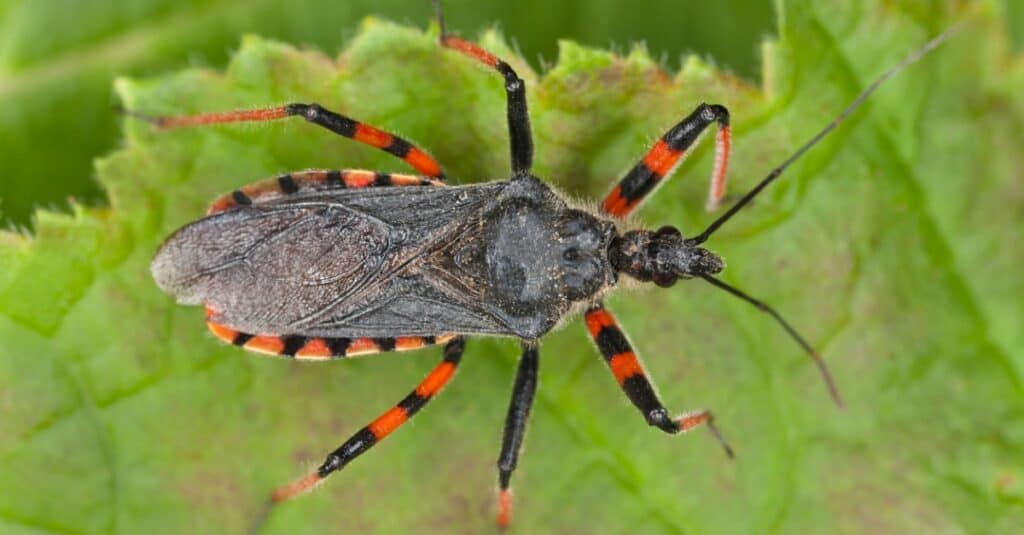
Kissing bugs have dark brown or black wings with orange, red, or yellow stripes around the edges.
©Henrik Larsson/Shutterstock.com