Quick Take
- One katydid species has cracked the code of mimicking another insect's mating calls and uses that trick to hunt. Hear about the mimicry trick →
- Female Bornean crested katydids break the 'green insect' rule in a way that raises more questions than it answers. Explore the color mystery →
- The peacock katydid has a backup plan for when leaf disguise fails, and it is nothing like you would expect from a bug. See the backup defense →
- Some katydids are carnivores, and the prey they target includes animals most people wouldn't expect an insect to take on. Discover their surprising prey →
In August 2025, the Journal of Orthoptera Research article described two newly identified katydid species endemic to the Southern Appalachian Mountains. The study examined the morphology and acoustic behaviors of the Amblycorypha zipticka and A. monticola. Biologists and researchers focused on communication through calling songs and uniquely timed duets. The study, led by Elon University biologist Jen Hamel alongside researchers Forrest and Holbrook, helps explain how ecology and evolution shape insect communication. Along with katydids’ unique vocal displays, these insects have another remarkable talent: leaf imitation. While some katydid species don’t resemble leaves at all, others show strong leaf mimicry, which provides excellent camouflage. Continue reading to learn more about these extraordinary insects.
What Are Katydids?
Katydids are a vast group of insects containing more than 8,000 described species worldwide, found on every continent except Antarctica. While they can comfortably thrive in cooler, drier environments and even arid deserts, their highest concentration and greatest diversity occur in tropical rainforests.
North America is home to approximately 255 distinct species of katydids. The differences among these species span appearance, size, diet, and habitat. Although some katydids can fly, most are poor flyers that walk, jump, or flutter-hop. This inability to fly makes avoiding predators more difficult, which is why many katydid species rely on leaf or lichen mimicry for camouflage.
Common True Katydid
The common true katydid (Pterophylla camellifolia) is a large, tree-dwelling insect native to North America, ranging from Southeastern Canada throughout the Eastern United States, from Maine down to Florida.
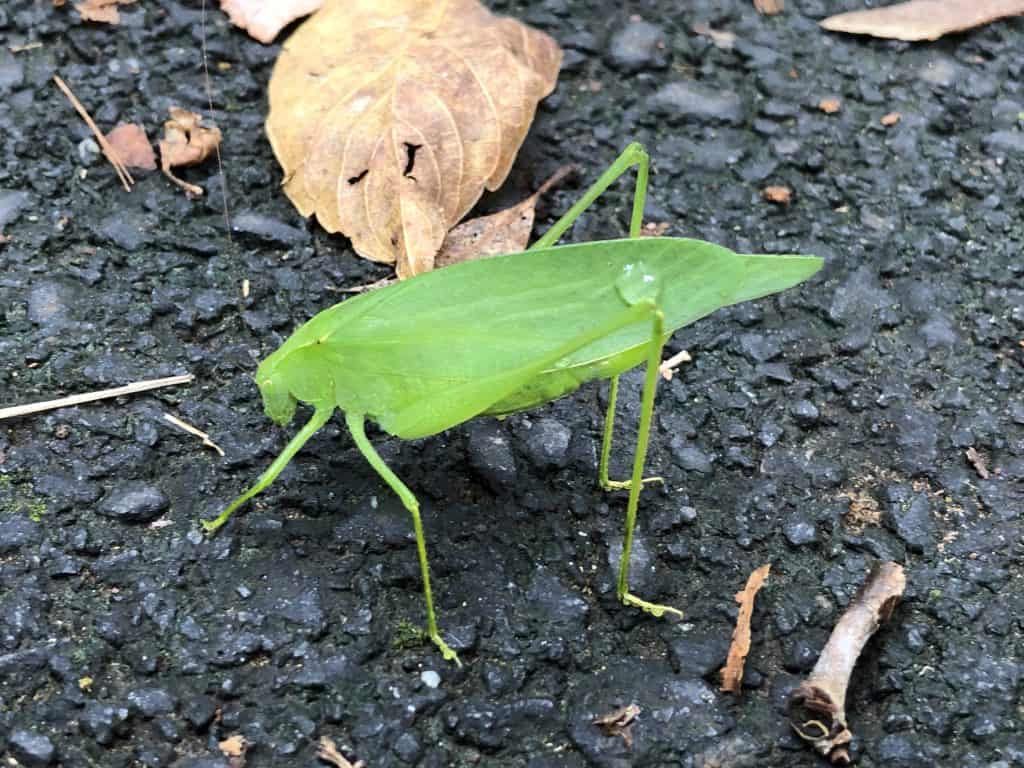
Measuring between 1.5 and 2 inches in length, the common true katydid is recognized by its bright leaf-green body, a distinctly rounded profile, and long, threadlike antennae. Its veins and oval forewings mimic camellia leaves so perfectly that the species is taxonomically named after them.
Although it has wings, the common true katydid is practically flightless and relies on crawling or clumsy hopping to move. Rarely seen, it can nonetheless be heard. Males of the species have a loud nocturnal mating call that echoes through summer nights.
Bornean Crested Katydid
The Bornean crested katydid (Eulophophyllum kirki) is found only on the island of Borneo in Southeast Asia. These incredibly leaf-like insects average 1.5 inches in length. Although males of the species are uniformly green, females are pink with green veins.
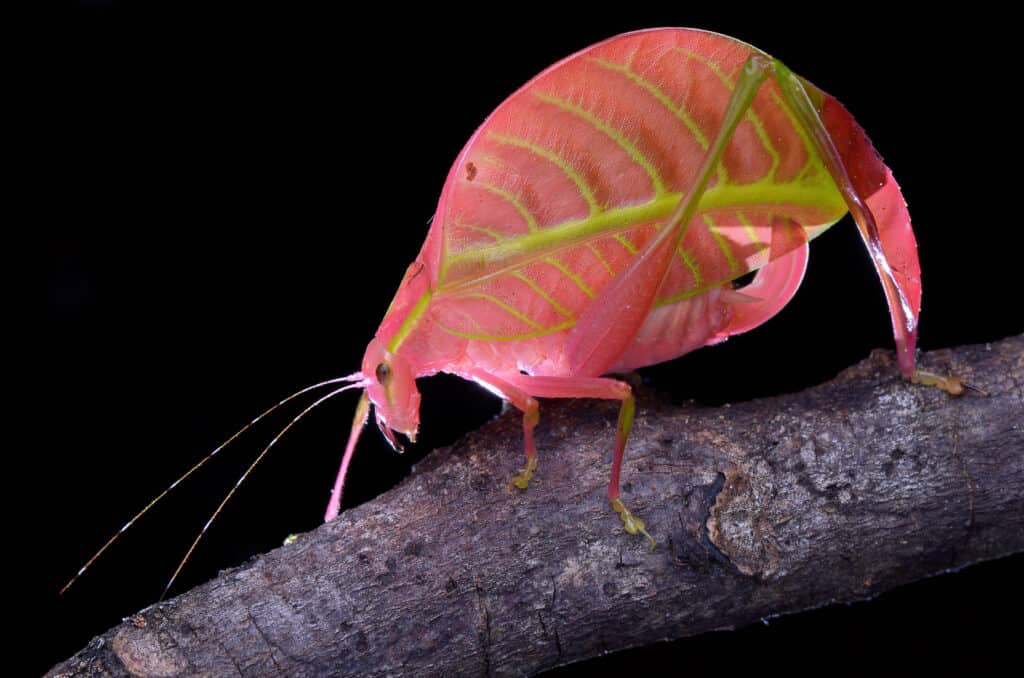
Although most Katydids are green, female Bornean crested katydids are pink.
©Simm Shim/Shutterstock.com
Because the Bornean crested katydid was discovered (circa 2013) in the protected Danum Valley Conservation Area, the species was described and named solely from photographs.
Peacock Katydid
The peacock katydid (Pterochroza ocellata) is native to the Amazon rainforest of Northern South America, where it spends much of its time navigating the dense forest floor. Peacock katydids have an average body length between 1.7 and 2.6 inches and long antennae that can span up to 3.5 to 7.8 inches.
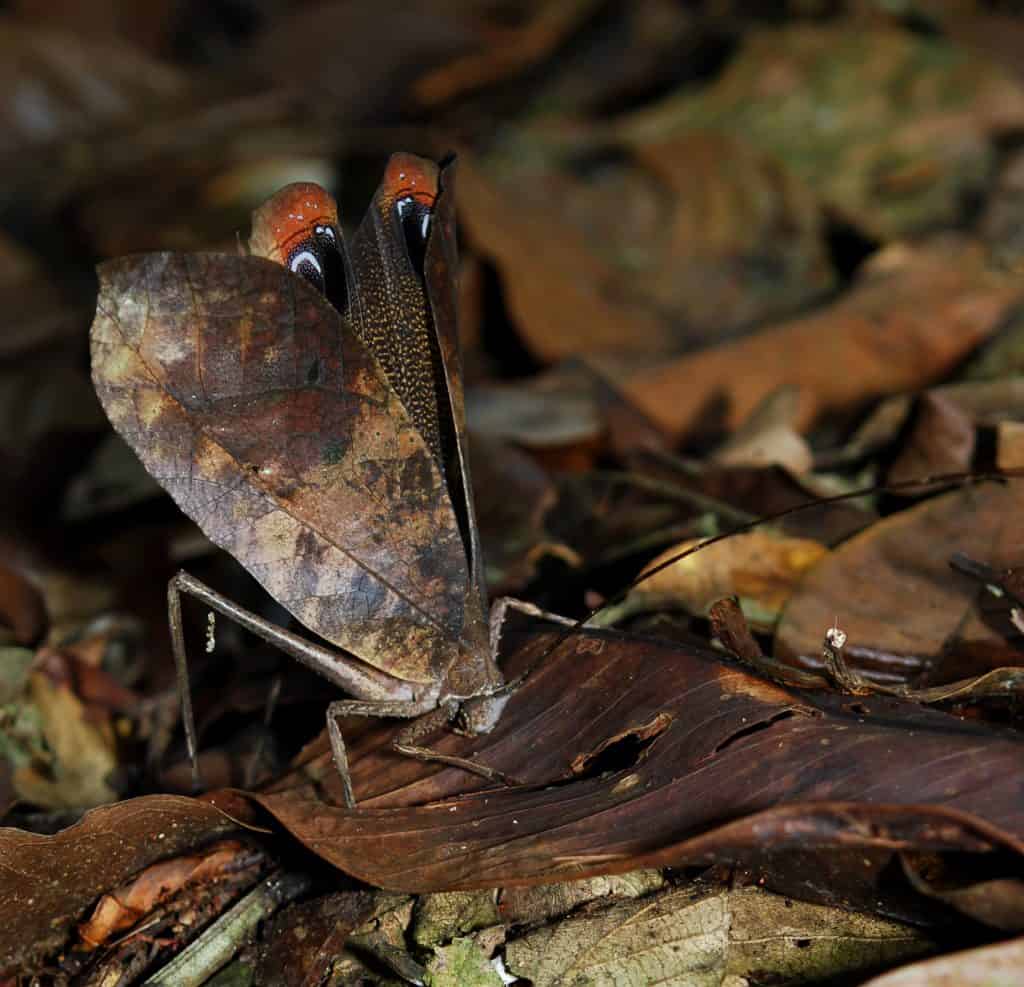
When they feel threatened, peacock katydids will display false eyespots to ward off predators.
©Geoff Gallice from Gainesville, FL, USA – Original / License
The peacock katydid’s forewings mimic the shape, color, and imperfections of a decayed leaf to blend seamlessly into the leaf litter on the rainforest floor. However, when peacock katydids feel threatened, they unfurl hidden hind wings, revealing a pair of large, conspicuous false eyespots (ocelli), tricking predators into thinking they face a much larger animal.
What Do Katydids Eat, and What Eats Them?
With thousands of species, katydids have incredibly diverse diets. Most katydid species are herbivores or frugivores, consuming leaves, flowers, fruits, and seeds. Many katydid species are omnivorous, supplementing their plant-based diet with protein from aphids, caterpillars, and insect eggs. A small percentage of katydids are carnivorous ambush predators that consume small lizards and frogs.
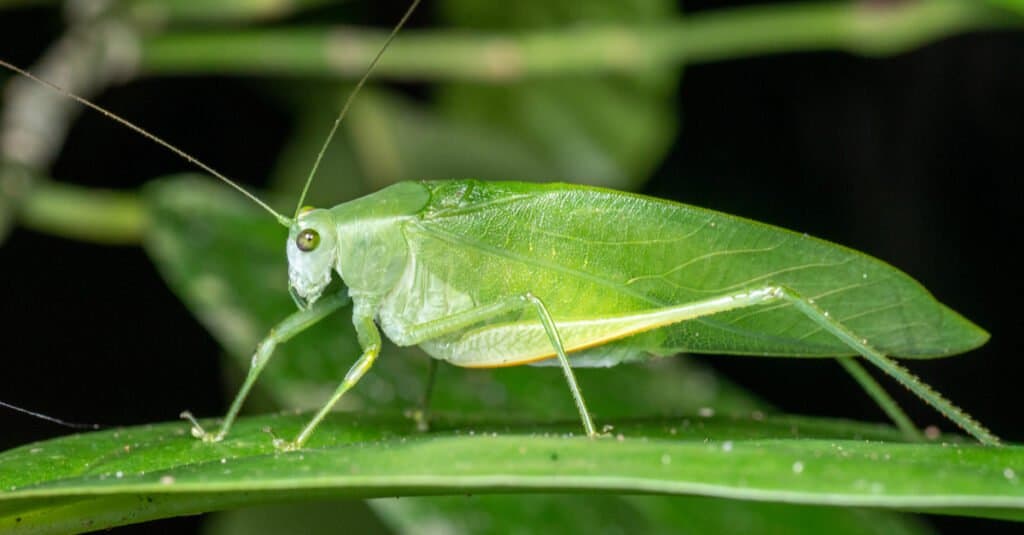
Katydids eat plant matter like flowers, leaves, bark, or seeds.
©Peter Yeeles/Shutterstock.com
Some katydid species are considered pests, such as the coconut treehopper (Segestidea defoliaria gracilis) and long-horned grasshopper (S. montana). These katydids feed on the foliage of karuka trees, tall, palm-like trees native to the high-altitude forests of Papua New Guinea. These trees produce edible nuts that are a principal food source for local communities in the area. Defoliation can result in lowered yield and, in extreme cases, the death of the tree.
While their leaf-mimicking appearance provides excellent camouflage, other creatures occasionally prey on katydids. These include spiders, ants, wasps, tree frogs, bats, and birds.
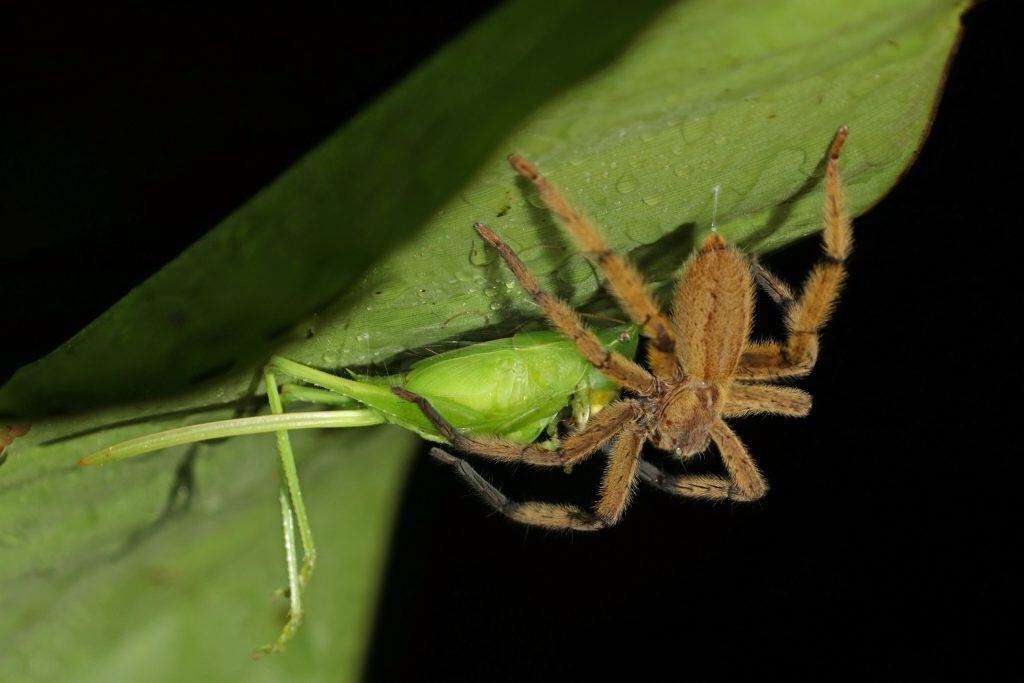
Katydids can fall prey to a variety of animals, from wasps and spiders to bats and birds.
How Long Do Katydids Live?
A katydid’s lifespan depends on where it lives. Species in tropical regions can live for several years, while those in colder climates rarely live longer than one year, with only their eggs surviving the winter.
How Do Katydids Communicate?
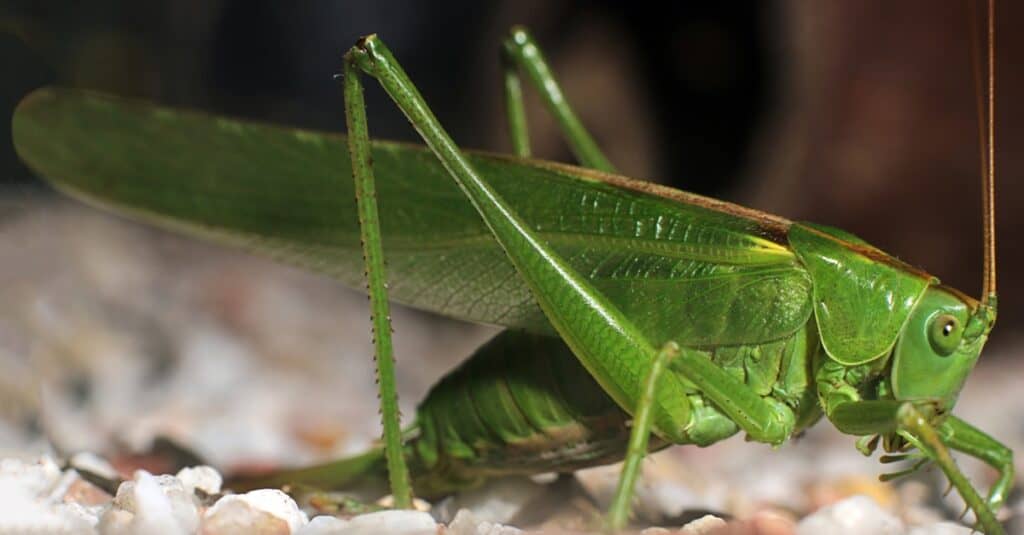
Male katydids are capable of stridulation, meaning they produce sounds by rubbing two parts of their bodies.
©iStock.com/Allexxandar
Male katydids are capable of stridulation, meaning that they produce sounds by rubbing two parts of their body together. The sound-producing organs are located on the hind angles of their front wings. They use these sounds to attract females or claim territory. Some females are also capable of stridulation.
Some katydid species have developed their communication skills to the point that they can mimic other insect songs. A study (Marshall & Hill, 2009) focused on the spotted predatory katydid (Chlorobalius leucoviridis) determined that they can imitate the wing-flick sounds female cicadas use as sexual replies, allowing the katydids to lure male cicadas directly to them and consume them as prey.