
Quick Take
- Mice have 16 teeth, including four continuously growing incisors.
- Incisors grow continuously and must be worn down by chewing on wood and other objects.
- Mouse teeth score about 5.5 on the Mohs scale.
The 38 species of mice in the order Rodentia are small, gnawing mammals known for their adaptability, all-encompassing diets, nocturnal habits, and roles as pests, pets, or lab models, inhabiting diverse environments across the globe. Certain wild mice, such as the white-footed mouse, are important reservoirs for diseases like hantavirus, salmonellosis, leptospirosis, and Lyme disease, whereas pet mice are generally safer as they come from controlled environments. Although the risk of disease varies between wild and pet mice, one characteristic they share is hypselodont teeth. Unlike human teeth, a mouse’s incisors never stop growing, which necessitates constant gnawing to wear them down and keep them at a functional length. Continue reading to discover everything you need to know about mouse teeth.
What Kind of Teeth Do Mice Have?
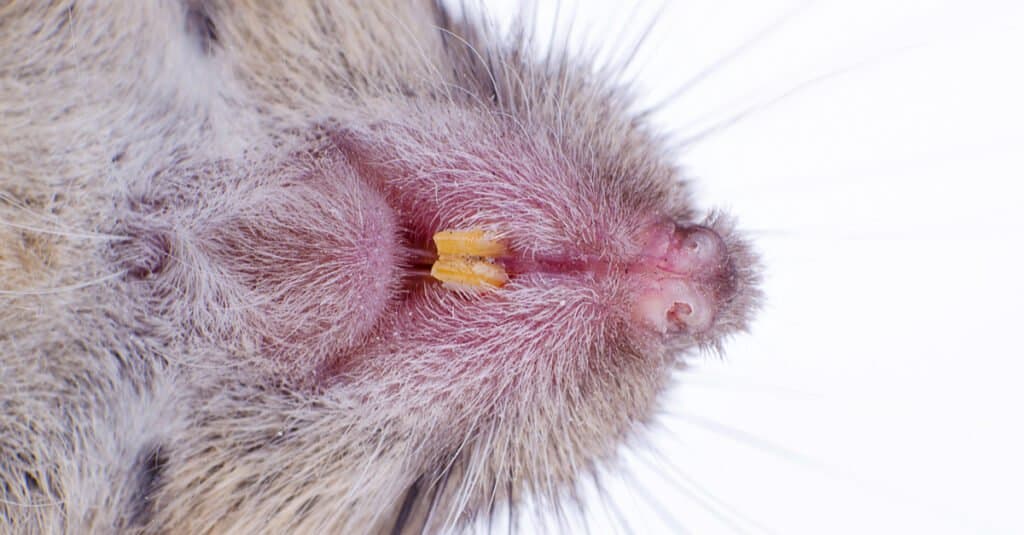
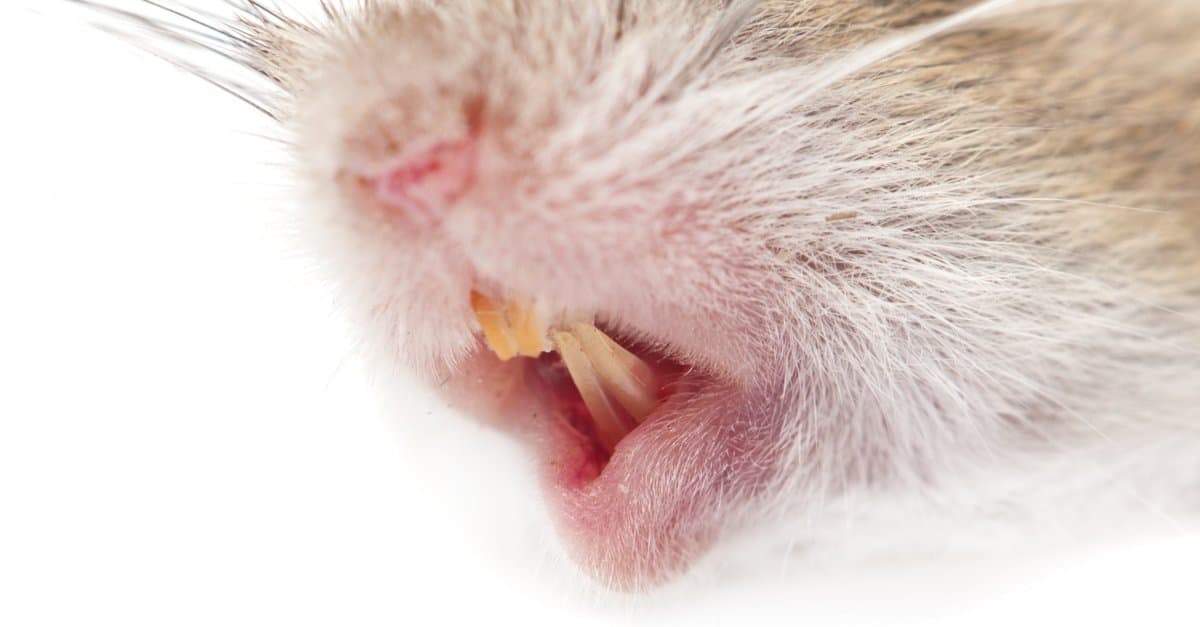
Mice have hypselodont incisors that continuously grow throughout their lifetime.
©Dmitro Derevyanko/Shutterstock.com
Mice have 16 teeth in their mouth. Unlike many mammals which have a complete set of incisors, canines, premolars, and molars, mice do not have canines or premolars. Instead, they have four incisors and twelve molars. The usual dental formula shared by both rats and mice is as follows: incisors 1/1, canines 0/0, premolars 0/0, and molars 3/3.
Mice have long front teeth, similar to other rodents. Each upper and lower jaw contains a single pair of incisors that grow continuously throughout the animal’s life. Mice also have molars at the back of their mouths, which help them chew food. Mice lack canines and premolars, leaving a gap called the diastema between their incisors and their molars, which are adapted for grinding.
Since their incisors grow continuously, mice must constantly chew and gnaw on a wide variety of materials to help wear down their teeth and keep them at a reasonable length. If these incisors get too long, mice can experience difficulty eating, which can lead to starvation. Left unchecked, their teeth can grow into the jaw or palate, causing severe injury and unnecessary pain.
In each tooth, the front portion is formed of hard enamel, and the rear portion is made of softer dentine. As the rodent eats away chips on fibrous matter, the incisors grind against one another, causing the dentine to erode more quickly than the enamel, creating a sharp, chisel-shaped edge to the incisors, and acting as a self-sharpening device. This process also helps keep the continuously growing incisors at a functional length.
How Strong Are Mouse Teeth?
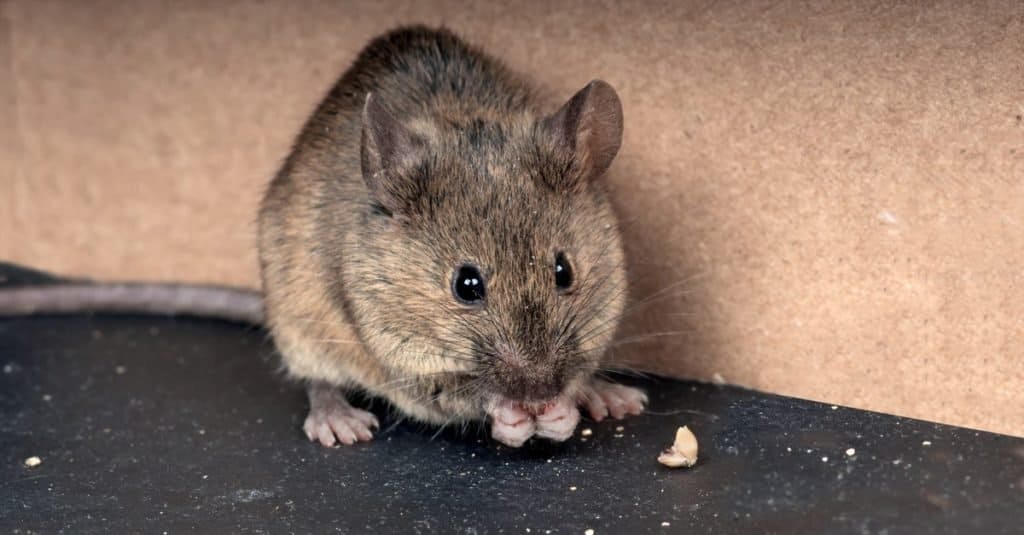
Mouse teeth have a hardness rating of 5.5 on the Mohs scale.
©IrinaK/Shutterstock.com
The teeth of both rats and mice are nearly the same strength based on the Mohs scale of hardness. Mice’s teeth score roughly 5.5, while human teeth are approximately just 5, and human fingernails are approximately 2.5.
Do Mice Have Baby Teeth?
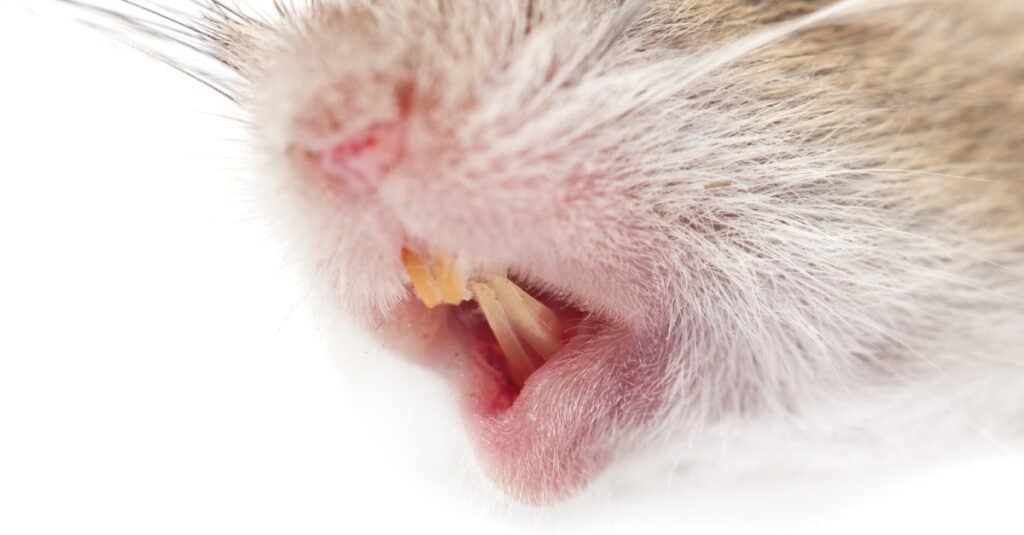
Mice do not have baby teeth, but their incisors erupt when they are 10 to 12 days old.
©schankz/Shutterstock.com
Mice are monophyodont, which means they have only one set of teeth, unlike many other mammals, which are diphyodont, meaning that they are born with a temporary set of teeth called deciduous teeth, or milk teeth, that will be replaced by a set of adult or permanent teeth.
What Do Mice Do with Their Teeth?
Mice use their sharp, elongated front teeth to excavate burrows and chew their food. They have a voracious appetite and eat a wide variety of foods, including seeds, insects, grains, fruits, cheese, meat, and anything else they can find.
Do Mice Bite?
Mice are unlikely to bite humans unless they feel trapped, as they are naturally timid and prefer to flee. However, a mouse will bite a human if it is protecting its young or is being handled carelessly.
A mouse bite is mildly painful, but infection is the main danger. A mouse bite can cause bacterial infections and, in rare cases, allergic reactions. While mice can carry viruses such as hantavirus, transmission to humans through bites is possible but extremely rare; most viral infections are contracted by inhaling particles from rodent urine, droppings, or saliva.