
Quick Take
- Triceratops and T. rex both lived during the late Cretaceous, 68-66 million years ago.
- If the current height and weight estimates are accurate, T. rex likely had the advantage in overall size.
- There is only one fossil showing evidence of a live encounter between a Triceratops and a T. rex.
- T. rex had significant advantages that most Triceratops would have found difficult to overcome.
Triceratops and Tyrannosaurus rex were two powerful dinosaurs that roamed the Earth during the Late Cretaceous, 68 to 66 million years ago. Triceratops was an herbivore, but it was not without defenses. T. rex, however, is considered one of the most terrifying carnivores to have ever lived. What happened when these two massive animals fought? The answers lie in the fossil record. Keep reading to find out which dinosaur would win in a battle between Triceratops vs. T. rex.
Comparing a Triceratops and a T. Rex
| Triceratops | T. rex | |
|---|---|---|
| Size | Weight: 12,000-16,000 pounds; possibly up to 20,000 pounds Height: 9-10 feet Length: 30 feet | Weight: 11,000-15,500 pounds; largest up to 20,000 pounds Height: 12-20 feet Length: 40 feet |
| Speed and Locomotion | 15-20mph; upright stance on four legs with elbows slightly bowed | 12-23mph; bipedal striding using its tail for balance and quick turns |
| Sensory Organs | Sense of smell less developed than other dinosaurs; possibly sensitive to sounds from long distances; wide field of view but no binocular vision | Exceptionally acute sense of smell; excellent vision due to large, forward-facing, wide-set eyes; ability to see an expanded color spectrum |
| Defensive Capabilities | Massive size; strong bones in the skull to protect from damage; the horns would have deterred frontal attacks | Massive size; agility; higher intelligence |
| Offensive Abilities | Used long horns and ramming to topple and kill predators; could potentially use its weight as leverage | 60 serrated teeth 8-12 inches long; strong bite force of 35,000N |
| Predatory Instincts | May have been territorial; engaged in ramming contests against other Triceratops. | Active hunter; ambush and endurance predator; may have hunted in packs |
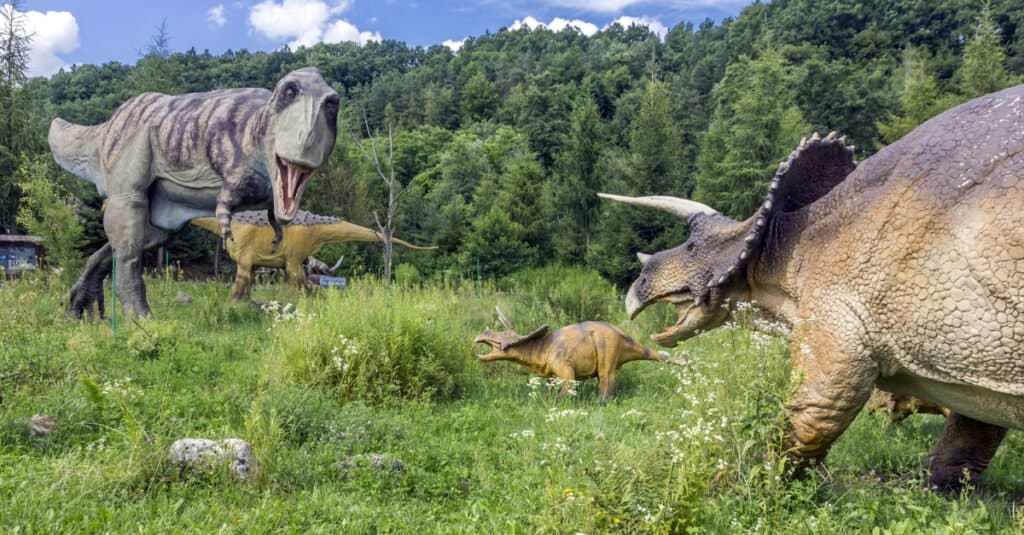
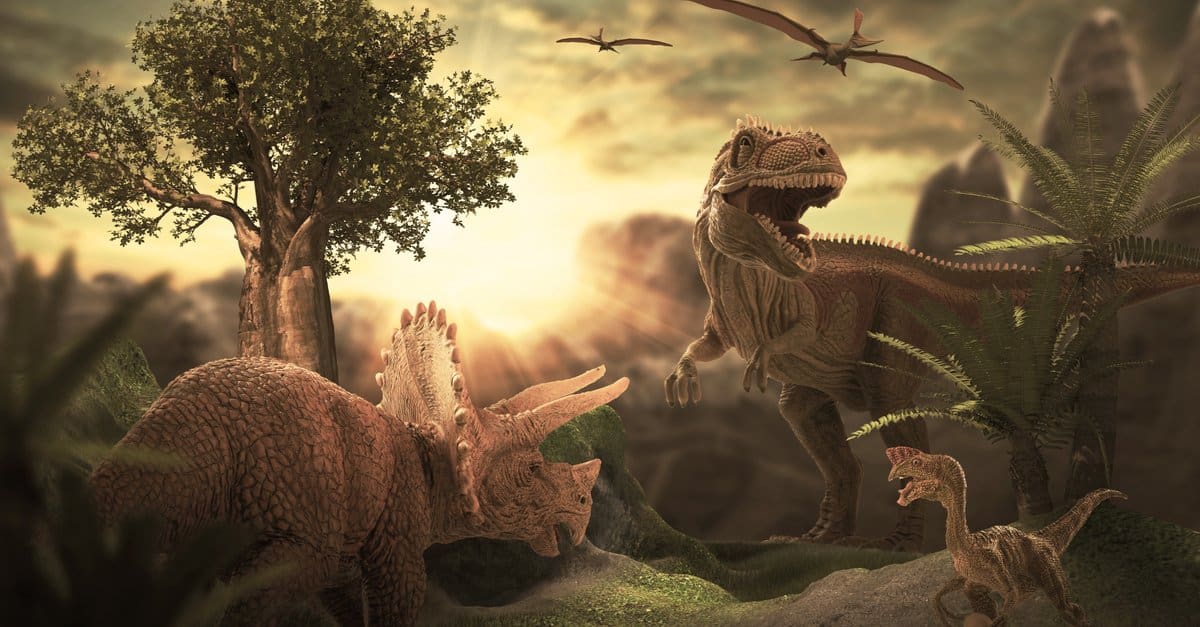
Triceratops and T. rex lived during the late Cretaceous, 68-66 million years ago.
©Greir/Shutterstock.com
The Key Factors in a Fight Between a Triceratops and a T. Rex
Deciding on a winner between T. rex or Triceratops requires an examination of different factors that would impact the outcome. Of course, it would depend on the size of the individuals, their ages, and general health. However, the discussion focuses on the average estimates for each animal. These include size, speed and locomotion, sensory organs, defensive capabilities, offensive abilities, and predatory instincts. Take an in-depth look at these characteristics in the sections below.
Size
Accurate dinosaur size comparisons are difficult for several reasons. First, there are different methods of estimating the size of an extinct animal. For example, one method compares the size of weight-bearing bones to those of extant animals. Another relies on 3D reconstructions of the dinosaur’s body. However, dinosaurs frequently fall outside of the scope of modern animals, causing extrapolation errors. 3D models can be subjective because they require assumptions about how much muscle and fat the animal had. Incomplete fossil specimens and intraspecific differences can also result in a wide range of weight estimates.
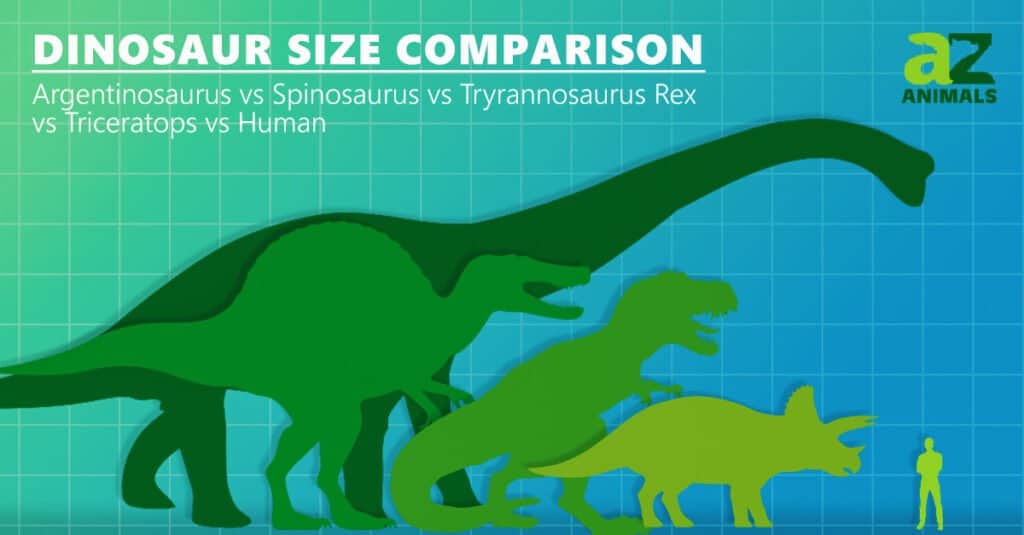
Current estimates for Triceratops average between 12,000 and 16,000 pounds, with some sources suggesting they could have weighed up to 20,000 pounds or more. They are believed to have stood 9-10 feet tall and measured up to 30 feet long.
T. rex is believed to have averaged 11,000-15,500 pounds, with the largest specimens, such as “Scotty,” weighing up to 19,555 pounds. Hip height is thought to have been around 12 feet, with an upright height of up to 20 feet. T. rex is estimated to have measured 40 feet long. If the current estimates are accurate, T. rex likely had the advantage in overall size. A slight edge in weight would not be enough for a Triceratops to overtake a T. rex of similar weight and superior height.
Speed and Method of Locomotion
The speed and method of locomotion would also influence the outcome of a struggle. Triceratops is thought to have walked semi-erect on four legs. Its back legs were held straighter than its front legs, which were thought to be slightly bowed like a rhinoceros. Although they were likely more ungainly than portrayed in the past, Triceratops is estimated to have been able to reach speeds of 15-20mph.
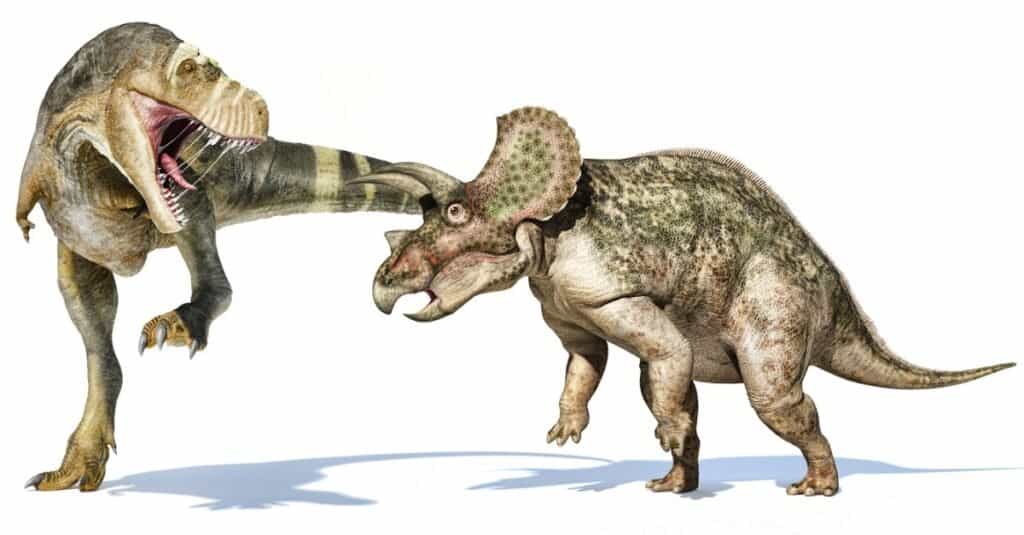
Triceratops had three horns on its head that were used for display and defense.
©iStock.com/leonello
Previous research suggested T. rex could run at speeds of up to 45mph, but modern researchers believe this is an overestimation. However, some paleontologists argue that T. rex could only walk, as its large size would have caused stress fractures in its legs had it attempted to run. The truth is likely somewhere in between. Once recent study suggests they could run up to 12mph. Another current study suggests they could reach a top speed of 17-23mph, which is consistent with interpretations of T. rex as an active hunter and apex predator. Its long tail was thought to aid in balance and maneuverability, allowing the theropod to make quick turns. If more recent estimates of the animals’ top speeds are correct, they could both move quickly when required, but T. rex would have been more agile on two legs.
Sensory Organs
As an herbivore, Triceratops did not hunt live prey. Its sense of smell is believed to have been less developed than in other dinosaurs. It was thought to be adapted to hearing lower frequencies, which would have made it more sensitive to detecting sounds from long distances. Like modern herbivores such as sheep, Triceratops had eyes on the side of its head. This gave it a wide field of view for scanning the terrain for predators, but no binocular vision.
As a carnivore and a hunter, it is no surprise that T. rex had the advantage over Triceratops with superior sensory organs. Large olfactory regions in its brain indicate T. rex had an exceptionally acute sense of smell. They also had large, forward-facing, wide-set eyes that would have given them excellent binocular vision and depth perception. Their eyes were also set higher on their heads, which would have aided in distance vision. Researchers also believe they could see an expanded color spectrum, which likely helped them locate and hunt prey in dense vegetation. T. rex could also hear low frequency sounds, which would have allowed it to hear sounds from long distances.
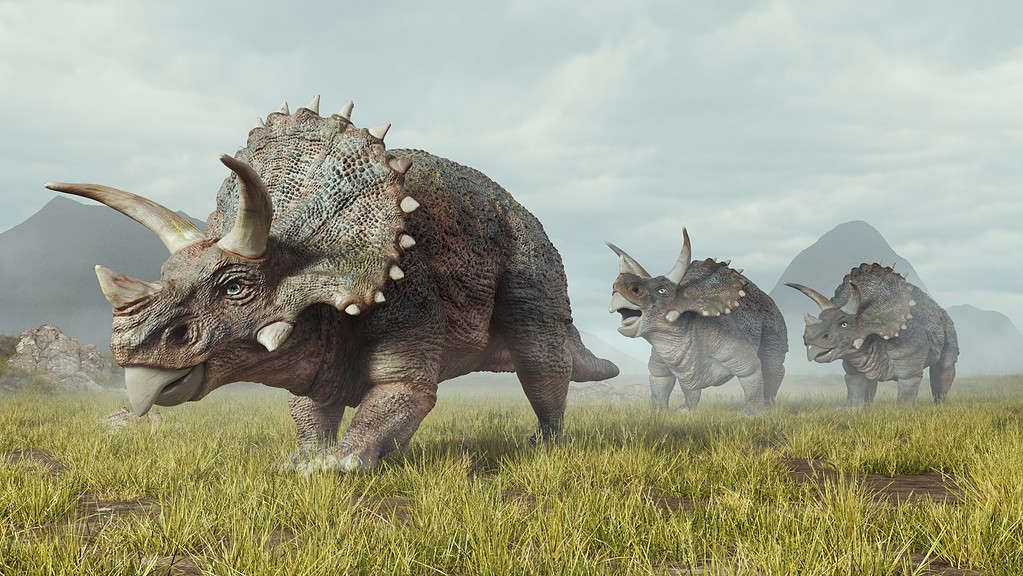
As herbivores, Triceratops did not hunt live prey like T. rex.
©ALLVISIONN/iStock via Getty Images
Defensive Capabilities
Triceratops would have relied on its massive size and large horns to deter frontal attacks. They had two long brow horns that measured upwards of 3 feet long. They also had a shorter horn on the snout. Triceratops had huge heads with strong bones in their skulls to protect them from damage, although their frills were not as thick and strong as one might have assumed. Researchers believe the frills may have been more for signaling and display than protection. Even their horns are thought to have evolved as much for display and intraspecific combat as for defense from predators. Triceratops also had a lower center of gravity, making it more difficult to knock over.
As an apex predator, T. rex would have had less need for defensive capabilities. However, its size and predatory abilities would have deterred other predatory dinosaurs. In a fight with a Triceratops, T. rex would have been the aggressor. So, it would have relied on its agility and intelligence to avoid being gored by Triceratops’ horns. Some researchers have suggested T. rex’s intelligence was similar to a baboon’s, but most paleontologists believe their intellect is overestimated and more on par with modern crocodilians. However, modern crocodilians are more intelligent than previously thought, which also shows the importance of not underestimating animal intelligence either. Regardless, most carnivorous dinosaur species are estimated to have been more intelligent than herbivores.
Offensive Skills
The Triceratops likely would have used its long, robust horns and ramming abilities to attempt to gore T. rex in a fight, using its weight as leverage. However, it is unlikely that an herbivore like Triceratops would have been the aggressor in a fight with a T. rex.
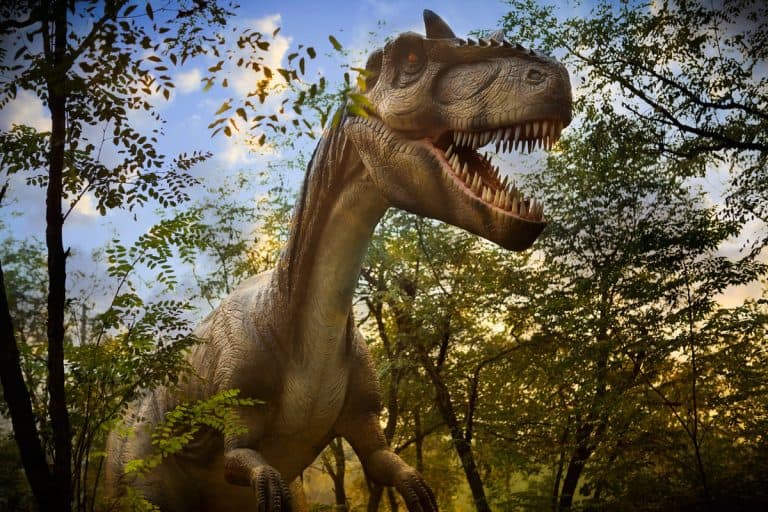
T. rex had 60 serrated teeth that measured from 8 to 12 inches long. There is fossil evidence that they used their teeth in combat, as well as to kill prey. Paleontologists have discovered that in fights with other T. rex, they bit each other’s faces — much like modern crocodilians. T. rex also had strong jaws and a powerful bite force of 35,000N, which is believed to be the most powerful bite force of any land animal that has ever lived.
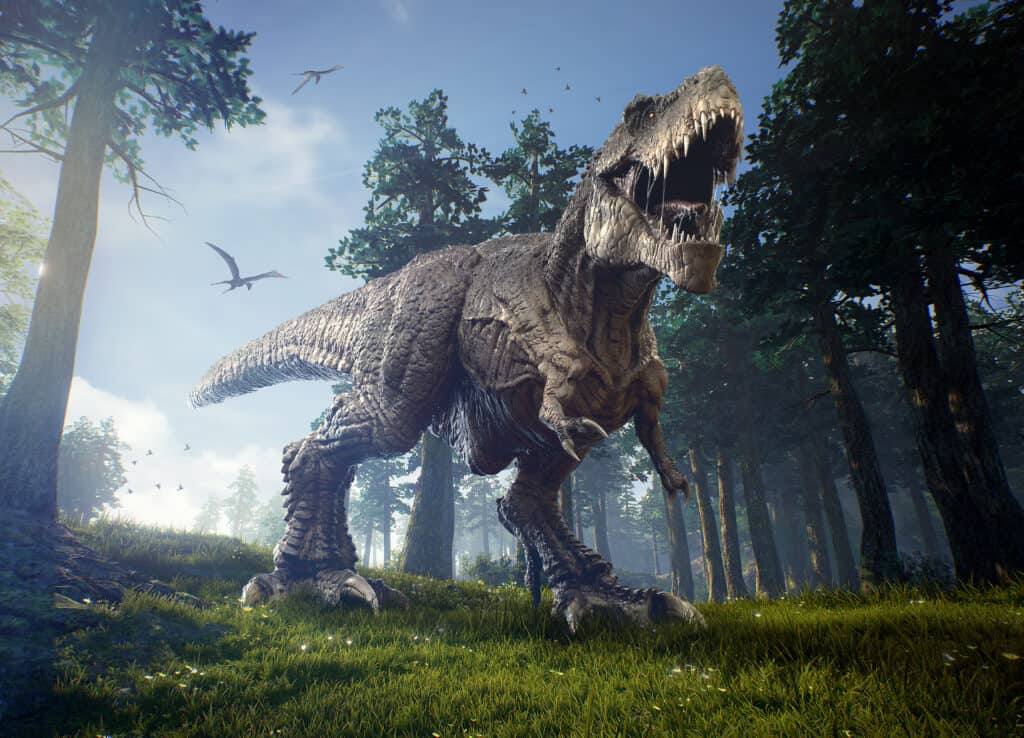
T. rex was a vicious fighter that used its teeth in combat and to kill prey.
©Herschel Hoffmeyer/Shutterstock.com
Predatory Behavior
As mentioned above, Triceratops was an herbivore. They ate only vegetation and did not hunt live prey. That is not to say that they did not have aggressive tendencies in some situations. Triceratops did not live in herds like most herbivores and likely battled over mates, territory, and food. Paleontologists have found lesions on Triceratops skulls that have been interpreted as the result of intraspecific combat, such as seen in extant horned animals. However, these lesions are consistent with head-ramming contests where combatants lock horns rather than attempting to gore each other. Researchers have also seen puncture marks on frills.
Some earlier research characterized T. rex as only a scavenger and not an active predator, but most paleontologists conclude T. rex was both. Like lions, T. rex is believed to have scavenged when the opportunity arose, but its predatory abilities have been documented in the fossil record. For instance, a T. rex tooth was found embedded in a duck-billed dinosaur that lived through the attack, showing that T. rex preyed on live animals. Its serrated teeth, powerful bite force, and exceptional sensory organs also indicate T. rex was a predator. Research suggests T. rex was an ambush hunter and may have been an endurance hunter as well. There is also some evidence that T. rex hunted in packs like wolves and may even have been cannibalistic.
Which Dinosaur Would Win the Ultimate Showdown Between a Triceratops and a T. Rex?
Even with tooth marks on bone, paleontologists have noted the difficulty of determining whether they were made by predation or scavenging. Although these animals lived at the same time and in similar habitats, there is only one fossil demonstrating evidence of a live interaction between a Triceratops and a T. rex. Researchers found a brow horn from a Triceratops in the Hell Creek Formation in Montana that is missing the end. Two deep depressions on the other end of the horn match the teeth of an adult T. rex. There are also teeth marks in the frill of the same animal. However, the frill shows signs of healing, indicating Triceratops lived through the encounter.
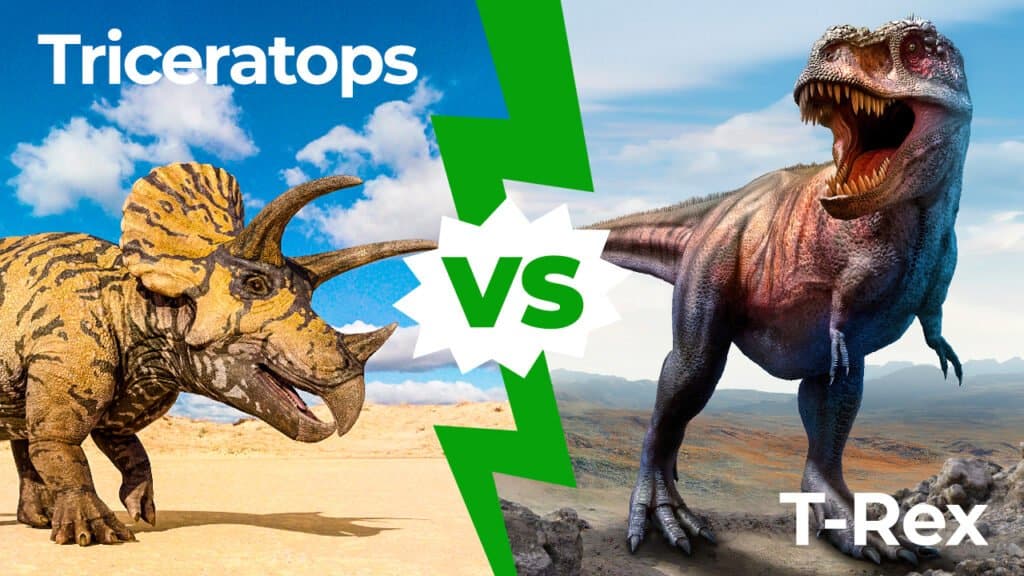
So, what does this tell us about which animal would win in a fight between a Triceratops vs. a T. rex? First, it suggests that T. rex was not particularly deterred from attacking a Triceratops due to its horns. With such an incredible bite force, T. rex likely snapped the end of the horn off. It also tells us that Triceratops‘ defensive capabilities did have some effectiveness against T. rex, as this individual lived.
As for our comparison of their relative strengths, the T. rex is believed to be the most formidable predator to have ever lived with good reason. T. rex is thought to have stalked and ambushed its prey, so it would have been less likely to engage a Triceratops in an open contest where its horns could have been a concern. Weight and speed estimates for these animals were fairly equal, but T. rex would have been more agile and had greater offensive abilities and predatory instincts. T. rex may even have hunted cooperatively with other T. rexes. While some individual Triceratops might have been able to hold their own against a T. rex, the T. rex had significant advantages that most Triceratops would have found difficult to overcome.