
Intriguing and incredibly unique, octopuses are cephalopods with three hearts that pump blue blood throughout their eight arms. These intelligent sea creatures have multiple brains — nine, to be exact. In addition to a central brain located between its eyes, an octopus has eight separate clusters of nerve cells, called ganglia, at the base of each of their eight arms. Compared with most invertebrates, octopuses are remarkably intelligent. These captivating oceanic creatures have short- and long-term memory and are capable of recognizing individual people by sight. Continue reading to discover how an octopus uses its nine brains.
Nine Brains: The Anatomy of an Octopus’s Nervous System
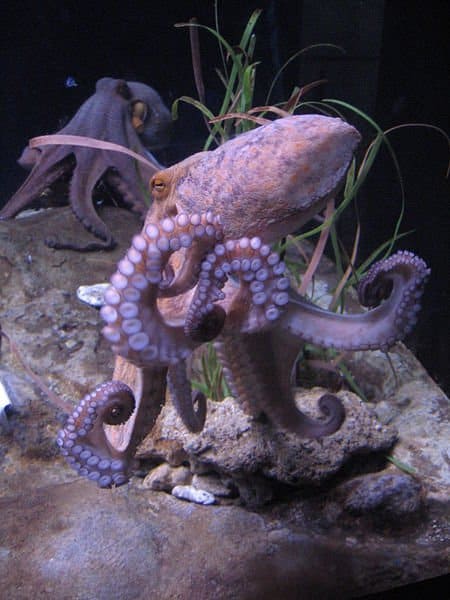
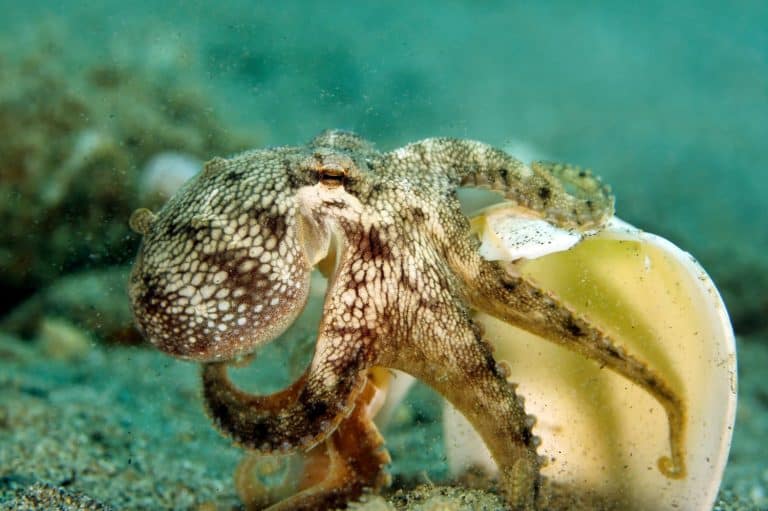
A single octopus arm possesses more neurons than you will find in a frog’s entire body — just one of many intriguing facts about their nervous systems.
©Anneli Salo / Creative Commons – Original
Octopuses possess a central brain situated between their eyes. This brain has a distinct doughnut-like shape, forming a ring around the creature’s esophagus. Technically, when an octopus ingests food, it passes through the “center” of its central brain.
Neurons control essential functions such as movement and sensation. Octopuses have about 500 million neurons, which is impressive for an invertebrate, though still far fewer than the billions found in dogs. Therefore, it’s not much of a stretch to say that octopuses are keenly intelligent, especially for invertebrates.
Where the Ganglia are Located

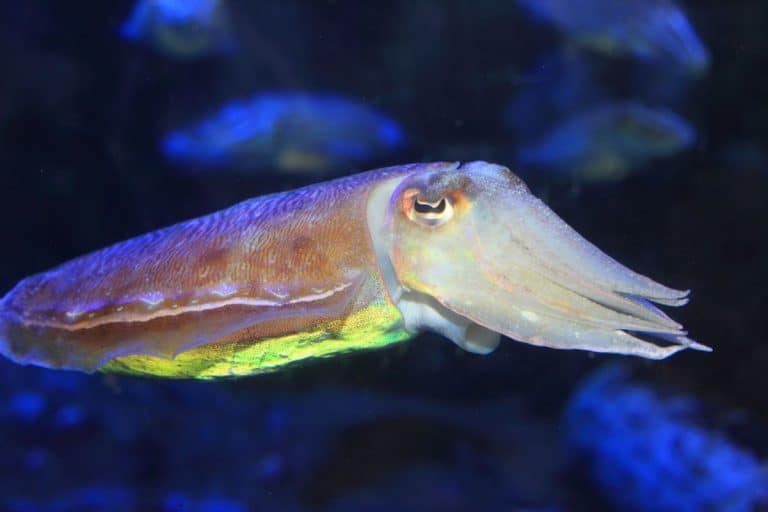
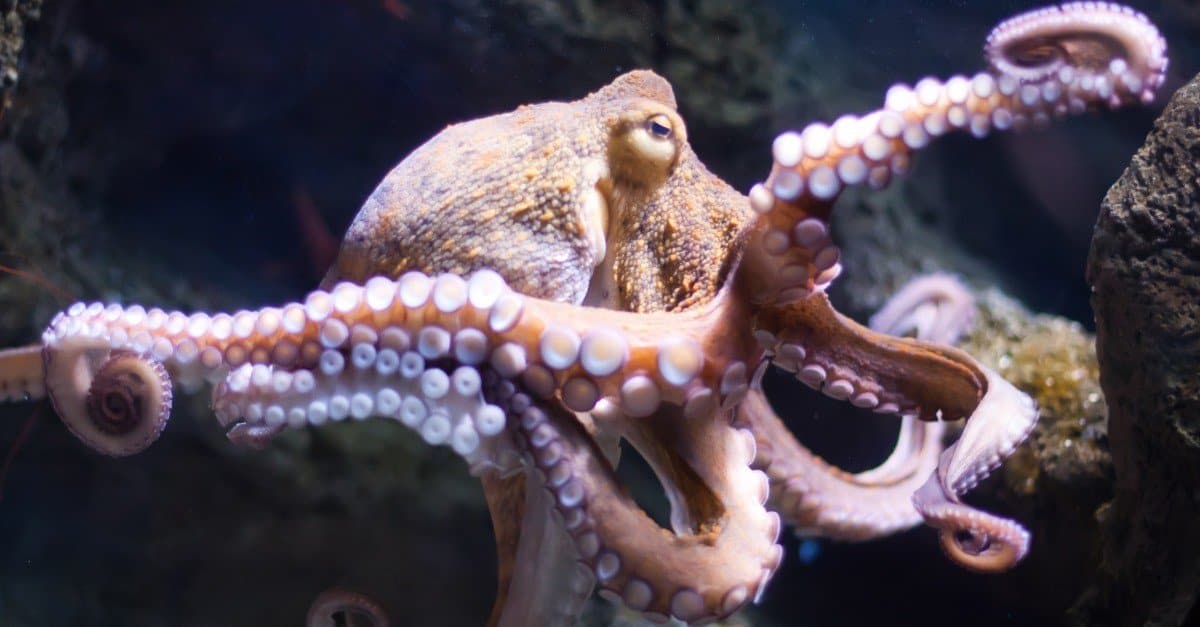
Each of an octopus’s 2,000 suckers has around 10,000 neurons.
©Greens and Blues/Shutterstock.com
Approximately 180 million of an octopus’s 500 million neurons are concentrated in the central brain. Roughly 40 million or so additional neurons are located in each of the ganglia of each of its eight arms. Therefore, 320 million of an octopus’s neurons are found at the bases of its arms rather than in its central brain.
Because each arm has its own ganglion, or cluster of neurons, each arm can act independently of the octopus’s central brain and other arms. The neurons at the base of each arm connect to suckers spread across it; typically, each arm has roughly 250 suckers. Each sucker may have around 10,000 neurons, which it uses to detect physical sensations via touch. These neurons also sense chemicals, allowing each arm to smell and taste objects while exploring them.
Octopuses have a unique form of proprioception that differs from vertebrates; they can sense the position and movement of their arms, but not through a fixed internal map like animals with skeletons. While humans can target a spot on their back without physically seeing it, octopuses lack this perception entirely. There’s a good reason for this: Unlike humans, octopuses don’t maintain a static body shape. Instead, their bodies are remarkably fluid, constantly changing to adapt to the environment. Octopuses compensate for their lack of proprioception by having those separate mini-brains at the base of each of their eight arms.
Benefits of Multiple Brains
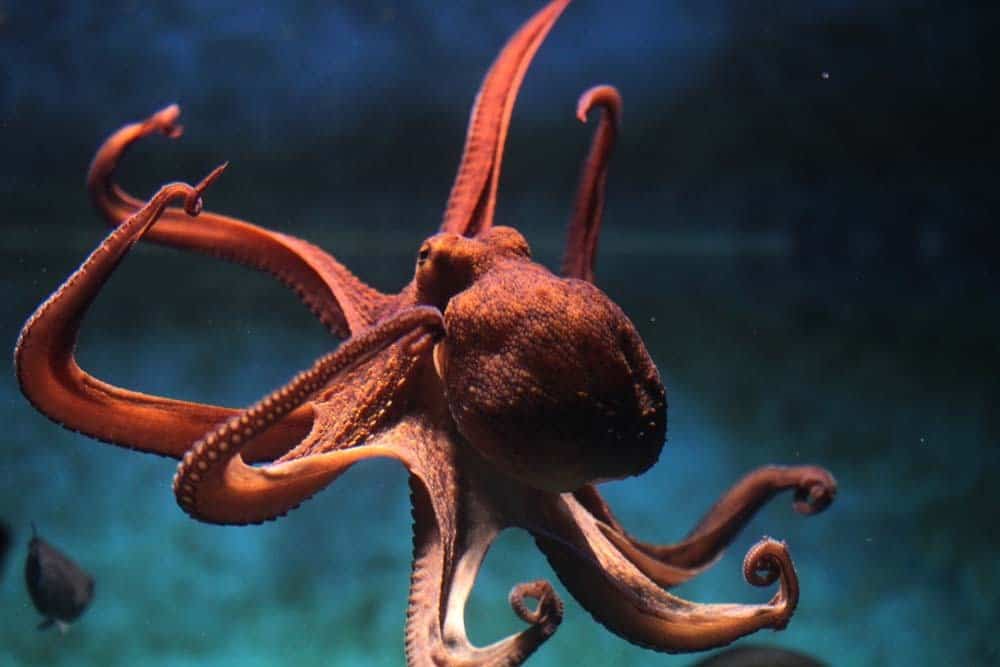
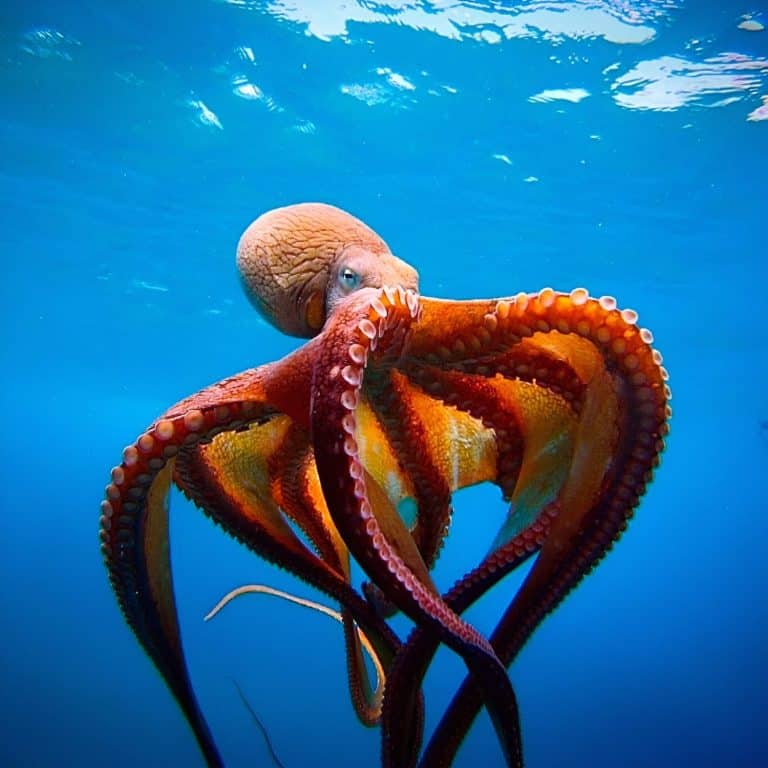
Having multiple brains allows an octopus to move with greater speed and flexibility.
©Vladimir Wrangel/Shutterstock.com
Having distinct ganglia controlling each arm compensates for the creature’s fluid body and lack of proprioception. These mini-brains lift some of the burden from the central brain, allowing it to perform more complex tasks.
Some of the benefits of the octopus’s central brain and eight ganglia include:
- They can react faster to threats because individual ganglia don’t have to communicate with the central brain.
- They can fine-tune the movement of each arm, passing the work off to the ganglia.
- They can regenerate new arms if one is severed, and the new arm even generates a new ganglion.
How Octopuses’ Brains Communicate with Each Other

Each of an octopus’s eight arms can act independently of the central brain.
©kaschibo/Shutterstock.com
Although octopuses have nine separate brains, these are still connected and communicate with each other. The eight ganglia, or mini-brains, are connected by a neural ring that bypasses the central brain. As a result, an octopus’s arms can transmit information to each other without involving the central brain, allowing them to coordinate more effectively.
More research is needed, but scientists suspect that the setup of an octopus’s nervous system provides both localized and top-down control — something important for a creature with a changing body shape and a partially decentralized nervous system. The central brain may control an arm’s path using eyesight, while the individual ganglion at the base of each arm fine-tunes its movement. This also allows each arm to taste, smell, and feel objects independently.
The central brain and its approximately 180 million neurons determine what the creature wants or needs; for example, it may send an alert to find food. The command is transmitted to the ganglia of all eight arms. In turn, each arm collects and processes its own positional and sensory information. From there, each arm issues commands about how to move most effectively, stiffening and relaxing specific areas for optimal efficiency. These ganglia continue collecting and processing sensory information as the arms move, sending the data to the central brain, which goes on to make more comprehensive decisions.