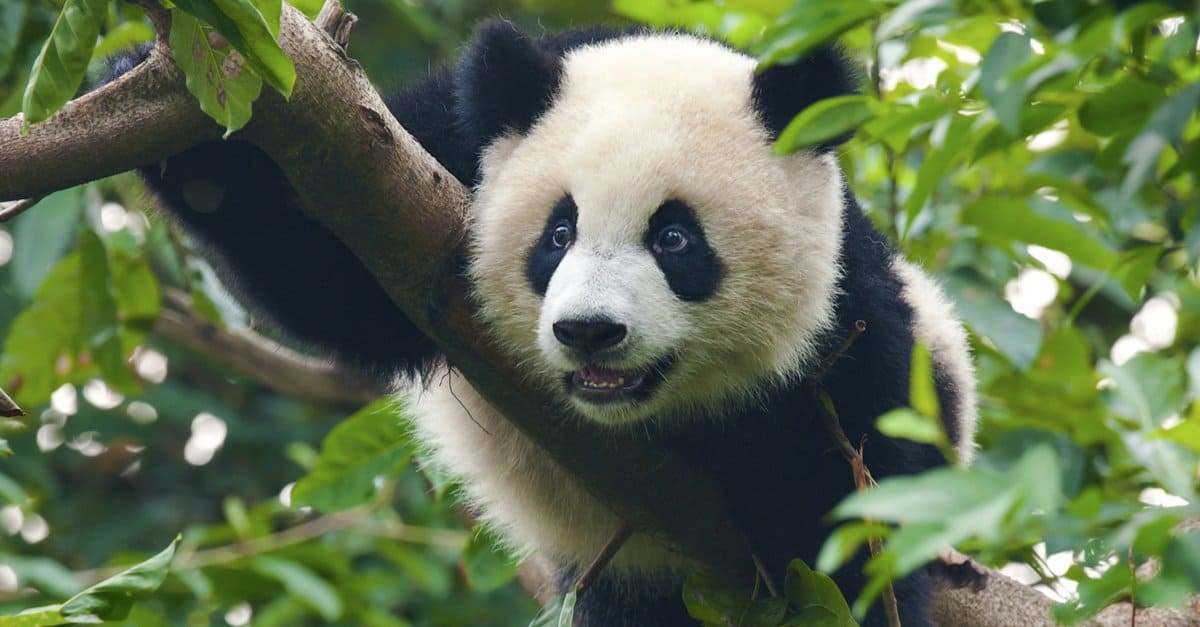

Giant pandas are an evolutionary mystery when it comes to their diets. Although pandas are herbivores, their guts are more like those of carnivores. After all, pandas are true bears, and most bears are omnivores, meaning they eat both plant and animal-based foods. So, why are pandas vegetarians, and do they really eat only bamboo? Keep reading to learn what pandas eat and find out how these bears evolved to survive on their specialist diet.
The Panda Diet

99% of a panda’s diet is bamboo.
©San Hoyano/Shutterstock.com
Although they primarily eat vegetation, giant pandas are in the clade Carnivora. Molecular studies have shown they are true bears that belong to the family Ursidae. However, around 19 million years ago, pandas diverged from their bear ancestors. Over millions of years, pandas have developed teeth and jaws suited to chewing plant matter. They have also lost the ability to taste umami, or savoriness, which is the flavor associated with meat. Around 99% of a panda’s diet is bamboo. Out of more than 1,000 types of bamboo species, pandas only eat around 35.
While the bulk of their diet is bamboo, their diet may also include:
- Other plant matter, such as the leaves, bark, stems, roots, and fruit of trees, herbs, and shrubs
- Rodents
- Carrion (most commonly eaten by pregnant or nursing females)
- Crops, including wheat, pumpkins, kidney beans, and other livestock feed
Giant pandas spend more than 50% of their day foraging for food. Some studies have shown they spend up to 14 hours a day feeding. Researchers have found that the average panda weighing around 220 pounds eats 26 to 33 pounds of bamboo leaves and stems or 50 to 84 pounds of bamboo shoots each day.
Seasonal Changes in Diet
Pandas consume different parts of the bamboo plant depending on the season. They prefer bamboo shoots, which are only available from late April through August. For the next eight months, generally from August to the following April, pandas primarily eat leaves.
Researchers also found that during the summer, pandas migrated to higher elevations to find bamboo shoots of a different species. Pandas generally only eat the stems and branches of the bamboo plant during the winter, as there are fewer high-quality plants available.
How Do Pandas Survive on Bamboo?

Pandas get their energy from bamboo protein.
©Karel Cerny/Shutterstock.com
Pandas are only able to digest about 20% of the bamboo they eat. They only digest the plant cell contents, not plant cell fibers or cell walls. Pandas also have short digestive tracts, and food passes through them relatively quickly. This is in sharp contrast to most mammalian herbivores, which have long digestive tracts to allow for increased microbial fermentation of plant cell fibers and cell walls. So, how do pandas get enough nutrients from bamboo?
Bamboo shoots contain more carbs and proteins, while leaves are composed of cellulose and hemicellulose. However, the fat content of both shoots and leaves is less than 4%. Yet researchers say that because bamboo is low in carbs and high in protein, a panda’s diet is actually closer to that of a carnivore. Pandas get between 48% and 61% of their energy from bamboo protein. This is similar to carnivores like cats, which get about 50% of their energy from protein. Most herbivores get only around 20% of their energy from protein. Scientists believe that by deriving energy from bamboo protein, pandas compensate for the protein they do not obtain from animal-based foods.
Since pandas rely on a relatively poor-quality diet for all of their energy needs, fat storage for periods when resources are scarce is critical. The composition of a panda’s gut microbiome changes throughout the year in accordance with its diet. Researchers found that pandas’ gut microbiome contained more Clostridium butyricum during the months when they consumed primarily shoots. This bacterium increases lipid production and fat storage, allowing pandas to gain more body mass when consuming shoots.