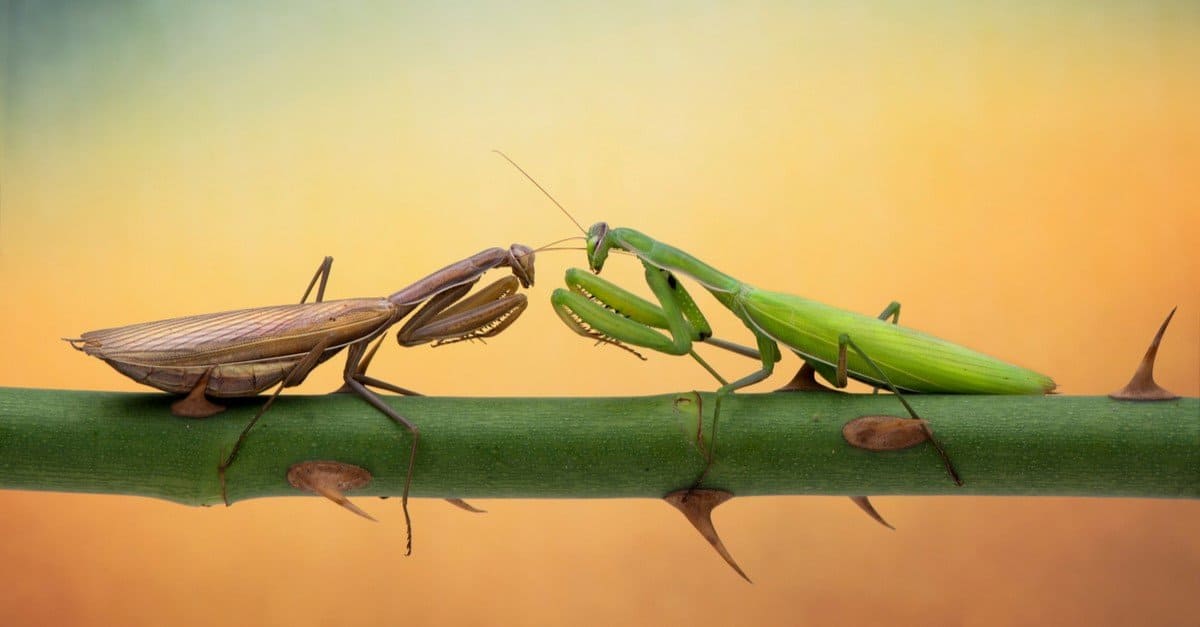

Mantises are a unique group of insects in the order Mantodea. There are over 2,400 species worldwide, with the exception of Antarctica. Insects in this order are commonly called praying mantises due to their posture. Their bent front legs are held together in a way that resembles praying. It is important to note that “mantis” really only refers to insects in the genus Mantis, while “mantid” refers to all insects in the order. However, for clarity, this article will use the more common term “mantis.” Although some male and female mantises may look similar, there are crucial differences between the sexes. Keep reading to learn what sets male and female praying mantises apart.
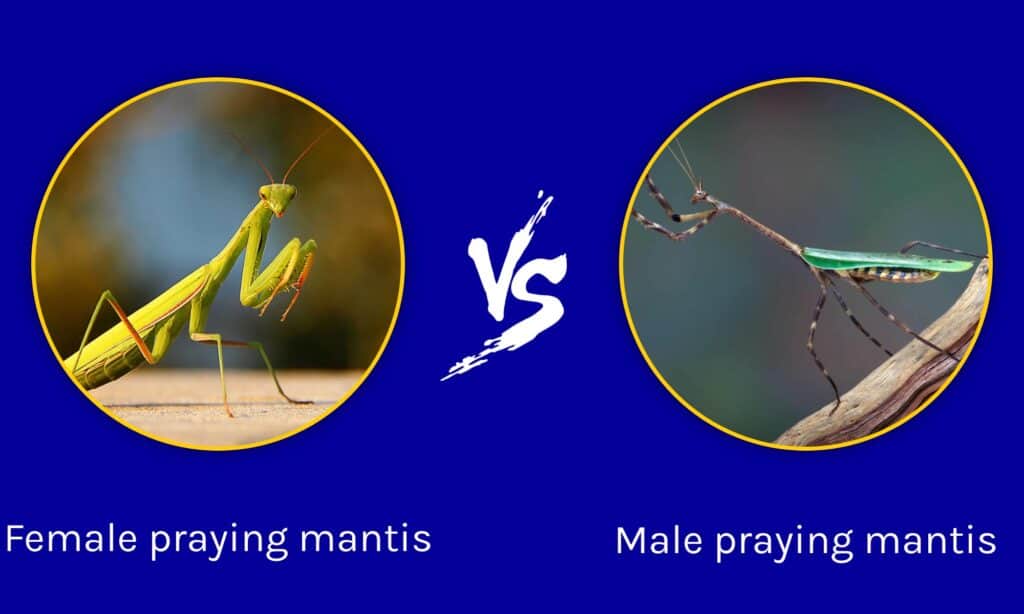
Male vs. Female Praying Mantis: Quick Comparison
| Male Praying Mantis | Female Praying Mantis | |
|---|---|---|
| Body Size | Thin and lightweight; more agile; shorter than females | Bulkier and heavier; rounder abdomens; longer than males |
| Physical Characteristics | Eight abdominal segments; larger eyes; long, thick antennae | Six abdominal segments; smaller eyes; Shorter, thread-like antennae |
| Flying Ability | Long wings; capable of flying long distances to search for mates | Shorter wings; often too heavy for flight |
| Development | Fewer molts; reach maturity more quickly | More molts than males since they grow larger; slower to develop |
| Behavior | When not on vegetation waiting for prey, they are in the air searching for feeding spots or mates | More sedentary; more aggressive; may engage in cannibalistic behaviors; more elaborate camouflage |
Key Differences Between a Male vs. a Female Praying Mantis
Both male and female mantises have triangular heads, long bodies, and two pairs of wings. However, they are measurably different in terms of body size, physical characteristics, flying ability, development, and behavior. Take a closer look at these differences in the following paragraphs.
Body Size
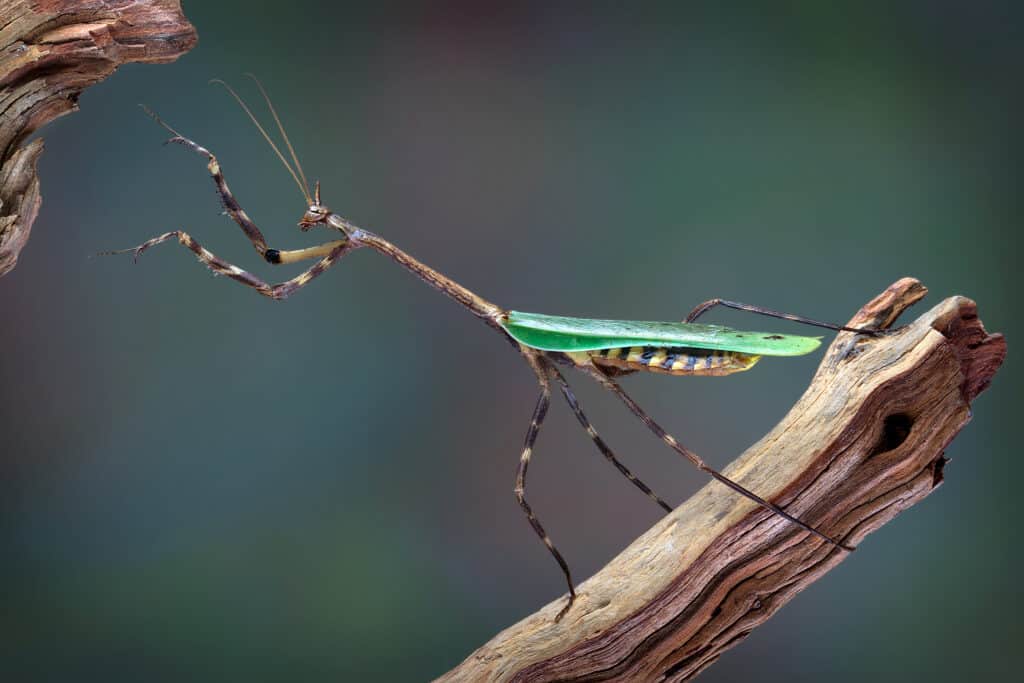
Male praying mantises are more slender and lightweight than females.
©Cathy Keifer/Shutterstock.com
Male and female mantises have different body sizes and shapes. While there is some variation between species, male mantises have thin and lightweight bodies, making them more agile. Males are also usually shorter than females. For example, in Chinese mantises, which are one of the most common species in the U.S., males only reach about 3-4 inches while females can reach up to 5 inches.
In addition to being longer than males, female praying mantises are also bulkier and heavier than males. Females typically have rounder abdomens, which helps support reproduction by allowing for fat storage and egg-laying.
Physical Characteristics
Size is not the only difference between males vs. females. Males have eight abdominal segments, while females only have six. Although both sexes have large, compound eyes, males’ eyes are larger in proportion to their body size than females’. Their large eyes provide a wider field of view and better vision in low light, which helps them hunt at twilight and at night, when they actively search for females.
Males also tend to have longer, thicker antennae that are more sensitive to detecting pheromones. Their antennae have significantly more sensory organs, or sensilla, which make them better equipped to detect the female’s chemical signals. In contrast, female antennae are generally shorter, thinner, and more delicate.
Wings and Flying Ability
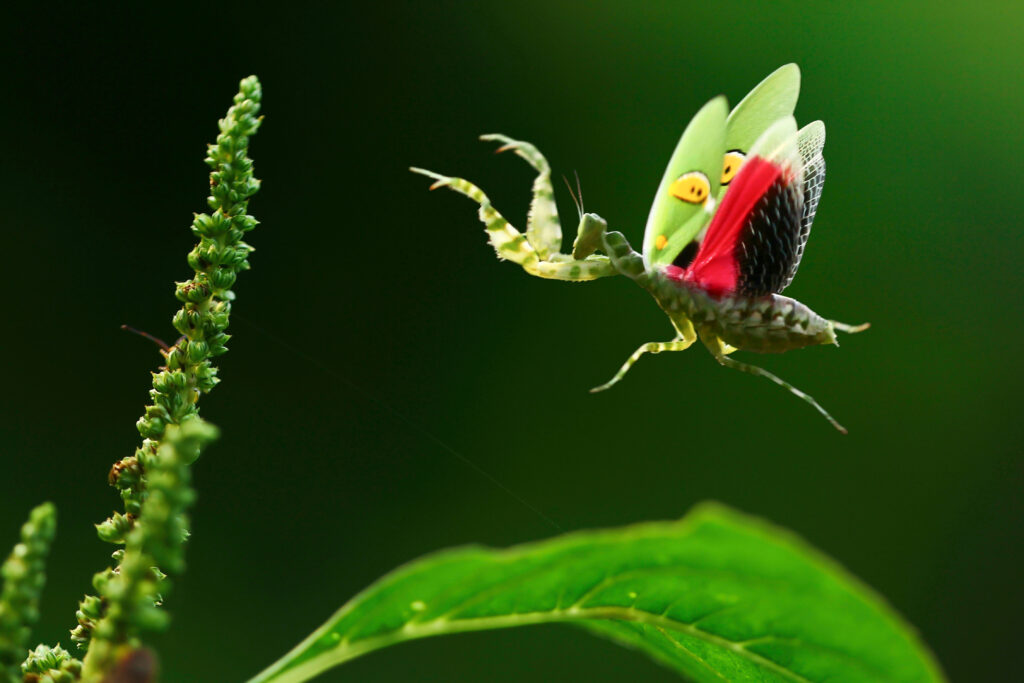
Male praying mantises can fly, but many females cannot due to their heavier bodies.
©SemilirBanyu/Shutterstock.com
Male and female praying mantises both have two pairs of wings. However, usually only the males can fly. Males have longer wings, often extending past the abdomen. Males are much lighter, which makes it easier for them to achieve flight.
Females typically have shorter wings that end at the abdomen, and some species have only vestigial wings. Because females are bulkier and heavier, some mantis species are too large to fly. Even in species where females can fly, they are unable to travel long distances. They generally only fly to find new hunting spots or escape predators.
Development
Both sexes molt as they transition from nymphs to adults, but females require more molts to reach their larger size. Males develop more quickly and reach maturity sooner. However, their smaller size means they are more mobile.
Females develop more slowly and must grow larger so their bodies can support reproduction. Undergoing more molts gives the female additional time to accumulate the resources needed to produce a protective egg case called an ootheca.
Behavior
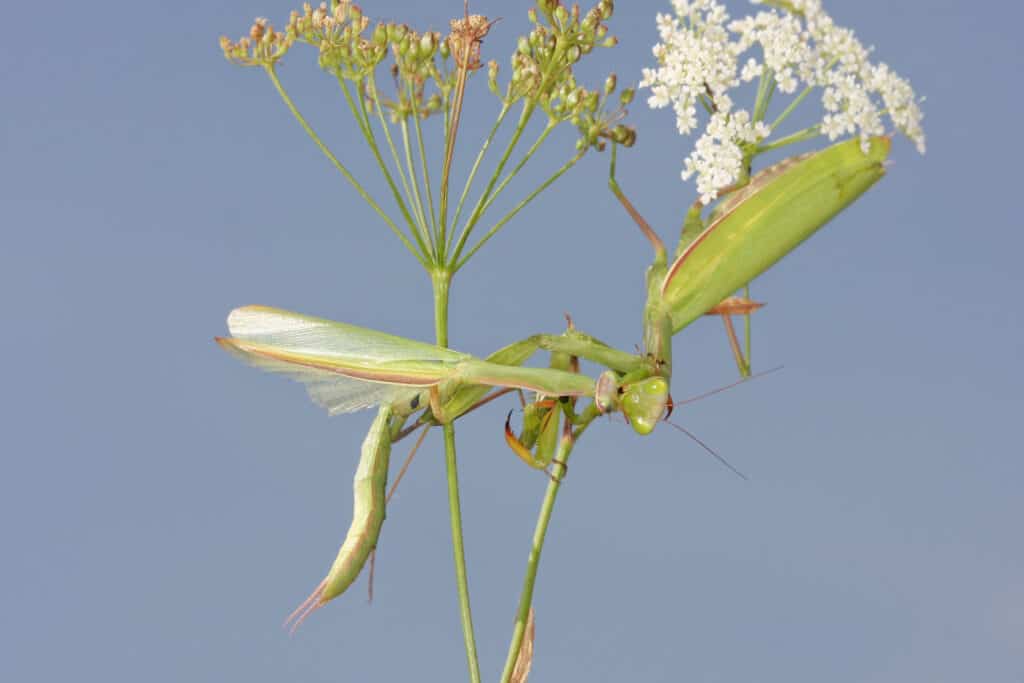
Female praying mantises sometimes eat the males during or after mating.
©Geza Farkas/Shutterstock.com
One major behavioral difference between male and female praying mantises is that females are more sedentary than males. This is because males are active fliers and females rarely fly, if they are able to at all. When not on vegetation waiting for prey, males spend their time in the air hunting for new feeding spots or searching for females. Females sometimes have more elaborate camouflage, which allows them to remain stationary while hunting. For example, female orchid mantises have more intricate leg lobes that aid in attracting small insects and hiding the mantis from predators.
Female praying mantises are also stronger and more aggressive than the males. Female mantises sometimes consume the males during or after mating. According to scientists, female praying mantises that are not well-fed are more likely to engage in cannibalism. Another experiment also suggested that males and females engage in battles before they mate, and the winner of the fight determines whether cannibalism occurs or not.