






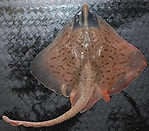
S
Species Profile

Skate Fish

Rajiformes

Glide low, hunt slow.
geniuscook_com/Shutterstock.com

Skate Fish Distribution

Click a location to explore more animals from that region

This map shows coastal regions where Skate Fish are found.

Loading map...
Skate Fish

At a Glance

Order Overview This page covers the Skate Fish order as a group. Stats below are general traits shared across the order.
Also Known As Skate, Skate ray, Sea skate, Ray, Batoid
Diet Carnivore
Activity Nocturnal+
Lifespan 10 years
Weight 100 lbs
Status Not Evaluated
Did You Know?

Size spans the order: roughly ~20 cm to ~2.5 m total length (the largest species can weigh well over 50 kg).

Scientific Classification

Order Overview "Skate Fish" is not a single species but represents an entire order containing multiple species.

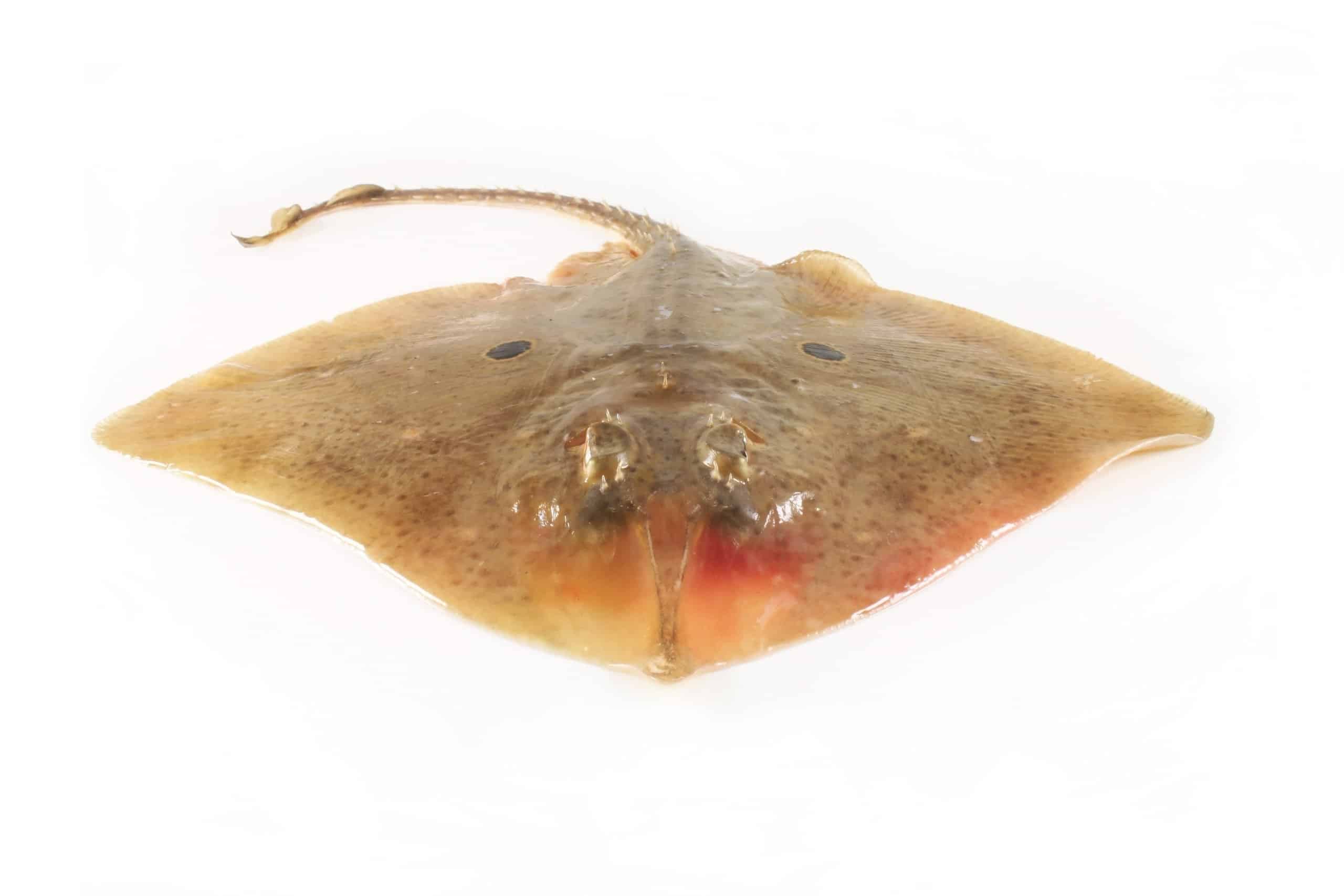
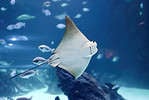
Skates are bottom-dwelling batoid fishes (close relatives of rays and sharks) with flattened bodies, enlarged pectoral fins forming a disc, and a long tail. Many species have rough skin and dorsal spines, and they typically feed on benthic invertebrates and small fishes.

Kingdom
Animalia
Phylum
Chordata
Class
Chondrichthyes
Order
Rajiformes

Distinguishing Features

  • Cartilaginous skeleton (like sharks)
  • Flattened, disc-shaped body with pectoral fins fused to the head
  • Ventral gill slits and mouth (typical of batoids)
  • Often thorny/spiny dorsal surface and/or tail spines (varies by species)
  • Egg-laying reproduction in many species (egg cases often called 'mermaid’s purses')

Physical Measurements

Males and females differ in size

Length
2 ft 4 in (8 in – 8 ft 10 in)
2 ft 11 in (6 in – 8 ft 6 in)
Weight
11 lbs (0 lbs – 220 lbs)
13 lbs (0 lbs – 243 lbs)
Tail Length
1 ft 2 in (3 in – 4 ft 7 in)
1 ft 6 in (2 in – 4 ft 7 in)
Top Speed
19 mph
swimming

Appearance

Primary Colors
Secondary Colors
Skin Type Cartilaginous fish skin with dermal denticles; commonly rough, with thorn-like spines along midline, shoulders, or tail. Texture ranges from very prickly to relatively smooth depending on species, sex, and maturity.
Distinctive Features
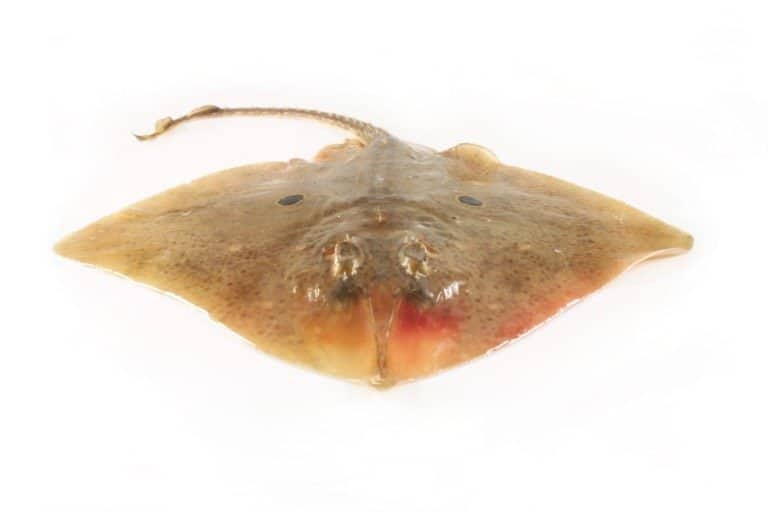
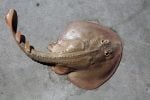
  • Body form: dorsoventrally flattened disc formed by enlarged pectoral fins; head fused to disc.
  • Tail: typically slender, without a venomous stinger; may bear dorsal fins and rows of thorns.
  • Defensive armature: many have prominent dorsal thorns/spines; distribution and size vary widely.
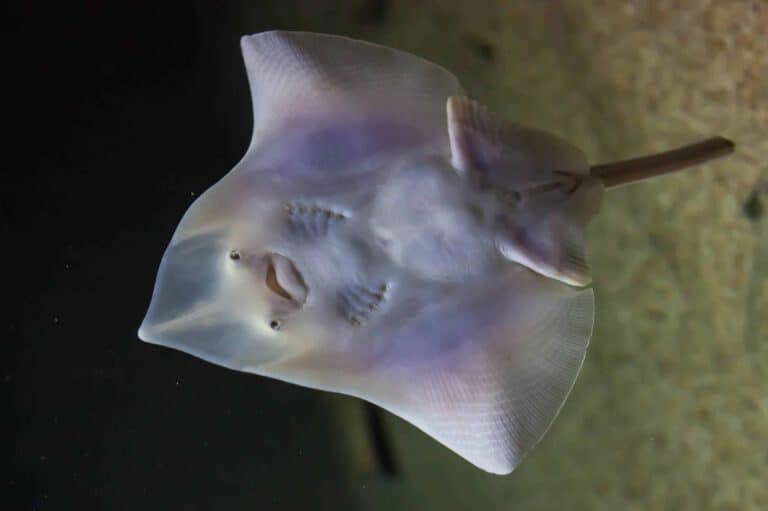
  • Sensory/respiration: eyes and spiracles on top; mouth and gill slits on underside.
  • Size range across the order: ~20-30 cm to ~200-250+ cm total length; disc width roughly ~15 cm to ~150-170+ cm (varies by lineage).
  • Longevity range reported across species: roughly ~5-10 years in small skates to ~30-40+ years in larger, slow-growing skates.
  • Ecology generalization: mostly benthic/demersal on continental shelves and slopes; depth and temperature niches vary from shallow coastal to deepwater.
  • Diet generalization: primarily benthic invertebrates (crustaceans, mollusks, worms) plus small fishes; prey emphasis varies with size and habitat.
  • Reproduction: many lay tough egg cases ("mermaid's purses"); egg-case shape and tendrils vary by species.
  • Difference from many stingrays: skates generally lack a venomous tail spine and often have more pronounced dorsal thorns; tail and fin structure differs among batoids.

Sexual Dimorphism

Males typically have external claspers and may mature smaller, sometimes with relatively more pronounced thorns. Females are often larger-bodied in many species, reflecting higher energetic investment in producing large egg cases and yolk-rich eggs.

  • Claspers on pelvic fins (external reproductive organs).
  • Often earlier maturation and smaller average size than females in many species.
  • In some species, relatively more conspicuous thorns or roughness during breeding.
  • Often larger disc width and heavier body mass in many species.
  • Egg-case production; enlarged oviducal glands associated with laying egg cases.
  • May show different thorn development patterns depending on species and maturity.

Did You Know?

Size spans the order: roughly ~20 cm to ~2.5 m total length (the largest species can weigh well over 50 kg).

They're batoids (ray-like), but many skates lack the venomous tail stinger typical of many stingrays.

Most skates lay leathery egg cases ("mermaid's purses") that often wash up on beaches.

Many species have rows of thorny spines ("thorns") along the back and tail-useful for defense and identification.

Skates hunt using electroreception (sensing tiny electrical signals from buried prey).

Across the order, lifespans range from fast-lived small species (~6-10 years) to long-lived large skates that can reach multiple decades (up to ~50 years in some).

Several skates are important both in fisheries (sold as "skate wings") and in science (some are model species for development and sensory biology).

Unique Adaptations

  • Pectoral fins form a flattened "disc," enabling efficient gliding and precise maneuvering just above the seabed.
  • Spiracles (openings behind the eyes) let skates breathe while resting on the bottom without drawing in sediment through the mouth.
  • Electroreception (ampullae of Lorenzini) helps detect hidden prey under sand or mud; smell and lateral-line sensing also contribute.
  • Dermal denticles and dorsal thorns: rough, sandpaper-like skin and spines can deter predators and reduce damage from abrasive seafloor habitats.
  • Robust egg cases: many are rectangular with horn-like tips and are tough enough to protect embryos in dynamic coastal environments.
  • Jaw and tooth variation across the order supports different diets-from crushing hard-shelled prey to gripping slippery fish.

Interesting Behaviors

  • Benthic lifestyle: most spend much of their time on or partly buried in sand/mud, using camouflage to avoid predators and ambush prey.
  • Feeding generalization: commonly take bottom invertebrates (crustaceans, worms, mollusks) and small fishes; larger species tend to include more fish, while smaller species often focus on invertebrates.
  • Daily activity varies: many are more active at night or in low light, but patterns differ by species and habitat (coastal vs. deepwater).
  • Seasonal movements are common in some regions (shifting between deeper and shallower water with temperature and prey), while other species are relatively resident.
  • Reproductive behavior centers on egg-laying: females deposit egg cases on the seafloor; timing and nursery areas vary widely across species and coastlines.
  • Social patterns vary: often solitary or loosely associating, but some species form local aggregations (e.g., in feeding or mating areas).

Cultural Significance

Skates (Rajiformes) are sold as "skate wings"; their egg cases are common beach finds. They grow slowly and mature late, so can be hurt by overfishing. As seafloor predators they shape food webs and help research vertebrate development and senses.

Myths & Legends

"Mermaid's purse" is a long-standing piece of European coastal folklore: beach-washed skate egg cases were imagined as purses (or small satchels) belonging to mermaids.

In parts of the British Isles, similar egg cases have also been nicknamed "devil's purses," reflecting older maritime traditions of giving uncanny, supernatural names to unfamiliar sea objects found after storms.

Natural history cabinets and seaside curiosity-collecting in the 18th-19th centuries popularized skate egg cases as objects of wonder-part folklore, part early citizen science.

Market names and sailor talk historically blurred skates and rays, feeding a tradition of "mystery fish" stories in ports where flattened fishes were grouped together and given dramatic nicknames based on shape and spines.

Conservation Status

NE Not Evaluated

Has not yet been evaluated against the criteria.

Population Decreasing

Protected Under

  • Fisheries management measures in multiple jurisdictions (e.g., catch limits, landing prohibitions/retention bans for some large threatened skates, bycatch mitigation requirements)
  • Spatial protections such as marine protected areas and trawl closures in parts of some species' ranges
  • National/regional threatened-species listings and protections for select species (varies by country; not uniformly applied across all skates)

You might be looking for:

Thornback ray / thornback skate

22%

Raja clavata

Common NE Atlantic skate with thorny spines; often encountered in coastal waters and fisheries.

View Profile

Winter skate

18%

Leucoraja ocellata

Northwest Atlantic skate, typically found on sandy/muddy bottoms; important in regional identification contexts.

Little skate

16%

Leucoraja erinacea

Small Western Atlantic skate frequently used in research; common in shallow coastal habitats.

Big skate

14%

Beringraja binoculata

Large Pacific skate found along the west coast of North America; notable for size and ocelli-like markings.

Common skate complex

12%

Dipturus batis

Historically treated as one species in the NE Atlantic; now recognized as multiple closely related species and often referenced in conservation contexts.

Life Cycle

Birth 1 hatchling
Lifespan 10 years

Lifespan

In the Wild
5–50 years
In Captivity
5–35 years

Reproduction

Mating System Polygynandry
Social Structure Solitary
Breeding Pattern Transient
Fertilization Internal Fertilization
Birth Type Internal_fertilization

Across Rajiformes, adults are typically solitary and form no lasting pair bonds; mating is brief, with males using claspers for internal fertilization. Both sexes can mate with multiple partners, sometimes during seasonal local aggregations; females deposit egg cases and provide no parental care.

Behavior & Ecology

Social Shoal Group: 5
Activity Nocturnal, Crepuscular, Cathemeral, Diurnal
Diet Carnivore Benthic crustaceans (especially crabs and shrimp), with many species also taking small bottom fishes when abundant.
Seasonal Migratory 124 mi

Temperament

Generally cryptic and non-aggressive; relies on camouflage and stillness
Avoidant of disturbance; may flee or bury in substrate when approached
Defensive when handled; tail thrashing and body flexing, thorny skin can deter predators
Intraspecific tolerance varies: solitary in many species, more tolerant in aggregating species

Communication

no confirmed species-typical vocal repertoire; communication largely non-vocal
electroreception and mechanoreception for close-range detection of conspecifics and prey
chemical cues in water Pheromone-like signals suspected during reproduction
tactile contact during mating Biting/holding and fin contact in some species
body postures and fin undulations as threat or displacement signals at close range
spatial signaling via occupancy of refuges and repeated use of benthic microhabitats

Habitat

Seabed/Benthic Coastal Deep Sea Open Ocean Estuary Rocky Shore Kelp Forest +1
Biomes:
Marine Tundra Temperate Forest
Terrain:
Coastal Island Rocky Sandy Muddy
Elevation: Up to 9842 ft 6 in

Ecological Role

Benthic mesopredators (and in some ecosystems higher-level demersal predators) that link seafloor invertebrate communities to higher trophic levels.

Regulate populations of benthic invertebrates and small demersal fishes through predation Transfer energy from benthic food webs to higher predators (e.g., larger sharks, marine mammals, large teleosts) Influence seafloor community structure by selective predation on key prey (e.g., crabs, worms, mollusks) Contribute to sediment disturbance/bioturbation indirectly through foraging, prey excavation, and pouncing behavior

Diet Details

Main Prey:
Benthic crustaceans Polychaete worms and other benthic worms Bivalves and other mollusks Cephalopods Small demersal and benthic fishes Echinoderms

Human Interaction

Domestication Status

Wild

Rajiformes (skates) are wild fish with no domestication history. People catch them in the wild (fisheries, bycatch) and sometimes keep a few in aquariums; there is no long-term breeding. Sizes range from about 30 cm to 2.5 m; lifespans often 10–50 years. They lay leathery "mermaid's purse" eggs, grow slowly, and are at risk from fishing.

Danger Level

Low
  • puncture/laceration from dorsal spines or rough dermal denticles during handling
  • bites when captured or cornered (usually minor but can break skin)
  • injury risk increases with larger species and when handling on deck/shore; skates lack the venomous tail stinger typical of many stingrays

As a Pet

Not Suitable as Pet

Legality: Skates (Rajiformes) are not banned everywhere, but owning them is often limited: many aren't sold legally, collecting may need licenses, size/season or bycatch rules, or permits; protected species can't be kept. Public aquariums may hold them.

Care Level: Expert Only

Purchase Cost: Up to $500
Lifetime Cost: $5,000 - $50,000

Economic Value

Uses:
Commercial fisheries (targeted and bycatch) Food markets Leather/skin products (limited, varies by region) Fishmeal/oil (often via bycatch processing) Public aquaria/education Scientific research and monitoring
Products:
  • skate wings (pectoral fins) sold fresh/frozen
  • whole skate or processed meat (region-dependent demand)
  • skins/leather goods (small, niche use in some areas)
  • bycatch landings for mixed demersal fisheries

Relationships

Related Species 11

Skate family Rajidae Shared Family
Softnose skates Arhynchobatidae Shared Family
Legskates Anacanthobatidae Shared Family
Pygmy skates Gurgesiellidae Shared Family
Typical skates Raja Shared Genus
Leucoraja Leucoraja Shared Genus
Longnosed skates Dipturus Shared Genus
Deepwater skates Bathyraja Shared Genus
Amblyraja Amblyraja Shared Genus
big skates Beringraja Shared Genus
Okamejei Okamejei Shared Genus

Ecological Equivalents 5

Animals that fill a similar ecological role in their ecosystem

Types of Skate Fish

20

Explore 20 recognized types of skate fish

Thornback ray
Thornback ray Raja clavata
Little skate Leucoraja erinacea
Winter skate Leucoraja ocellata
Barndoor skate Dipturus laevis
Clearnose skate
Clearnose skate Rostroraja eglanteria
Starry skate Amblyraja radiata
Blue skate Dipturus batis (species complex)
Longnose skate Beringraja rhina
Alaska skate Bathyraja parmifera
Arctic skate Amblyraja hyperborea
Big skate Beringraja binoculata
California skate Beringraja inornata
Sandpaper skate Bathyraja kincaidii
Kamei skate Okamejei kenojei
Mottled skate Raja pulchra
Small-eyed ray Raja microocellata
Spotted ray Raja montagui
Round skate Rajella fyllae
Thorny skate Amblyraja radiata (regional common name usage)
Yellownose skate Dipturus chilensis

Generally abundant across the world’s waters, skates are often caught as byproducts by trawlers, so some species are now critically endangered. Skates are also known for having meat that can match a scallop in consistency and flavor when prepared properly. In fact, many Michelin-starred restaurants now feature skate dishes on their menus.

3 Amazing Facts:

  • One gigantic liver: The skate fish has one of the largest livers in the animal kingdom. Its liver accounts for a quarter of its body mass. In comparison, the human liver accounts for 2% of body mass. This large liver helps skate fish stay near the ocean floor.
  • Thorn-like defense: While stingrays utilize a barbed tail for defense, the body of skates is made of a “thorn-like” material that helps defend them.
  • “Mermaid pouches:” Unlike stingrays, which have live births, skates lay eggs. The pouches that contain these eggs are called “mermaid pouches.” It is not uncommon to find them washed up on beaches around the world.

Classification and Scientific Name
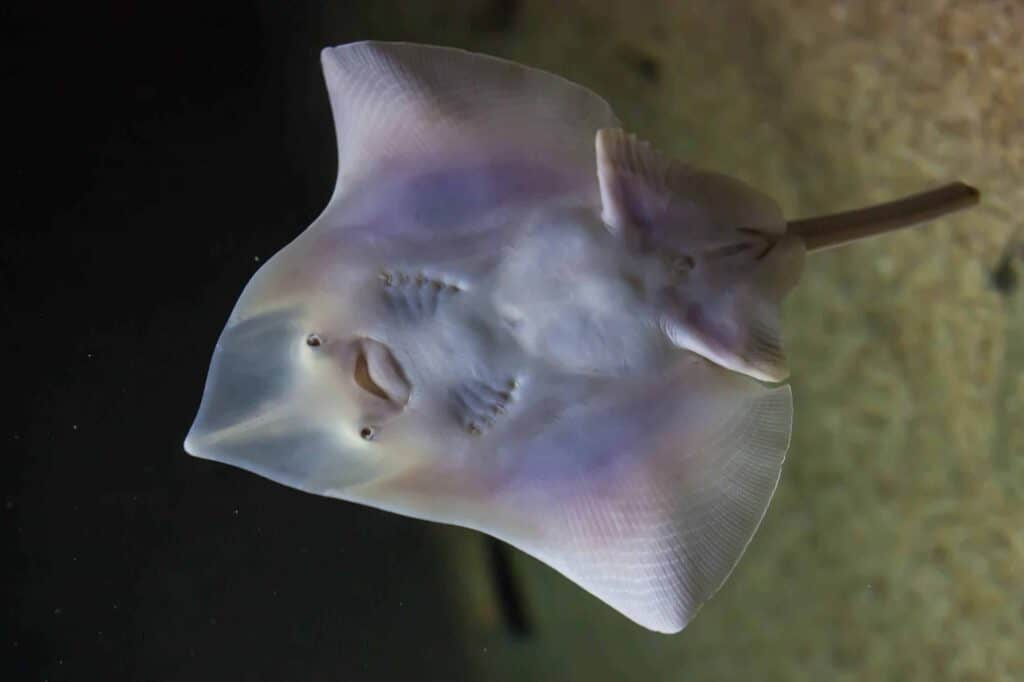
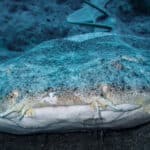
Skate Fish Mouth

Skate fish have an evolutionary history that goes back over 400 million years.

Skate fish are cartilaginous fish that are part of the class Chondrichthyes, which also includes sharks, stingrays, and chimaeras. While fish in this class lack bones and thus leave behind limited fossil evidence, it’s believed modern skates began evolving during the Jurassic Period (200 to 145 million years ago).

Over 400 million years ago, the ancestors of all jawed vertebrates, including skates, sharks, and bony fishes, diverged. The first animals to leave the sea and begin walking on land were early tetrapods, which evolved from lobe-finned fishes, a different lineage from skates. Genetic and brain studies show that skates have the makings of a walking animal, and they still “walk” on the ocean floor.

Skate fish belong to the Order Rajiformes, which contains more than 200 species spread across four families. These other families include smooth skates, soft-nose skates, and pygmy skates.

The largest skate fish family is Rajidae, which, as of late 2020, contains 159 described species spread out across 16 genera. An example of a specific skate species’ scientific name would be the big skate, which is named Raja binoculata.

Knowledge of skate taxonomy continues to grow. With these bottom-dwellers often living to depths of up to 8,900 feet, new species and genera may continue to be discovered in the years to come. In fact, during the past decade (2011 to 2020), six new species of skates were discovered.

Species
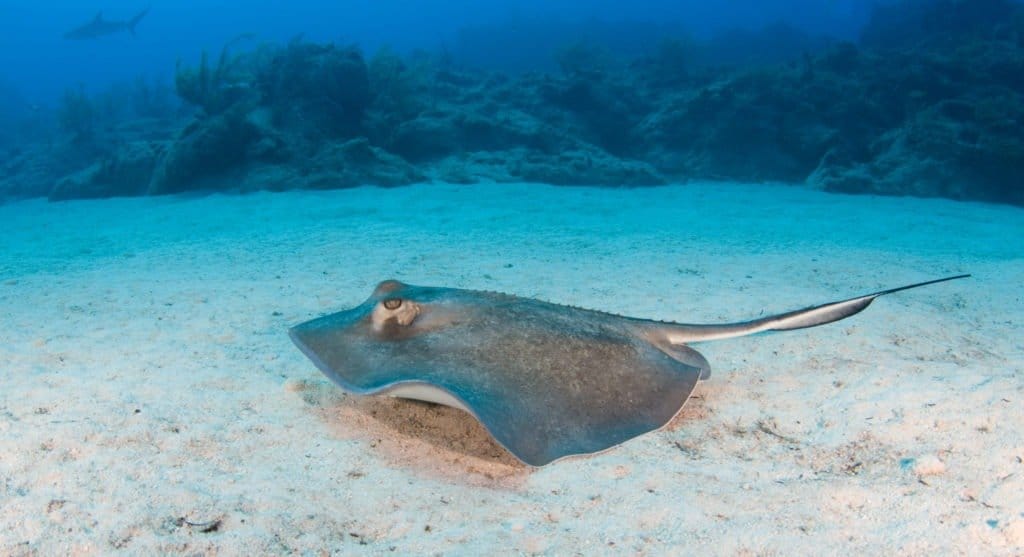
Skate fish are bottom-dwellers, so the depths of their habitats make it difficult to find and classify them, but it helps that they are region-specific.

Most skate fish species have relatively narrow geographic regions. For example, there are eight different skate fish species that are endemic to the water surrounding New Zealand.

Some notable skate fish species include:

  • Big skate (Raja binoculata): Found from Baja California to Alaska, the big skate is one of the largest skate species and can reach 8 feet in length and 200 pounds.
  • Deepsea skate (Bathyraja abyssicola): A species of skate that lives at the bottom of continental slopes and has been discovered living at depths reaching 8,900 feet.
  • Arctic skate (Amblyraja hyperborea): A skate with a wide geographic distribution that lives in cold waters off Greenland and the frigid waters off Antarctica.
  • Common skate (Dipturus batis): contrary to its name, it is now critically endangered. Note: Recent research has split the former ‘common skate’ into two species, both of which are threatened.

Appearance

Skate fish species can possess extremely unique body shapes, colors, and even sizes. While big skate have reached 8 feet in length and weigh up to 200 pounds, most skate fish species measure less than 3 feet and weigh in at 10 pounds or less.

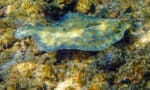
With approximately 200 species, skate fish appearance can vary dramatically. The most common color is a “brownish” tint that helps the species blend in with the bottom of the ocean; however, certain skate species have dots or other markings. In addition, skates tend to have a “diamond” or even circular body shape.

Comparison to Stingrays
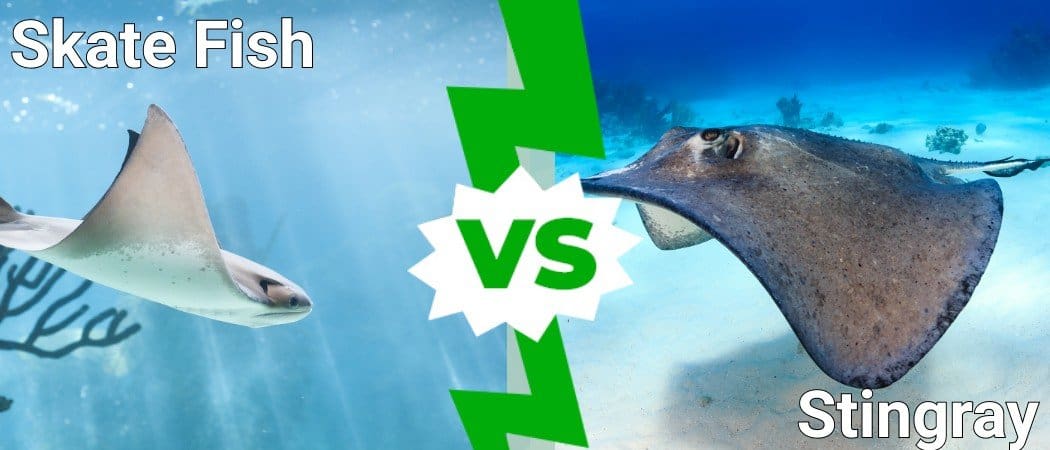
Stingray and Skate fish may be similar in appearance; however, they differ in four key points.

Skates and rays look very similar, but they have key differences that set them apart into different families.

  • Eggs vs. live births: Skates produce eggs that they place in a protective pouch known as a “mermaid pouch”, whereas ray species have live births of offspring.
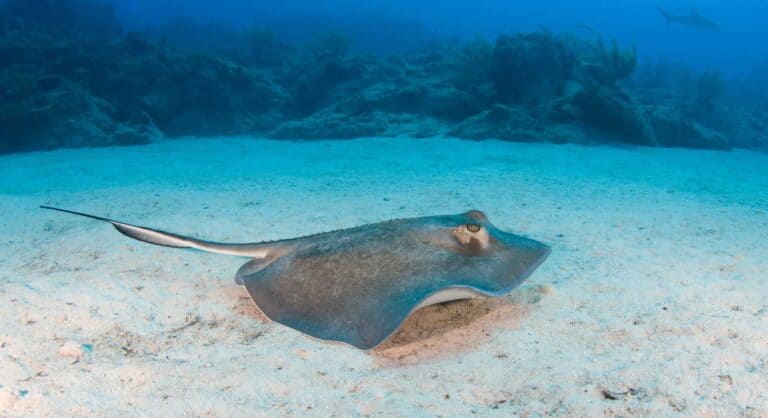
  • Different tails: Rays have sharp barbs at the end of their tails that are used for defense. Skate tails lack this barb, and they instead use “thorn-like” skin as their main defense against predators.
  • Dorsal fins: Skates generally have either one or two dorsal fins (fins used for stabilization). Rays either lack dorsal fins or have small remnant fins.
  • Size: Skates are generally smaller than rays. The largest ray species — the giant manta ray — can reach a wingspan of 29 feet and a weight of 3,600 pounds. Compare that to the largest skate species, which weighs only about 200 pounds.

Beyond these differences, rays and skate fish also have key differences in their teeth and habitat (skates generally prefer living in deeper waters).

Distribution and Habitat

Skate fish are found in oceans across the globe. Different skate species inhabit environments that range from the shallow mouths of river deltas all the way to outer continental shelves that can reach 8,900 feet in depth.

Skates are found in both cold and temperate climates. Species can be found near the equator all the way to Antarctica in the Southern Hemisphere and Greenland in the Northern Hemisphere. As skate fish lie on the ocean floor, they breathe through spiracles, which are positioned behind their eyes. These specially evolved openings allow skate fish to breathe oxygenated water while buried in sand near the ocean floor.

Reproduction, Eggs, and Lifespan
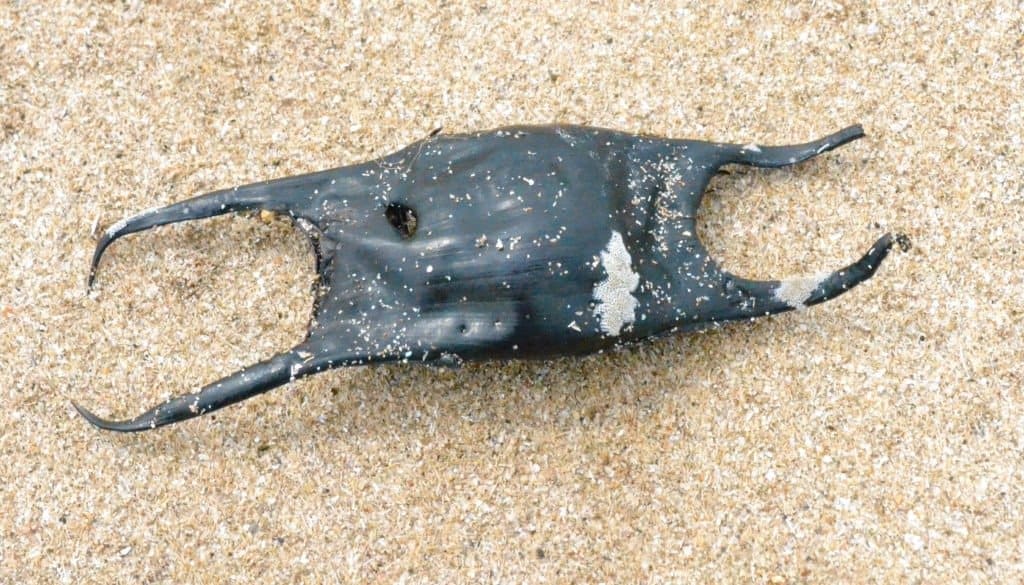
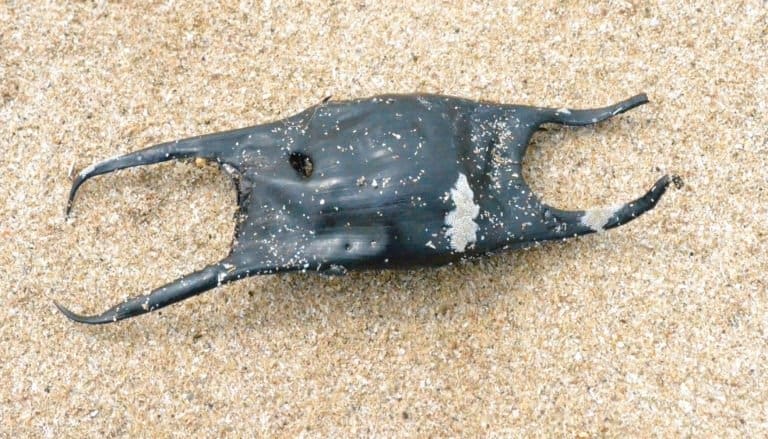
Found on the beach, a mermaid pouch that protects skate eggs and baby skates from predators.

Skate fish reproduce with eggs that are placed in “mermaid pouches” that are made of collagen proteins and give skate eggs additional protection from predators on the bottom of the oceans. Skate embryos generally live in these pouches for about 3 months (12 weeks) before breaking free. Adolescents grow to about double the size of the pouch (generally about 4″ to 6″) by the time they’re ready to leave its protection.

As skates mostly live in deeper environments and are difficult to observe, it’s a challenge to estimate their exact longevity. However, scientists have placed the common skate fish’s lifespan at 50 to 100 years. Other species may live for shorter periods. For example, estimates of the Winter skate lifespan are listed at about 20 years.

The long lifespan of some skate fish species means it can take 10 or more years to reach maturity, which can make repopulation challenging. Most skate species lay many eggs (common skates will lay approximately 40), but few of these eggs will lead to skate fish that reach maturity.

Conservation Status

Most species of skate fish are considered abundant; however, trawling has led to a decrease in the estimated biomass of a number of skate species.

The common skate is now listed as critically endangered and is offered protection in the European Union. In the United States, the population of Thorny skates is declining, but in 2017, the fisheries service ruled it didn’t warrant protections under the Endangered Species Act. Although the species’ numbers are declining, the final report on its status noted that Thorny skate populations are still estimated to number in the hundreds of millions.

In Cooking

Many skate fish species are abundant and often caught as a byproduct by trawlers. Traditionally, skate fish haven’t been cooked nearly as commonly as other fish species, but their use in cooking is growing.

One of the challenges of cooking skate fish is that, like other cartilaginous fish (like sharks), skates carry urea in their tissues. This can lead to an ammonia-like taste when not prepared properly. Most skates that carry this unpleasant odor are the result of poor storage and mishandling.

Skate is now found on the menu at Michelin-starred restaurants like New York City’s Le Bernardin. In addition, skate fish are seen as a delicacy in other cultures under different preparations. In South Korea, the city of Mokpo has become famous for its skate dishes that have a pungent odor from fermenting the fish.

View all 391 animals that start with S

Sources

  1. Phys Org / Accessed October 27, 2020
  2. Washington Post / Accessed October 27, 2020
  3. Fisheries New Zealand / Accessed October 27, 2020
  4. Chef's Resources -- Skatefish / Accessed October 27, 2020
  5. Paxton, Eschmeyer, Et Al. Encyclopedia of Fishes / Accessed October 27, 2020
  6. Florida Museum / Accessed October 27, 2020
  7. Shark Trust / Accessed October 27, 2020
  8. Seattle Aquarium / Accessed October 27, 2020
Thank you for reading! Have some feedback for us?


Skate Fish FAQs (Frequently Asked Questions)

Skate fish feed mostly on small invertebrates that live on the ocean floor. Their diet includes shrimp, crabs, fish, clams, and mollusks.