
Quick Take
- Not every black snake you spot in Florida is harmless. One species on this list is venomous and found in every single county, including the Keys. Meet the venomous one →
- One of these snakes looks so little like a snake that most people who find one don't even realize what they're looking at. See the worm-like snake →
- At least one species pulls off a defense so dramatic and bizarre that it's hard to believe it's real, and the method has nothing to do with biting. Watch the death-faker →
- One black snake earns its name by hunting and killing other snakes, including venomous ones, and it is considered the strongest constrictor on Earth relative to its size. Discover the snake killer →
If any state in the United States is known for its reptiles, it has to be Florida. The varying ecosystems, the huge swamps, and the warm climate all allow reptiles to thrive. Like it or not, reptiles, especially snakes, are a part of a Floridian’s life. Finding a snake in your yard or while hiking can be a scary, or fun, event, depending on whether you like snakes in general. Obviously, the next step is to identify it! With so many black snakes in Florida, it can be quite a task. However, we’ve compiled a list of all the most common black snakes in Florida to help you identify them.
Identifying Your Snake
Identifying a snake requires getting all the information you can and putting it together to form a whole picture. We have a list of 10 of the most common black snakes in Florida, along with some helpful information that can narrow things down. Our identification elements are as follows:
- Appearance
- Distribution within Florida
- Habitat
Each snake entry will include this information to aid you in identifying the black snake you stumbled across. Here are the 10 most likely options.
Eastern Indigo
Eastern indigo snakes (Drymarchon couperi) are the longest snakes in North America. They are non-venomous and disinclined to bite humans, preferring to be left alone. When threatened, they may flatten their necks, hiss, and vibrate the tip of the tail, which is said to make a buzzing sound in the leaves. These snakes may also release a foul-smelling odor from cloacal glands at the base of the tail.
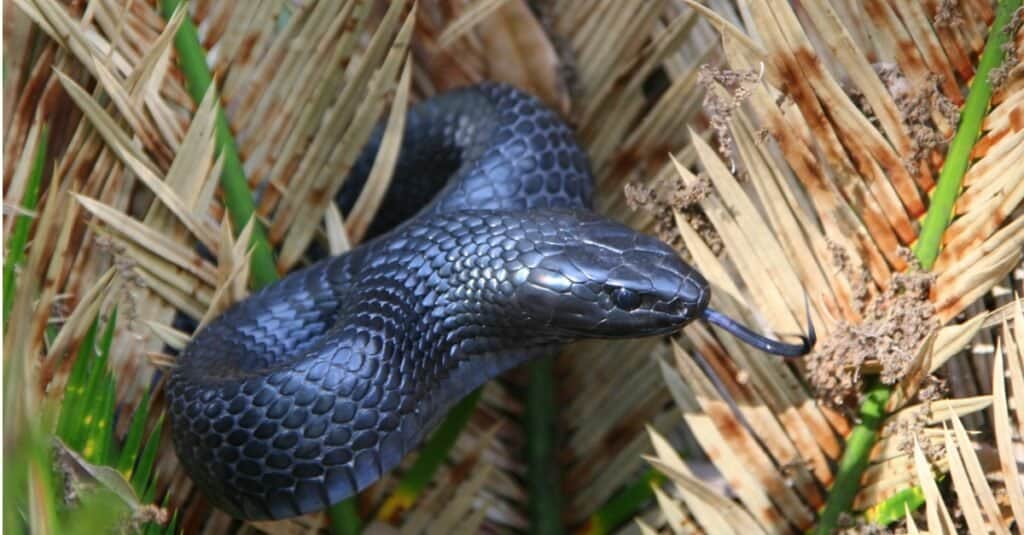
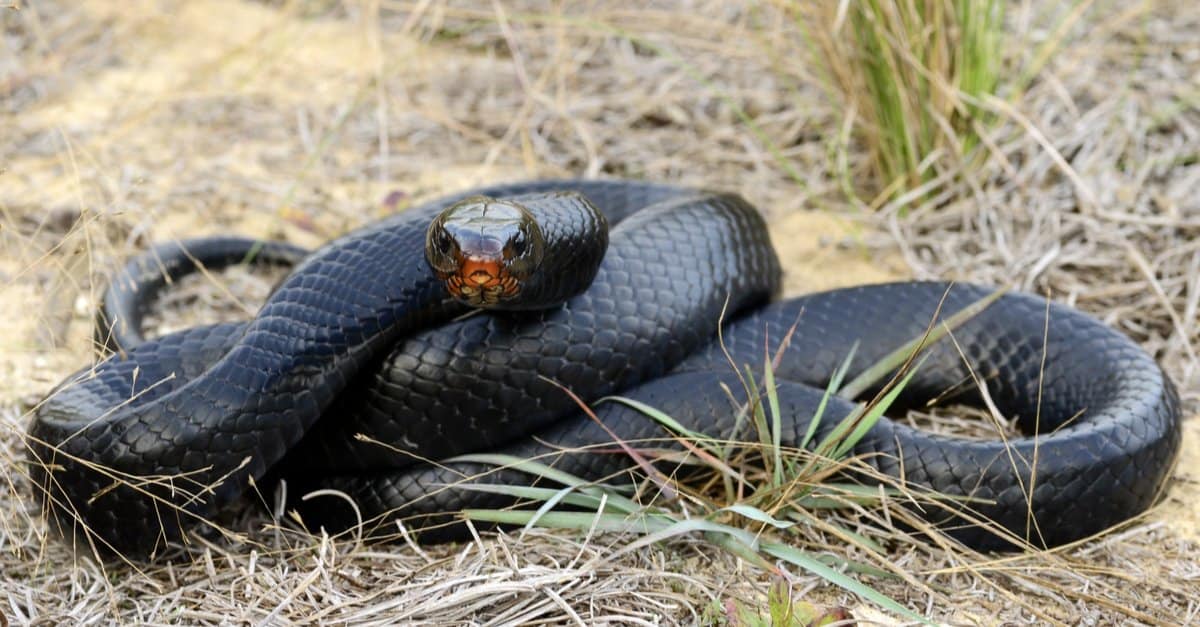
The eastern indigo snake is a large, non-venomous snake native to the Eastern United States.
©iStock.com/sstaton
Appearance: Long, large-bodied snakes. Glossy black with smooth scales. May have a reddish or orange marking on the chin and throat that extends down the body. Round pupils. Most snakes are between 5 and 7 feet, but some large males can reach over 8 feet in length.
Distribution: Most of Florida. May still be present in the Florida Keys, but sightings are rare.
Habitat: Forests, pine stands, prairies, coastal dunes, cypress ponds, freshwater marshes, and more. Frequently around water.
Eastern Hognose
The eastern hognose (Heterodon platirhinos) is famous for faking its own death when threatened, in the hopes of dissuading potential predators. They typically roll over onto their backs and pretend to convulse. They may also vomit, defecate, and emit a foul-smelling odor from the cloacal glands in the base of their tail. These snakes are considered non-venomous, as they are no danger to people or pets. Their mild venom is only powerful enough to subdue small prey. These snakes are docile and typically do not even bite in self-defense.
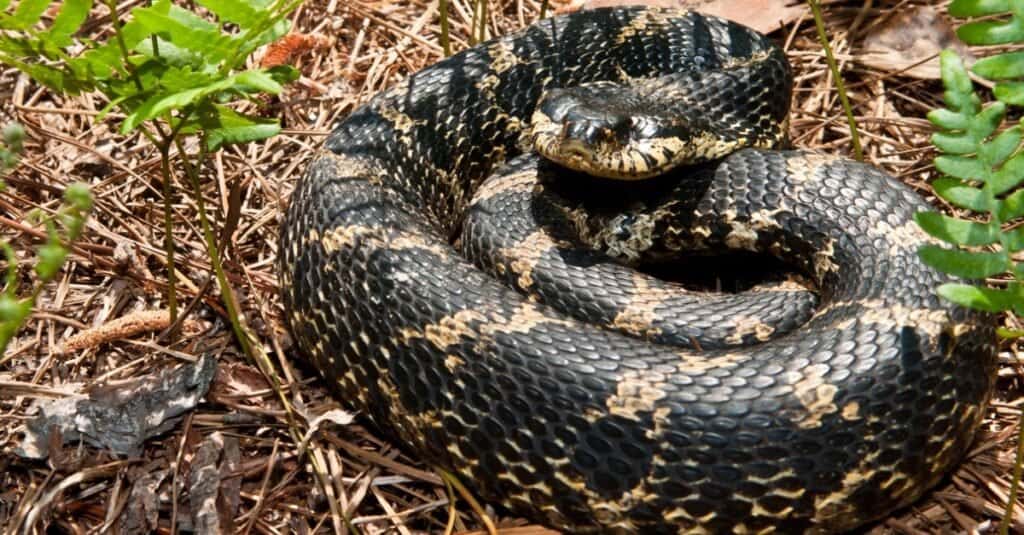
Eastern hognose snakes are famous for playing dead when threatened.
©iStock.com/JasonOndreicka
Appearance: These snakes can be a wide variety of colors with a pattern of blotches on the top and sides. However, some eastern hognose snakes may be completely black or dark gray without a pattern. They have keeled, or ridged, scales. Identifiable through their long, pointed snouts that turn slightly upward. The pupil is round. They typically measure between 1.6 to 2.75 feet long, with the longest snake on record reaching just over 4 feet.
Distribution: All of mainland Florida. They are absent from the Keys.
Habitat: Scrubland, agricultural fields, woodlands, meadows, forests, and sandhills.
Black Racer
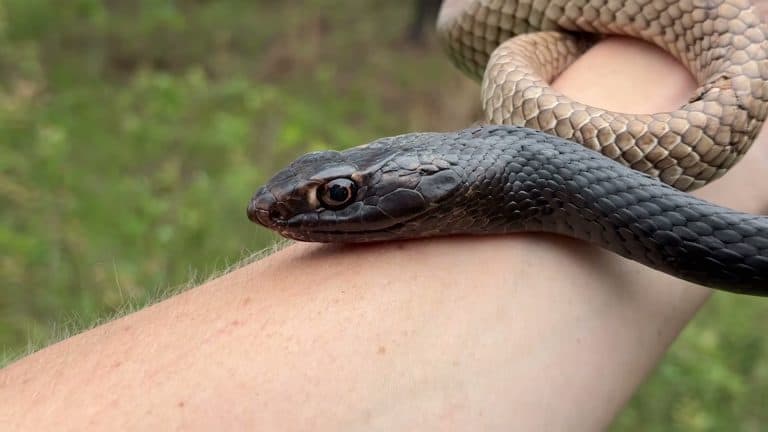
The black racer (Coluber constrictor), also called the North American racer, is one of the most common snakes in the U.S. and one of the most common black snakes in Florida. Black racers are non-venomous. They typically depend on speed and agility to avoid predators. They are not dangerous to humans or pets and would rather avoid conflict, but they will bite in self-defense.
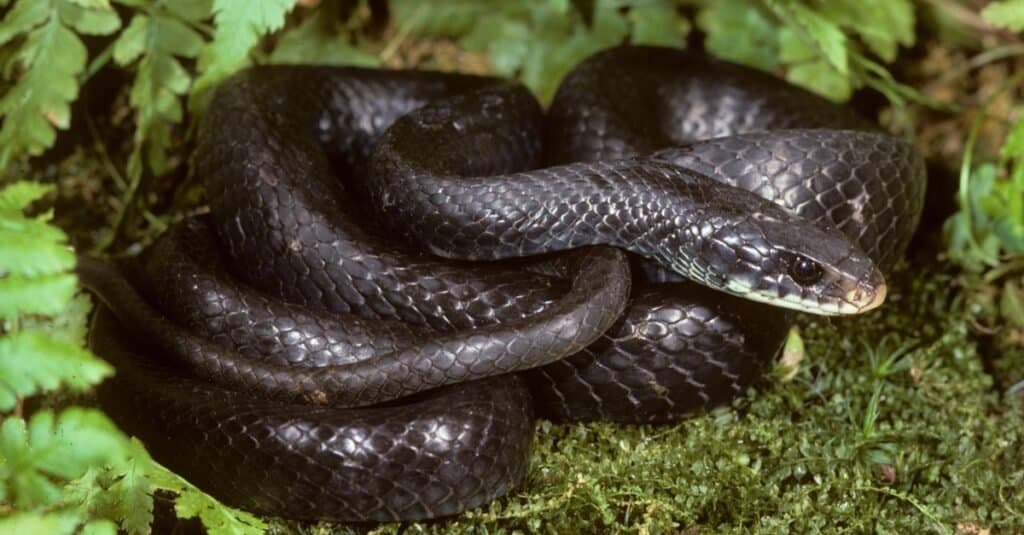
The black racer depends on its speed and agility to escape predators.
©Breck P. Kent/Shutterstock.com
Appearance: Dark grey to black or bluish-black with pale markings on the chin and throat. They are long and thin with smooth scales, small, teardrop-shaped heads, and large eyes. These snakes typically measure 1.6 feet to 4.7 feet in length, with the largest black racer on record reaching 6 feet in length.
Distribution: In every county in Florida, including the Keys.
Habitat: Forests, cypress swamps, pine flatwoods, scrub, prairies, sandhills, and suburbs.
Eastern Kingsnake
The eastern kingsnake (Lampropeltis getula) gets its name from its habit of eating other snakes, especially venomous ones. Eastern kingsnakes are believed to have the strongest constriction relative to body size of any snake in the world. They are non-venomous and are not dangerous to people or pets, although they may bite in self-defense, as well as emit a foul odor from their cloacal glands.
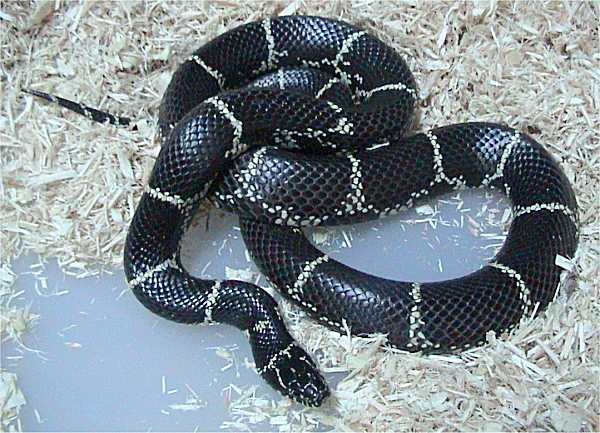
The eastern kingsnake is widely considered the strongest constrictor on Earth relative to body size.
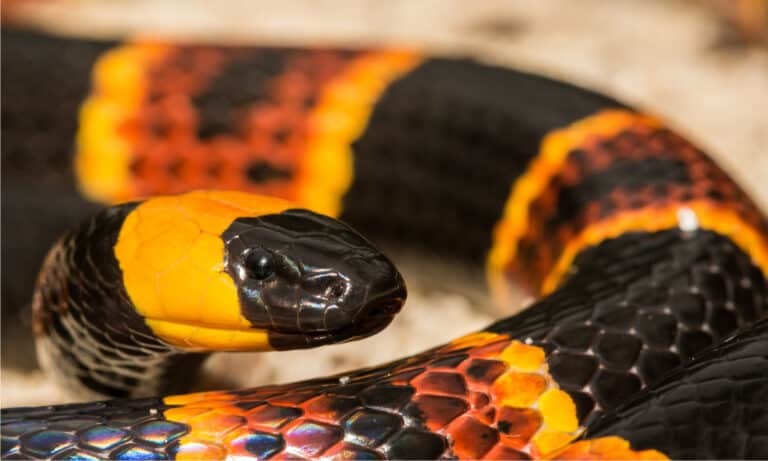
Appearance: The kingsnake can come in many colors, but dark brown to black with yellow or white bands on the back and sides is the most common color pattern. They have smooth scales and round pupils. They typically measure 3 to 4 feet in length.
Distribution: Peninsular Florida and into the panhandle. Populations are declining through most of the state.
Habitat: Pine strands, marshes, cypress strands, prairies, estuaries, and along the edges of lakes and streams. Usually found near water.
Southern Ringneck
With its contrasting colors, the southern ringneck (Diadophis punctatus) is one of the prettiest snakes in the U.S. They are non-venomous and are not a danger to people or pets. They generally do not even bite in self-defense. When caught, these snakes forcefully wiggle and release a foul-smelling odor from their cloacal glands.
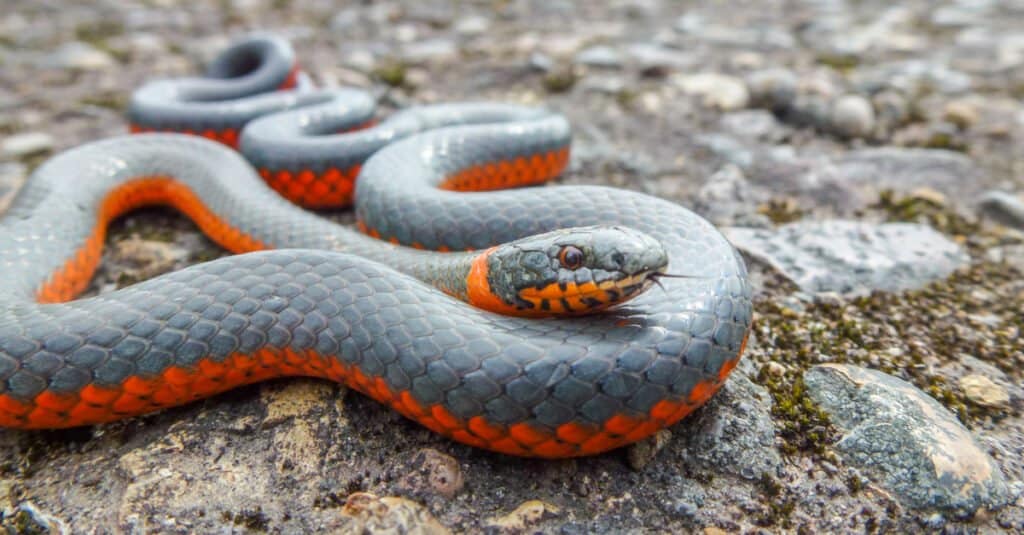
Ringneck snakes are named after the colorful collars around their necks.
©Tom Fenske/Shutterstock.com
Appearance: The ringneck snake is typically black or grey with a colorful ring around its neck. It has a vibrantly colored belly that it flashes as a defense mechanism. Ringneck snakes have smooth scales and round pupils. They are small and slim, generally only measuring from 8 to 14 inches in length.
Distribution: All of Florida, including the Keys.
Habitat: Meadows, pine forests, prairies, and fields.
Brahminy Blind Snake
The Brahminy blind snake (Indotyphlops braminus) is truly unique. Tiny and adapted to burrowing, these snakes are completely blind. Their size and appearance often result in them being mistaken for earthworms. They are non-venomous. These snakes are also a non-native species from Asia.
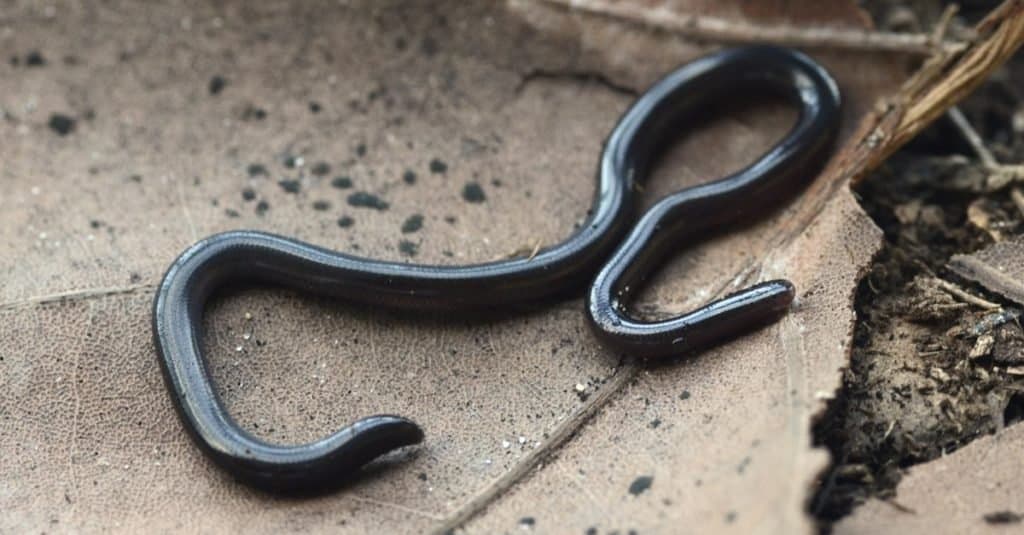
Brahminy blind snakes may get into homes by crawling under doors or through cracks.
©Patrick K. Campbell/Shutterstock.com
Appearance: Small and thin, with shiny, silvery-grey to charcoal grey coloration. No visible eyes. It has a rounded snout, but both ends are relatively blunt, giving it the appearance of an earthworm with scales. They can grow to 6.5 inches in length.
Distribution: From Key West north throughout most of peninsular Florida, with some records in the panhandle.
Habitat: These snakes frequently burrow under loose soil, leaf litter, rocks, rotting logs, or other debris.
Black Swamp Snake
The black swamp snake (Liodytes pygaea) has two subspecies in Florida, the Northern Florida swampsnake and the Southern Florida swampsnake, but both of them are shades of black. They are non-venomous and pose no danger to humans or animals. They generally do not bite in self-defense, but they may release a foul odor from their cloacal glands.
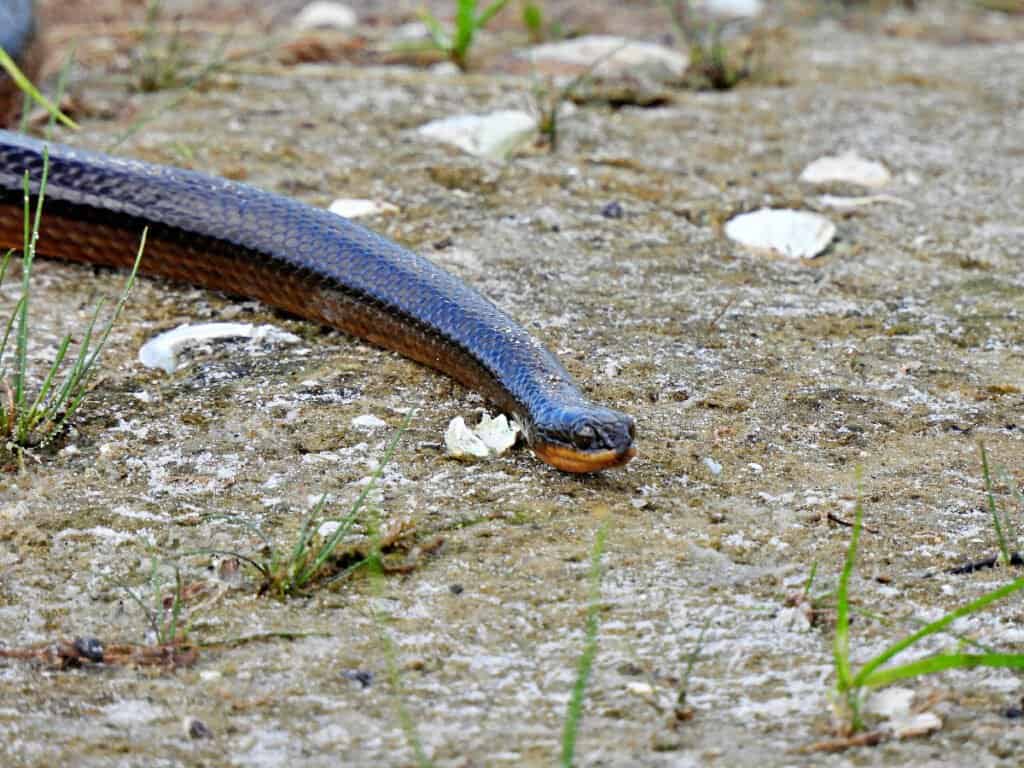
Black swamp snakes are small, glossy black snakes with vibrant bellies.
©iStock.com/passion4nature
Appearance: These snakes are glossy black with bright red or orange bellies and black markings along the edges. They have smooth scales and round pupils. These small snakes generally only measure between 10 and 15 inches in length, but the largest snake on record reached over 2 feet long.
Distribution: Almost all of mainland Florida including the Panhandle.
Habitat: As the name suggests, these snakes are primarily aquatic. They favor water sources with abundant aquatic vegetation, including cypress swamps, marshes, lakes, canals, ponds, estuaries, streams, and slow-moving rivers.
Eastern Coachwhip
Eastern coachwhips are fast and agile snakes. They are non-venomous and are not a danger to people or pets. These snakes are not aggressive, and striking is typically a last resort, but they will bite to defend themselves.
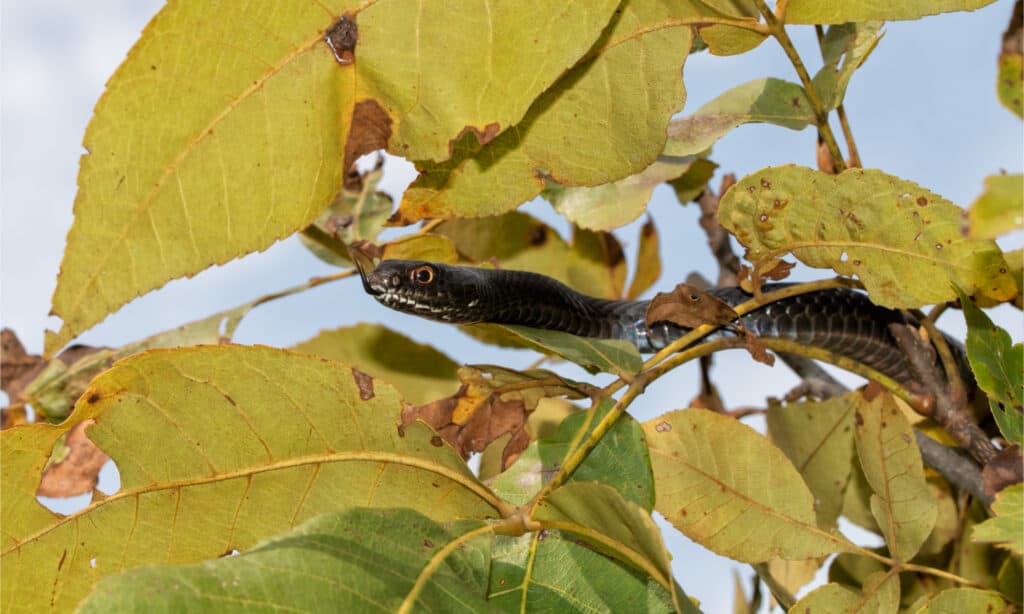
Eastern coachwhips are not exclusively arboreal, but they can climb trees in search of prey.
©Sari ONeal/Shutterstock.com
Appearance: Eastern coachwhips may be black, brown, tan, or grey. Some are solid colors, but many have darker heads with lighter bodies. They have round pupils and yellow irises. These snakes are long and thin, typically measuring between 3.5 and 5 feet in length. The longest eastern coachwhip on record measured 8.5 feet.
Distribution: Most of Florida except the Keys.
Habitat: Pine stands, sandhills, scrublands, and along beach dunes. Although they are not exclusively arboreal, they can climb trees.
Florida Cottonmouth
Florida cottonmouths (Agkistrodon conanti) are venomous, and bites may be very dangerous to humans and animals. Victims should seek immediate medical care. Cottonmouths are not aggressive snakes and would rather flee than come into contact with people. Most bites occur when the snake is intentionally provoked or has been accidentally stepped on. Cottonmouths warn intruders by coiling their bodies and opening their mouths to flash the white interior.
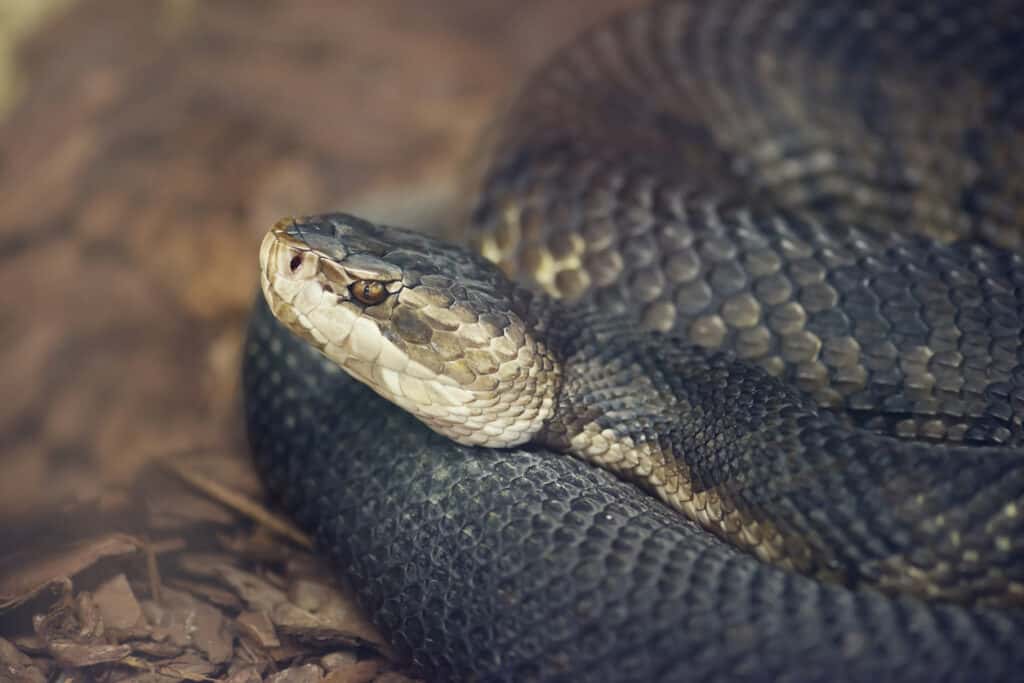
Florida cottonmouth darken with age and may appear uniformly black.
©iStock.com/Saddako
Appearance: These are heavy-bodied snakes with light to dark brown crossbands and dark spots. However, this pattern darkens over time, so adults may appear uniformly black. Cottonmouths have keeled scales and the eyes are obscured by wide, dark stripes. Their pupils are vertically elliptical like a cat’s eye. They typically measure 2.5 to 4 feet in length, but the largest cottonmouth on record measured 6.2 feet long.
Distribution: Throughout Florida. They can be found in every county, as well as the Upper Keys.
Habitat: Cottonmouths can be found in or around any waterways or wetlands.
Red-Bellied Mudsnake
The red-bellied mudsnake is easy to identify due to its unique red and black coloration. These docile snakes are nonvenomous and do not bite in self-defense, although they may bluff by striking with a closed mouth. It may also press its pointed tail against an intruder and emit a foul odor from its cloacal glands.
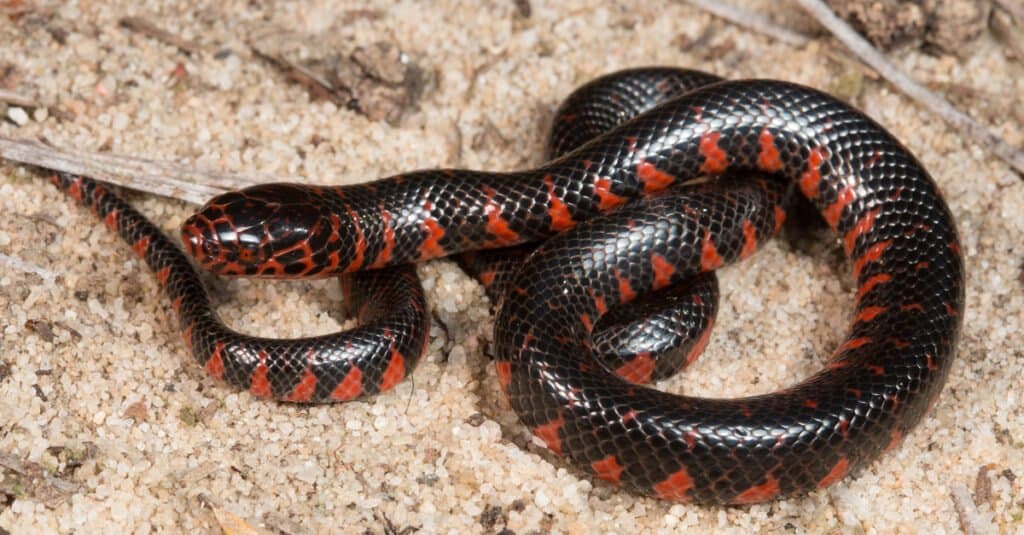
Mud snakes can have different color patterns, but they are most often black with red bellies.
©Nathan A Shepard/Shutterstock.com
Appearance: These are large, heavy-bodied snakes. They have black backs and red to pink bellies with black markings. The scales are smooth and glossy. Their pupils are round with red irises. These snakes typically measure 3.3 to 4.5 feet, with a record length of approximately 6.8 feet.
Distribution: All of Florida except the Keys.
Habitat: Swamps, marshes, drainage canals, rivers, lakes, and ponds.