


E
Species Profile

Eastern Indigo Snake

Drymarchon couperi

Iridescent hunter of the longleaf
Patrick K. Campbell/Shutterstock.com

Eastern Indigo Snake Distribution

Click a location to explore more animals from that region

Endemic Species
Loading map...
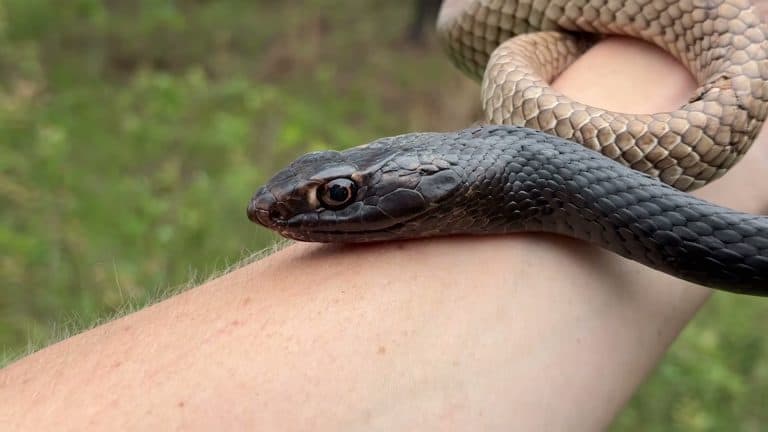
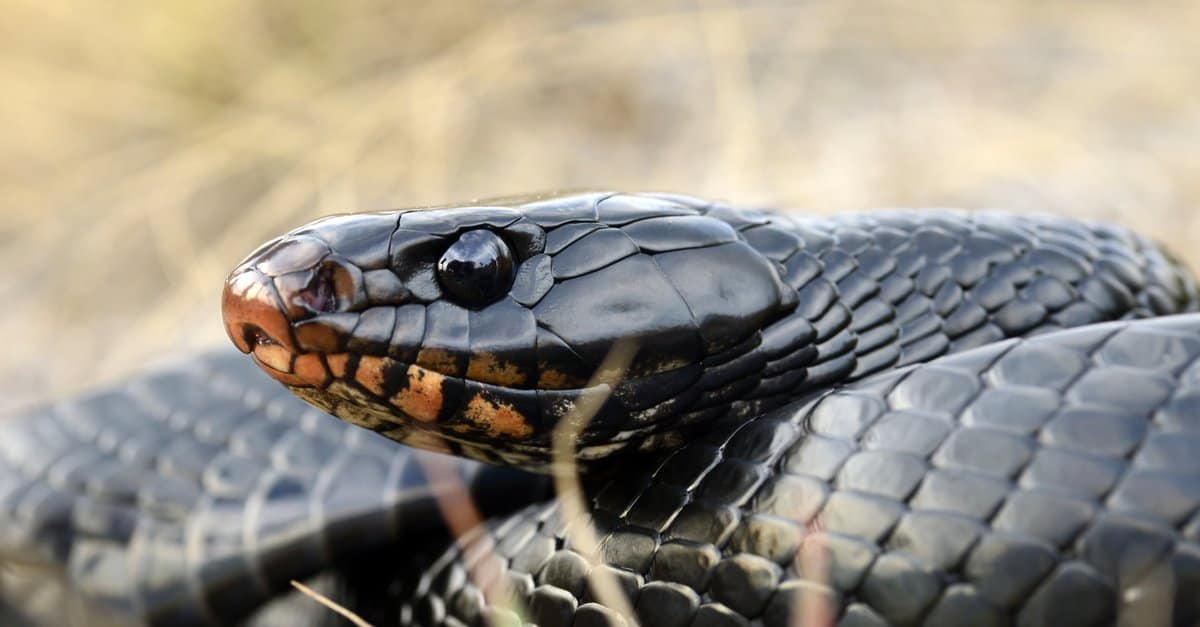
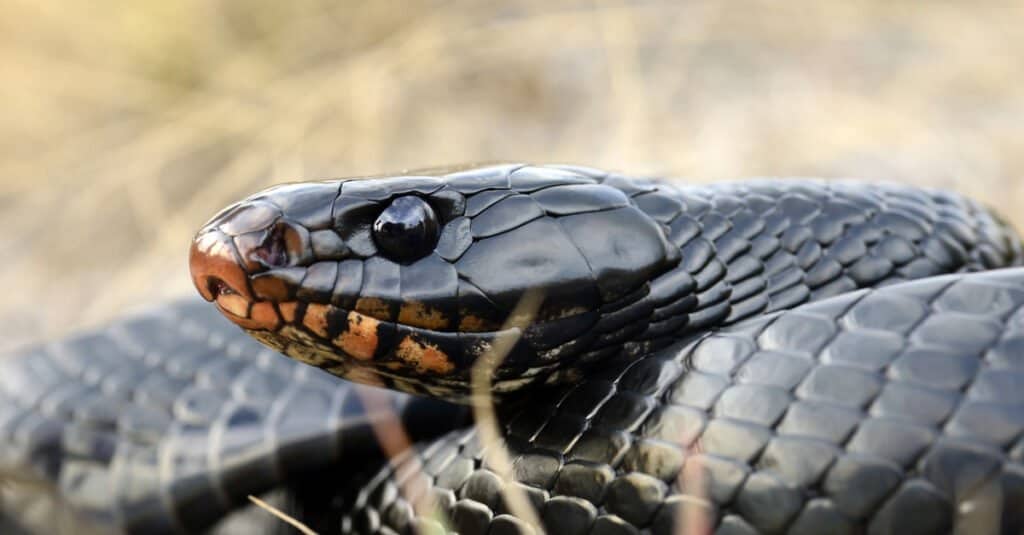
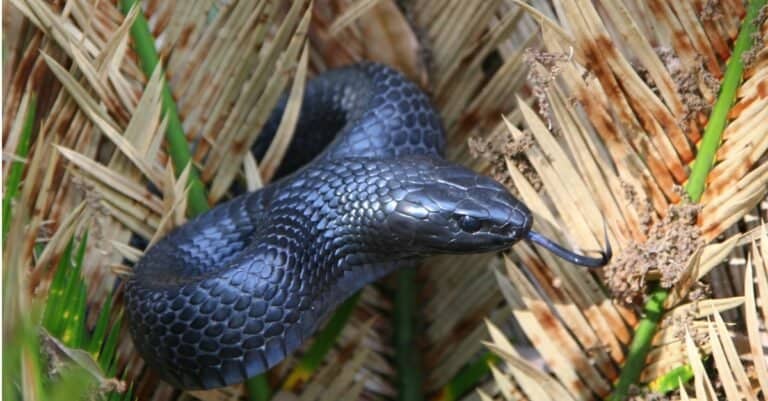
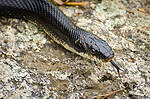
The Eastern indigo snake is a long, somewhat thin snake with large smooth blue-black scales that are iridescent purple in the light.

At a Glance

Wild Species
Also Known As Indigo snake, Indigo, Blue indigo snake, Black indigo snake
Diet Carnivore
Activity Diurnal+
Lifespan 12 years
Weight 5 lbs
Did You Know?

It is the longest native snake in North America, reaching up to about 2.6 m in total length.

Scientific Classification

A large, nonvenomous colubrid snake endemic to the southeastern United States, known for its glossy iridescent dark (blue-black) coloration and status as a threatened species. It is an active diurnal hunter that preys on a wide variety of vertebrates, including other snakes.

Kingdom
Animalia
Phylum
Chordata
Class
Reptilia
Order
Squamata
Family
Colubridae
Genus
Drymarchon
Species
couperi

Distinguishing Features

  • Large, robust-bodied snake (one of the longest native snakes in North America)
  • Glossy blue-black to black dorsum with iridescence
  • Often reddish/orange coloration on chin and throat (especially adults)
  • Nonvenomous; active, diurnal forager that may eat venomous snakes
  • Southeastern U.S. distribution (especially Florida and southern Georgia)

Physical Measurements

Males and females differ in size

Length
6 ft 7 in (3 ft 11 in – 8 ft 6 in)
5 ft 3 in (3 ft 11 in – 6 ft 7 in)
Weight
7 lbs (3 lbs – 11 lbs)
2 lbs (1 lbs – 4 lbs)
Tail Length
1 ft 2 in (10 in – 1 ft 6 in)
Top Speed
3 mph
estimated burst several km/h

Appearance

Primary Colors
Secondary Colors
Skin Type Smooth, glossy overlapping keratin scales (non-keeled); large, heavy-bodied colubrid with reflective scale surface producing iridescence.
Distinctive Features
  • Largest native snake in the United States; documented maximum total length about 262 cm (about 2.62 m), with adults commonly about 120-180 cm depending on sex and locality.
  • Head often appears slightly reddish-brown to dark, with conspicuous orange/orange-red chin and throat (key diagnostic appearance trait).
  • Robust, muscular body with a relatively large, broad head and smooth, shiny scales that give a lacquered look in the field.
  • Nonvenomous; does not have a rattle, facial pits, or specialized venom-delivery fangs (rear-fanged in the general colubrid sense is not a defining feature in this species).
  • Diurnal, active-foraging hunter; frequently seen moving during daylight in suitable habitat rather than lying coiled in ambush.
  • Southeastern U.S. endemic with core extant distribution in Florida and southern Georgia; closely associated with longleaf pine ecosystems (sandhills, pine flatwoods) and other open-canopy uplands.
  • Strong reliance on gopher tortoise (Gopherus polyphemus) burrows and similar subterranean refugia for shelter/thermoregulation, especially during winter and for avoiding fire.
  • Broad vertebrate diet that commonly includes other snakes (including venomous species), plus lizards, amphibians, birds, and small mammals-consistent with its large head and strong jaw musculature.
  • Conservation status: federally listed as Threatened in the U.S.; major threats include habitat loss/fragmentation of longleaf pine landscapes, reduction of gopher tortoise burrows, road mortality, and historical over-collection/intentional killing.

Sexual Dimorphism

Sexual dimorphism is present primarily in size and proportions: males average larger and heavier and typically have proportionally longer tails and broader heads than females (a common pattern in large colubrids, including Drymarchon couperi).

  • Typically longer maximum total length than females (males are the largest individuals in most populations).
  • Proportionally longer tail and more pronounced tail base compared with females.
  • Head often appears broader/more robust relative to body diameter.
  • Typically shorter maximum total length than males in the same populations.
  • Proportionally shorter tail and less pronounced tail base.
  • Often a slightly more slender overall build at comparable lengths.

Did You Know?

It is the longest native snake in North America, reaching up to about 2.6 m in total length.

Adults are typically ~1.5-2.1 m total length; hatchlings are roughly ~0.4-0.6 m when they emerge (field references: Stevenson et al., species monographs/field guides).

Nonvenomous and diurnal: it actively searches for prey by day rather than ambushing.

Diet is famously broad-snakes (including venomous species), lizards, frogs, birds and eggs, turtles, and small mammals have all been recorded (USFWS species accounts; Stevenson et al.).

Strongly tied to the longleaf pine-wiregrass ecosystem and commonly uses gopher tortoise (Gopherus polyphemus) burrows as critical refuges, especially in colder months (USFWS recovery/SSA documents).

Federally listed as Threatened in the U.S. (Endangered Species Act; listing effective 1978). Core remaining range is Florida and southeastern Georgia; major threats include habitat loss/fragmentation, reduced tortoise burrows, road mortality, and illegal collection (USFWS).

Unique Adaptations

  • Highly smooth, glossy scales that produce strong blue-black iridescence; many individuals show a reddish/orange wash on the chin and throat-useful for intraspecific signaling at close range.
  • Powerful, nonvenomous subduing: relies on speed, jaw strength, and holding/pressing prey rather than venom.
  • Refuge specialization: effective use of deep burrow systems (especially gopher tortoise burrows) buffers temperature extremes and predators, enabling survival in fire-maintained uplands.
  • Broad physiological/behavioral flexibility that supports a wide prey spectrum across multiple habitat types within the southeastern Coastal Plain mosaic.

Interesting Behaviors

  • Day-active, wide-ranging forager that patrols pine flatwoods, sandhills, scrub, and adjacent wetlands/edges while hunting.
  • Seasonal refuge-switching: frequently retreats into deep shelters (especially gopher tortoise burrows) during cold snaps and drought, then resumes surface activity when conditions improve.
  • Generalist predation strategy: takes diverse vertebrate prey and is well known for consuming other snakes, including large species.
  • Defensive display is typically nonlethal: loud hissing, neck/body flattening, and tail vibration; most individuals try to flee rather than bite.
  • Large-scale movements: males in particular can travel long distances across the landscape when breeding or searching for prey/refugia, making them vulnerable to roads and habitat fragmentation.

Cultural Significance

The Eastern Indigo Snake (Drymarchon couperi) is a symbol for restoring longleaf pine and the gopher tortoise burrow community. Conservation uses controlled burns, habitat links, burrow protection, and raising and reintroducing young to gain public support.

Myths & Legends

Southern rural folklore long portrayed the indigo snake as a 'protector' of people and livestock because it was believed to seek out and kill rattlesnakes near homes, barns, and hunting camps.

Across parts of Florida and Georgia, storytellers sometimes called it a 'king of snakes,' a title tied to its calm confidence, large size, and reputation for eating other snakes.

The common name 'indigo' is a cultural association with its deep, dye-like blue-black sheen-echoing the historic importance of indigo dye in the coastal Southeast's colonial-era economy and imagery.

The species name couperi commemorates James Hamilton Couper, a 19th-century Georgia naturalist/collector-an origin story reflecting early American natural history exploration in the Coastal Plain.

Conservation Status

NT Near Threatened

Likely to qualify for a threatened category in the near future.

Population Decreasing

Protected Under

  • United States: Listed as Threatened under the U.S. Endangered Species Act (ESA); take, possession, transport, and sale are regulated/prohibited except under permit (USFWS).
  • Florida: State-protected (state-listed Threatened) with prohibitions on take/harassment and protections via state wildlife regulations (FWC rules/administrative code).
  • Georgia: State-protected (state-listed Threatened) with take restrictions and permitting requirements (Georgia DNR wildlife regulations).
  • HUBS (group context): Within Drymarchon and closely similar large, wide-ranging North American colubrids, conservation status spans from Least Concern to Near Threatened/Threatened at regional scales; the most consistent pressures are habitat loss/fragmentation from urbanization and agriculture, road mortality/infrastructure expansion, and direct persecution. Notable at-risk focal taxa in the broader southeastern upland-snake assemblage include species tightly linked to longleaf pine/sandhill systems and gopher tortoise burrow landscapes, where fragmentation and altered fire regimes compound declines.

Life Cycle

Birth 8 hatchlings
Lifespan 12 years

Lifespan

In the Wild
10–15 years
In Captivity
15–25 years

Reproduction

Mating System Promiscuity
Social Structure Solitary
Breeding Pattern Transient
Fertilization Internal Fertilization
Birth Type Internal_fertilization

Eastern Indigo Snake (Drymarchon couperi) are solitary with no pair bonds. Mating is brief in winter (Nov–Apr); males search and fight. Females lay 4–12 eggs (often 8–9) Apr–Jun; ~90–110 day incubation. No care. Genetic paternity data are limited.

Behavior & Ecology

Social None (solitary species; temporary mating pair/loose refuge congregations) Group: 1
Activity Diurnal, Crepuscular
Diet Carnivore Other snakes (ophiophagy), including venomous pit vipers when encountered
Seasonal Hibernates

Temperament

Generally non-aggressive toward humans; defensive responses when threatened/handled may include loud hissing, rapid escape attempts, head/neck flattening, striking/bites, and cloacal discharge (Moler, 1992; Ernst & Ernst, 2003).
Eastern Indigo Snake (Drymarchon couperi) is an active snake that ranges widely and hunts while moving rather than ambushing, more active above ground on warm winter days and less so at midday in heat.
Eastern Indigo Snake (Drymarchon couperi) can reach about 2.62 m (262 cm) long. In captivity they can live about 20–26 years; they usually live fewer years in the wild, and wild ages are less known.

Communication

Hissing Forced exhalation; defensive
Chemosensory communication via tongue-flicking and vomeronasal Jacobson's organ) sampling of scent trails; sex pheromones are used in mate location and courtship (general squamate mechanism; documented broadly for colubrids and referenced for Drymarchon in species accounts such as Moler, 1992
Tactile signaling during courtship/copulation Body alignment, chin-rubbing/pressing, and sustained contact typical of snake mating behavior) (Moler, 1992
Male-male competitive interactions can include ritualized physical combat/over-bridging and attempts to dominate access to females Reported in Drymarchon and noted in species natural history summaries) (Ernst & Ernst, 2003; Moler, 1992
Use of shared refugia and repeated return to key shelter sites can function as indirect information transfer Others encounter residual chemical cues at refugia/burrow entrances), producing localized 'hubs' of overlap without true social cohesion (telemetry-based refuge overlap noted in field studies, e.g., Stevenson et al.

Habitat

Biomes:
Temperate Forest Savanna Wetland Freshwater
Terrain:
Coastal Plains Riverine Sandy
Elevation: Up to 492 ft 2 in

Ecological Role

Large-bodied, diurnal mesopredator/top predator in southeastern upland and xeric ecosystems; an important regulator of vertebrate prey communities and a notable predator of other snakes (including venomous species).

Population control of small vertebrates (snakes, lizards, amphibians, small mammals) Potential suppression of local abundance/encounter rates of medically significant venomous snakes via predation Supports trophic balance and biodiversity in longleaf pine-sandhill and associated habitats Indicator/umbrella value: presence often reflects intact upland habitats with functional burrow/refugia networks (e.g., gopher tortoise systems)

Diet Details

Main Prey:
Snakes Nonvenomous snakes Lizards Anurans Small mammals Birds Reptile eggs and hatchlings +1

Human Interaction

Domestication Status

Wild

Eastern Indigo Snake (Drymarchon couperi) is wild, not domesticated, and is listed as Threatened in the U.S., so people usually work to protect it. The largest native U.S. snake (up to 2.64 m), it is active by day, eats many animals, shelters in burrows, can live over 20 years in captivity, and faces killing, road deaths, habitat loss, and illegal collection.

Danger Level

Low
  • Nonvenomous; no medically significant venom risk.
  • Defensive bites can occur if handled; due to large body size (max reported 2.64 m), bites may cause lacerations and bruising.
  • Zoonotic risk typical of reptiles (e.g., Salmonella) via handling/poor hygiene.
  • Handling stress/injury risk to the snake itself is significant; improper handling and illegal collection are major conservation concerns (USFWS).

As a Pet

Not Suitable as Pet

Legality: Usually not legal as pets: Eastern Indigo Snake (Drymarchon couperi) is federally listed Threatened under the Endangered Species Act. Capture, possession, transport, and sale require permits; some institutions hold them for conservation, and Southeast laws often add protections.

Care Level: Expert Only

Purchase Cost: $1,500 - $5,000
Lifetime Cost: $12,000 - $30,000

Economic Value

Uses:
Conservation and biodiversity value (protected native species; recovery planning and habitat management funding) Research value (ecology, movement, fire-managed ecosystems, trophic interactions) Education/zoos and public outreach (permitted display animals) Ecosystem services (predation on rodents and other vertebrates; role as apex-like colubrid predator) Negative economic interactions: road mortality and development conflicts; mitigation costs (surveys, permitting, set-asides) Historical/illegal pet trade value (collection pressure; now regulated/restricted)
Products:
  • Non-consumptive value only (no legitimate commercial products); conservation program outputs such as captive-breeding/reintroduction stock under permit

Relationships

Predators 8

Related Species 5

Black-tailed Cribo Drymarchon melanurus Shared Genus
Common Cribo Drymarchon corais Shared Genus
Common Kingsnake Lampropeltis getula Shared Family
Eastern Ratsnake
Eastern Ratsnake Pantherophis alleghaniensis Shared Family
Eastern Hognose Snake
Eastern Hognose Snake Heterodon platirhinos Shared Family

Ecological Equivalents 6

Animals that fill a similar ecological role in their ecosystem

Common Kingsnake Lampropeltis getula Large, nonvenomous constrictor (Drymarchon couperi) that often eats other snakes, including venomous species; diurnally active and roams across the southeastern U.S.; adults typically 1.2–2.0 m in length, maximum recorded 2.62 m.
Eastern Racer
Eastern Racer Coluber constrictor Shares an active, primarily diurnal foraging strategy with high movement rates and a broad diet in uplands and edge habitats; both can occupy pine flatwoods and sandhills and exploit open-canopy systems maintained by fire.
Coachwhip
Coachwhip Masticophis flagellum Ecological analogue: a fast-moving, visually oriented, diurnal predator of xeric, open habitats (sandhills, scrub, pine). It overlaps with indigo snakes in the Coastal Plain and can take similar prey (lizards, small mammals, and other reptiles).
Eastern Ratsnake Pantherophis alleghaniensis Both species share prey (birds and eggs, small mammals) and use upland forests and ecotones, often utilizing burrows. Eastern Indigo Snakes heavily use gopher tortoise burrows in some areas during cold periods, as documented by telemetry.
Eastern Diamondback Rattlesnake
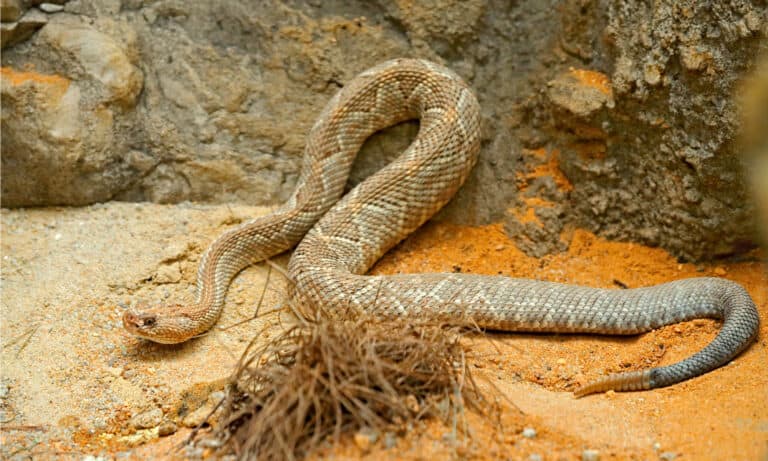
Eastern Diamondback Rattlesnake Crotalus adamanteus Shares longleaf pine–wiregrass and xeric upland habitats and uses gopher tortoise burrows. As a large predator of small mammals, it overlaps trophically with Eastern Indigo Snakes (Drymarchon couperi); indigos also eat rattlesnakes, creating both competition and predator–prey interactions.
Gopher Tortoise
Gopher Tortoise Gopherus polyphemus Not a trophic analogue but a key associate: Eastern indigo snakes (Drymarchon couperi) often use gopher tortoise burrows for shelter and overwintering, so tortoise-burrow locations shape the snakes' space use and seasonal behavior.
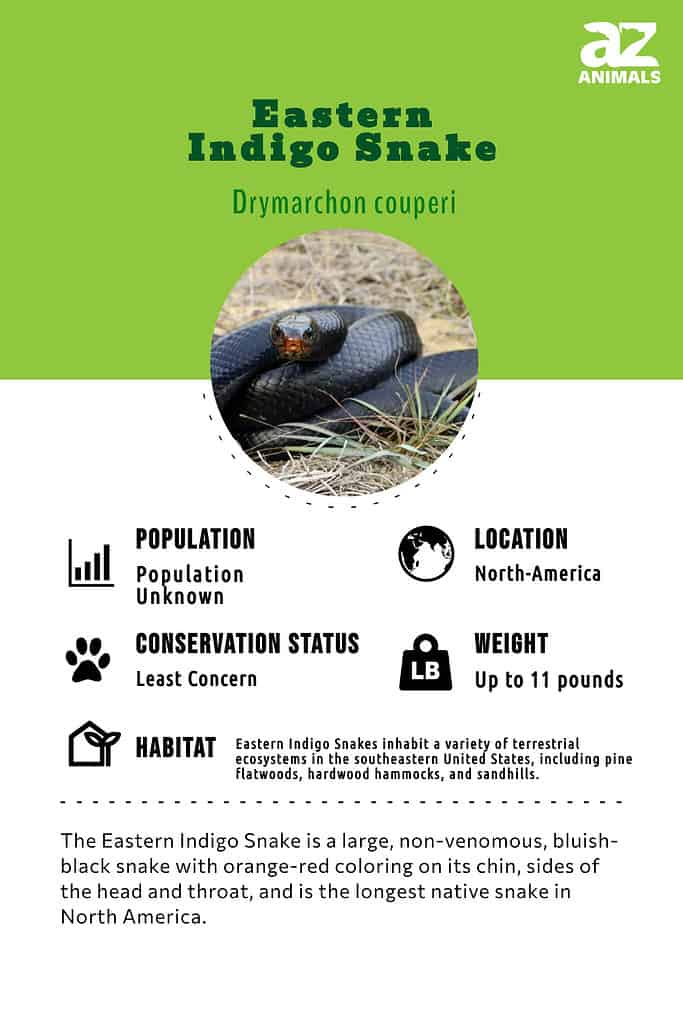
The Eastern Indigo Snake is a large, non-venomous, bluish-black snake with orange-red coloring on its chin, sides of the head and throat, and is the longest native snake in North America.

The Eastern indigo snake is a long black nonvenomous snake that inhabits the southeastern United States.

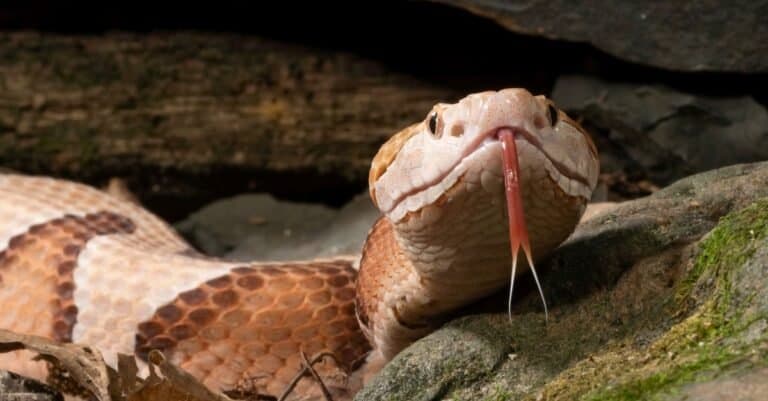
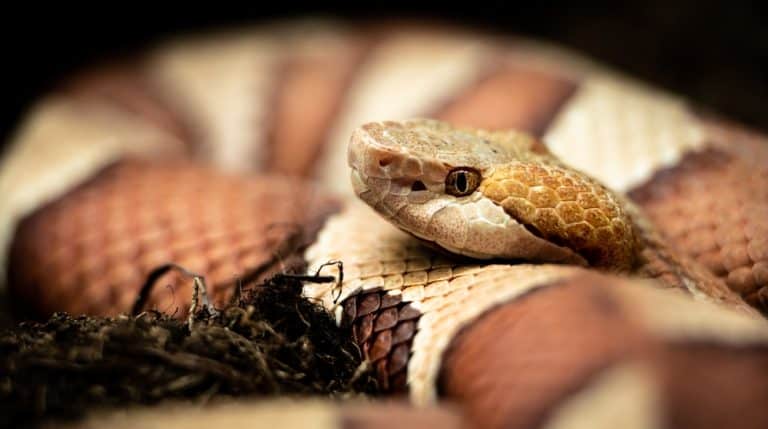
It is the longest snake native to North America and is known for chasing down its prey, including all native venomous snakes such as copperheads and rattlesnakes. This snake is not aggressive but will defend itself by biting or releasing a foul-smelling musk. Even so, it prefers to escape over confrontation with people.

A healthy population of indigo snakes in your wilderness is a sign of a healthy ecosystem. They help keep rodent and venomous snake populations balanced and may even be resistant to rattlesnake venom. Unfortunately, they are threatened, and their range is much smaller than it once was. However, several conservation organizations are working to reintroduce them to areas where they previously lived.

Eastern Indigo Snake Amazing Facts
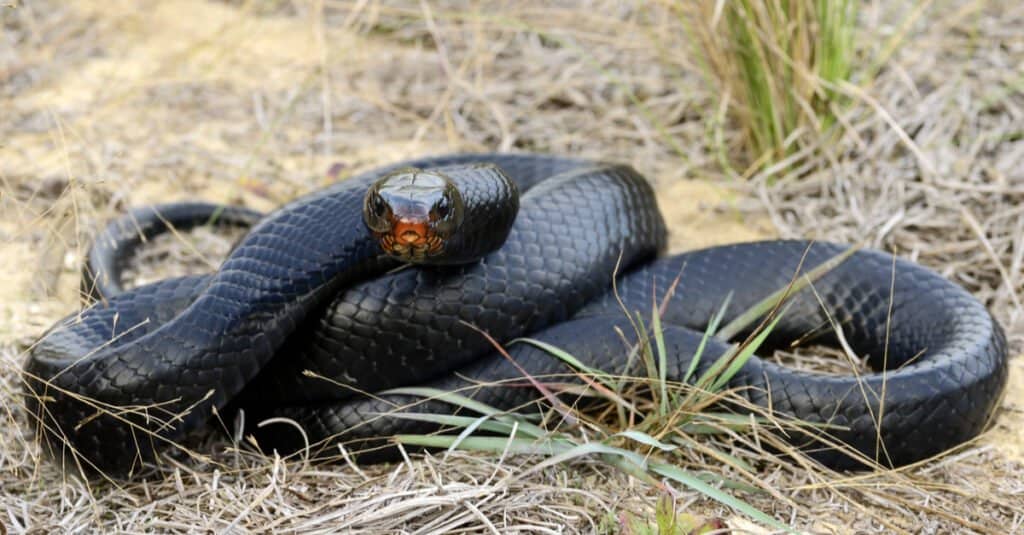
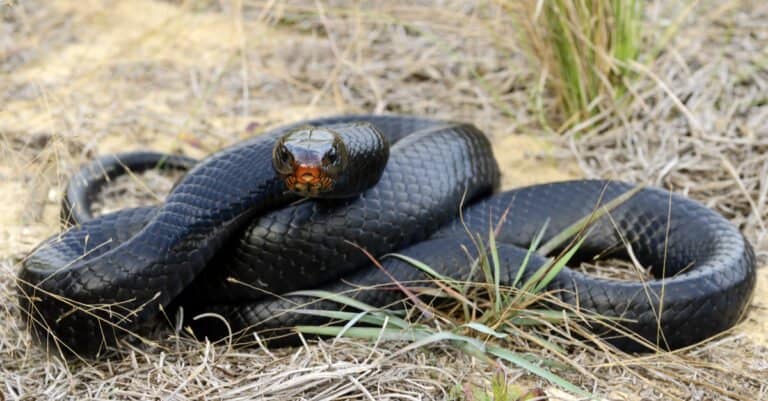
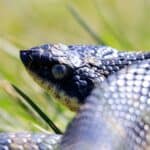
Eastern indigo snake (Drymarchon couperi) lyin in grass. The Eastern Indigo Snake is the longest snake in America.

Eastern indigo snake (Drymarchon couperi) lyin in grass. The Eastern Indigo Snake is the longest snake in America.

  • Longest snake native to North America
  • Eastern indigo snakes use brute force to subdue their prey
  • There’s evidence that they may occasionally reproduce via parthenogenesis, where embryos spontaneously develop in unfertilized eggs.
  • Regularly eat venomous snakes, including cottonmouths and copperheads
  • Biologists have observed Eastern Indigo snakes survive rattlesnake bites and believe they may be at least somewhat immune to rattlesnake venom.

Where To Find Eastern Indigo Snake

They were once widely distributed across the southeastern United States. However, habitat loss and rattlesnake collectors have reduced their range to the Florida peninsula, southeastern Mississippi, Georgia, and southern Alabama.

They prefer to live in pine and scrubby flatwoods, sandhills, the edges of marshes, pine rocklands, dry prairie, and agricultural and other human-disturbed areas. When the temperatures dip, they seek shelter underground; those in the northern reaches of their territory hide in gopher tortoise burrows where available, but hollow logs and rodent burrows are also great shelters for them.

Scientific Name

The scientific name for the Eastern indigo snake is Drymarchon couperi . Drymarchon is Greek and roughly translates to “Lord of the Forest.” This snake is a member of the colubrid family of snakes, related to kingsnakes, but unlike kingsnakes, they are not constrictors.

Evolution and Origins

The Drymarchon couperi, also known as the eastern indigo snake, belongs to the Colubridae family and is a big, harmless species of snake found in the southeastern region of the United States.

The eastern indigo snake (Drymarchon corais couperi) is a non-poisonous, black-colored, and large snake that inhabits the southeastern United States and is known to grow up to almost 9 feet long, making it the longest native snake in the country.

  • The eastern indigo is bluish-black and appears iridescent purple in the light.
  • It has orange-red coloration on the chin, sides of the head, and throat.
  • Males of this species can grow up to 7-9 feet in length, while females are slightly smaller.
  • New hatchlings are typically between 16-24 inches long.
  • The snake produces annual clutches of 6-12 eggs.
  • During warmer seasons, indigos may travel up to three miles in search of new habitats and prey.

Types of Indigo Snakes

Until recently, all indigo snakes were classified as subspecies of Drymarchon corais, but genetic research revealed that there are five separate species.

Three of them occur in North America:

  • D. melanurus erebennus mainly lives in south Texas and northern Mexico. It is primarily black but has some brown speckling.
  • D. couperi lives in the southeastern United States.
  • D. kolpobasileus This newly recognized species is endemic to the gulf coast of Florida and Mississippi. It has a shorter and shallower head shape than the Eastern indigo snake.

Two indigo snake species inhabit Central and South America:

  • D. caudomaculatus lives in Venezuela and Colombia and has more brown speckling than its northern cousins
  • D. margaritae inhabits the Western Margarita Islands and Venezuela.

Population and Conservation Status
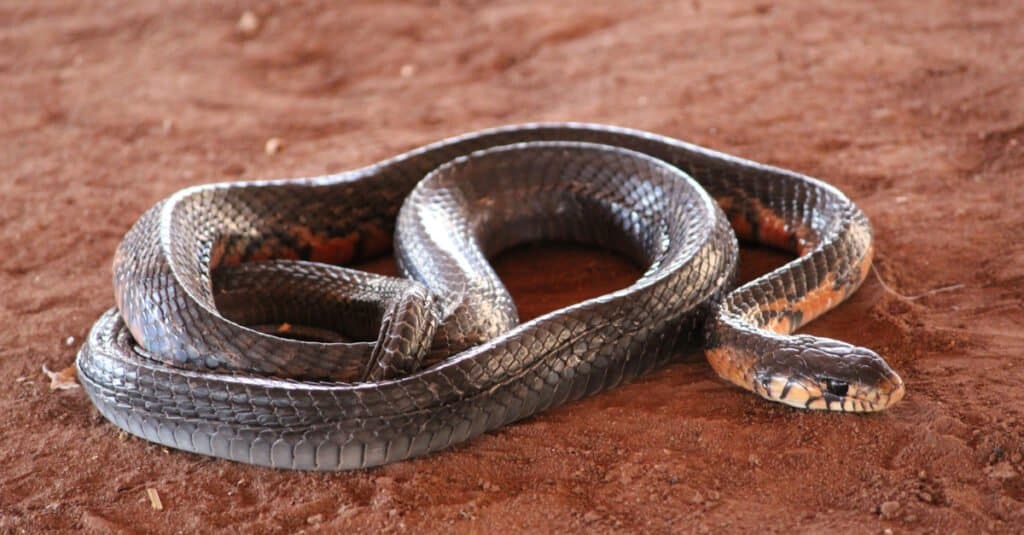
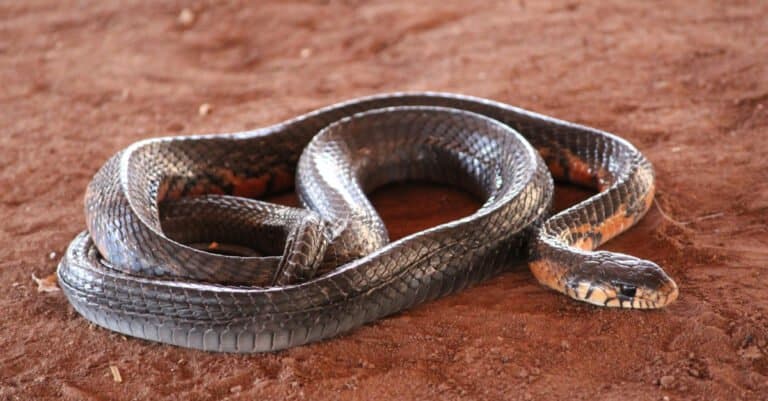
Eastern Indigo Snake lying on sand. Some of these snakes have cream or orange-red on its cheeks, chin, and throat.

Eastern Indigo snakes have cream or orange-red on their cheeks, chin, and throat.

The U.S. Fish & Wildlife Services listed Eastern Indigos as threatened in 1978, but IUCN lists them as least concerned. Indigo populations are connected to gopher tortoises and their burrows because they and other snake species such as rattlesnakes also use gopher tortoise burrows.

Rattlesnake hunters gassed burrows, where they pour gasoline into them to flush out rattlesnakes, but the practice is often fatal to all animals in the burrow. Gassing killed many animals and decimated the Eastern indigo snake and gopher tortoise populations.

Efforts are underway to help restore the Eastern indigo snake and gopher tortoise to the wild. At the Orianne Center for Indigo Conservation (OCIC), a captive breeding program released 169 eastern indigo snakes in the Conecuh National Forest in southern Alabama between 2010 and 2019, and 47 between 2017 and 2019 in the Nature Conservancy’s Apalachicola Bluffs and Ravines Preserve in the Florida Panhandle.

How To Identify Eastern Indigo Snakes: Appearance and Description
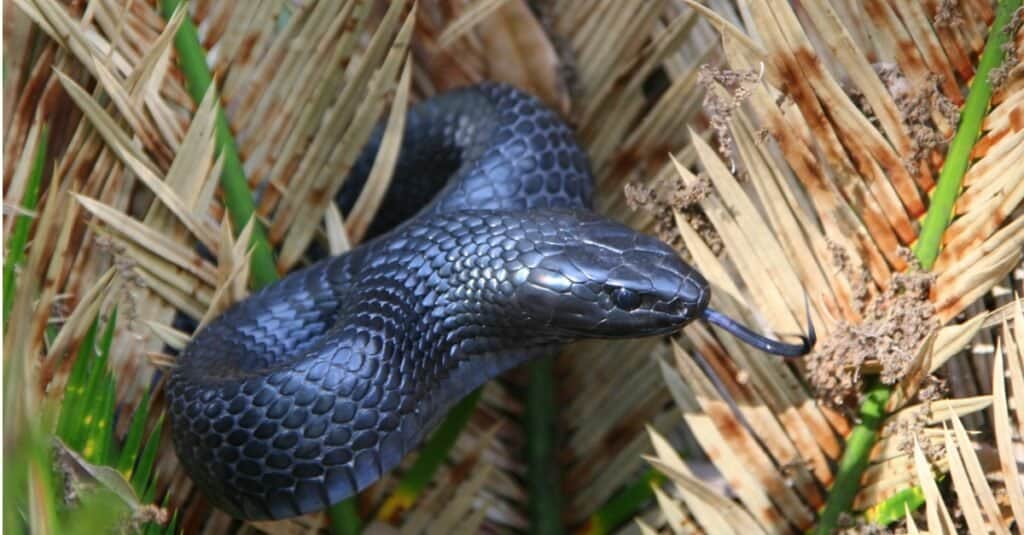
The eastern indigo snake is a large nonvenomous snake native to the Eastern United States. Its head and body are about the same size, and it doesn’t have much of a neck.

The eastern indigo snake is a large nonvenomous snake native to the Eastern United States. Its head and body are about the same size, and it doesn’t have much of a neck.

It is the longest snake native to North America, and males regularly reach 7-9 feet, females are slightly shorter, and hatchlings measure 17-24 inches long.

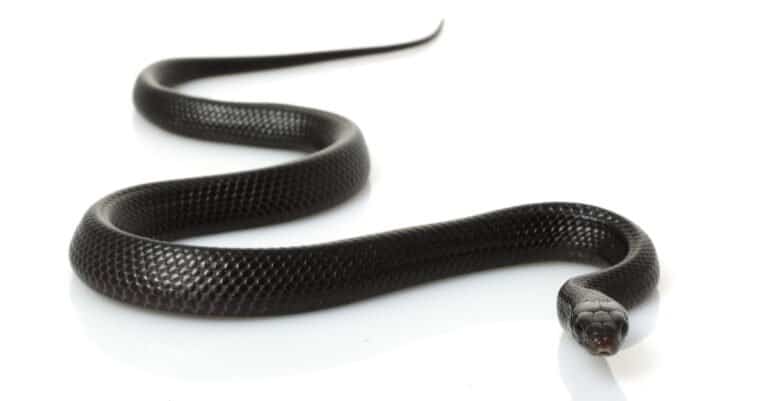
It is a long, somewhat thin snake with large smooth blue-black scales that are iridescent purple in the light; some have cream or orange-red on their cheeks, chin, and throat. Its head and body are about the same size, and it doesn’t have much of a neck.

How Dangerous Are Eastern Indigo Snakes?

Eastern indigo snakes are not dangerous to humans or pets. They tend to avoid direct contact whenever they can and are not aggressive. However, if startled they’ll bite (and they have a strong bite!) and release a foul-smelling musk from their cloaca.

Behavior and Humans

Video from ZooAmerica explaining all about Eastern Indigo Snakes.

Eastern indigos are fast-moving snakes that often chase down their prey. They are helpful snakes that help control rodent and venomous snake populations. Unlike other members of the Colubridae family, like kingsnakes, they do not constrict their prey. Instead, they suffocate it using their very strong bite and pinning it against a hard surface.

They use the burrows of other animals to thermoregulate (control their body temperature). When the winter temperatures dip too far for comfort, they hibernate in burrows to keep a little warmer; when the summer is too hot, they go underground to cool off a bit.

It’s the beauty of underground burrows – they maintain a more stable temperature all year long allowing ectothermic reptiles like eastern indigo snakes to control their body temperature.

Similar Animals

View all 185 animals that start with E

Sources

  1. Everglades / Accessed February 15, 2022
  2. Smithsonian's National Zoo & Conservation Biology Institute / Accessed February 15, 2022
  3. Central Florida Zoo & Botanical Gardens / Accessed February 15, 2022
  4. The Nature Conservancy / Accessed February 15, 2022
  5. National Library of Medicine / Accessed February 15, 2022
  6. IUCN / Accessed February 15, 2022
Gail Baker Nelson

About the Author

Gail Baker Nelson

Gail Baker Nelson is a writer at A-Z Animals where she focuses on reptiles and dogs. Gail has been writing for over a decade and uses her experience training her dogs and keeping toads, lizards, and snakes in her work. A resident of Texas, Gail loves working with her three dogs and caring for her cat, and pet ball python.
Connect:

Thank you for reading! Have some feedback for us?


Eastern Indigo Snake FAQs (Frequently Asked Questions)

No, and they are not dangerous to people or pets.