Quick Take
- One of these spiders hunts prey you'd never expect from an arachnid, including tadpoles and small fish. Meet the fishing spider →
- Not all black and white spiders look like spiders. One has a body shape so bizarre it barely resembles an arachnid at all. See its bizarre body shape →
- One species on this list carries venom, bites, and still poses virtually no threat, and the reason why is more interesting than you'd think. Understand its weak venom →
- The smallest spider here fits on a fingernail, but its hunting strategy rivals spiders three times its size. Discover its hunting strategy →
Spiders come in many colors, shapes, and sizes. While black and white spiders may be relatively common, they have a wide variety of markings that make them unique. For example, some spiders are black with white stripes, while others are white with black spots or other markings. Keep reading to learn more about 6 different types of black and white spiders, including their exact color patterns, where they can be found, and whether or not they are dangerous.
1. Zebra Jumping Spider
Zebra jumping spiders (Salticus scenicus) are one of the most popular black and white spiders in the world. You can find them in Europe, North America, and North Asia. Zebra jumping spiders live in sunny open habitats and are also sometimes found on vertical spaces around homes. As their name suggests, zebra jumping spiders have black and white stripes across their bodies, resembling a zebra’s markings. These small spiders measure about 0.16-0.25 inches in length. Females are typically larger and may have lighter markings, but males have longer mouthparts. These spiders are non-aggressive, and their fangs are too small to be harmful to humans.

Zebra jumping spiders have black and white stripes said to resemble the well-known equine.
©Rabanser/Shutterstock.com
2. Spiny-Backed Orb Weaver
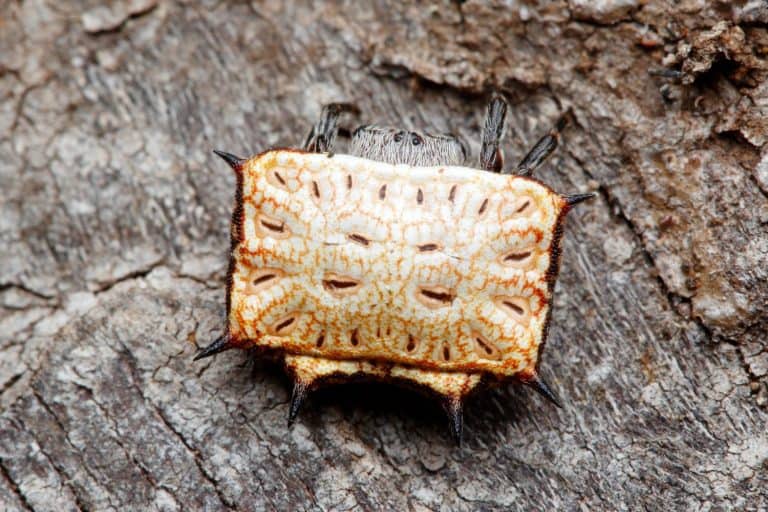
The spiny-backed orb weaver (Gasteracantha cancriformis) may also be black and white. They are easy to spot and identify because of their unique shape. These small spiders are can reach 0.33 inches in length and 0.5 inches in width, with males being smaller than females. They have six spiny or pointy abdominal projections on their abdomens. These spiders usually have a black carapace, legs, and undersides with white spots under the abdomen. Their dorsal side can be white, red, orange, or yellow with black spots. They favor shrubby areas and woodland edges from the southern U.S. through Central and South America, as well as the Caribbean. They are docile and rarely bite, but if they do, they are harmless.

Spiny-backed orb weavers are recognized by their unique abdominal spines.
©Vinicius R. Souza/Shutterstock.com
3. Spined Micrathena
The spined micrathena (Micrathena gracilis) is also known as the castle back orb weaver. These spiders are native to North and Central America. In the U.S., they are found in a variety of wooded locations in most states east of the Rocky Mountains. They weave large, tight, stunning webs. Most spined micrathenas have black and white bodies. These spiders have five pairs of black cone spines protruding from their abdomens. They are very small, with females only reaching 0.39 inches, while males only measure up to approximately 0.20 inches. These spiders are not dangerous to humans.

The spined micrathena has five pairs of spines protruding from its abdomen.
©Wirestock Creators/Shutterstock.com
4. Bold Jumping Spider
The bold jumping spider (Phidippus audax) is found in North America from southeastern Canada down to northern Mexico. They favor grasslands, open woodlands, prairies, and agricultural lands. It is a hairy black spider with white or yellow spots on top of its abdomen. In adults, the legs and pedipalps are banded with white or silver. These spiders also have greenish-blue metallic chelicerae (mouthparts). They measure from around 0.24 inches to 0.59 inches, with males being smaller than females. Bold jumping spiders are generally curious and shy. They rarely bite and are not harmful to humans.

The bold jumping spider has metallic, greenish-blue chelicerae.
©iStock.com/JWJarrett
5. White-Banded Fishing Spider
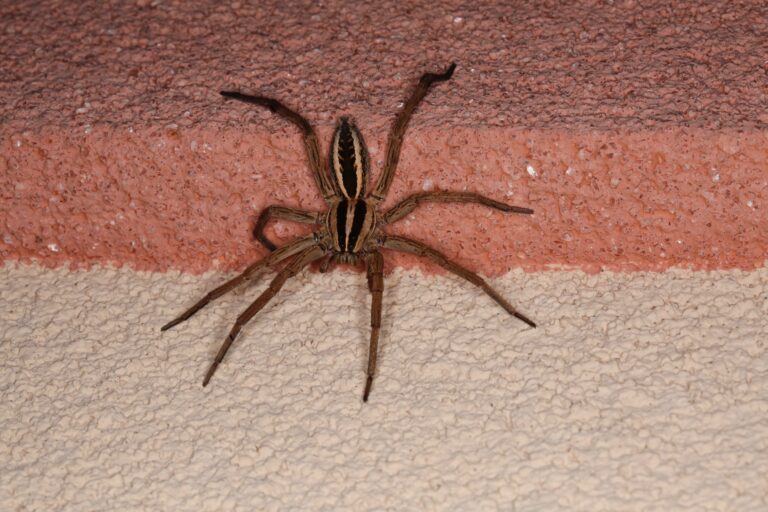
White-banded fishing spiders (Dolomedes albineus) have variable colors. Some can be white with black, geometric markings and pale bristly hairs. They also usually have a white band along the front edge of the face, and some may have a white carapace. They measure up to approximately 0.88 in body length with a leg span of 2-3 inches. These spiders are semi-aquatic, and they are often found away from water, on vertical surfaces such as trees and walls. They are found in the eastern U.S., particularly favoring the warm, humid conditions of the Southeast. Fishing spiders do have fangs and venom, but it is weak venom meant to paralyze insects, tadpoles, and small fish. Bites are accidental, and symptoms are mild and localized.
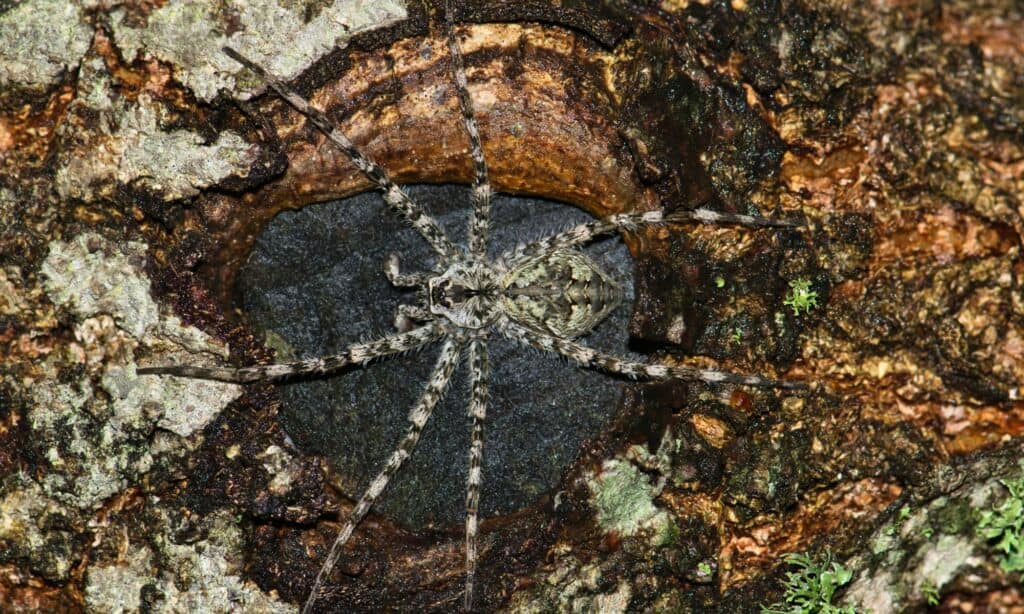
White-banded fishing spiders favor the warm, humid climate of the American Southeast.
©iStock.com/Brett_Hondow
6. Regal Jumping Spider
The regal jumping spider (Phidippus regius) is the largest jumping spider species in eastern North America. These spiders are arboreal, so they prefer vertical spaces. They can be found in woodlands, open fields, and on building walls in the Southeastern U.S., the Bahamas, Bermuda, and the Greater Antilles. Males are mostly black with white markings on the abdomen and black-and-white leg fringes, while females are more variable in color. Regal jumping spiders measure up to 0.88 inches for females and 0.75 inches for males. They are typically docile and curious. Bites are rare and pose no danger to humans.
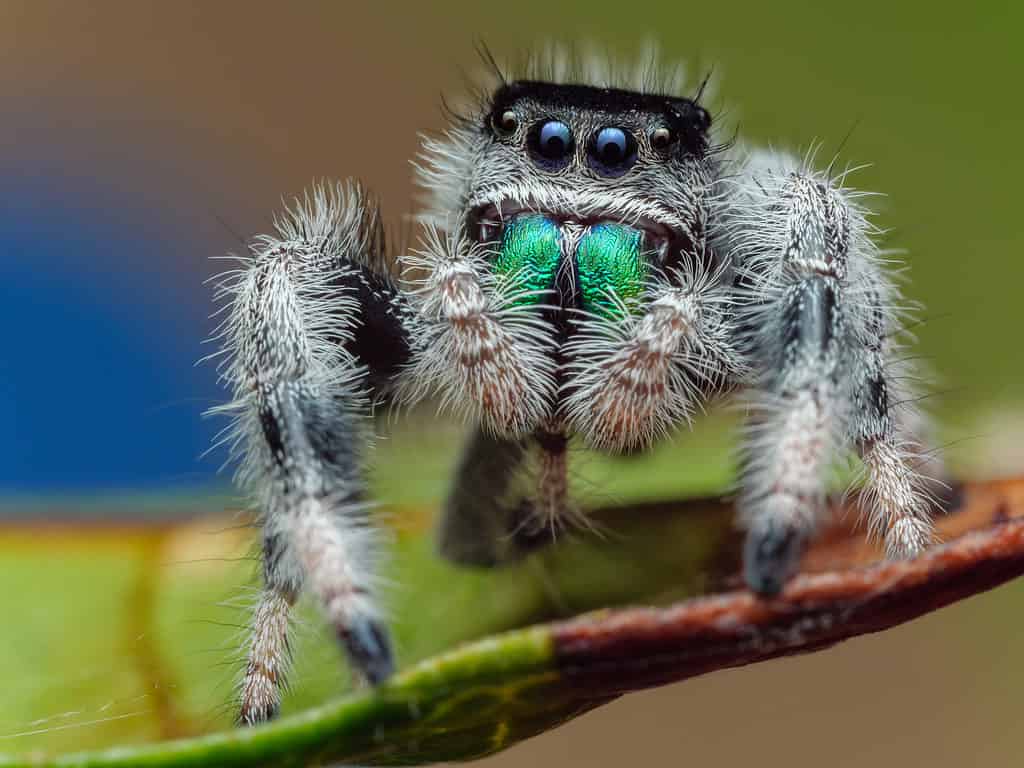
In the U.S., regal jumping spiders are primarily found in the Southeast.
©iStock.com/Macrolife.it