Quick Take
- Crushing a black widow egg sac seems like the safest move, though doing so could make your situation dramatically worse. Safer removal methods →
- Black widow eggs and trapped prey look similar in a web, so here is how to tell them apart before you get too close. Spot the egg sacs →
- One common household habit unintentionally makes your home far more attractive to black widows than they'd otherwise find it. Habits that attract them →
- Not all spider egg sacs in your home deserve the same reaction, so misidentifying one could cost you a useful ally.
For some people, the sight of a spider egg sac is incredibly unsettling. They may be tempted to immediately destroy or remove it from the home, assuming that the progeny that emerges will be dangerous. In many cases, however, this is not true. Many species of spiders are beneficial to have in the home and help control pest insect populations. The presence of their eggs in the home simply assures that these friendly arachnids will lend you a hand for another generation. In the case of black widow spider eggs, however, concern may be warranted.
Though they will not bite unless harassed, accidental contact with a female black widow spider can be harmful, especially to small children and the elderly. Black widow spiderlings are venomous, but they are too small to break human skin. The eggs themselves are harmless if accidentally touched or ingested, though they should still be removed carefully to avoid spreading spiderlings indoors. In this article, we’ll discuss where you might find black widow spider eggs, as well as the mother spider. We’ll also discuss how to identify a black widow egg sac and how to safely and carefully remove it from the home.
Where You Might Find Black Widow Spiders
Black widow spiders prefer to live outside. They live near the ground in woodpiles, mulch, hollow logs, bushes, and even rodent burrows. They also favor cracks, holes, and crevices in human structures. You may also find black widows in sheds, storage areas, garages, basements, attics, crawl spaces, or other little-used places. However, they rarely come inside homes unless by accident, such as when carrying in wood, as there is typically not enough prey.
There are several species of black widow that are common in the U.S. Western black widows (Latrodectus hesperus) are found across the western half of the U.S. Southern black widows (Latrodectus mactans) are more common throughout the southern and southeastern states, as well as the Gulf region and the mid-Atlantic. Northern black widows (Latrodectus variolus) are primarily found across the eastern U.S., ranging from southeastern Canada south to northern Florida and west to eastern Texas, Oklahoma, and Kansas.
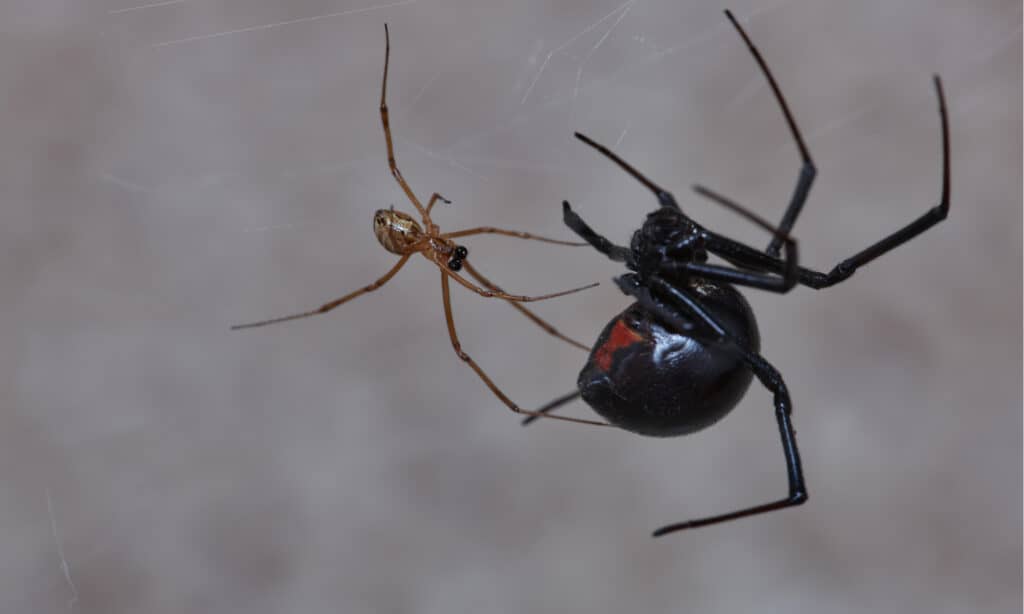
Male black widows are considerably smaller than females and do not bite.
©lighTTrace Studio/Shutterstock.com
Identifying a Black Widow
Black widows are generally easy to identify by their glossy, black bodies and, in the case of adult females, bright red or orange hourglass-shaped abdominal markings. In some cases, however, this marking may deviate from its usual shape. Though it will still be red or orange, it may appear as a pair of spots or as a simple rectangle. Regardless of the shape of the marking, these spiders are easy to identify by their shiny, black coloration and exceptionally large abdomens. Male black widows are much smaller than females and barely resemble them at all. They do not feature hourglass markings and seldom appear where humans catch sight of them. Male black widows do not bite.
If you come across a female black widow in her web, there is a chance that you may also encounter her eggs. While these spiders are not aggressive, they do tend to be more defensive, and therefore more likely to bite, in the presence of their eggs. Yet how can you differentiate between an egg sac and a neatly packaged insect meal? Or what if there is no spider in the web to tip you off?
How to Identify Black Widow Spider Eggs
Black widow eggs appear in the mother spider’s web, but not out in the open. The eggs rest safely within an egg sac, protected from the outside world. At a glance, this structure is easy to identify. It is smooth, papery, and roughly spherical. It is typically about 0.37 to 0.5 inches across with a pale cream or light tan color. The egg sac is often suspended in the web near the female’s retreat. It has well-defined edges, as opposed to the fluffier appearance of many other spider egg sacs, and is usually roughly the size of the female’s abdomen, so smaller than the spider itself.
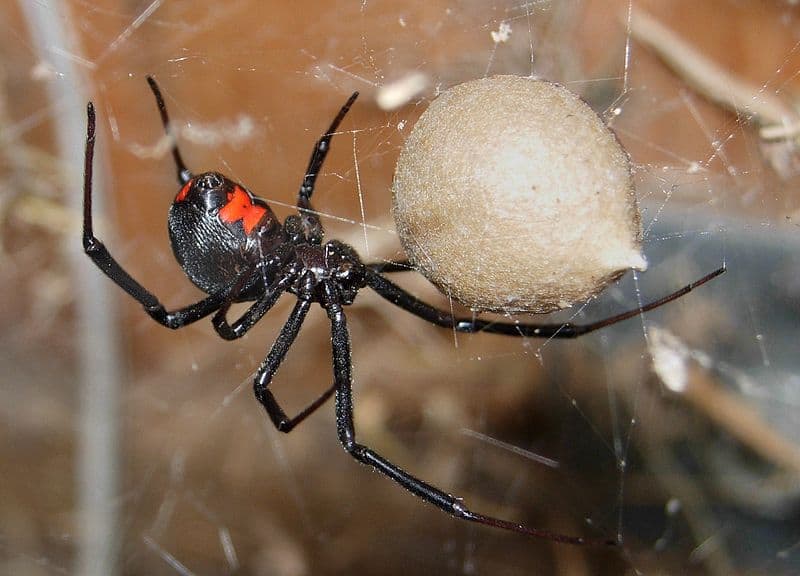
Black widow spider eggs reside in a silky, teardrop, or gourd-shaped egg sac.
©Chuck Evans(mcevan)”./ CC BY 2.5, via Wikimedia Commons – Original / License
There may be multiple egg sacs present in a single web. A single female may create several egg sacs over her lifetime, each containing up to a few hundred eggs. Spiderlings hatch within the sac after an incubation period of approximately 26 to 30 days before dispersing.
If you find a black widow in her web, then you already know that there may be spider eggs present. If there is no spider, however, take note of the characteristics of any objects in the web. Trapped prey items tend to be irregular in shape or may be incompletely wrapped, while an egg sac will be complete, generally round, and well-defined.
What Should You Do If You Find Eggs Outside?
If you find black widow spider eggs outside of the home, in a place where they are unlikely to be disturbed, it is best to leave them alone. These spiders are important members of your local ecosystem. They deserve respect and a chance to live their lives. Inside of the home, however, or in a place where the resultant spiders may cause harm to you, your pets, or your children, you will want to remove them.
How to Safely Remove Black Widow Spider Eggs from the Home
Fortunately, removing black widow spider eggs from your home is easy, and there are several ways to do so. Whichever route you choose, it’s never a bad idea to wear long-sleeved clothes and gloves to protect yourself from potential bites. This is an especially good idea in tight spaces.
Though it may be tempting, avoid breaking or crushing the egg sac. Doing so may release hundreds of immature spiderlings into your home or onto your clothes. If you own a vacuum cleaner, probably the easiest way to remove them is to simply vacuum them up. Use a hose attachment to get at the webs from a distance, making sure the remove all egg sacs present. Once you’ve secured the eggs, and maybe even the parent spider, empty them outside. Choose a location far from the home and high-traffic areas, such as a wooded or brushy spot.
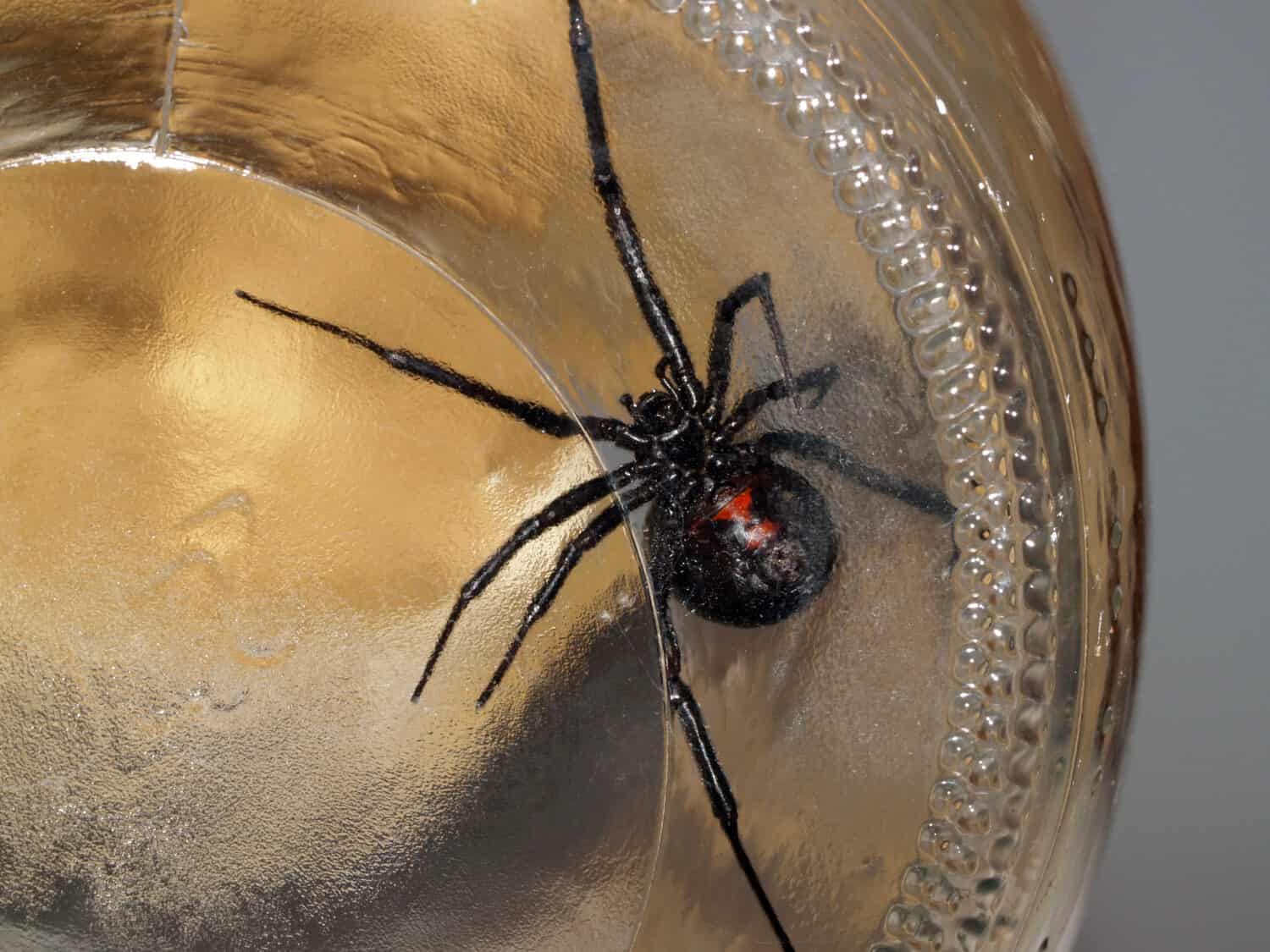
Releasing black widows and their eggs outdoors is environmentally friendly, but exercise caution.
©Jeff Cleveland/Shutterstock.com
Remember that black widows are important members of your local food web. If you or someone you know feels able to do so, a catch-and-release approach is always best. Carefully trap the parent spider and her eggs in a vessel such as a jar or box and slide a piece of paper or cardboard over the opening. Then, flip the vessel upside down so she cannot escape.
Once you’ve secured the spider and her eggs, take them outside, far from your home, and release them. This way, the residents of your home are safe from injury and the spider and her offspring can live out their lives. If you find an unusually large number of black widows in your home, you may want to contact a professional to help you deal with the problem.
How to Deter Black Widow Spiders
If you’re especially concerned about black widow spiders, there are measures you can take to deter them from the start. Often, one of the best approaches is simply to clean and use the spaces inside your home. Remember, these spiders prefer solitude and safety and avoid interaction with other animals and people. Black widows are not aggressive and would rather flee than come into contact with you. By using your spaces, you make them unappealing nesting sites for black widows.
Reducing the amount of clutter in crawlspaces, garages, and attics also reduces the number of places a spider and its prey insects can hide. This approach works outdoors as well. By reducing nesting sites within 20 feet of the home, you reduce the chances that a spider will venture indoors. If you have a small storage shed, firewood pile, or stack of building material outside, it’s a good idea to relocate it further from the home.
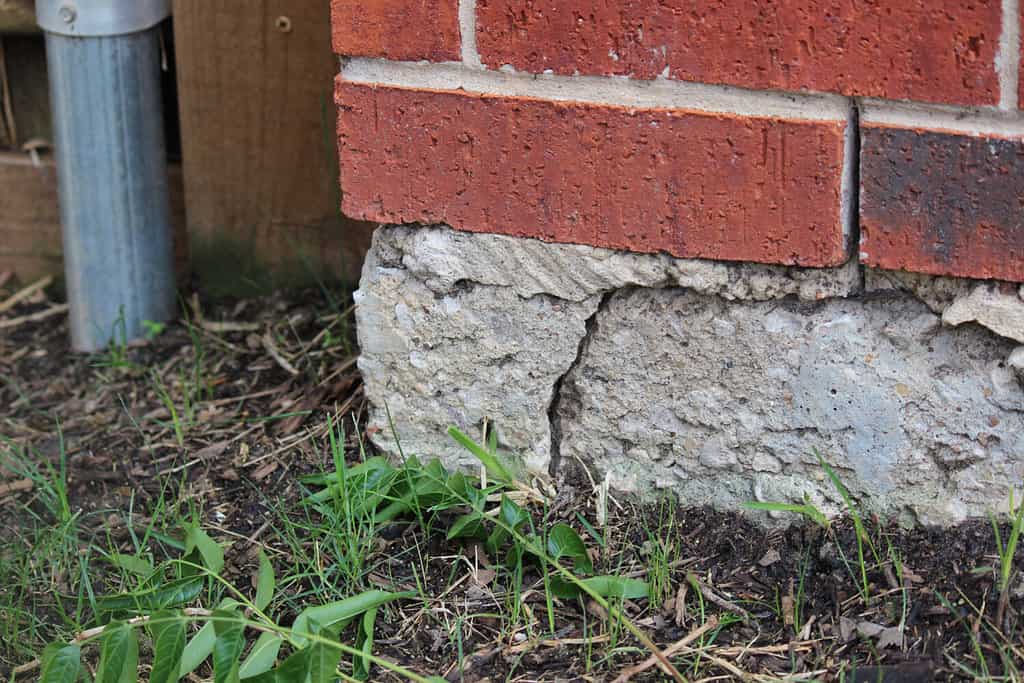
Sealing gaps and cracks in the exterior of the home can prevent spiders and their prey from entering.
©Jasmine Sahin/Shutterstock.com
Occasionally, black widow spiders make it inside via cracks and gaps in the foundation, in vents, or joist blocking, or around pipe entries. They may also enter through openings around doors and windows. It’s never a bad idea for you or a professional to check for and seal gaps like these and address any problems associated with them. With a little attention to detail, you can reduce the number of entry points for black widows and other pests.