
Quick Take
- One black widow lookalike is actually venomous enough to cause serious symptoms, and it's probably already living in your house. Meet the venomous lookalike →
- The most visually convincing black widow mimic isn't even in the same genus, a species that is spreading across multiple continents. See the spreading mimic →
- One species looks almost identical to a black widow but carries venom that's actually been neutralized by science for decades. Explore the antivenom story →
- Spotting the hourglass marking won't always save you, because some lookalikes use a different warning pattern entirely. See the orange hourglass →
Spiders come in numerous varieties, from furry tarantulas and wolf spiders to tiny jumping spiders and orb-weavers. Yet, the female black widow stands out with an appearance that very few other spiders share. She has a round, shiny, jet-black body with a bright red, hourglass-shaped mark on her lower abdomen, giving her a unique look that is hard to mistake. However, there are a few spider species that resemble the black widow. Continue reading to discover which spiders look similar to a black widow and what sets them apart.
The Black Widow
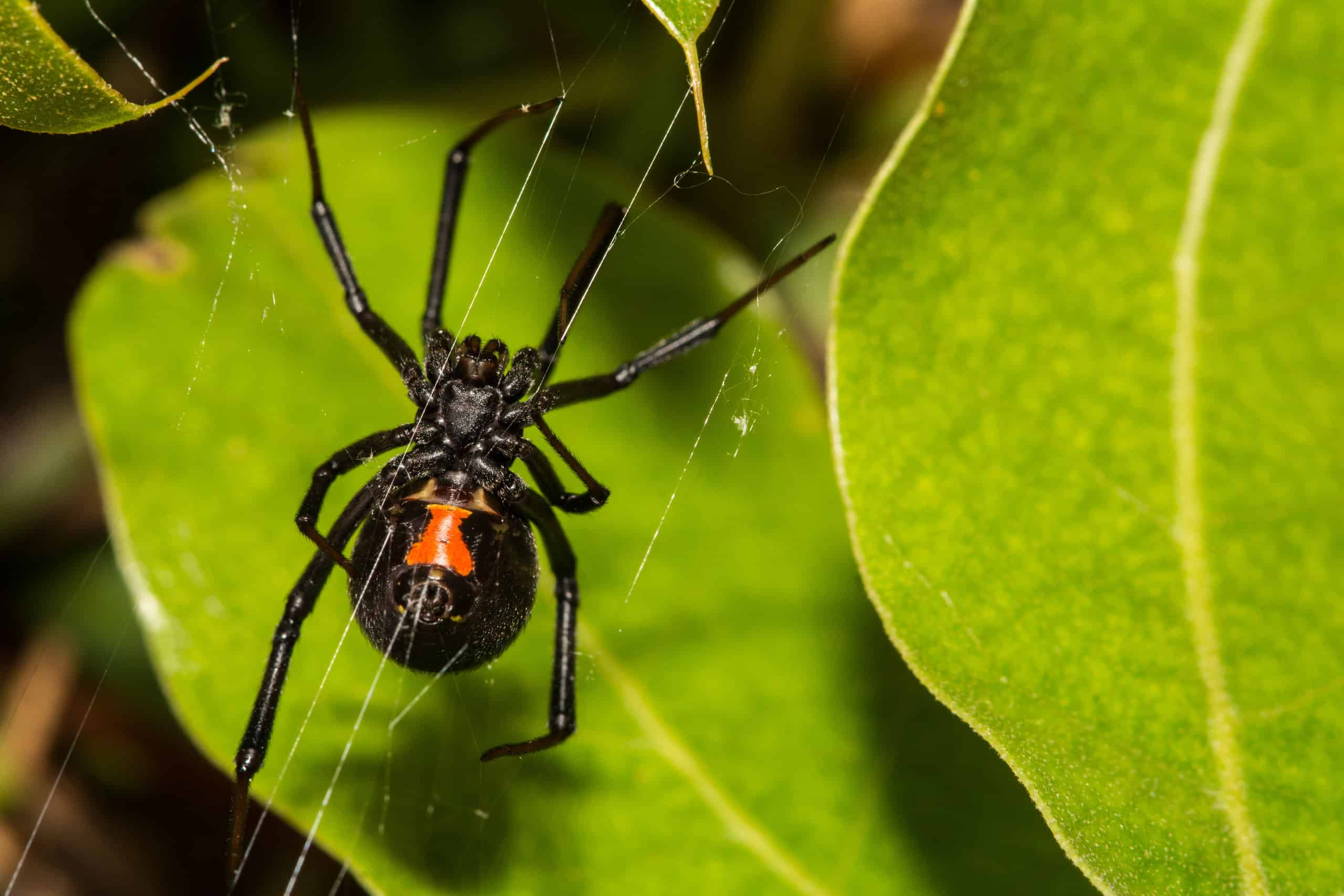
The black widow spider genus Latrodectus contains more than 30 recognized species of widow spiders. They are distributed across the globe in temperate and subtropical climates on every continent except Antarctica. There are five species of widow spiders found in North America: the Northern black widow (Latrodectus variolus), the Southern black widow (L. mactans), the Western black widow (L. hesperus), the red widow (L. bishopi), and the brown widow (L. geometricus).
All of the species within the widow genus Latrodectus possess medically significant venom, but only mature females are dangerous to humans.
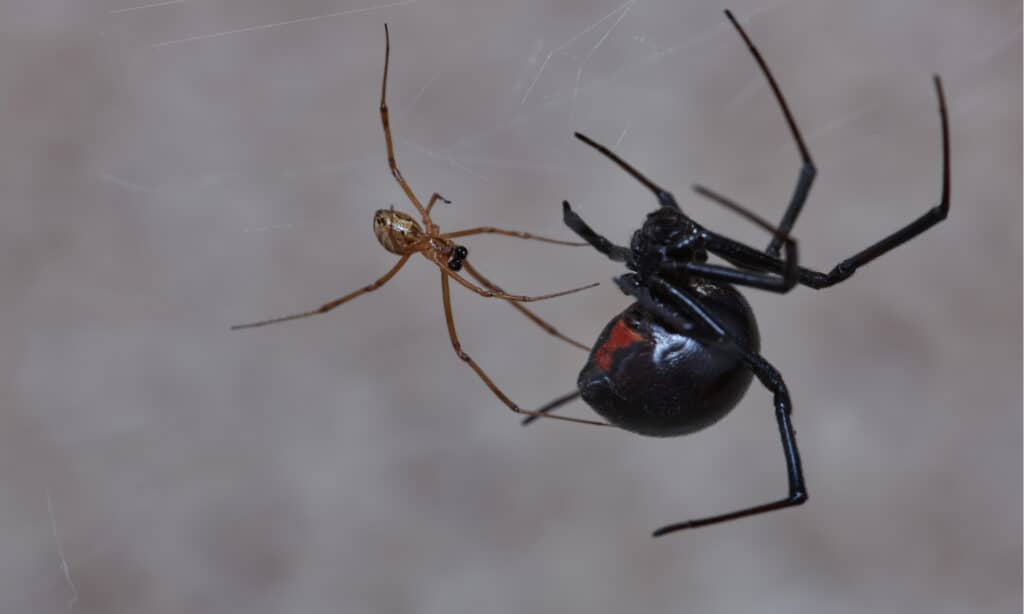
Male and female black widows look very different, and females are much easier to identify.
©lighTTrace Studio/Shutterstock.com
The female black widow spider has a glossy, bulbous abdomen and jet-black body with an average length of 0.3 to 0.5 inches and a total leg span of 1 to 1.5 inches. Her most iconic feature is the red or bright orange hourglass found on the underside of her belly. In some species, this marking may be split into two separate triangles, but it always provides a sharp contrast to her shiny, pitch-black body.
False Black Widow
The false black widow (Steatoda grossa) can be very difficult to distinguish from the true black widow spider. One indication is the shape: false black widows are much more oval in shape than round. This species is dark in color, but it is slightly more brownish than black, and the markings are not as bright as those of a black widow. Instead, they’re light yellow or grayish. These markings can look like crescents, but in many instances, they are faded.
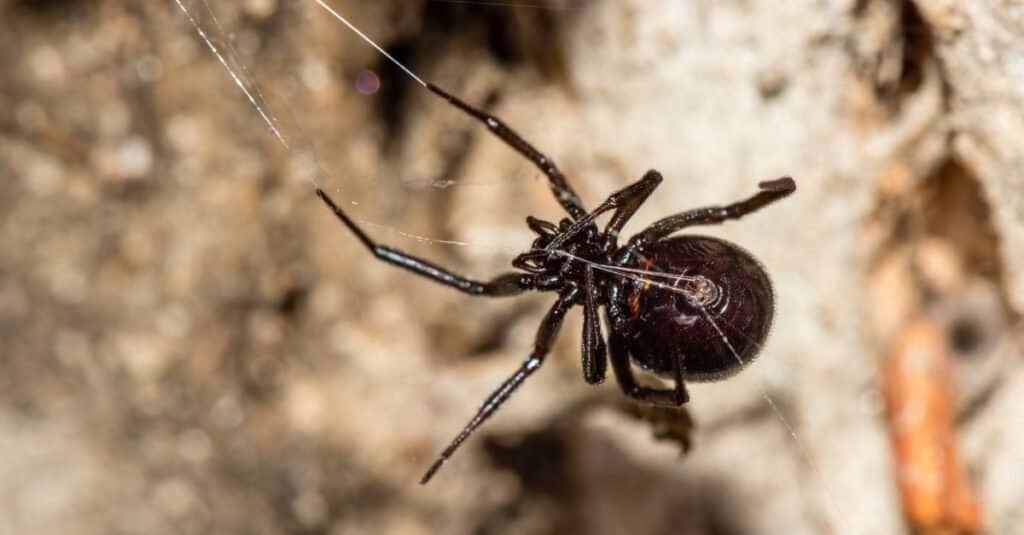
False black widows are similarly proportioned to true black widows.
©Danie Spreeth Photography/Shutterstock.com
These spiders are common house spiders, often referred to as cupboard spiders. In North America, false black widows are found in states along both the Pacific and Atlantic coasts.
The false black widow can inflict a painful bite similar to that of a black widow, but less severe. Symptoms can include swelling, pain at the bite site, and lethargy.
Redback Spider
The redback spider (Latrodectus hasselti), also known as the Australian black widow, is primarily native to Australia but has established populations in Southeast Asia, New Zealand, and Japan. Adult females are easily recognized by their spherical, pea-sized, shiny black bodies with a bright red or orange stripe down the upper side of the abdomen and a classic red hourglass marking on the underside.
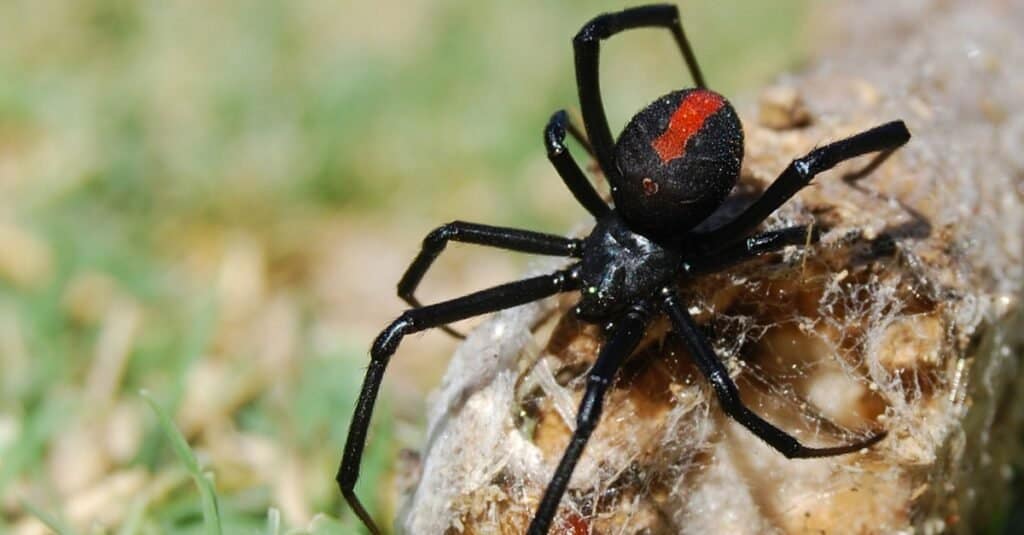
The redback spider would be easily confused with the black widow, except it is much smaller.
©iStock.com/maria72
Females are quite small, with a body length of only about 0.4 inches and a total leg span between 0.8 and 1.5 inches. Males are notably smaller, measuring just 0.12 to 0.16 inches long.
While the tiny, light-brown males are completely harmless, the venom of the female redback is highly toxic and harmful to humans. Her neurotoxic bite can cause intense, debilitating pain, muscle weakness, nausea, and sweating.
However, because the venom acts relatively slowly and a highly effective antivenom has been widely available since 1956, redback bites are treatable and have not caused a human death in decades.
Brown Widow
As their name suggests, brown widows (Latrodectus geometricus) are most easily distinguished from black widows by their color. Brown widows are mottled brown or tan with black accents. Immature black widows might be harder to tell apart from the brown widow due to this coloration. Brown widows do not have a bright red hourglass marking; instead, their hourglass is orange.
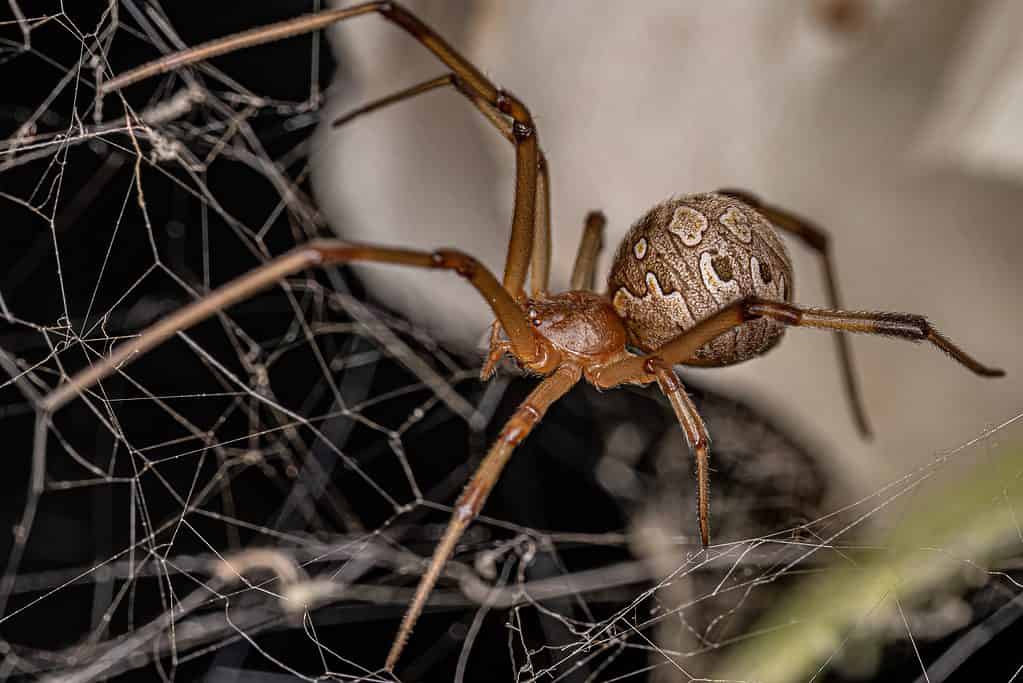
Although the brown widow is approximately the same size and shape as a black widow, their coloring is quite different.
©Vinicius R. Souza/Shutterstock.com
The brown widow spider is found across the globe in tropical, subtropical, and warm temperate zones. In the United States, the brown widow is an introduced, invasive species that has rapidly established itself across the southern tier of the country, with highly concentrated populations in Florida.
Although brown widow spiders are venomous, they are not considered dangerous or medically significant to humans.
Noble False Widow
The noble false widow spider (Steatoda nobilis) is easily recognized by its glossy, dark brown to reddish-brown body and a bulbous abdomen marked with cream or beige patterns that can resemble a pentagon or skull shape.As the largest false widow species, females measure 0.27 to 0.59 inches long, while males are slightly smaller, measuring about 0.16 to 0.47 inches; both sexes share a maximum leg span of approximately 1 inch.
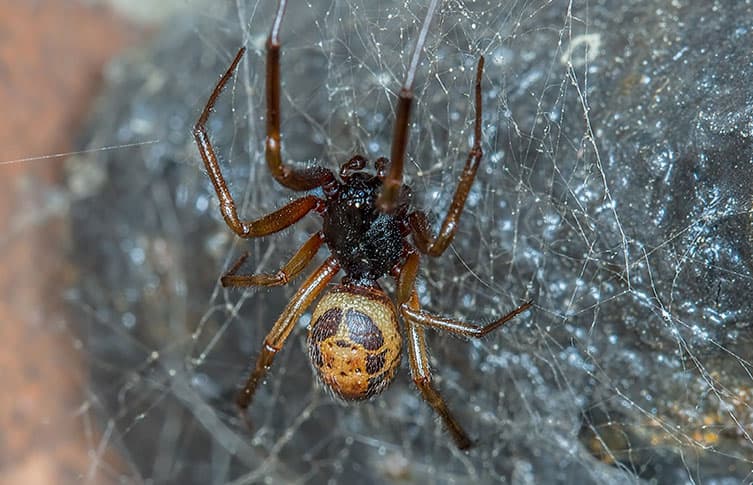
Noble false widows are lighter colored than black widows.
©thatmacroguy/Shutterstock.com
Endemic to Madeira and the Canary Islands, the noble false widow is considered an invasive species across Western Europe, the United States, Chile, Colombia, and New Zealand.
Although they are venomous and the noble false widow’s bite delivers a potent neurotoxin that immobilizes small prey, their venom is only mildly toxic and generally not dangerous to humans, causing symptoms similar to those of a wasp or bee sting.
Red Widow (Latrodectus bishop)
The red widow spider (Latrodectus bishopi) has a brownish-orange head, thorax, and legs, paired with a shiny black abdomen that features rows of red or orange spots outlined in pale yellow or white. The red widow generally lacks a distinct red hourglass marking on the underside of its abdomen. Instead, most female red widows have a single flattened triangle or an incomplete red mark.
Adult females, which are similar in size to black widows, have a body length of approximately 0.5 inches and a leg span of 1.5 to 2 inches, while males are much smaller, measuring only about one-third the size of the females.
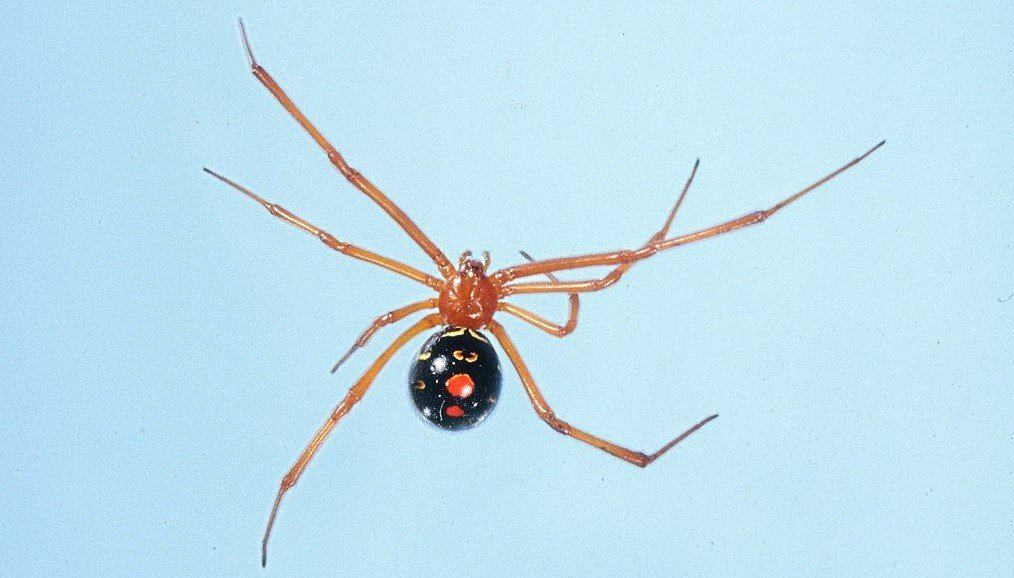
Like the black widow, the red widow is quite venomous.
©Florida Division of Plant Industry Archive / CC BY 3.0 US, via Wikimedia Commons – Original / License
Red widows are restricted to Central and Southern Florida’s sand-pine and palmetto scrub forests. Although they are reclusive and rarely come into contact with humans, the female’s venom is considered dangerous. However, their bites are rarely life-threatening, and there have been no confirmed human fatalities associated with this species.