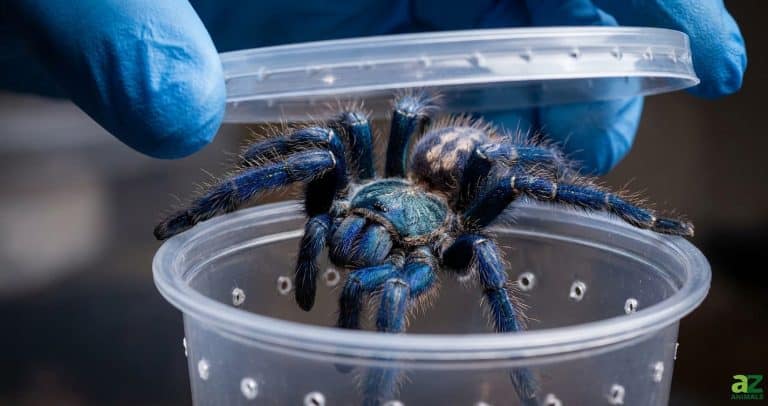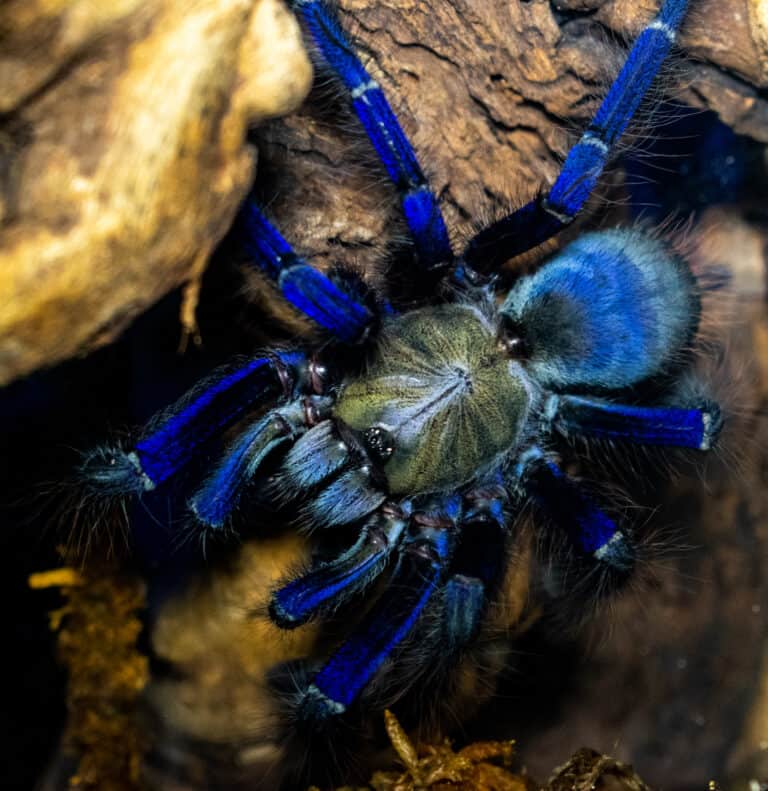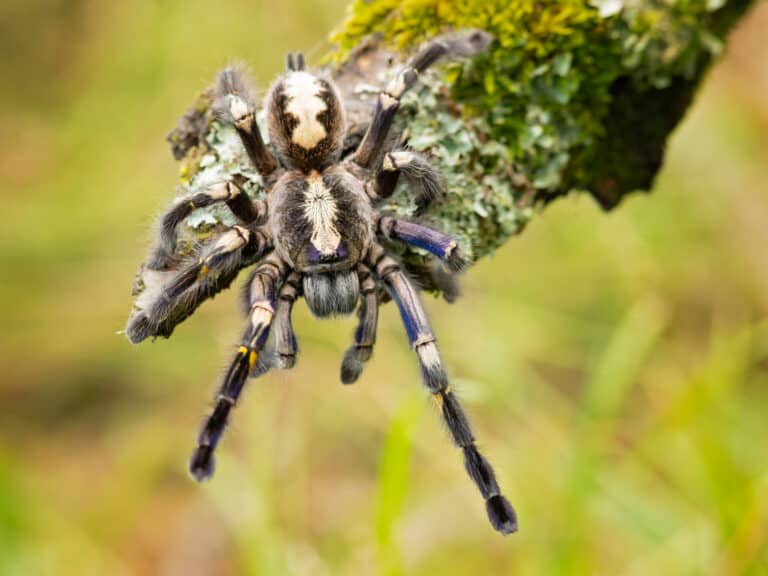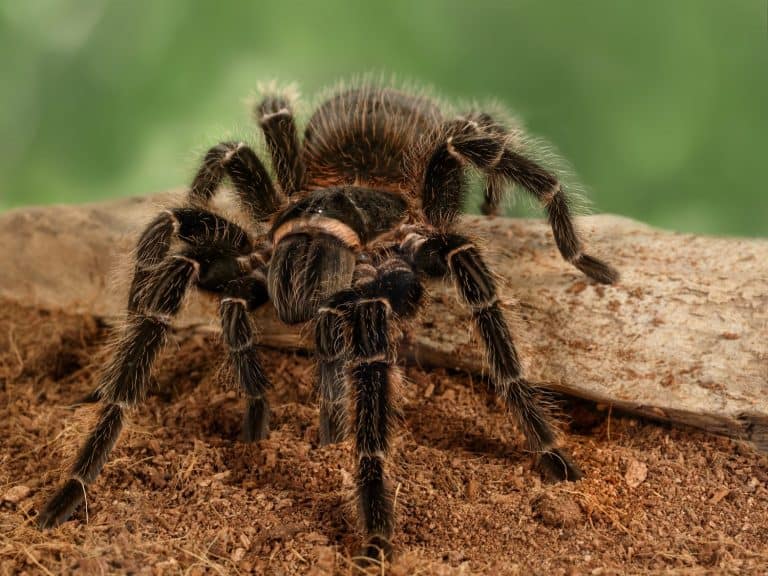

Quick Take
- The king baboon spider, Pelinobius muticus, of Kenya and Tanzania has an incredible 9-inch leg span, which is how it got the common name “king.”
- The absence of spermathecae, the female reproductive organ, in Encyocratella olivacea is a major hurdle in the sexing process of these spiders.
- Hysterocrates gigas possesses the uncommon ability to swim and submerge despite its terrestrial nature.
- Males in the Satyrex genus have 2-inch palps to survive the lethal risks of the reproduction process.
There are over 140 tarantula species that inhabit the countries of Africa. There are diverse habitats across the continent, from the Sahara and Kalahari deserts to the savannas of the Serengeti, the mountain ecosystems of the Ethiopian Highlands, and the dense rainforests of the Congo. Some researchers believe that all modern tarantulas have their origins in Africa. Africa’s diversity of tarantula species is believed to result from their evolutionary history and favorable local conditions.
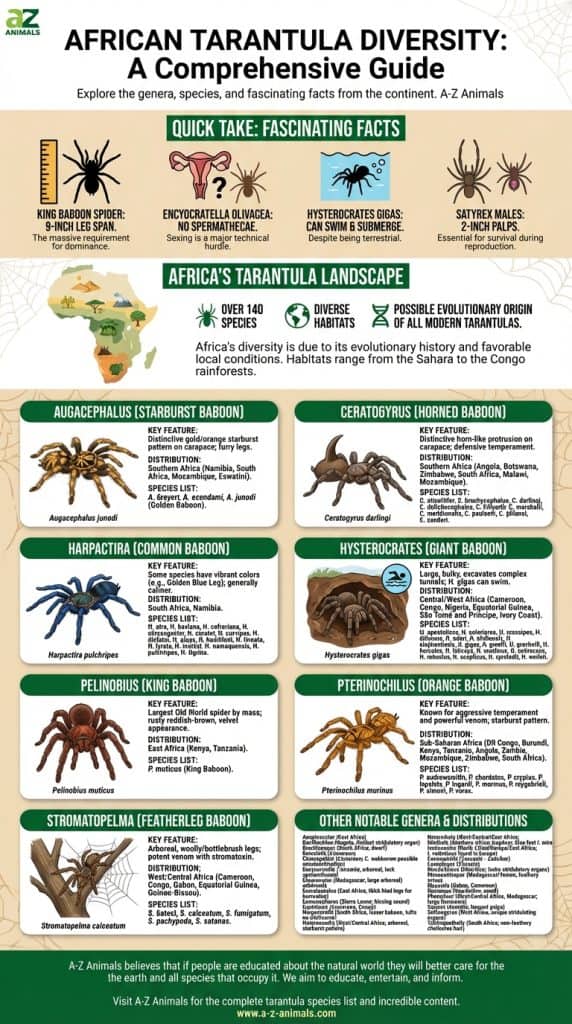
From nine-inch behemoths to predators that strike underwater, Africa’s tarantulas defy every rule of biology. Witness the eight legendary genera that dominate the continent’s harshest landscapes.
©A-Z Animals
Common baboon and horned baboon spiders of the Harpactira and Ceratogyrus genera, respectively, are just two of the fascinating types of tarantulas to populate the continent. The list below includes all of the tarantula species with a distribution in Africa currently recognized by the World Spider Catalog as of December 2025. Listings with an asterisk indicate it is the type species. For a comprehensive reference, please see our complete list of tarantula species.
Anoploscelus Pocock, 1897
The genus Anoploscelus includes two species of terrestrial burrowing spiders from East Africa. Anoploscelus lesserti is a rusty-brown color with long, lighter-colored hairs (setae) on its legs and abdomen. Observations have described Anoploscelus celeripes as brown and grey with long, pale, woolly setae on its legs and abdomen. Size information is not provided.
- Anoploscelus celeripes* Pocock, 1897
- Common name: N/A
- Distribution: Uganda, Tanzania
- Anoploscelus lesserti Laurent, 1946
- Common name: N/A
- Distribution: Rwanda, Burundi
Augacephalus Gallon, 2002
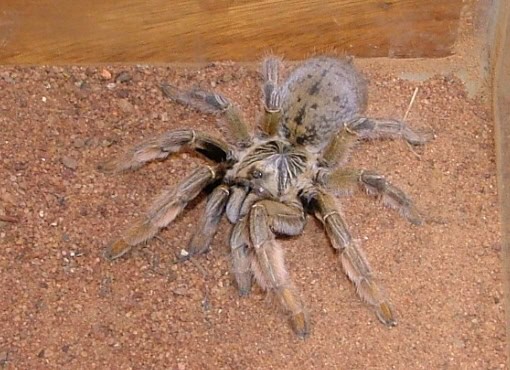
The golden baboon spider, Augacephalus junodi, is found in Namibia and South Africa.
Tarantulas in the genus Augacephalus are large burrowing spiders found in southern Africa. They are sometimes called starburst baboon spiders due to the distinctive gold or orange starburst pattern on their dark carapace. These spiders also have patterned abdomens and furry gold, orange, or golden brown legs. They generally reach a leg span of 4-5 inches.
- Augacephalus breyeri (Hewitt, 1919)
- Common name: Lowveld golden-brown baboon spider, Mozambique flame foot
- Distribution: South Africa, Mozambique, Eswatini
- Augacephalus ezendami (Gallon, 2001)
- Common name: Mozambique golden baboon spider
- Distribution: Mozambique
- Augacephalus junodi (Simon, 1904)
- Common name: Golden baboon
- Distribution: Namibia, South Africa
Bacillochilus Gallon, 2010
Bacillochilus contains only a single species found in the coastal regions of Angola. It is primarily known for its distinct stridulatory organ that includes long bristles on the spider’s mouthparts. Its name is derived from the Greek word “xeno,” meaning “strange,” and the Latin word “stridere,” which means to creak. The spider is black with long, pale setae on its legs and abdomen.
- Bacillochilus xenostridulans* Gallon, 2010
- Common name: N/A
- Distribution: Angola
Brachionopus Pocock, 1897
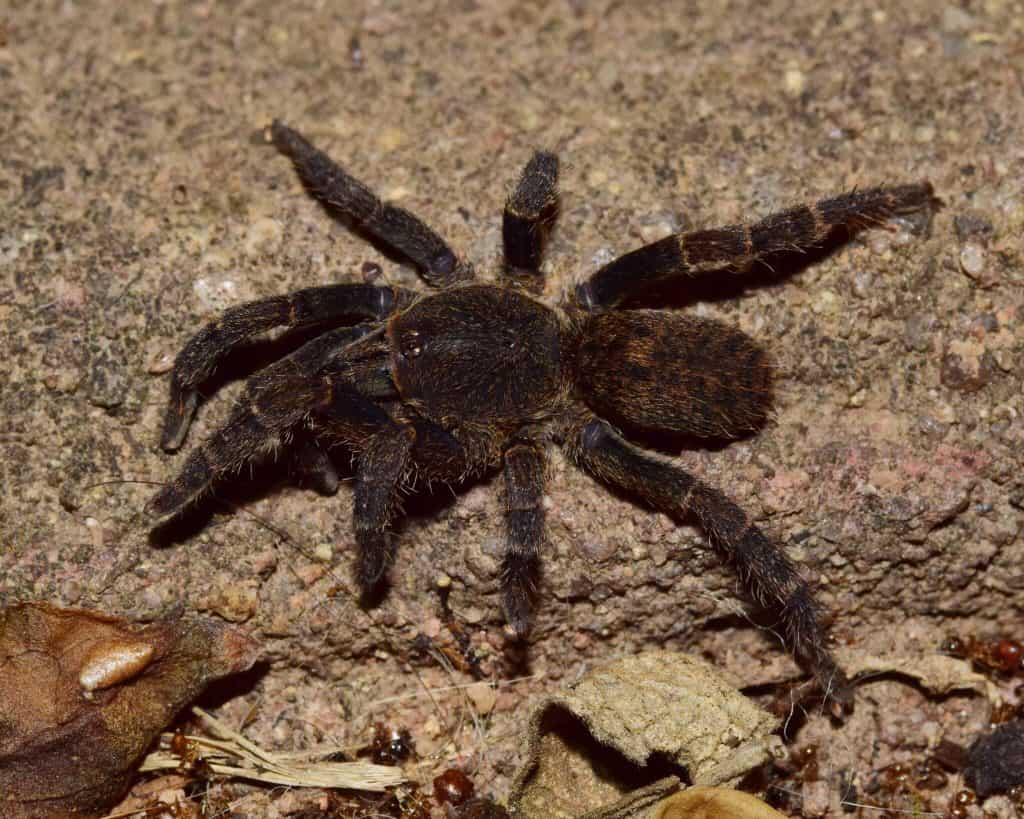
Brachionopus robustus is also known as the robust lesser baboon spider.
The genus Brachionopus is known for small, fast, burrowing spiders. Like other baboon spiders, they are very hairy. They typically have dark legs and may have a patterned carapace and/or abdomen. These dwarf spiders are said to be little more than 1 inch across when fully grown. Brachionopus spiders are found throughout South Africa.
- Brachionopus annulatus Purcell, 1903
- Common name: N/A
- Distribution: South Africa
- Brachionopus pretoriae Purcell, 1904
- Common name: Pretoria dwarf baboon spider
- Distribution: South Africa
- Brachionopus robustus Pocock, 1897
- Common name: Robust lesser baboon spider
- Distribution: South Africa
- Brachionopus tristis Purcell, 1903
- Common name: N/A
- Distribution: South Africa
Batesiella Pocock, 1903
The genus Batesiella contains just a single species found in Cameroon. Little is known about this rarely seen tarantula species.
- Batesiella crinita* Pocock, 1903
- Common name: N/A
- Distribution: Cameroon
Ceratogyrus Pocock, 1897
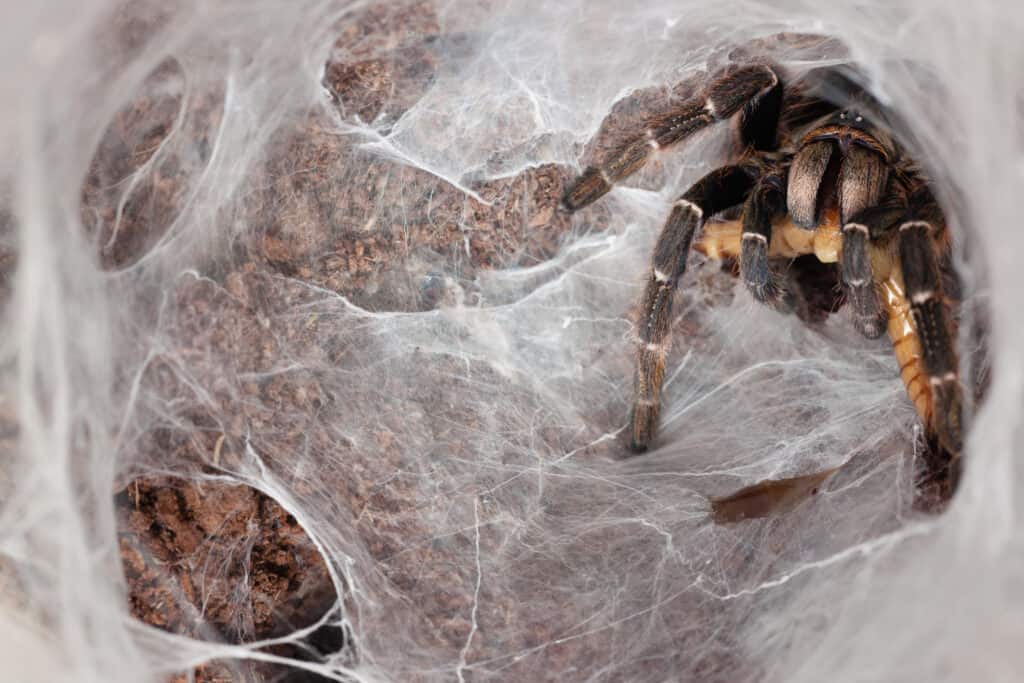
The rear-horned baboon spider, Ceratogyrus darlingi has a black, backward-curving horn on its carapace.
©iStock.com/skydie
Ceratogyrus spiders are called horned baboon tarantulas, due to the distinctive horn-like protrusion on their carapace. They generally range in color from an ashy grey to dark brown and reach a leg span of 4-6 inches. They excavate deep burrows heavily lined with silk in the arid regions across southern Africa. These spiders are known to have defensive temperaments and strong venom.
- Ceratogyrus attonitifer Engelbrecht, 2019
- Common name: N/A
- Distribution: Angola
- Ceratogyrus brachycephalus Hewitt, 1919
- Common name: Greater horned baboon spider
- Distribution: Botswana, Zimbabwe, South Africa
- Ceratogyrus darlingi Pocock, 1897
- Common name: Rear-horned, African rear-horned, burst horned baboon spider
- Distribution: Southern Africa
- Ceratogyrus dolichocephalus Hewitt, 1919
- Common name: Cranial-horned baboon spider
- Distribution: Zimbabwe
- Ceratogyrus hillyardi (Smith, 1990)
- Common name: N/A
- Distribution: Malawi
- Ceratogyrus marshalli Pocock, 1897
- Common name: Straight-horned baboon spider
- Distribution: Zimbabwe, Mozambique
- Ceratogyrus meridionalis (Hirst, 1907)
- Common name: Zimbabwe grey baboon or grey mustard baboon
- Distribution: Malawi, Mozambique
- Ceratogyrus paulseni Gallon, 2005
- Common name: N/A
- Distribution: South Africa
- Ceratogyrus pillansi (Purcell, 1902)
- Common name: N/A
- Distribution: Zimbabwe, Mozambique
- Ceratogyrus sanderi Strand, 1906
- Common name: Namibian horned baboon spider
- Distribution: Namibia, Zimbabwe
Chaetopelma Ausserer, 1871
Most Chaetopelma spiders have a Mediterranean or Middle Eastern range. Chaetopelma webborum is the only Chaetopelma species found outside of that region. It is known only from the female holotype species collected in Efulen, Cameroon. Researchers believe the information provided in the original description and its occurrence far outside the usual range suggest that C. webborum is misclassified.
- Chaetopelma webborum Smith, 1990
- Common name: N/A
- Distribution: Cameroon
Encyocratella Strand, 1907
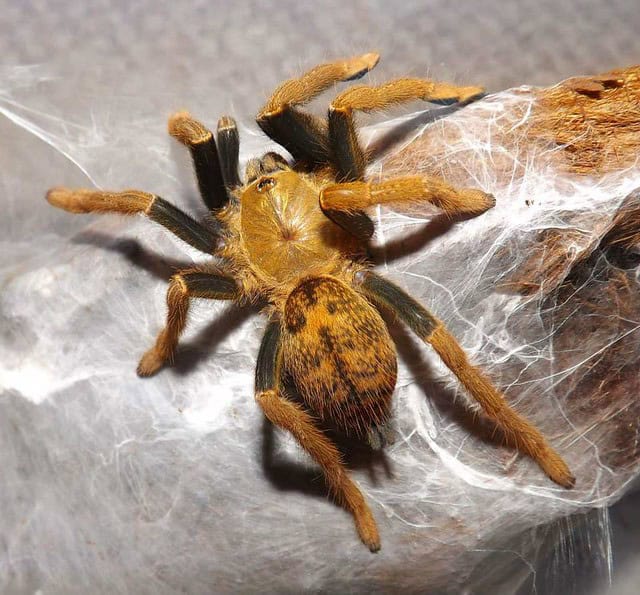
The Tanzanian black and olive baboon spider, Encyocratella olivacea, is brightly colored with an intricately patterned abdomen.
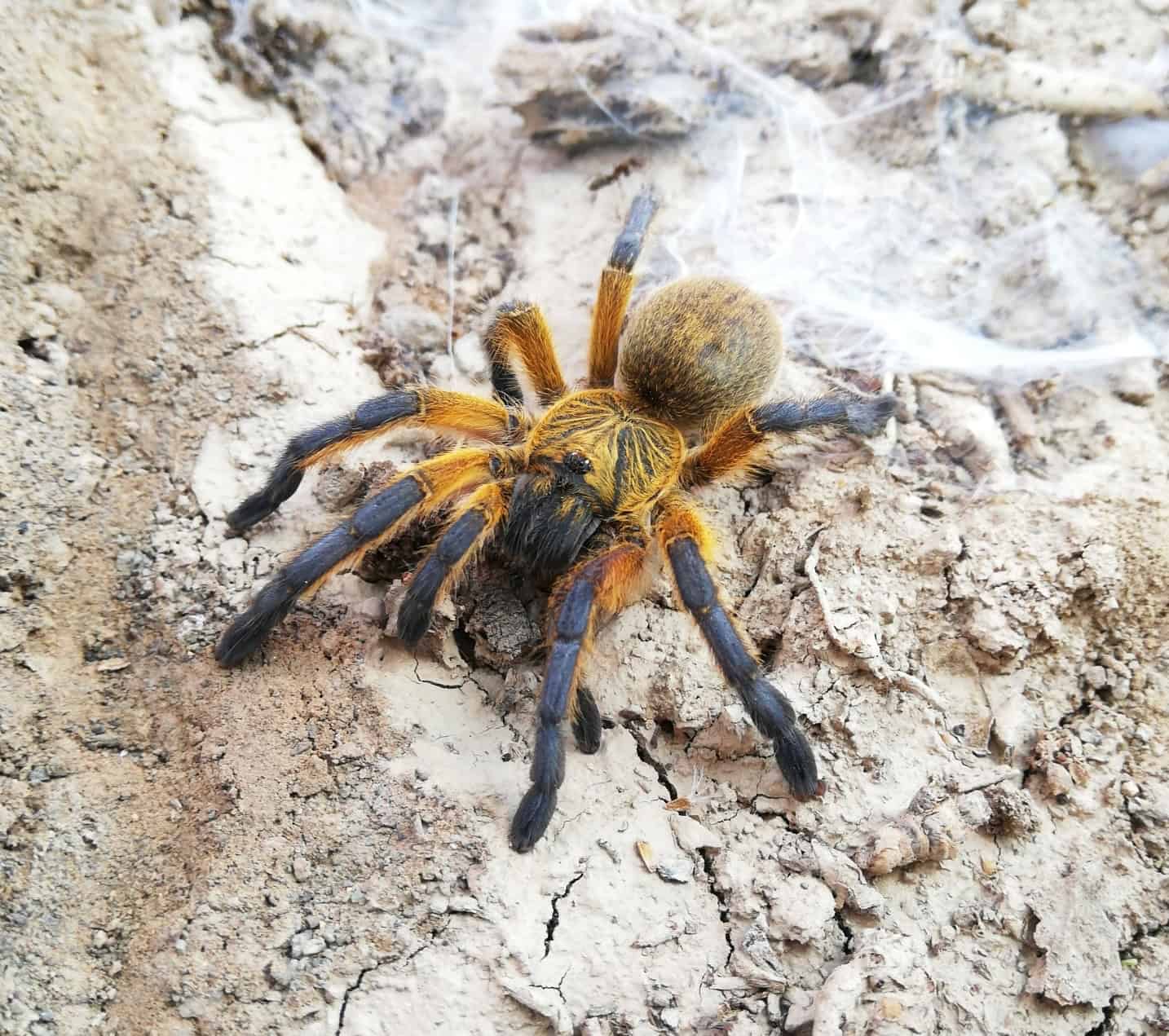
Encyocratella is a monotypic genus. Encyocratella olivacea is known for its olive-green, gold, and black coloring and intricate patterns on its abdomen. It is one of the few species where females lack spermathecae (sperm storage organs), which makes sexing them difficult. They are primarily an arboreal species, making elaborately webbed homes in trees. These spiders are generally defensive and have potent venom. They can reach 4.5-6 inches in leg span.
- Encyocratella olivacea* Strand, 1907
- Common name: Tanzanian black and olive baboon spider
- Distribution: Tanzania
Encyocrates Simon, 1892
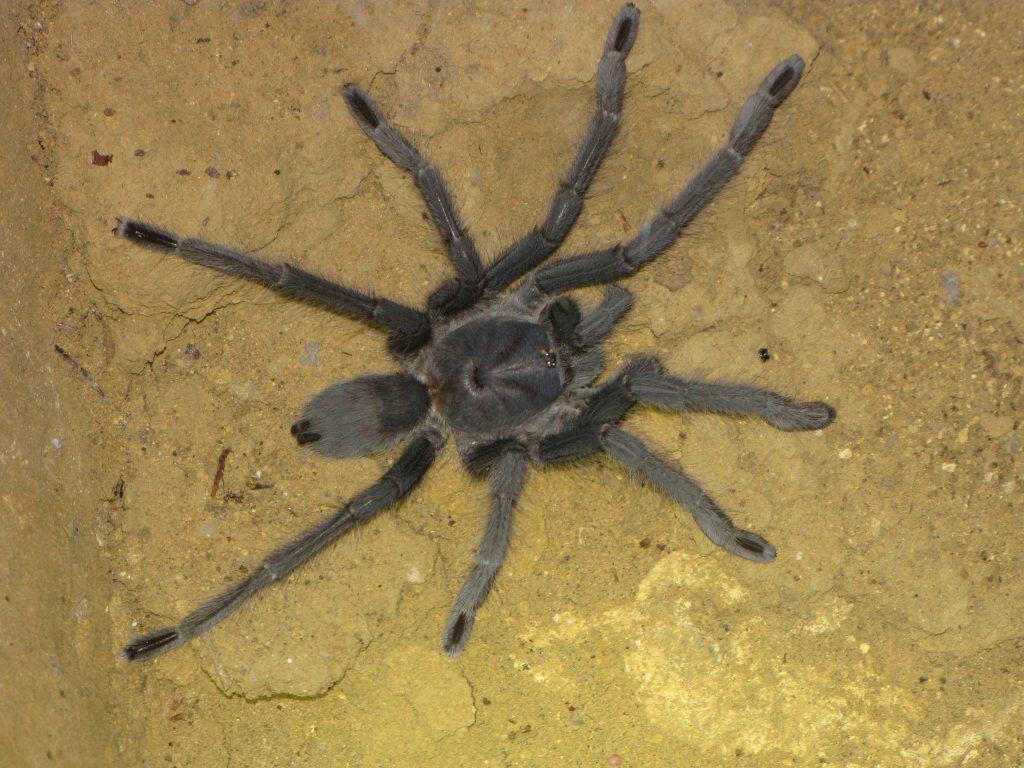
Encyocrates raffrayi is found in the caves of Madagascar.
The sole species in the genus Encyocrates is Encyocrates raffrayi. E. raffrayi is a large, hairy, brown to black arboreal spider found in the rainforests of Madagascar. It has also been observed in caves. This spider has a body length of over 2 inches and is estimated to have a leg span of over 7 inches.
- Encyocrates raffrayi* Simon, 1892
- Common name: N/A
- Distribution: Madagascar
Eucratoscelus Pocock, 1898
Tarantulas in the genus Eucratoscelus are known for their thick, bristly hind legs, which they use to excavate deep, extensive, vertical tunnels in the savannas of East Africa. They have two-tone bodies, with their carapace and all but their hind legs being tan, while their abdomens and hind legs are dark brown. These are small to medium-sized tarantulas, only reaching around 4-5 inches in leg span.
- Eucratoscelus constrictus* (Gerstäcker, 1873)
- Common name: N/A
- Distribution: Kenya, Tanzania
- Eucratoscelus pachypus Schmidt & von Wirth, 1990
- Common name: Tanzania stout leg baboon spider
- Distribution: Tanzania
Eumenophorus Pocock, 1897
There are just two species in the little-known genus Eumenophorus. These burrowing spiders have stridulatory organs that make a hissing sound to warn off intruders. Eumenophorus tarantulas are native to Sierra Leone.
- Eumenophorus clementsi Pocock, 1897
- Common name: N/A
- Distribution: Sierra Leone
- Eumenophorus murphyorum Smith, 1990
- Common name: N/A
- Distribution: Sierra Leone
Euphrictus Hirst, 1908
Euphrictus spinosus is only known from a male specimen collected near the Dja River in Cameroon. This spider is unique for having multiple spines on the tibia of its first pair of legs. It is described as having a yellowish carapace with a brown abdomen covered in long, yellow setae. Euphrictus squamosus is said to be similarly colored with a reddish-brown body and a yellowish carapace.
- Euphrictus spinosus* Hirst, 1908
- Common name: N/A
- Distribution: Cameroon
- Euphrictus squamosus (Benoit, 1965)
- Common name: N/A
- Distribution: Congo
Harpactira Ausserer, 1871
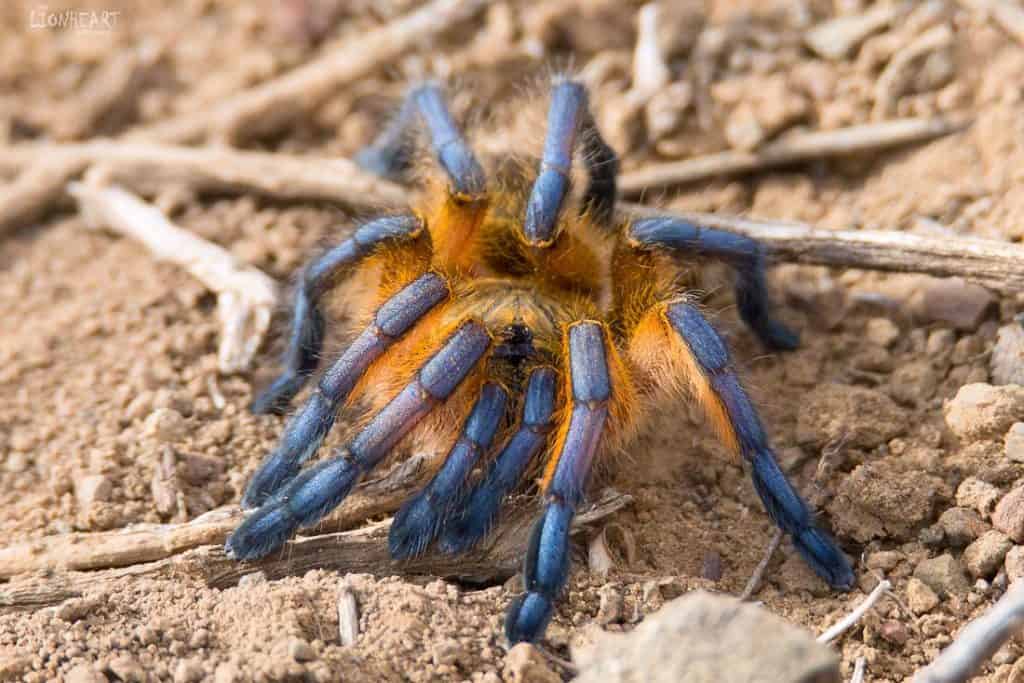
The golden blue leg baboon spider, Harpactira pulchripes, is popular in the pet trade for its vibrant colors.
Harpactira tarantulas belong to the Harpactirinae subfamily of spiders, commonly called baboon spiders. However, tarantulas in the genus Harpactira are known to be much calmer than their aggressive cousins, although they are still very fast and have potent venom. Some species in this genus have vibrant colors, such as the golden blue leg baboon, shown above, and they are very hairy. They are medium- to large-sized tarantulas, generally reaching between 5-6 inches in leg span. These terrestrial spiders excavate elaborate, heavily webbed burrows. They are found in South Africa, with Harpactira namaquensis also found in Namibia.
- Harpactira atra* (Latreille, 1832)
- Common name: Common black baboon spider
- Distribution: South Africa
- Harpactira baviana Purcell, 1903
- Common name: Purcell’s baboon spider
- Distribution: South Africa
- Harpactira cafreriana (Walckenaer, 1837)
- Common name: Cape Copper baboon, amber baboon spider
- Distribution: South Africa
- Harpactira chrysogaster Pocock, 1897
- Common name: Redrump baboon spider
- Distribution: South Africa
- Harpactira curator Pocock, 1898
- Common name: Malvern starburst or Malvern baboon spider
- Distribution: South Africa
- Harpactira curvipes Pocock, 1897
- Common name: Kleinpoort mouse baboon spider
- Distribution: South Africa
- Harpactira dictator Purcell, 1902
- Common name: Dictator baboon spider
- Distribution: South Africa
- Harpactira gigas Pocock, 1898
- Common name: The common baboon spider
- Distribution: South Africa
- Harpactira hamiltoni Pocock, 1902
- Common name: Highveld baboon spider
- Distribution: South Africa
- Harpactira lineata Pocock, 1897
- Common name: N/A
- Distribution: South Africa
- Harpactira lyrata (Simon, 1892)
- Common name: N/A
- Distribution: South Africa
- Harpactira marksi Purcell, 1902
- Common name: Elizabethfontein baboon spider
- Distribution: South Africa
- Harpactira namaquensis Purcell, 1902
- Common name: Bronze baboon spider
- Distribution: Namibia, South Africa
- Harpactira pulchripes Pocock, 1901
- Common name: golden blue leg baboon spider
- Distribution: South Africa
- Harpactira tigrina Ausserer, 1875
- Common name: Tiger baboon, golden baboon spider
- Distribution: South Africa
Harpactirella Purcell, 1902
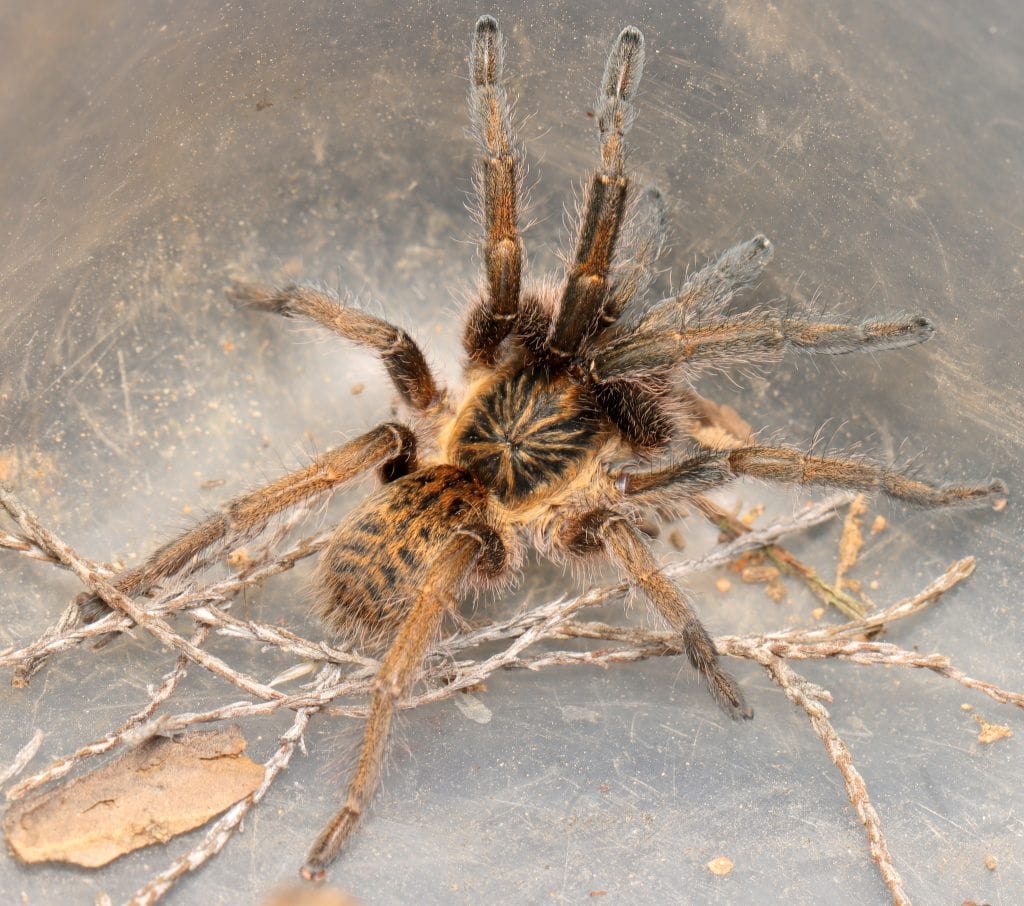
Like all species in the genus Harpactirella, Harpactirella lightfooti can be found in South Africa.
Spiders in the genus Harpactirella are also part of the subfamily Harpactirinae. However, Harpactirella spiders are generally smaller than others in this subfamily, and are commonly called lesser baboon spiders. The females generally reach no more than 2-4 inches in leg span. These spiders have been reported to be fast and aggressive with potent venom. In addition to size, they can be differentiated from Harpactira by the tufts of bristly hairs on their chelicerae, which are their fang-bearing mouthparts. They make silk-lined tunnels under rocks, logs, or other debris in the open, grassy plains of South Africa.
- Harpactirella domicola Purcell, 1903
- Common name: N/A
- Distribution: South Africa
- Harpactirella helenae Purcell, 1903
- Common name: N/A
- Distribution: South Africa
- Harpactirella karrooica Purcell, 1902
- Common name: N/A
- Distribution: South Africa
- Harpactirella lapidaria Purcell, 1908
- Common name: N/A
- Distribution: South Africa
- Harpactirella lightfooti Purcell, 1902
- Common name: Lightfoot’s lesser baboon spider
- Distribution: South Africa
- Harpactirella longipes Purcell, 1902
- Common name: N/A
- Distribution: South Africa
- Harpactirella magna Purcell, 1903
- Common name: Dunbrody golden lesser baboon spider
- Distribution: South Africa
- Harpactirella overdijki Gallon, 2010
- Common name: N/A
- Distribution: South Africa
- Harpactirella schwarzi Purcell, 1904
- Common name: N/A
- Distribution: South Africa
- Harpactirella spinosa Purcell, 1908
- Common name: N/A
- Distribution: South Africa
- Harpactirella treleaveni* Purcell, 1902
- Common name: Table Mountain golden baboon spider
- Distribution: South Africa
Heteroscodra Pocock, 1900
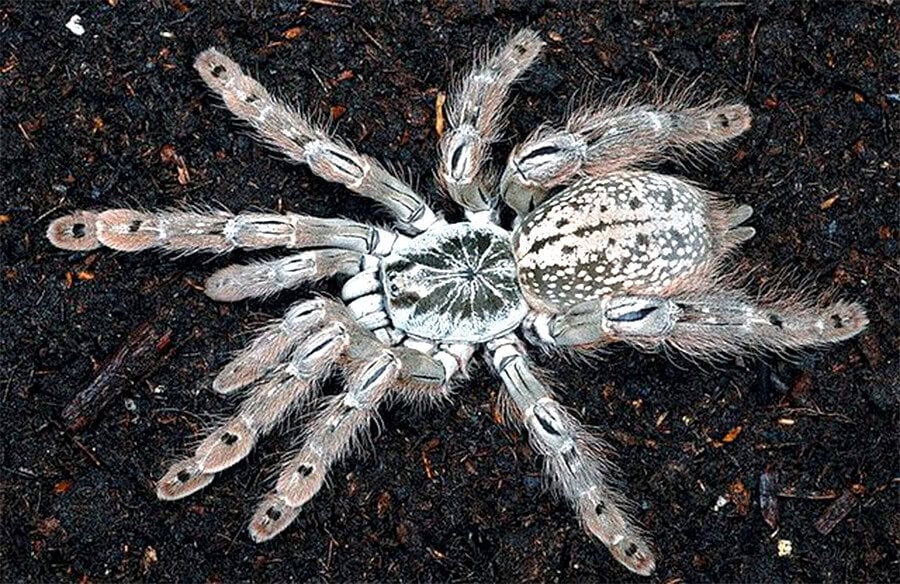
Heteroscodra maculata has several common names, including Togo starburst and ornamental baboon spider.
Spiders in the genus Heteroscodra are arboreal, making their homes in the humid forests of West and Central Africa. These tarantulas are very fast, defensive, and have powerful venom. Both spiders in this genus have a sunburst pattern on their carapace, a patterned abdomen, and dark brown to black patches on their legs. However, H. maculata is shades of white, grey, and black, while H. crassipes is a greyish-brown to dark brown. Adult spiders reach a leg span of 4-6 inches.
- Heteroscodra crassipes Hirst, 1907
- Common name: Sometimes referred to as Cameroon brown baboon
- Distribution: Cameroon, Gabon, Congo
- Heteroscodra maculata* Pocock, 1900
- Common name: Togo starburst, ornamental baboon spider, ghost spider
- Distribution: West and Central Africa
Heterothele Karsch, 1879
Heterothele spiders are relatively small, quick tarantulas, with adult leg spans typically reaching between 2 and 3 inches. They are generally burrowers and heavy webbers, but some species, such as Heterothele gabonensis show semi-arboreal tendencies, living in trees and in burrows around trees. They have been observed living in close proximity to one another in the wild and showing tolerance for conspecifics.
- Heterothele affinis Laurent, 1946
- Common name: N/A
- Distribution: Congo, Tanzania
- Heterothele atropha Simon, 1907
- Common name: N/A
- Distribution: Congo
- Heterothele darcheni (Benoit, 1966)
- Common name: N/A
- Distribution: Gabon
- Heterothele decemnotata (Simon, 1891)
- Common name: N/A
- Distribution: Congo
- Heterothele erdosi Sherwood & Gallon, 2025
- Common name: N/A
- Distribution: Nigeria
- Heterothele gabonensis (Lucas, 1858)
- Common name: Blue dwarf baboon
- Distribution: Gabon
- Heterothele honesta* Karsch, 1879
- Common name: N/A
- Distribution: Angola
- Heterothele hullwilliamsi Smith, 1990
- Common name: N/A
- Distribution: Cameroon
- Heterothele ogbunikia Smith, 1990
- Common name: N/A
- Distribution: Nigeria
- Heterothele spinipes Pocock, 1897
- Common name: N/A
- Distribution: Tanzania
Hysterocrates Simon, 1892
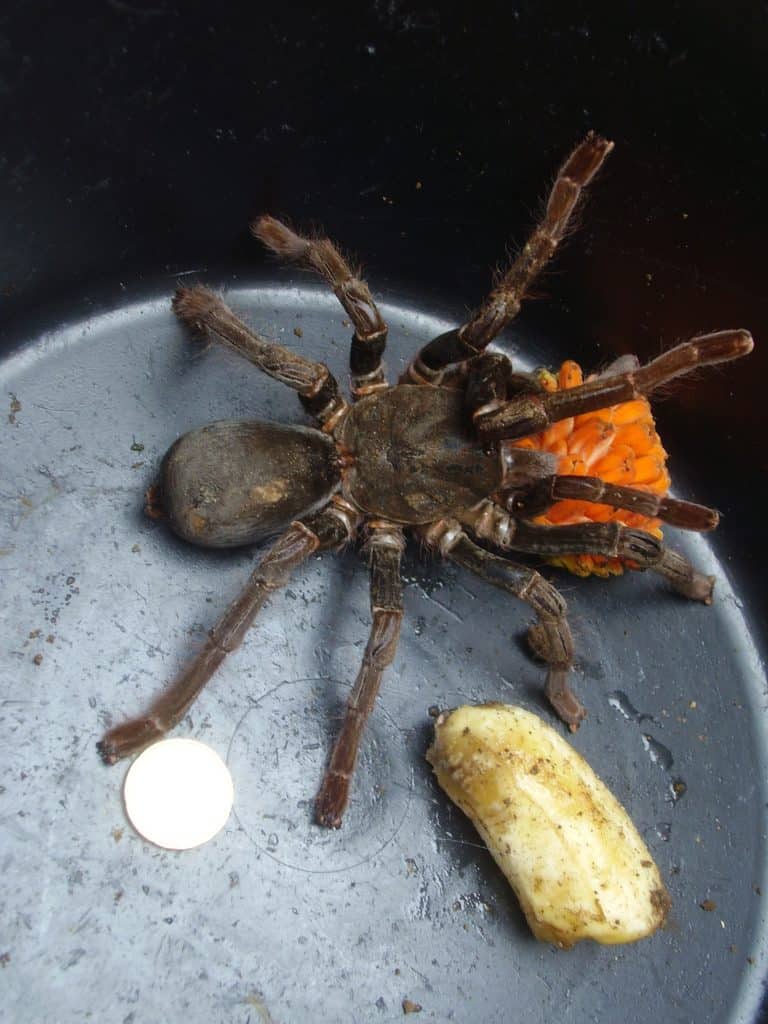
The São Tomé giant baboon spider, Hysterocrates scepticus, has a leg span of up to 8 inches.
Tarantulas in the genus Hysterocrates are large, bulky burrowing spiders that are known to excavate complex tunnel systems. Like most Old World tarantulas, they are defensive, fast, and have strong venom. These large tarantulas can reach a leg span of 8 inches. H. gigas is notable among tarantulas for its ability to swim and submerge for extended periods.
- Hysterocrates apostolicus Pocock, 1900
- Common name: Cricket-leg baboon spider
- Distribution: São Tomé and Príncipe
- Hysterocrates celerierae (Smith, 1990)
- Common name: N/A
- Distribution: Ivory Coast
- Hysterocrates crassipes Pocock, 1897
- Common name: Cameroon brown
- Distribution: Cameroon
- Hysterocrates didymus Pocock, 1900
- Common name:
- Distribution: São Tomé and Príncipe
- Hysterocrates ederi Charpentier, 1995
- Common name: Bioko baboon spider
- Distribution: Equatorial Guinea (Bioko)
- Hysterocrates efuliensis (Smith, 1990)
- Common name: N/A
- Distribution: Cameroon
- Hysterocrates elephantiasis (Berland, 1917)
- Common name: N/A
- Distribution: Congo
- Hysterocrates gigas Pocock, 1897
- Common name: Giant baboon, Cameroon red baboon, or red baboon spider
- Distribution: Cameroon
- Hysterocrates greeffi (Karsch, 1884)
- Common name: N/A
- Distribution: Cameroon
- Hysterocrates greshoffi* (Simon, 1891)
- Common name: N/A
- Distribution: Congo
- Hysterocrates hercules Pocock, 1900
- Common name: Hercules baboon spider
- Distribution: Nigeria
- Hysterocrates laticeps Pocock, 1897
- Common name: Nigerian rusted tarantula, Nigerian rust rump baboon spider
- Distribution: Cameroon (Despite the common name, the World Spider Catalog does not list Nigeria in its distribution as of 2025.)
- Hysterocrates maximus Strand, 1906
- Common name: N/A
- Distribution: Cameroon
- Hysterocrates ochraceus Strand, 1907
- Common name: N/A
- Distribution: Cameroon, Congo
- Hysterocrates robustus Pocock, 1900
- Common name: N/A
- Distribution: Equatorial Guinea (Mbini)
- Hysterocrates robustus sulcifer Strand, 1908
- Common name: N/A
- Distribution: Cameroon
- Hysterocrates scepticus Pocock, 1900
- Common name: Saltome giant baboon spider
- Distribution: São Tomé and Príncipe
- Hysterocrates sjostedti (Thorell, 1899)
- Common name: N/A
- Distribution: Cameroon
- Hysterocrates weileri Strand, 1906
- Common name:
- Distribution: Cameroon
Idiothele Hewitt, 1919
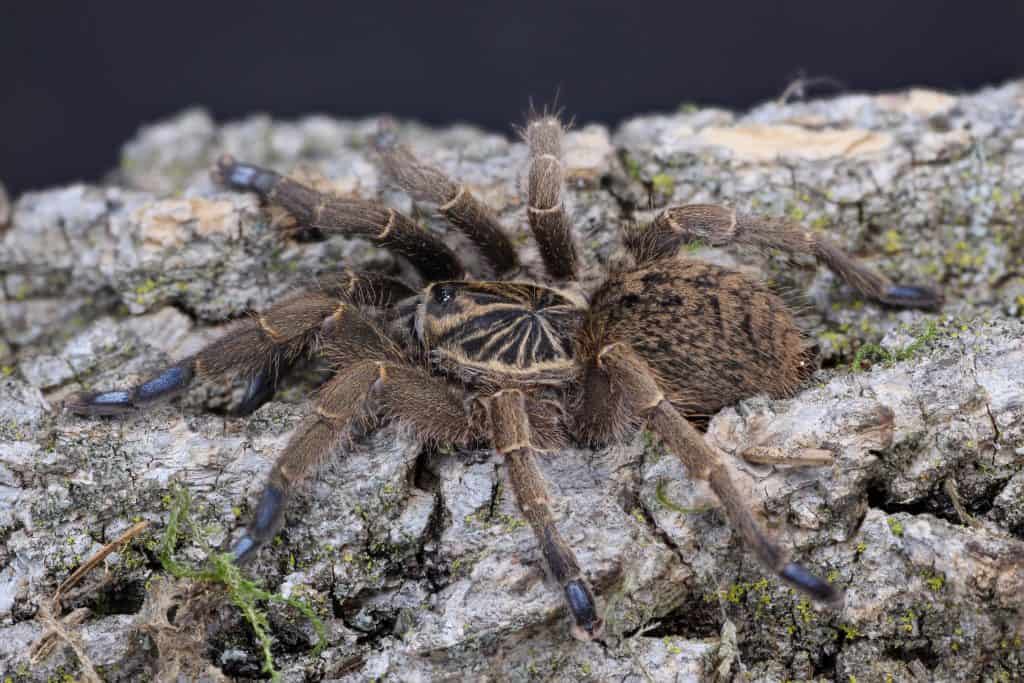
The blue-foot baboon spider, Idiothele mira, has sky blue tarsi and metatarsi.
Idiothele tarantulas are one of two tarantula species that seal the entrance of their burrows with a thin silk trapdoor. The spiders in this genus are predominantly brown with a sunburst pattern on the carapace and a patterned abdomen. They have long, light-colored setae on their legs and abdomens. I. mira is distinguished from I. nigrofulva by its sky blue tarsi and metatarsi. These small spiders only reach a leg span of about 4.5 inches.
- Idiothele mira Gallon, 2010
- Common name: Blue-foot baboon spider
- Distribution: South Africa
- Idiothele nigrofulva* (Pocock, 1898)
- Common name: Common trapdoor baboon spider
- Distribution: Southern Africa
Ischnocolus Ausserer, 1871
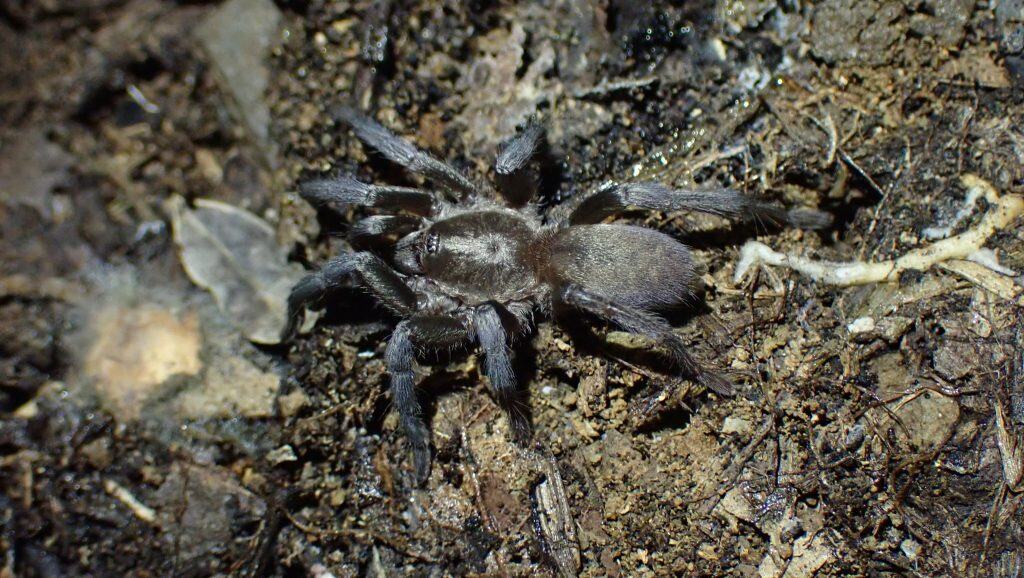
Ischnocolus valentinus is native to parts of southern Europe and northern Africa.
Tarantulas in the Ischnocolus genus are small, burrowing tarantulas with a total body length between 0.50 inches and 1 inch. Researchers have determined that the genus Ischnocolus should only include the tarantulas from the Mediterranean region in Europe, the Middle East, and the Ethiopian region in East Africa. Many of the species in this genus have a striped pattern on their abdomens.
- Ischnocolus elongatus (Simon, 1873)
- Common name: N/A
- Distribution: Morocco, Algeria
- Ischnocolus jickelii L. Koch, 1875
- Common name: Hajar Mountain tarantula, Dhofar blue tarantula
- Distribution: Djibouti, Ethiopia, Somalia, Yemen
- Ischnocolus mogadorensis Simon, 1909
- Common name: N/A
- Distribution: Morocco, Western Sahara
- Ischnocolus tomentosus Thorell, 1899
- Common name: N/A
- Distribution: Cameroon, Congo
- This species is considered incertae sedis, meaning its placement in this genus is uncertain, partially due to its geographical location.
- Ischnocolus valentinus* (Dufour, 1820)
- Common name: N/A
- Distribution: Spain, Italy (Sicily), Morocco, Algeria, Tunisia, Libya
- This species is one of only two tarantula species found in Europe.
Loxomphalia Simon, 1889
Loxomphalia is known from a single species endemic to the archipelago of Zanzibar off the coast of Tanzania. They are part of the subfamily Eumenophorinae, differentiated by spiky, stridulatory setae between the coxae of leg I–IV, the parts of the leg that connect them to the body. With the exception of the genus Mascaraneus, spiders in this subfamily also have a patch of stiff setae on the femur of the pedipalps.
- Loxomphalia rubida* Simon, 1889
- Common name: N/A
- Distribution: Tanzania (Zanzibar)
Loxoptygus Simon, 1903
The genus Loxoptygus also belongs to the subfamily Eumenophorinae. However, there has been little research conducted on this genus. The two species were discovered in Ethiopia.
- Loxoptygus coturnatus Simon, 1903
- Common name: N/A
- Distribution: Ethiopia
- Loxoptygus ectypus* (Simon, 1889)
- Common name: N/A
- Distribution: Ethiopia
Mascaraneus Gallon, 2005
The genus Mascaraneus is only known from a single species found on Serpent Island, the most remote and inaccessible islet of Mauritius. This large spider measures approximately 1.8 inches in total body length. It is described as a uniform light mustard brown color with short, uniform setae on its abdomen. Its legs have short setae with a few longer hairs scattered on the tarsi and metatarsi. The setae on the carapace are extremely short. Live specimens have been observed inhabiting the crevices of volcanic rock. As a eumenophorine genus, Mascaraneus spiders are considered unusual for their lack of stridulatory organs.
- Mascaraneus remotus* Gallon, 2005
- Common name: N/A
- Distribution: Mauritius
Monocentropus Pocock, 1897
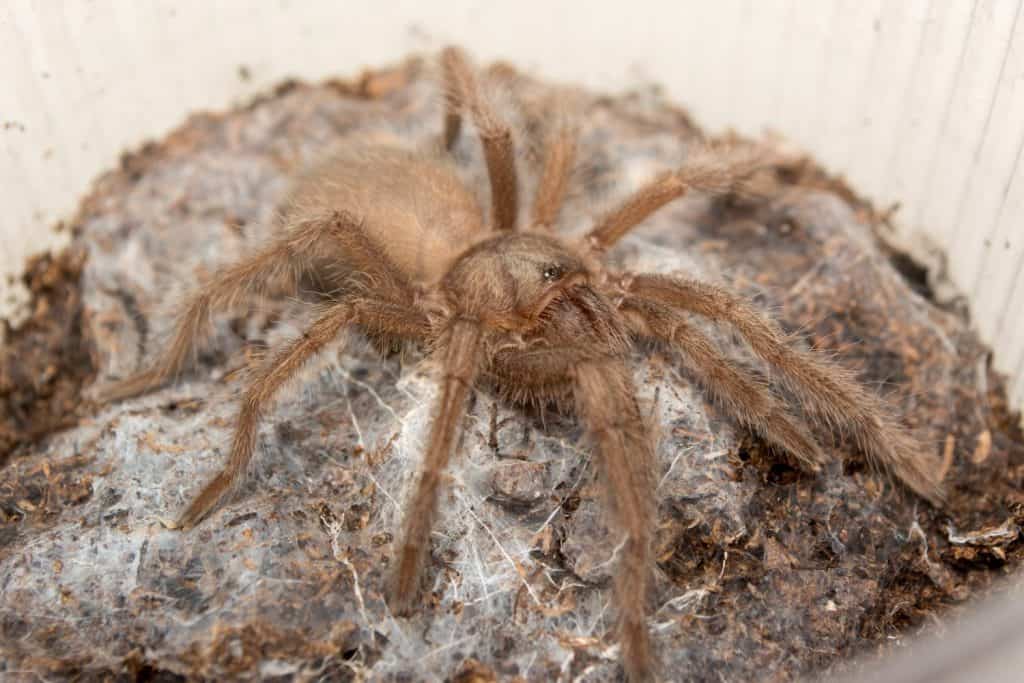
Lamberton’s baboon spider, Monocentropus lambertoni, is a medium-sized tarantula native to Madagascar.
©xtotha/Shutterstock.com
Monocentropus consists of two species of burrowing spiders known from Madagascar and Yemen. Monocentropus lambertoni is a medium-sized spider with a leg span of up to 5 inches. It is shades of light to medium brown with an abundance of lighter setae covering its body. The genus is differentiated from other genera in the Eumenophorinae subfamily by having only feathery setae instead of both spiky stridulatory setae and large feathery setae.
- Monocentropus lambertoni Fage, 1922
- Common name: Lamberton’s baboon spider, Malagasy Lamberton brown tarantula
- Distribution: Madagascar
- Researchers note that molecular phylogenetics and morphological characteristics suggest M. lambertoni is misplaced. It is currently regarded as incertae sedis, of uncertain placement, pending further studies.
Myostola Simon, 1903
Myostola is a monotypic genus. M. occidentalis is described as having a dark brown body and legs, with light, rose-colored setae on the joints of the legs and palps. It is a large burrowing spider with a total body length measuring around 2.4 inches.
- Myostola occidentalis* (Lucas, 1858)
- Common name: N/A
- Distribution: Gabon, Cameroon
Nesiergus Simon, 1903
Spiders in the genus Nesiergus are relatively small tarantulas with a maximum length of around 1 inch. They are native to the Seychelles archipelago, east of mainland Africa. Burrows are found under rocks and rotting logs (N. insulanis) and on sandy beaches under rocks and coral fragments (N. halophilus). N. gardineri inhabits the forests and is also presumed to be a burrowing spider.
- Nesiergus gardineri (Hirst, 1911)
- Common name: N/A
- Distribution: Seychelles
- Nesiergus halophilus Benoit, 1978
- Common name: N/A
- Distribution: Seychelles
- Nesiergus insulanus* Simon, 1903
- Common name: N/A
- Distribution: Seychelles
Pelinobius Karsch, 1885
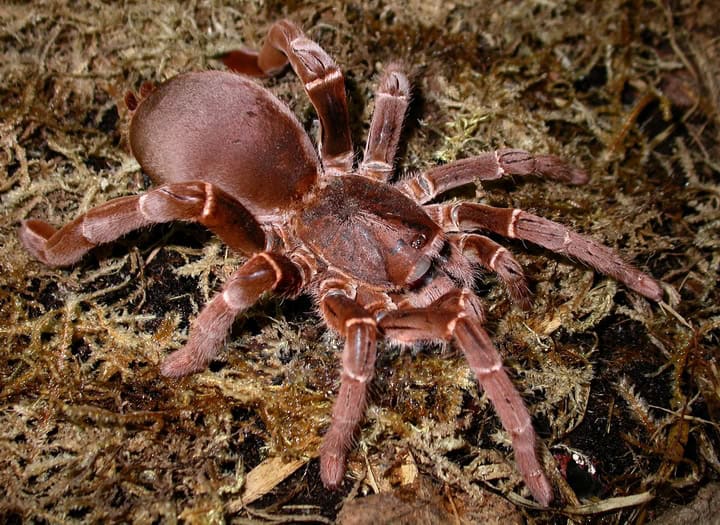
The king baboon spider, Pelinobius muticus, is believed to be the largest Old World spider by mass.
Pelinobius muticus is the only species in the genus Pelinobius. These large burrowing spiders can reach a leg span of up to 9 inches. The king baboon spider is among the largest Old World spiders, if not the largest. It is a rusty reddish-brown with very short setae, giving it a velvet-like appearance. These spiders inhabit the arid savannas and scrublands of Kenya and Tanzania. Like many other baboon spiders, P. muticus is very defensive and has potent venom.
- Pelinobius muticus* Karsch, 1885
- Common name: King baboon spider
- Distribution: Kenya, Tanzania
Phoneyusa Karsch, 1884
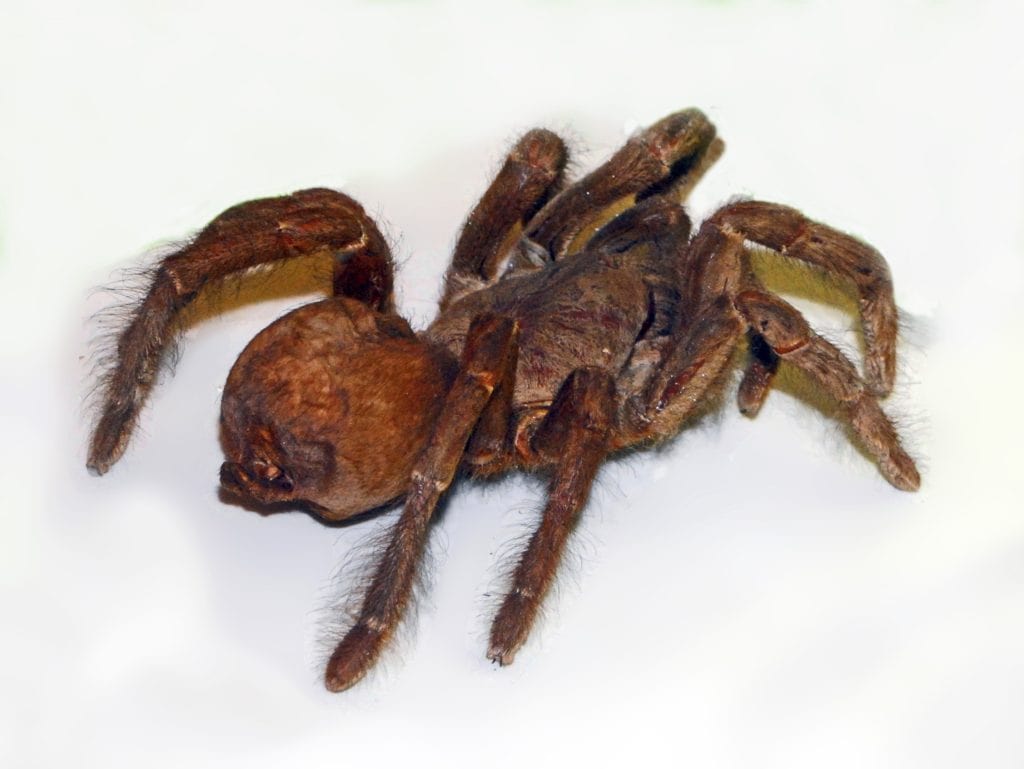
Phoneyusa lesserti is a type of baboon spider found in Central Africa.
Little is known about the spiders in the genus Phoneyusa. The genus is typically placed within the Eumenophorinae subfamily, and its members are believed to be relatively large, heavy burrowing tarantulas. As noted above, Eumenophorinae tarantulas have spiky stridulatory setae between the coxae of leg I–IV and a spot of stiff setae on the femur of the pedipalps.
- Phoneyusa antilope (Simon, 1889)
- Common name: N/A
- Distribution: Congo
- Phoneyusa belandana* Karsch, 1884
- Common name: N/A
- Distribution: Central African Republic
- Phoneyusa bidentata Pocock, 1900
- Common name: N/A
- Distribution: West, Central Africa
- Phoneyusa bidentata ituriensis Laurent, 1946
- Common name: N/A
- Distribution: Congo
- Phoneyusa bouvieri Berland, 1917
- Common name: N/A
- Distribution: Madagascar
- Phoneyusa buettneri Karsch, 1886
- Common name: N/A
- Distribution: Gabon
- Phoneyusa chevalieri Simon, 1906
- Common name: N/A
- Distribution: West Africa
- Phoneyusa cultridens Berland, 1917
- Common name: N/A
- Distribution: Congo
- Phoneyusa gabonica (Simon, 1889)
- Common name: N/A
- Distribution: Gabon
- Phoneyusa giltayi Laurent, 1946
- Common name: N/A
- Distribution: Congo
- Phoneyusa gracilipes (Simon, 1889)
- Common name: N/A
- Distribution: Angola
- Phoneyusa lesserti Dresco, 1973
- Common name: N/A
- Distribution: Central African Republic
- Phoneyusa manicata Simon, 1907
- Common name: Príncipe Island black baboon spider
- Distribution: São Tomé and Príncipe
- Phoneyusa principium Simon, 1907
- Common name: N/A
- Distribution: São Tomé and Príncipe
- Phoneyusa rutilata (Simon, 1907)
- Common name: West African gray baboon spider
- Distribution: Guinea-Bissau
- Phoneyusa westi Smith, 1990
- Common name: N/A
- Distribution: Angola
Pterinochilus Pocock, 1897
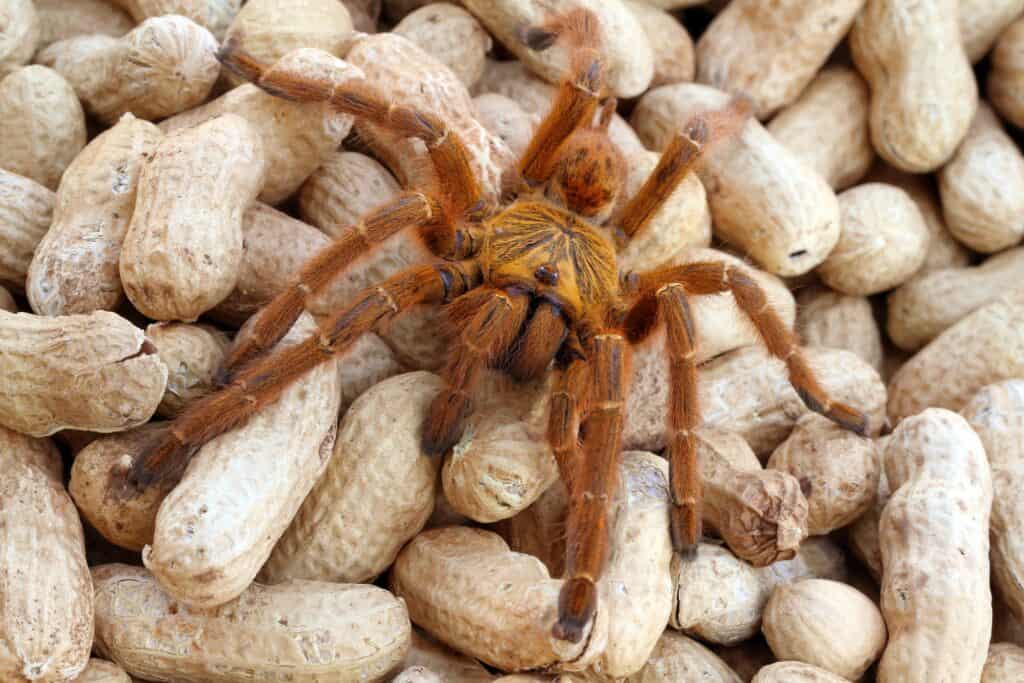
The orange baboon spider, Pterinochilus murinus, is known for its aggressive temperament.
©Mark_Kostich/Shutterstock.com
Tarantulas in the genus Pterinochilus are small to medium-sized baboon spiders, reaching a leg span of 4-6 inches. These spiders are typically hairy with a sunburst-patterned carapace and a patterned abdomen. They are known to be quick and defensive with powerful venom. Pterinochilus spiders inhabit a wide range of habitats across sub-Saharan Africa. Although they are terrestrial burrowing spiders, some species, such as P. murinus, exhibit semi-arboreal tendencies in captivity.
- Pterinochilus andrewsmithi Gallon, 2009
- Common name: N/A
- Distribution: Kenya
- Pterinochilus chordatus (Gerstäcker, 1873)
- Common name: Kilimanjaro mustard baboon spider
- Distribution: East Africa
- Pterinochilus cryptus Gallon, 2008
- Common name: N/A
- Distribution: Angola
- Pterinochilus lapalala Gallon & Engelbrecht, 2011
- Common name: Waterberg baboon spider
- Distribution: South Africa
- Pterinochilus lugardi Pocock, 1900
- Common name: Dodoma baboon, Grey starburst baboon, Fort Hall baboon, Tanzanian blonde baboon spider
- Distribution: Southern and East Africa
- Pterinochilus murinus Pocock, 1897
- Common name: Orange baboon spider, Usambara baboon spider
- Distribution: Democratic Republic of the Congo, Burundi, Kenya, Tanzania, Angola, Zambia, Mozambique, Zimbabwe, South Africa
- Pterinochilus raygabrieli Gallon, 2009
- Common name: N/A
- Distribution: Kenya
- Pterinochilus simoni Berland, 1917
- Common name: N/A
- Distribution: Angola, Congo
- Pterinochilus vorax* Pocock, 1897
- Common name: East African lesser banded baboon spider
- Distribution: Angola, Central, East Africa
Satyrex
Tarantulas in the genus Satyrex have the longest known palps (leg-like appendages near the mouth) of all tarantula species. These appendages are believed to aid in reproduction and decrease the male’s risk of death by cannibalism. These spiders are known to be aggressive, but their venom is said to be relatively mild. The S. speciosis male specimen measures 1.06 inches in total length, while the female measures 1.19 inches. The male palp is 3.13 times the length of the carapace. Males are dark golden-brown and females are light golden brown. They construct deep, lightly-lined burrows in semi-arid shrublands. The total length of the male S. somalicus specimen measures 0.72 inches, while the male palp is 2.23 times the length of the carapace. The female of S. somalicus is unknown. It is a small, grey-brown tarantula that constructs its burrows under rocks in semi-arid shrublands.
- Satyrex somalicus Zamani & von Wirth, 2025
- Common name: Somali dwarf tarantula
- Distribution: Somaliland
- Satyrex speciosus Zamani, von Wirth & Just, 2025
- Common name: Somali blonde tarantula
- Distribution: Somaliland
Selenogyrus
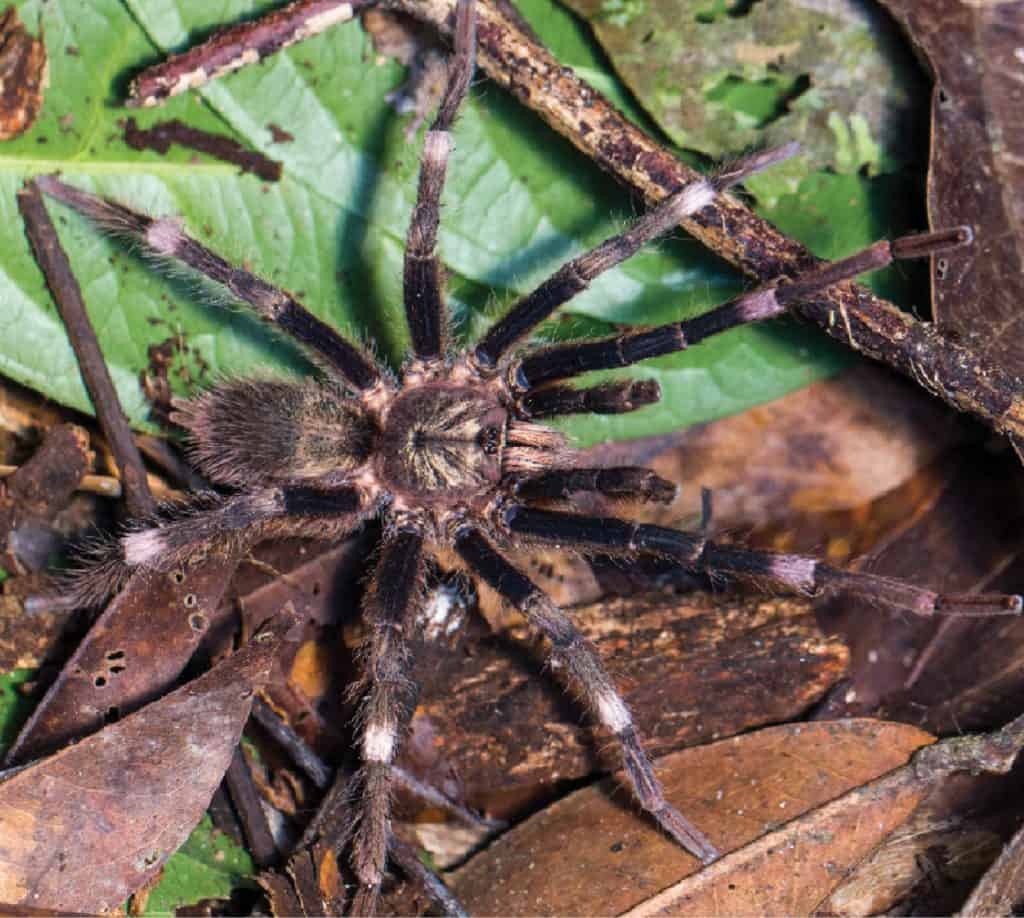
The tarantula species Selenogyrus foordi has a green and fawn-colored sunburst carapace.
©Sherwood D., Henrard A., VandenSpiegel D. / CC BY 4.0 – Original / License
Selenogyrus spiders are differentiated by the unique stridulating organs between their chelicerae. Recent research, including the 2024 description of Selenogyrus foordi, has expanded our knowledge of the genus, though many species remain poorly studied. The newly described S. foordi has a total length of just over 2 inches. Males are described as having a carapace with fine, soft, turquoise hairs and a sunburst pattern with alternating bands of dark green and fawn. Its legs and abdomen are light to dark brown and covered in long, light setae. Females are black with dense orange-red setae on their legs.
- Selenogyrus africanus (Simon, 1887)
- Common name: N/A
- Distribution: Ivory Coast
- Selenogyrus aureus Pocock, 1897
- Common name: N/A
- Distribution: Sierra Leone
- Selenogyrus austini Smith, 1990
- Common name: N/A
- Distribution: Sierra Leone
- Selenogyrus caeruleus* Pocock, 1897
- Common name: N/A
- Distribution: Sierra Leone
- Selenogyrus foordi Sherwood, Henrard & Van Den Spiegel, 2024
- Common name: N/A
- Distribution: Guinea
Stromatopelma
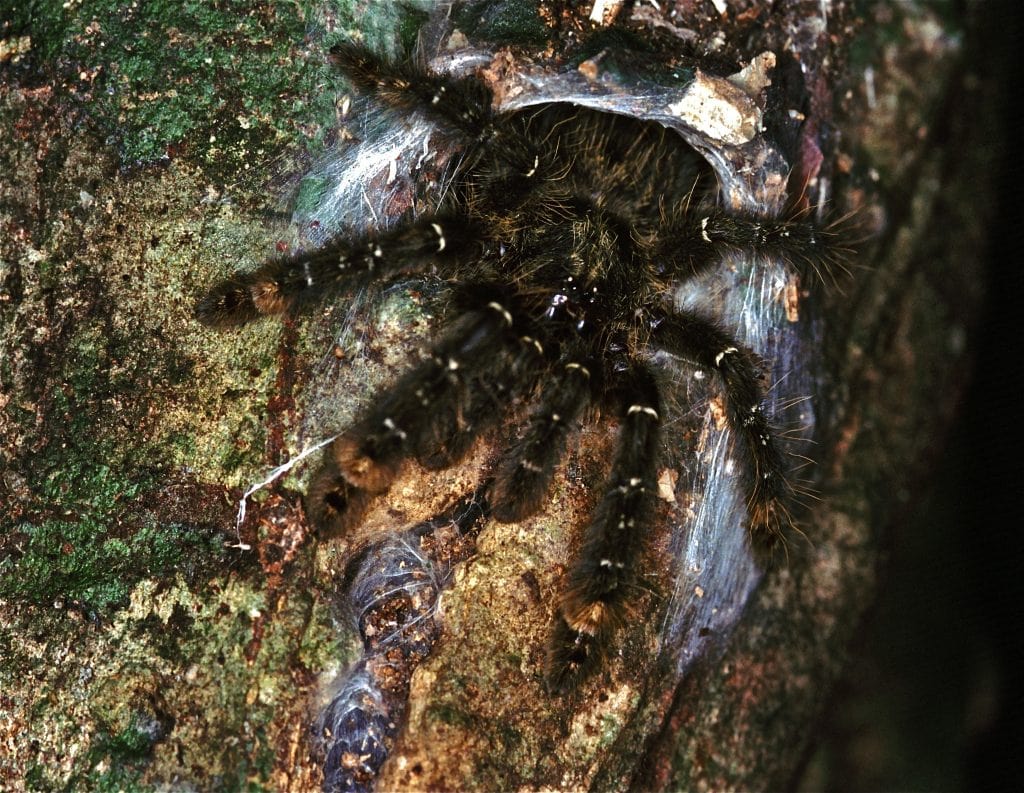
Tarantulas in the genus Stromatopelma are arboreal spiders native to West Africa.
Stromatopelma tarantulas are known for the woolly, bottlebrush-like setae on their legs and abdomen. These spiders are arboreal and build tube-like webs in lower elevation forest regions. They are described as defensive, skittish, and quick. Stromatopelma spiders have very potent venom with stromatoxin peptides, which can cause medically significant effects in humans. These spiders can reach a leg span of 5.5-7 inches.
- Stromatopelma batesi (Pocock, 1902)
- Common name: N/A
- Distribution: Cameroon, Congo
- Stromatopelma calceatum* (Fabricius, 1793)
- Common name: Featherleg baboon
- Distribution: West Africa
- Stromatopelma calceatum griseipes (Pocock, 1897)
- Common name: Featherleg baboon (subspecies)
- Distribution: West Africa
- Stromatopelma fumigatum (Pocock, 1900)
- Common name: N/A
- Distribution: Equatorial Guinea (Mbini)
- Stromatopelma pachypoda (Strand, 1908)
- Common name: N/A
- Distribution: Cameroon
- Stromatopelma satanas (Berland, 1917)
- Common name: N/A
- Distribution: Gabon, Congo
Trichognathella
Trichognathella is a monotypic genus consisting only of Trichognathella schoenlandi. The genus was established because the hair on these tarantulas’ chelicerae is not feathery, unlike the spiders in Harpactira. This small burrowing tarantula is brownish-grey with a gold, sunburst patterned carapace and a patterned gold abdomen. The joints of its legs and palps are also gold. It has long, light-colored setae on its legs and abdomen.
- Trichognathella schoenlandi* (Pocock, 1900)
- Common name: N/A
- Distribution: South Africa