
Quick Take
- Red-eared sliders generally reach from 5 to 12 inches in length.
- These turtles can reach about 2 inches in length during their first year.
- In red-eared sliders, size is more important than age in determining sexual maturity.
- Red-eared sliders have an average weight of about 8.5 ounces.
Red-eared sliders (Trachemys scripta elegans) are freshwater turtles native to North America, specifically the Mississippi Valley. However, they can now be found in every state except Alaska. They are often found in the pet trade, and in many places, they are considered a regulated invasive species. This usually means they can be kept as pets, but cannot be released into the wild. In some states, such as Florida, owners must obtain a permit, and in other states, ownership is restricted or even banned. However, if you have a pet red-eared slider or you are thinking about adopting one, you probably want to know how big your new pet will get. Read on to learn more about red-eared sliders and find out just how big they can get.
Red-Eared Slider Facts
Red-eared sliders inhabit a wide variety of freshwater habitats. These turtles can be found in natural water sources such as ponds, streams, marshes, swamps, lakes, and rivers. They may also be found in man-made freshwater sources, such as retention ponds, park lakes, irrigation ditches, and canals. They favor slow-moving water with soft bottoms, plenty of aquatic vegetation, and nearby basking sites. These turtles are called sliders because they are known to slide quickly from their basking sites into the water when startled.
Adult turtles are generally more herbivorous, while juveniles are more carnivorous. However, these turtles are classified as omnivores, and they are opportunistic generalist feeders. In addition to aquatic plants and algae, red-eared sliders eat tadpoles, frog eggs, fish, aquatic snakes, aquatic invertebrates, and even carrion.
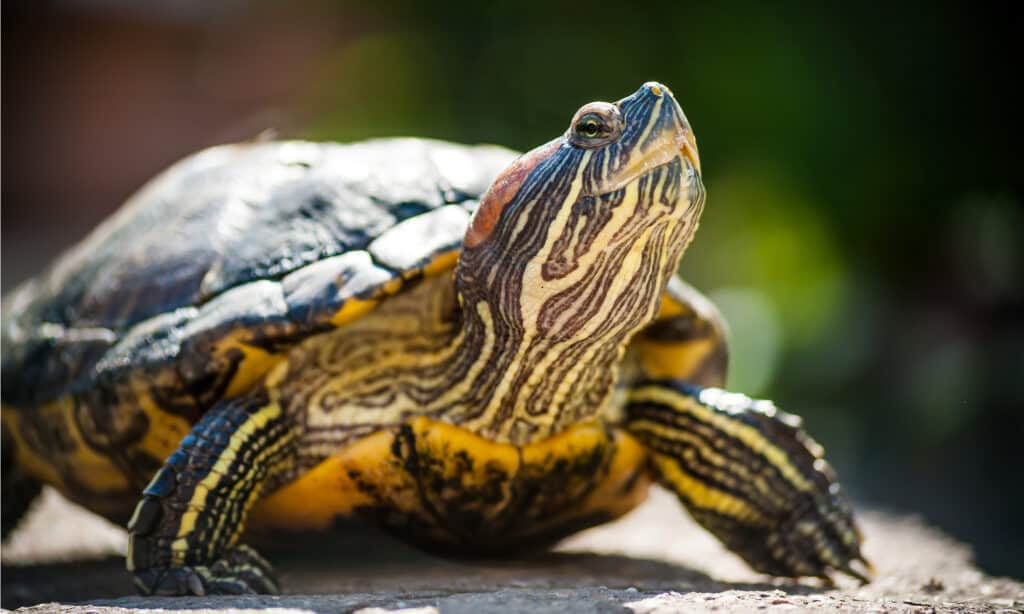
Red-eared sliders are known for the broad, reddish stripe behind each eye.
©effective stock photos/Shutterstock.com
If red-eared sliders are released into the wild outside of their native range, they can out-compete native species for food and territory. They may also transmit diseases and parasites to native turtles, as well as Salmonella to humans. These turtles are known for the wide, reddish-colored stripe behind each eye. Their shells and skin are brown to olive green with yellow stripes. The bottom shell, or plastron, is typically yellow with black markings. Some older male turtles may appear nearly black with few visible markings.
How Big Do Red Eared Sliders Get?
Newly hatched juveniles have a plastron length of just over an inch. They can reach about 2 inches in their first year, but their growth slows as they mature. Red-eared sliders generally reach from 5 to 12 inches in length. Their average weight is about 8.5 ounces. Females are typically larger than males. Female red-eared sliders generally measure 10 to 12 inches, while males measure 5 to 9 inches.
Females have a wider, higher-domed shell and a flat plastron, while males have a longer, flatter shell and a more concave plastron for mating. Males also have very long front claws, long, thick tails, and their vent is located past the edge of the shell. In contrast, females have short front claws, shorter, thinner tails, and their vent is closer to the body.

Red-eared sliders generally reach from 5 to 12 inches in length.
©WITOON077/Shutterstock.com
Size Also Determines Maturity
In red-eared sliders, size is more important than age in determining sexual maturity. Male red-eared sliders reach sexual maturity when they measure about 4 inches long, which typically occurs between the ages of 3 and 5 years old. Females reach sexual maturity when they are 6 to 7.5 inches in length, which typically occurs between the ages of 5 and 7 years old.
Breeding happens between March and July, with most nesting occurring from May to July, although the timing can vary by region. Females will often travel long distances to find a nesting site. They use their back feet to dig a 2 to 4 inch hole. The females lay from 4 to 23 eggs, then they cover the eggs with soil. Once the eggs are laid, there is no additional parental care. The gestation period lasts up to 85 days, with hatching occurring between July and September. If hatching occurs later in the fall, the hatchlings may stay in the nest during winter and emerge in the spring.