
Quick Take
- Humpback whales are baleen whales that are filter feeders.
- Humpback whales are found in all of the world’s major oceans.
- Despite their size, Humpback whales are not apex predators.
Most mammals, including whales, have teeth, but there are some exceptions. There are two different whale suborders: the Mysticeti, which are the baleen whales, and the Odontoceti, which are the toothed whales. Humpback whales are baleen whales, but what exactly does that mean? If they are not toothed whales, how do they eat? Read on to discover whether or not humpback whales have teeth and learn more about their feeding behaviors.
Identifying a Humpback Whale
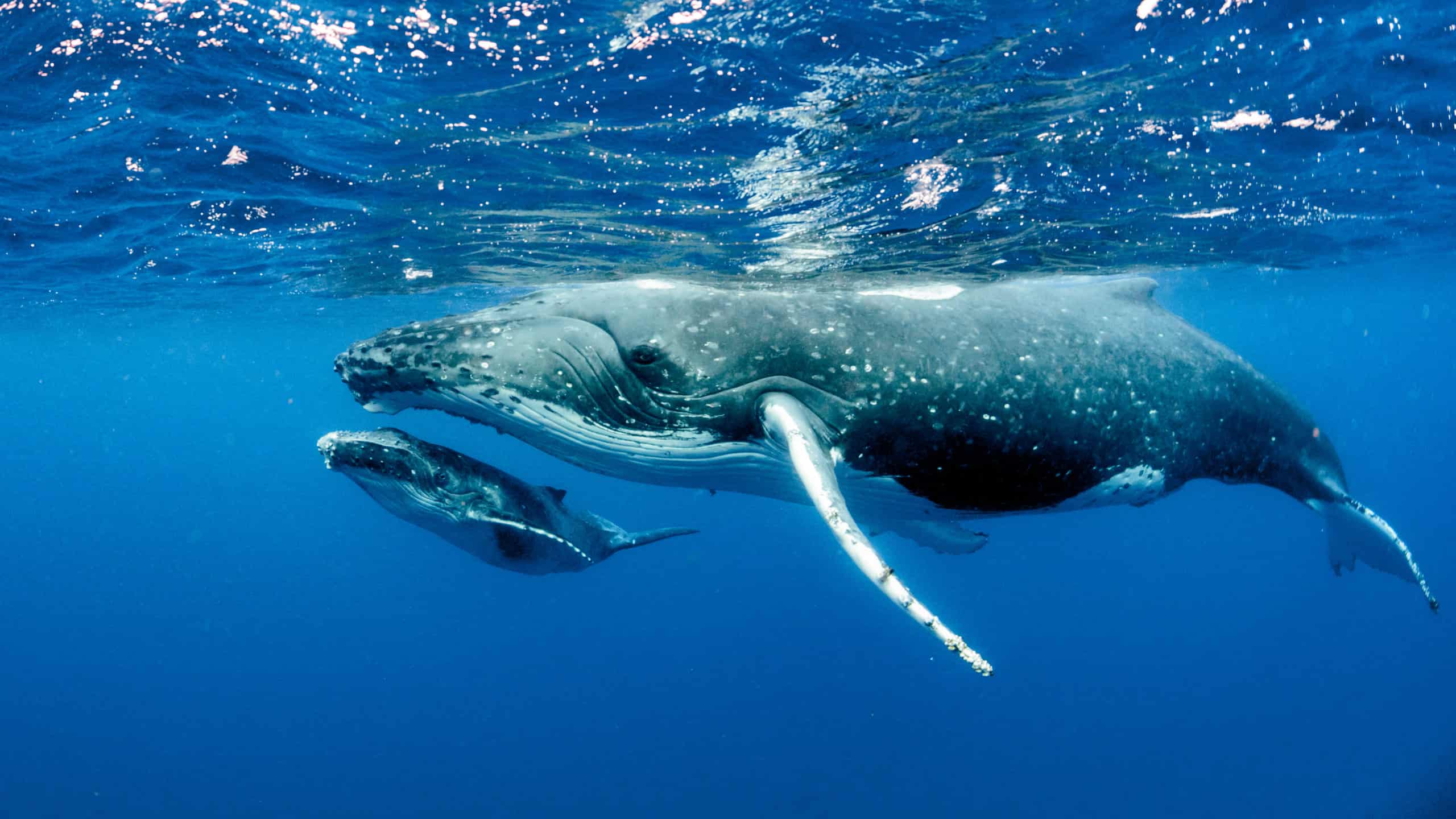
Humpback whales (Megaptera novaeangliae) live in all of the world’s major oceans, including the waters of the polar regions. They undertake long migrations, sometimes traveling as far as 5,000 miles between summer feeding grounds in colder waters and winter breeding areas in tropical waters. They are often seen close to the shore, breaching and slapping the water with their fins and tails.
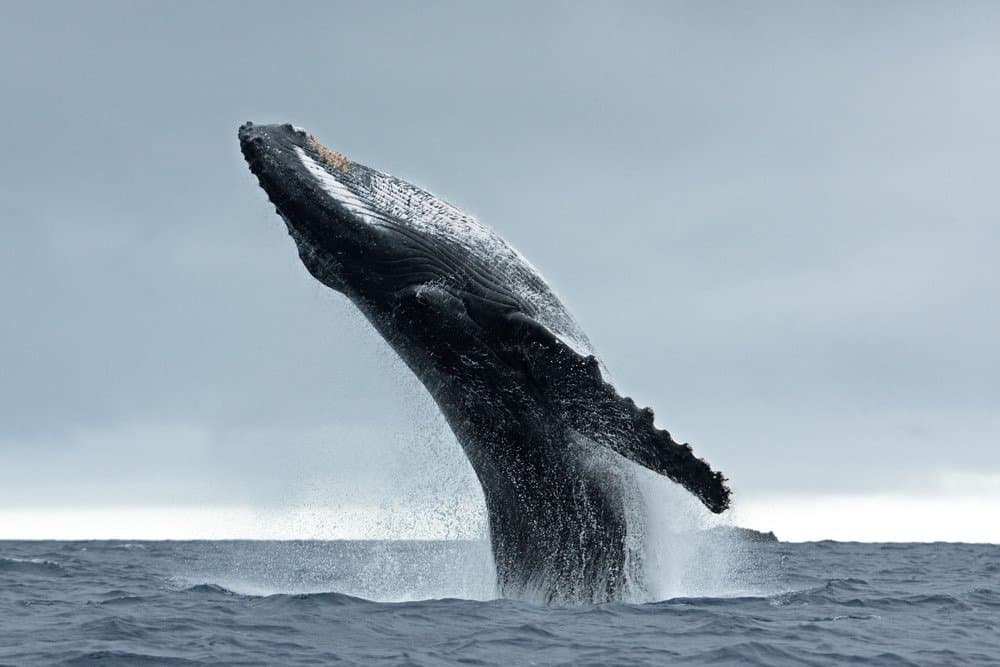
Humpback whales are primarily black with white markings.
©Martin Prochazkacz/Shutterstock.com
Their bodies are mostly black, with white markings on their bellies, pectoral fins, and tails. A humpback whale’s pectoral fins are the longest limbs of any animal, reaching up to 15 feet in length. Their tails have pointed tips and can measure up to 18 feet wide. Humpback whales can reach up to 60 feet long and weigh as much as 40 tons. Female humpback whales are typically larger than the males.
Do Humpback Whales Have Teeth?
Humpback whales do not have teeth. They are baleen whales, so they have a row of fringed baleen plates hanging from their upper jaws. Baleen is made of keratin, which is a fibrous protein that also makes up human fingernails and hair. Humpback whales have between 270 and 400 baleen plates on each side that measure 24-30 inches long.
Humpback whales are also rorqual whales, which is a group of whales that includes the blue whale and the minke whale, among others. Rorqual whales not only have baleen plates, but they also have parallel folds of skin like pleats running from their chins to their bellies. During feeding, these pleats expand, allowing them to pull in large amounts of water — and therefore, food.
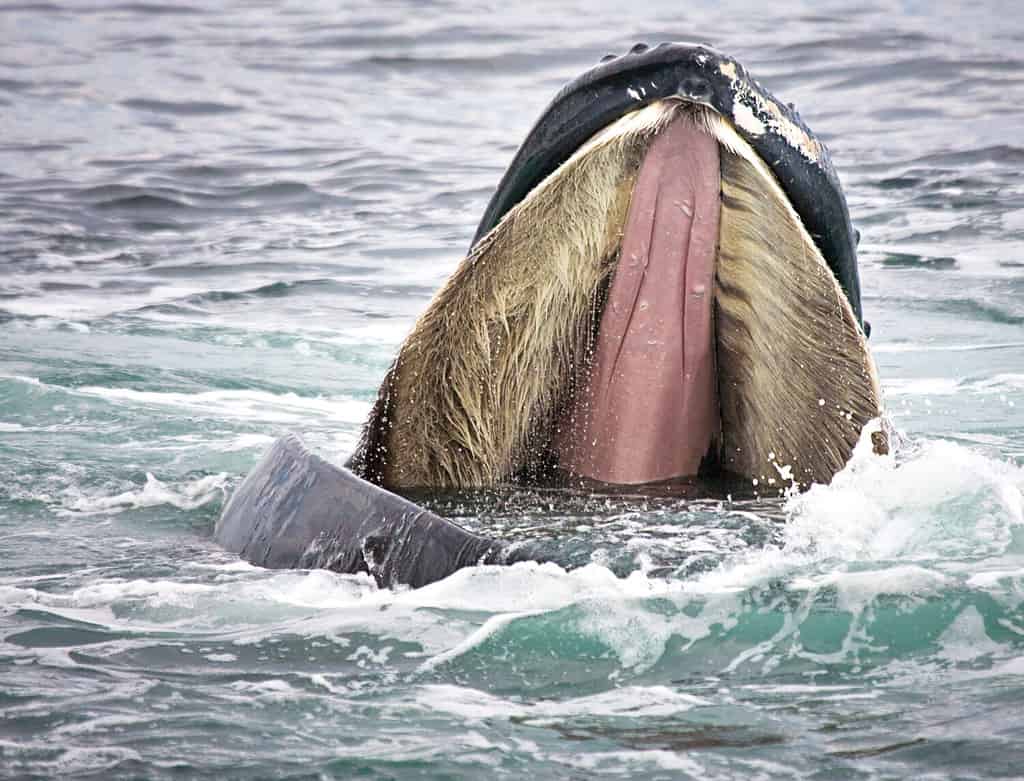
Humpback whales do not have teeth. They have a row of fringed baleen plates on their upper jaws.
©John Tunney/Shutterstock.com
Feeding With Baleen Plates
Humpback whales are filter feeders. While swimming, they open their mouths and expand the grooves in their throats to take in large volumes of water. Then, they close their mouths and contract their throat pleats, using their tongues and belly muscles to expel the water through their baleen plates. The baleen plates act as a sieve to capture krill, small fish, and plankton.
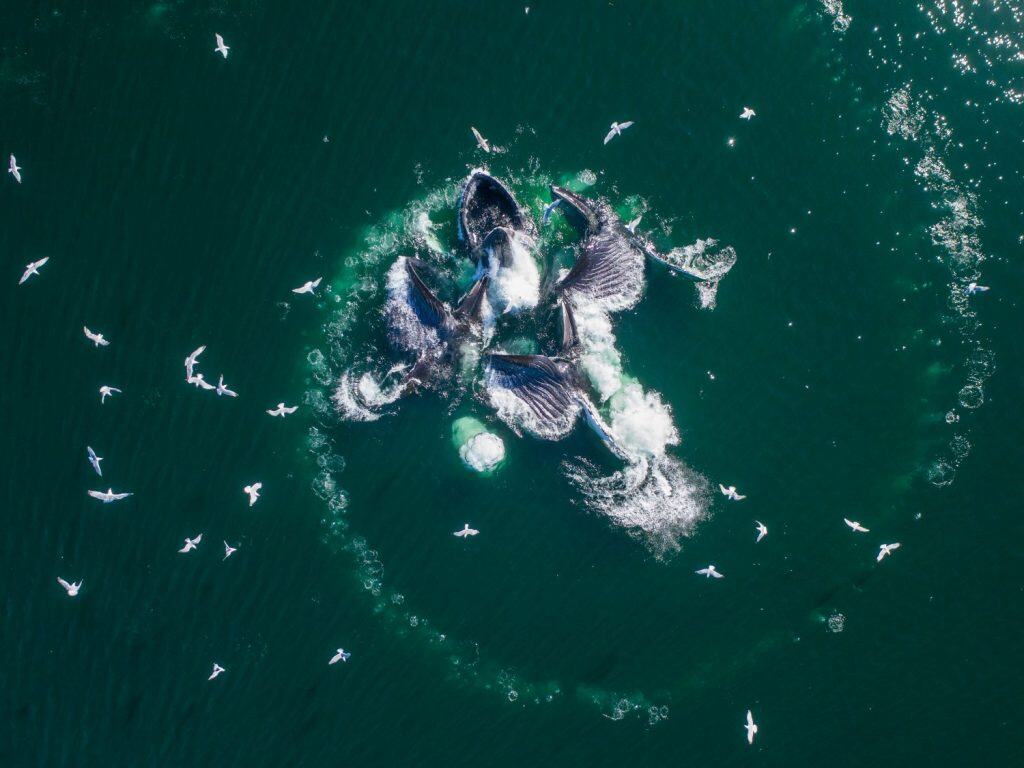
Humpback whales participate in a cooperative feeding behavior called bubble-net feeding.
©Danita Delimont/Shutterstock.com
Humpback whales also lunge feed. Using their tails, they rapidly propel themselves upward into a large group of fish or krill with their mouths open. Then the whale closes its mouth and forces the water out through its baleen plates.
These whales have also been observed participating in a cooperative feeding behavior called bubble-net feeding. The whales dive beneath a school of fish and blow bubbles while swimming around them in a circle. The bubbles rising up through the water column disorient and confine the fish. When the ring of bubbles reaches the water’s surface, the whales lunge up with their mouths open to gulp down the water and fish. Despite lacking teeth, humpback whales’ feeding behaviors enable them to consume up to 3,000 pounds of food each day.