
Quick Take
- Male humpbacks don't just sing the same song on repeat. What they're doing with their bodies changes the song in a way nobody expected. See the dive-song link →
- Some whales sing non-stop for longer than a full workday, and the reason scientists care has nothing to do with the sound itself. Explore why it matters →
- A whale's song might soon tell scientists exactly where it is in the water, and no one would even need to be watching it. Discover depth-tracking potential →
- The part of the song that varies most between individual whales is not random, and it may reveal something about how males compete for mates. Uncover the sexual selection clue →
For decades, researchers have known that male humpback whales use song as an essential form of communication, especially during breeding season. What researchers didn’t understand is what the whales were doing while they sang, sometimes for hours on end.
Now, thanks to a new study, scientists are a step closer to knowing what’s going on underwater. More importantly, there is now a known link between the whale’s song and its movements through the water.
Here’s what researchers discovered and why it’s important.
What Is the Importance of Whale Song and Movement?
Scientists have long been able to record humpback whale songs. Researchers also knew that these songs happen mostly during winter breeding season and likely play a role in mating.
What they couldn’t figure out is what the whales were doing during the hours they sang. After all, recording songs that travel for miles is easy. Simultaneously observing a humpback deep in the ocean is the hard part.
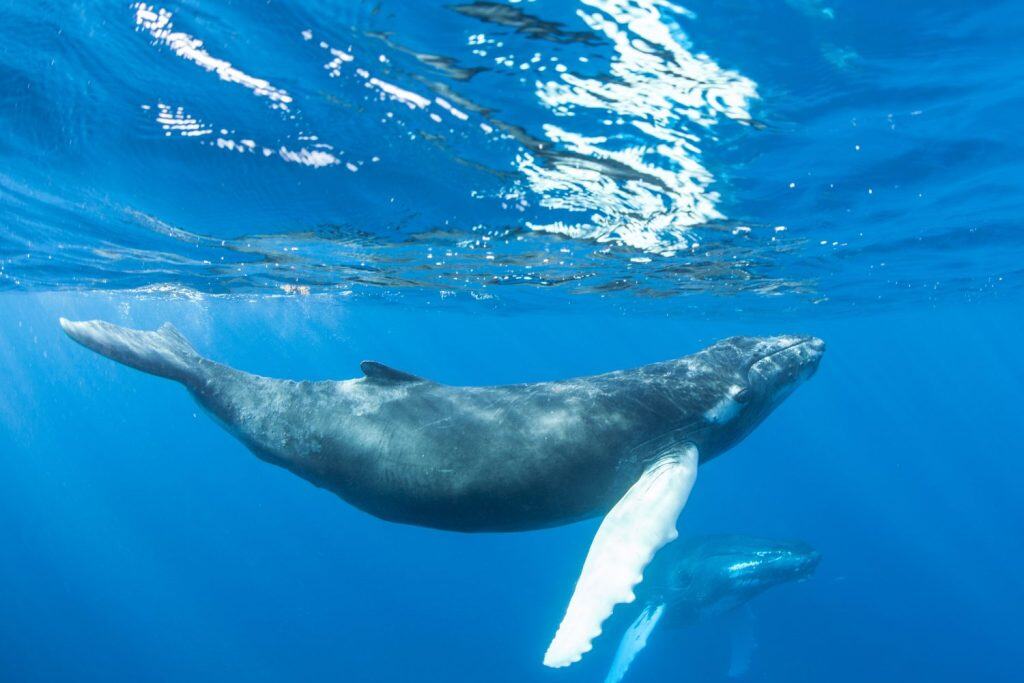
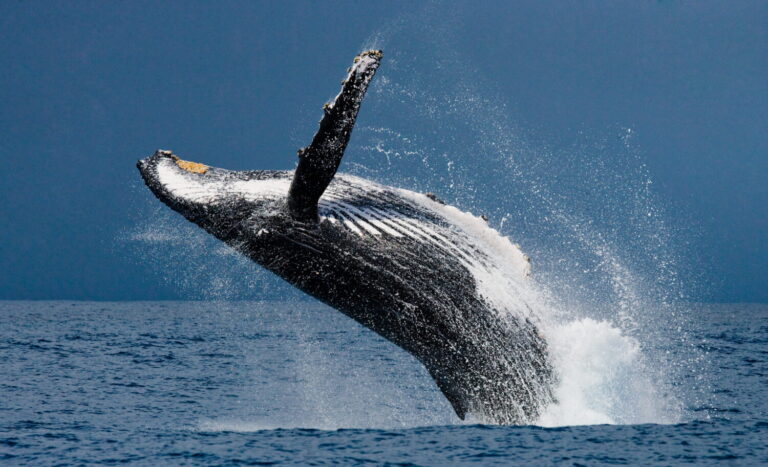
The whale song is one of nature’s great beauties.
©Ethan Daniels/Shutterstock.com
However, understanding what the whale’s body was doing during its songs was important. This knowledge could help scientists learn how singing affects a whale’s energy use and air management, as well as provide insight into the whales’ depth and activities beyond singing.
This information could also help researchers understand elevated risks the whales face when singing, like from ship strikes, if the whales became less aware of their surroundings when focused on singing.
How Researchers Got This Information
From 2018 to 2024, researchers off the coast of Maui, Hawaii, temporarily attached small suction-cup recording devices to singing whales using long poles from small boats. They also used drones. The tags naturally fall off the whales, allowing researchers to collect them and extract the data.
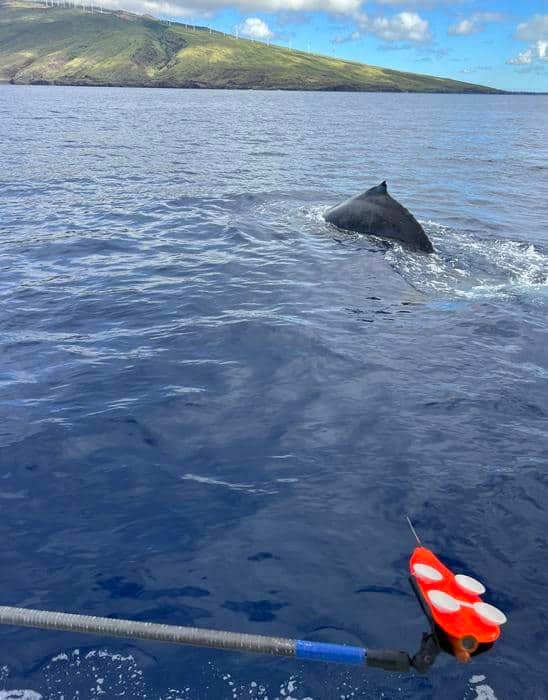
Researchers used long poles to attach the temporary monitoring device to the whales with suction cups.
©Julia Zeh; NOAA NMFS Permit #19655 and #26593 – Original / License
In the study, 16 whales were tagged. Scientists consider this a solid sample size for this type of study. One of the most unusual findings was that some whales repeated their songs non-stop for up to 16 hours.
However, that was not the only significant finding.
The Most Important Discovery
The data showed that recurring song parts, which researchers call “themes,” lined up consistently with different stages of a whale’s dive. It is the first time scientists have been able to map out an entire whale song to the entire dive cycle. Previously, they were only able to connect bits of each.
Researchers discovered that themes sung during the deepest and steadiest part of a whale’s dive varied among individual whales. This contrasts with the similar themes sung by all whales during their descent or ascent.
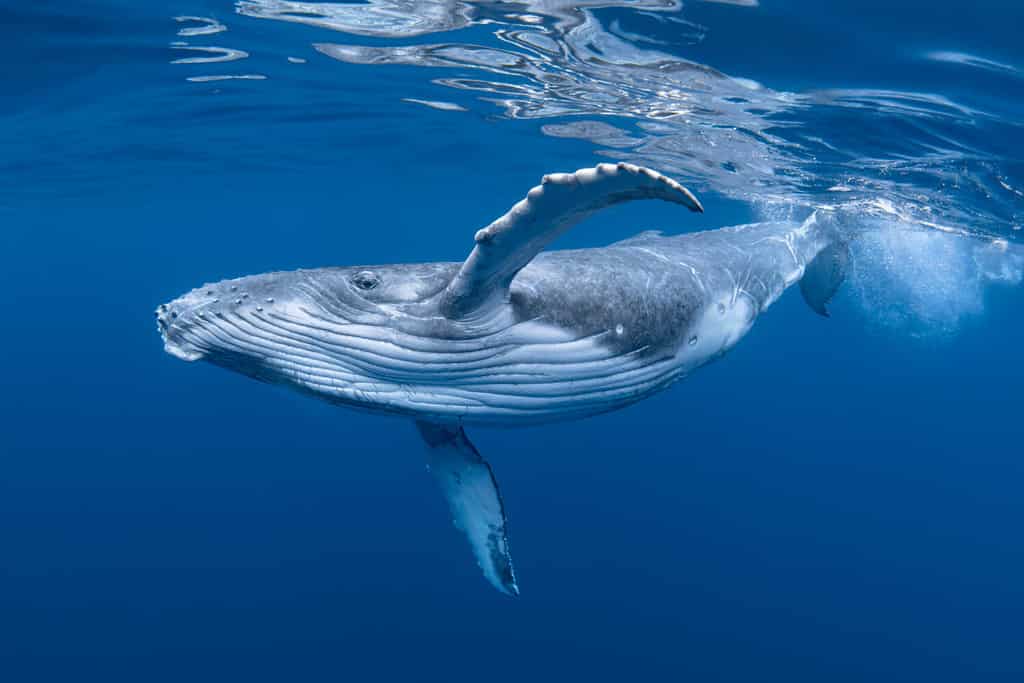
Male humpback whales sing different songs at depth, perhaps to make themselves appear unique to females.
©Craig Lambert Photography/Shutterstock.com
Researchers hypothesize that the varied songs at depth might be shaped by male competition in attracting a mate. They call this “sexual selection.” In plain terms, it could show that males use their unique songs as a way to stand out to females.
“This gives us direction for which parts of the song to investigate if we’re interested in variation, which is likely driven by sexual selection,” says study author Julia Zeh, a Ph.D. graduate of Syracuse University and member of the Bioacoustics and Behavioral Ecology Lab there. Zeh now leads the Archival Passive Acoustic Monitoring Team at the Maine Department of Marine Resources in West Boothbay.
What Else the Discovery Tells Researchers
In addition to providing a better understanding of how whale songs vary at different parts of the animal’s dive, this song variation can help in another way. By understanding how song relates to movement, researchers can determine a whale’s depth or position directly from a recording.
This could help scientists establish a clearer baseline for normal humpback behavior, which is essential for understanding how, if at all, humpback whales are disturbed by human activities such as vessel traffic or ocean noise.
Do All Humpback Whales Behave the Same?
The study focused exclusively on humpback whales around the Hawaiian Islands. Zeh is quick to point out that whether the same song-dive pattern holds for humpback whales elsewhere in the world cannot be confirmed.
She expects some patterns, such as air management, to exist in breeding populations elsewhere. But she’s also careful to note that humpback songs are known to be different between hemispheres. Zeh notes that to answer this question, researchers would need to collect comparable tag data from singing whales on breeding grounds around the world.
What’s Next?
Zeh’s work at Syracuse University opened the door for future researchers to discover even more about how whale song and behavior intersect. On a more personal note, it helped her refine her approach to future whale song research.
“Projects like this one, where we combined acoustics with movement data, gave me the tools to ask exciting questions about whale behavior and the opportunity to be creative in how we look at well-studied phenomena like humpback whale song. These experiences inform how I conduct research and have given me the foundation for my current work in ecological monitoring and conservation,” she said in a press release announcing the study.