Quick Take
- Dolphins use whistles mainly to communicate with one another, while echolocation clicks help them navigate their surroundings and locate potential prey. Explore dolphin vocalizations →
- Researchers found that dolphin whistles and echolocation clicks were concentrated in different areas, suggesting they may be used in different habitats and activities.
- Echolocation hotspots overlapped with areas containing sound-producing fish, raising the possibility that dolphins listen for prey. See how fish sounds help →
- Acoustic monitoring could help scientists identify important dolphin habitats and understand how human noise affects them. Discover the acoustic method →
Dolphins are some of the most intelligent animals in the world and are known for their playful behavior. They are also incredibly social animals with complex communication and vocalization skills. A recent study in Florida has found that dolphin sounds can reveal a surprising amount about where they live and what they do, including how it affects their feeding behavior.
Continue reading
How Dolphins Use Different Sounds
Dolphins produce a wide range of sounds, including clicks and whistles. Both of these are extremely important for them, but for different reasons. Whistles are the main form of communication for dolphins, as they use them to communicate with each other. Most dolphins have their own signature whistle, which is unique to them, and these whistles can be used to identify one another. Females repeatedly use their own signature whistle both before and after they give birth. This is so that their calf learns to recognize it and distinguish her from other dolphins. Other types of whistles and squeaks are used for general communication between dolphins and can be used to signal things such as food or danger.
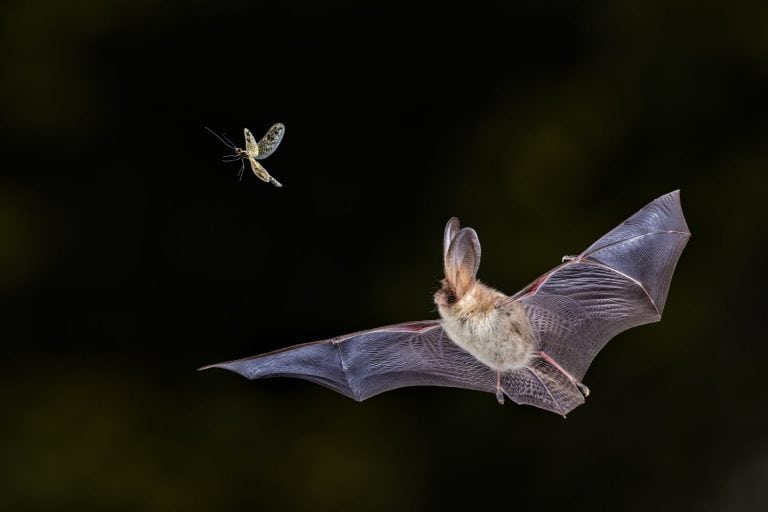
Clicks are the other main sound that dolphins make, and these are used for echolocation. Dolphins emit a series of high-pitched clicks, which then bounce off nearby objects. The sound returns as an “echo”. The dolphin then interprets the echo to determine the size, shape, and distance of the object. Dolphins can vary the pitch and frequency of their clicks to detect objects at different distances. They use slower clicks when searching for objects or prey that are farther away, allowing time for each echo to return before the next click is sent. Conversely, they use faster clicks when investigating objects that are much closer.
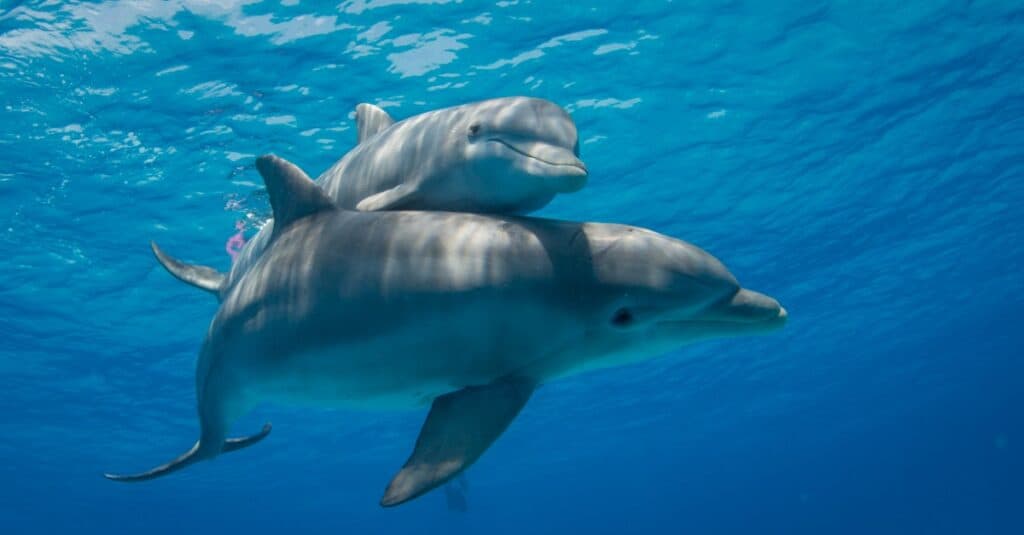
Dolphins use a variety of different sounds, with whistles being predominantly used for socializing and clicks for echolocation.
©iStock.com/NaluPhoto
Are Dolphins Listening for Fish?
Researchers from Florida Atlantic University recently conducted a study to better understand how dolphins navigate and how they use their vocalizations. They used an autonomous wave glider with an acoustic recorder to record the vocalizations of dolphins across the East Florida Shelf. The study recorded more than 62 hours of sound and allowed them to compare the whistles and clicks at different depths and in different conditions. As well as detecting where the dolphins were, it also revealed surprising insights into their behavior.
Regular communication whistles were found to be centered around St. Augustine and Ponce Inlet, as well as near Melbourne Beach. However, the most surprising findings were the echolocation clicks that they recorded. Echolocation activity was prominent around Melbourne Beach, Ponce Inlet, and Long John Reef. Surprisingly, these locations were also where sound-producing fish were found.
Fish don’t have vocal cords, so they don’t produce sound in the typical way. However, some fish can use their muscles or body parts to create various sounds. Not all fish make sounds, but those that do use them to attract mates or to signal predators. The overlap between echolocation activity by the dolphins and areas containing sound-producing fish suggests that dolphins could be responding to the sounds produced by the fish. Researchers theorize that they are using them as an acoustic clue for where prey is located. Interestingly, researchers also found areas without the same overlap. This suggests that the fish may also sometimes become quieter in the dolphin’s presence.
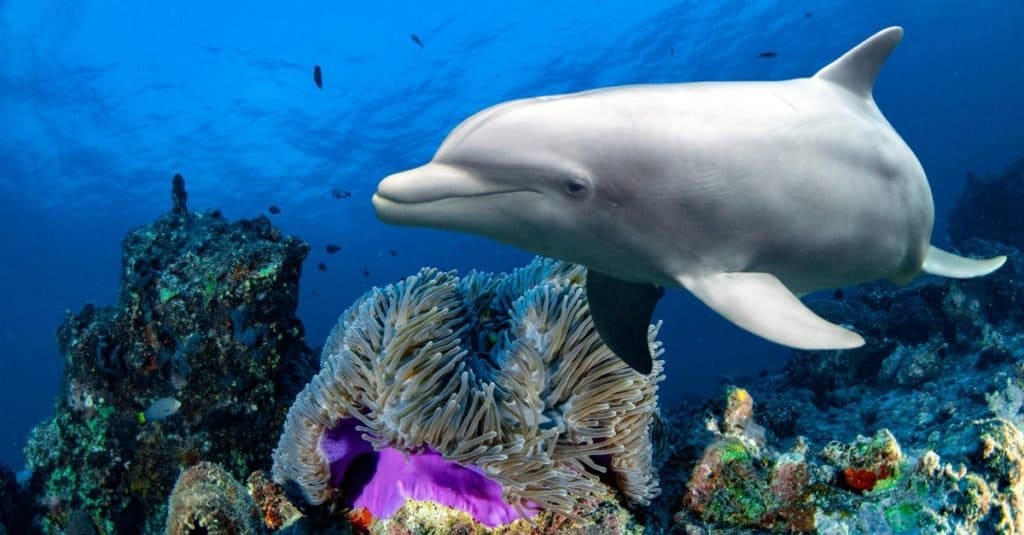
Dolphins could be using the sounds that fish make to identify where they are.
©Andrea Izzotti/Shutterstock.com
Can Sound Reveal Where Dolphins Feed?
The results of the study suggest that listening to the sounds that dolphins make can provide researchers with a useful way to identify important feeding and socialization areas. This is important as it means they can track them even when the dolphins cannot be seen. By looking at where echolocation is often used and comparing it to the sounds produced by fish, it is possible to identify the feeding areas. On the other hand, locations with a lot of squeaks and whistles are more likely to be socialization areas.
The study also found that dolphin activity changed between March and April, with more detections in March. It’s thought that this reflects the seasonal movement of dolphins along Florida’s Atlantic coast. These differences could help to reveal how dolphins use an area over time, such as returning to one spot at the same time every year when the prey is particularly abundant.
Additionally, some areas where dolphins are especially vocal also experience high levels of boat traffic. Noise from vessels can mask dolphin vocalizations, making communication more difficult. If important feeding or socializing grounds also have high levels of vessel noise, it could affect how dolphins use these habitats over the long term. However, identifying these areas also helps researchers determine which locations might need more protection.